
 Worksheets
Astronomical Forces
Total questions: 27
Worksheet time: 14mins
Name
Class
Date
1.
What does Newton's First Law of Motion state?
a)
An object in motion will eventually stop due to friction.
b)
An object at rest stays at rest, and an object in motion stays in motion unless acted upon by an external force.
c)
For every action, there is an equal and opposite reaction.
d)
Force equals mass times acceleration.
2.
Which of the following equations represents Newton's Second Law of Motion?
a)
F=ma
b)
F=21mv2
c)
F=r2Gm1m2
d)
F=rmv2
3.
According to Newton's Third Law, if you push against a wall with a force of 10 N, what force does the wall exert on you?
a)
0 N
b)
5 N
c)
10 N
d)
20 N
4.
Which of the following is an example of Newton's First Law?
a)
A car accelerating when the gas pedal is pressed.
b)
A rocket launching into space.
c)
A book remaining at rest on a table.
d)
A ball bouncing off a wall.
5.
If a 5 kg object is accelerating at 2 m/s², what is the force applied to it according to Newton's Second Law?
a)
5 N
b)
10 N
c)
15 N
d)
20 N
6.
Which of the following scenarios best illustrates Newton's Third Law of Motion?
a)
A car stopping at a red light.
b)
A ball rolling down a hill.
c)
A swimmer pushing water backwards to move forward.
d)
A book falling off a table.
7.
Calculate the gravitational force between two 10 kg masses separated by a distance of 2 meters. (Use G=6.674×10⁻¹¹Nm2/kg2)
a)
1.67×10⁻¹⁰N
b)
6.67×10⁻¹⁰N
c)
3.34×10⁻¹⁰N
d)
1.34×10⁻⁹N
8.
Which of the following is an application of gravity?
a)
The orbit of the Moon around the Earth.
b)
The lift of an airplaine.
c)
The acceleration of a car.
d)
The friction between two surfaces.
9.
If the mass of an object is doubled, how does this affect the gravitational force it experiences from another object?
a)
The gravitational force is halved.
b)
The gravitational force doubled.
c)
The gravitational force remains the same.
d)
The gravitational force is quadrupled.
10.
Which of the following best describes the concept of inertia?
a)
The tendency of an object to accelerate.
b)
The force exerted by a surface as an object moves across it.
c)
The tendency of an object to resist changes in its state of motion.
d)
The force that pulls objects toward the center of the Earth.
11.
If a force of 15 N is applied to a 3 kg object, what is the acceleration of the object?
a)
3 m/s²
b)
5 m/s²
c)
10 m/s²
d)
15 m/s²
12.
Which of the following is NOT an example of Newton's Third Law?
a)
A rocket launching into space.
b)
A car accelerating forward.
c)
A person walking on the ground.
d)
A book resting on the table.
13.
What is the effect of gravity on an object in free fall near the Earth's surface?
a)
The object will move at a constant speed.
b)
The object will decelerate until it stops.
c)
The object will accelerate at approximately 9.8 m/s².
d)
The object will move in a circular path.
14.
What is the net force acting on an object moving at a constant velocity?
a)
Greater than zero.
b)
Less than zero.
c)
Equal to zero.
d)
Depends on the mass of the object.
15.
If a 10 kg object is accelerating at 3 m/s², what is the force applied to it according to Newton's Second Law?
a)
20 N
b)
30 N
c)
40 N
d)
50 N
16.
What is the effect on the gravitational force between two objects if the distance between them is doubled?
a)
The gravitational force is halved.
b)
The gravitational force is reduce to one-fourth.
c)
The gravitational force is doubled.
d)
The gravitational force remains the same.
17.
If a 20 N force is applied to a 4 kg object, what is the resulting acceleration of the object?
a)
2 m/s²
b)
4 m/s²
c)
5 m/s²
d)
10 m/s²
18.
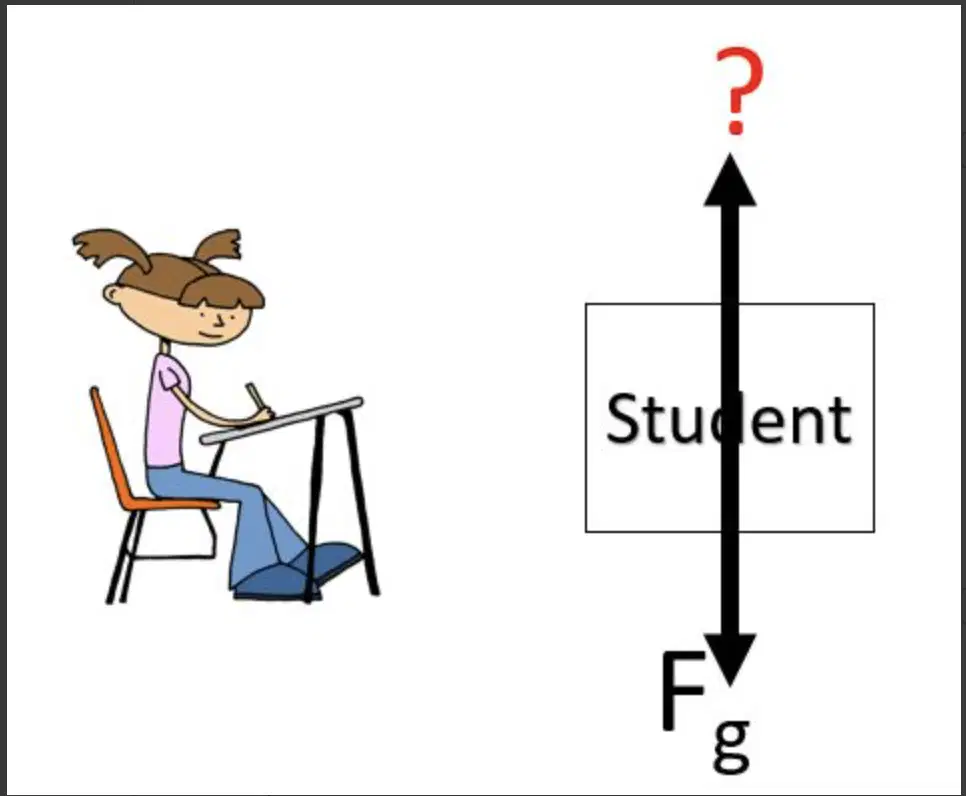
Name the missing force....
a)
Weight force
b)
Frictional force
c)
Normal force
d)
Tension force
19.

Name the missing force....
a)
Frictional force
b)
Thrust force
c)
Weight force
d)
Buoyant force
20.

What force opposes gravity when an object is on a surface?
a)
Applied force
b)
Frictional force
c)
Normal Force
d)
Air Resistance
21.

The forces on a couch being pushed across the floor?
a)
gravity, applied force and friction
b)
gravity, applied force, friction and normal force
c)
tension force, applied force, friction and normal force
d)
gravity and Normal force
22.

Name the missing force....
a)
Tension force
b)
Frictional force
c)
Normal force
d)
Buoyant force
23.
In a force diagram the size/length of the arrow tells you this about the force:
a)
The strength of the force
b)
The direction of the force
c)
The distance of the force
d)
The type of force
24.
Friction is a force that acts in an ___________ direction of movement.
a)
Similar
b)
Parallel
c)
Opposite
d)
West
25.

What force is always present when an object is close to the earth's mass?
a)
Applied force
b)
Frictional Force
c)
Normal Force
d)
Gravitational Force
26.

Which type of force resists motion?
a)
Friction
b)
Gravity
c)
Pull
d)
Push
27.

In the diagram below, a girl sits on a sled and slides down a hill of snow. Which arrow represents the force of friction opposing the motion of the sled down the hill?
a)
Arrow A
b)
Arrow B
c)
Arrow C
d)
Arrow D
100 %

