
 Worksheets
Unit 2 Test Review
Total questions: 91
Worksheet time: 23hrs 45mins

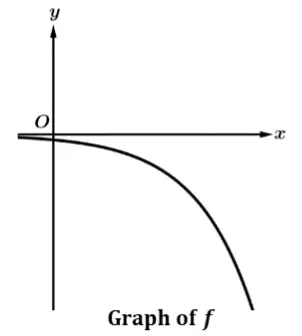
The graph of the function f is shown above. Which of the following statements about f is correct?
f is increasing at an increasing rate.
f is increasing at a decreasing rate.
f is decreasing at an increasing rate.
f is decreasing at a decreasing rate.
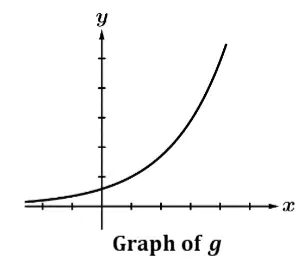
The graph of the function g is shown above. Which of the following statements about g is correct?
The function g is increasing and the graph of g is concave up.
The function g is increasing and the graph of g is concave down.
The function g is decreasing and the graph of g is concave up.
The function g is decreasing and the graph of g is concave down.
The logarithmic function h is defined by h(x) = -2 ln x. Which of the following statements about h is correct?
The function h is increasing and the graph of h is concave up.
The function h is increasing and the graph of h is concave down.
The function h is decreasing and the graph of h is concave up.
The function h is decreasing and the graph of h is concave down.
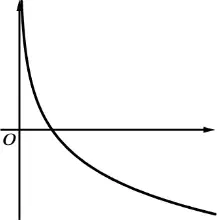
The graph of the function k is shown above. Which of the following statements about k is correct?
The rate of change of k is positive and increasing.
The rate of change of k is positive and decreasing.
The rate of change of k is negative and increasing.
The rate of change of k is negative and decreasing.
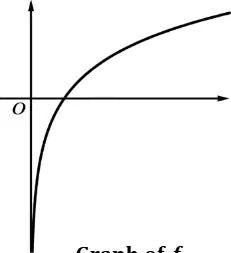
The graph of f is shown above. Which of the following could be the equation for f?
f(x) = 3 ln x
f(x) = -3 ln x
f(x) = 3e^x
f(x) = -3e^x
The logarithmic function l is defined by l(x)=−3log4x . Which of the following pairs of statements correctly describes the end behavior of l?


Let h(x) = 2 ln(x - 3) - 5. Which of the following gives the domain of the function h?
(0, ∞)
(-3, ∞)
(3, ∞)
(-5, ∞)
(5, ∞)
The graph of f is shown above. Which of the following statements about f is correct?
The function f is increasing and the rate of change of f is positive.
The function f is increasing and the rate of change of f is negative.
The function f is decreasing and the rate of change of f is increasing.
The function f is decreasing and the rate of change of f is decreasing.
The logarithmic function k is defined by p(x)=21logx . Which of the following statements about p is correct?
The function p is increasing and the graph of p is concave up.
The function p is increasing and the graph of p is concave down.
The function p is decreasing and the graph of p is concave up.
The function p is decreasing and the graph of p is concave down.
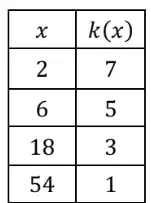
Values of the function k are shown in the table above at selected values of x. Determine if the function k could be linear, exponential, or logarithmic. Explain your reasoning.
Linear
Exponential
Logarithmic
None of the above
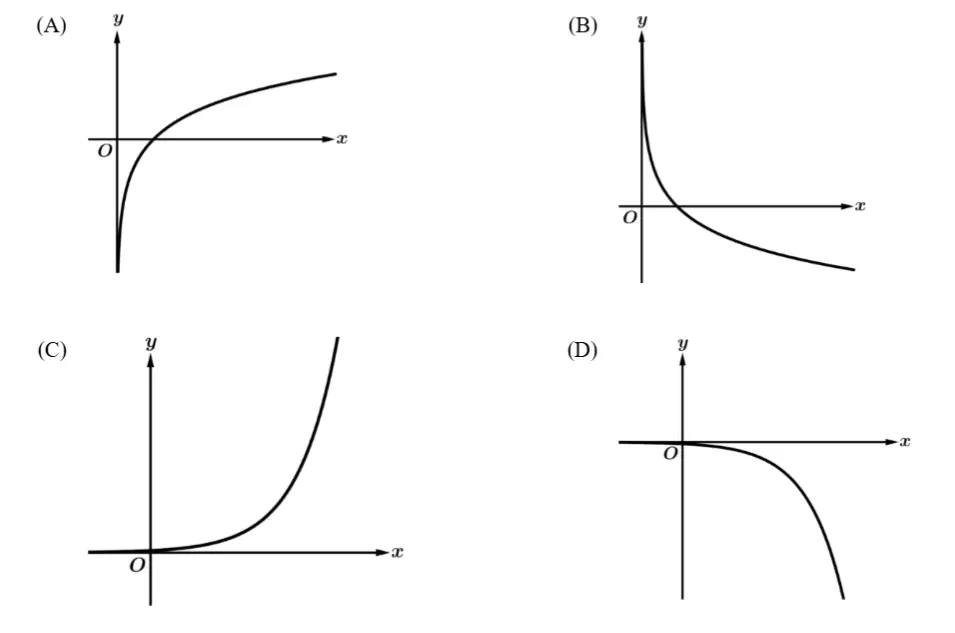
The function f is defined by f(x) = 3 ln x. Which of the following could be the graph of f?
(A)
(B)
(C)
(D)
The logarithmic function f is defined by f(x) = 2 ln x. Which of the following pairs of statements correctly describes the end behavior of f?
(A) x→0+limf(x)=−∞ and x→∞limf(x)=∞
(B) x→0+limf(x)=∞ and x→∞limf(x)=−∞
(C) x→0+limf(x)=0+ and x→∞limf(x)=∞
(D) x→0+limf(x)=−∞ and x→∞limf(x)=0+
The function g is defined by g(x) = 3(2)^x. Which of the following pairs of statements correctly describes the end behavior of g?
(A) x→−∞limg(x)=−∞ and x→∞limg(x)=∞
(B) x→−∞limg(x)=∞ and x→∞limg(x)=−∞
(C) x→−∞limg(x)=0 and x→∞limg(x)=∞
(D) x→−∞limg(x)=−∞ and x→∞limg(x)=0
The function f is defined by f(x) = -2(3)^x. Which of the following statements about f is correct?
The function f is increasing and the graph of f is concave up.
The function f is increasing and the graph of f is concave down.
The function f is decreasing and the graph of f is concave up.
The function f is decreasing and the graph of f is concave down.
The function g is defined by g(x) = 6 log x. Which of the following statements about g is correct?
The function g is increasing and the graph of g is concave up.
The function g is increasing and the graph of g is concave down.
The function g is decreasing and the graph of g is concave up.
The function g is decreasing and the graph of g is concave down.
The function h is defined by h(x) = 7 (1/2)^x. Which of the following statements about h is correct?
The function h is increasing and the graph of h is concave up.
The function h is increasing and the graph of h is concave down.
The function h is decreasing and the graph of h is concave up.
The function h is decreasing and the graph of h is concave down.
The logarithmic function f is defined by f(x) = -5 ln x. Which of the following statements about f is correct?
f is increasing at an increasing rate.
f is increasing at a decreasing rate.
f is decreasing at an increasing rate.
f is decreasing at a decreasing rate.
The logarithmic function g is defined by g(x)=3log5x . Which of the following statements about g is correct?
g is increasing at an increasing rate.
g is increasing at a decreasing rate.
g is decreasing at an increasing rate.
g is decreasing at a decreasing rate.
The function h is defined by h(x) = 4(2)^x. Which of the following statements about h is correct?
h is increasing at an increasing rate.
h is increasing at a decreasing rate.
h is decreasing at an increasing rate.
h is decreasing at a decreasing rate.
During the busy season, the most popular roller coaster at a large amusement park experienced a technical issue and was forced to shut down temporarily. The number of people waiting in line for the ride to reopen can be modeled by an arithmetic sequence. After 7 minutes, there were 46 people in line, and after 15 minutes there were 134 people in line. According to the model, how many people will be in line after 19 minutes?
11 people
155 people
178 people
202 people
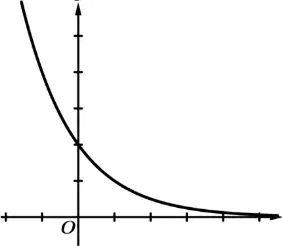
The graph of the function f is shown above. Which of the following could be an expression for f?
21(3)x
−2(31)x
2(31)x
−3(21)x

The exponential function g is defined by g(x) = ab^x, where a and b are positive constants. The table gives values of g(x) at selected values of x. Which of the following statements is true?
g demonstrates exponential decay because a > 0 and 0 < b < 1.
g demonstrates exponential decay because a > 0 and b > 1.
g demonstrates exponential growth because a > 0 and 0 < b < 1.
g demonstrates exponential growth because a > 0 and b > 1.
Which of the following exponential functions demonstrates exponential growth?
y = 3 (2/3)^x
y = -3(2)^x
y = 3 (3/2)^x
y = -3 (2/3)^x
The end behavior of an exponential function h is described by the limit statements x→−∞limh(x)=−∞ and x→∞limh(x)=0 . Which of the following could be h(x) ?
h(x) = 3 (2/3)^x
h(x) = -3(2)^x
h(x) = 3 (3/2)^x
h(x) = -3 (2/3)^x

Selected values of the function f are shown in the table above. Which of the following claim and explanation statements best fits these data?
(A) f is best modeled by a logarithmic function because the outputs over consecutive equal-length input-value intervals are proportional.
(B) f is best modeled by a logarithmic function because the inputs over consecutive equal-length output-value intervals are proportional.
(C) f is best modeled by an exponential function because the outputs over consecutive equal-length input-value intervals are proportional.
(D) f is best modeled by an exponential function because the inputs over consecutive equal-length output-value intervals are proportional.
Which of the following functions is an equivalent form of the function y=43x ?
y = 12x
y = 3 ⋅ 4x
y = 64x
y = 64 ⋅ 4x
Which of the following functions is an equivalent form of the function
y = 9 · 4x?
y = 81 · 22x
y = 3 · 2x/2
y = 9 · 22x
y = 9 · 2x/2
Which of the following functions is an equivalent form of the function y=3x+3 ?
y=27x
y=9⋅3x
y=27+3x
y=27⋅3x
Which of the following functions is an equivalent form of the function f(x)=4(x−2) ?
f(x)=2x
f(x)=2⋅2x
f(x)=2⋅4x
f(x)=161⋅4x
The function g is given by g(x) = 16 · 9x. Which of the following is an equivalent form for g(x)?
g(x)=4⋅3(2x)
g(x)=4⋅3(2x)
g(x)=16⋅3(2x)
g(x)=16⋅3(2x)
The function h is given by h(x) = 25 · 36x. Which of the following is an equivalent form for h(x)?
h(x)=5⋅6(2x)
h(x)=5⋅6(2x)
h(x)=25⋅6(2x)
h(x)=25⋅6(2x)
The function h is given by k(x) = 9 · 4x. Which of the following is an equivalent form for k(x)?
k(x)=3⋅2(2x)
k(x)=3⋅2(2x)
k(x)=9⋅16(2x)
k(x)=9⋅16(2x)
The function f is given by f(x) = 16 · 4x. Which of the following is an equivalent form for f(x)?
f(x)=4(2x)
f(x)=4(x+2)
f(x)=4(x+4)
f(x)=4(x−2)
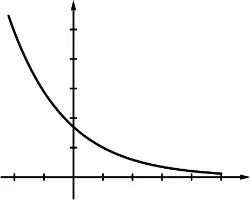
The graph of the exponential function f is shown above. Which of the following pairs of statements correctly describes the end behavior of f?
(A) x→−∞limf(x)=−∞ and x→∞limf(x)=0
(B) x→−∞limf(x)=∞ and x→∞limf(x)=0
(C) x→−∞limf(x)=0 and x→∞limf(x)=−∞
(D) x→−∞limf(x)=0 and x→∞limf(x)=∞

The exponential function f is defined by f(x) = ab^x, where a and b are positive constants. The table gives values of f(x) at selected values of x. Which of the following statements is true?
f demonstrates exponential decay because a > 0 and 0 < b < 1.
f demonstrates exponential decay because a > 0 and b > 1.
f demonstrates exponential growth because a > 0 and 0 < b < 1.
f demonstrates exponential growth because a > 0 and b > 1.

The exponential function g is defined by g(x) = ab^x, where a and b are positive constants. The table gives values of g(x) at selected values of x. Which of the following statements is true?
g demonstrates exponential decay because a > 0 and 0 < b < 1.
g demonstrates exponential decay because a > 0 and b > 1.
g demonstrates exponential growth because a > 0 and 0 < b < 1.
g demonstrates exponential growth because a > 0 and b > 1.

14. Selected values of the function f are shown in the table above. Which of the following claim and explanation statements best fits these data?
(A) f is best modeled by a logarithmic function because the outputs over consecutive equal-length input-value intervals are proportional.
(B) f is best modeled by a logarithmic function because the inputs over consecutive equal-length output-value intervals are proportional.
(C) f is best modeled by an exponential function because the outputs over consecutive equal-length input-value intervals are proportional.
(D) f is best modeled by an exponential function because the inputs over consecutive equal-length output-value intervals are proportional.

Selected values of the function h are shown in the table above. Which of the following claim and explanation statements best fits these data?
(A) h is best modeled by a logarithmic function because the outputs over consecutive equal-length input-value intervals are proportional.
(B) h is best modeled by a logarithmic function because the inputs over consecutive equal-length output-value intervals are proportional.
(C) h is best modeled by an exponential function because the outputs over consecutive equal-length input-value intervals are proportional.
(D) h is best modeled by an exponential function because the inputs over consecutive equal-length output-value intervals are proportional.

The decreasing function S gives the number of students inside a classroom after school ends. The table gives values of S(t) for selected values of t, in minutes, since the school bell ended the day. If a model is constructed to represent these data, which of the following best applies to this situation?
y = −256t + 512
y = −120t + 512
y = 512(2)ᵗ
y = 512(1/2)t
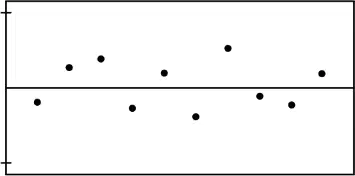
A fitness trainer created a new fitness program designed to help her clients increase their bench press. The trainer made estimates about the maximum amount one of her clients could bench press over time using her program. A linear regression was used to develop a model for the maximum bench press over time. The figure shows a graph of the residuals of the linear regression. Which of the following statements about the linear regression is true?
The linear model is not appropriate, because there is not a clear pattern in the graph of the residuals.
The linear model is not appropriate, because there is a clear pattern in the graph of the residuals.
The linear model is appropriate, because there is not a clear pattern in the graph of the residuals.
The linear model is appropriate, because there is a clear pattern in the graph of the residuals.
Find the eighth term:
3, 6, 12, 24, ...
(a)
What is a5 for the sequence below?
an = 5 ⋅ 2(n-1)
Which sequence is a geometric sequence with a common ratio of 2?
5, 3, 1, -1, ...
5, 7, 9, 11, ...
5, 10, 20, 40, ...
5, 15, 45, 135, ...
Find the explicit formula:
3, 6, 12, 24, ...
aₙ = 6⋅(½)ⁿ ⁻ ¹
aₙ = 6⋅(½)ⁿ
aₙ = 3⋅2ⁿ ⁻ ¹
aₙ = 3⋅2ⁿ
Which of the following best describes this sequence?
An arithmetic sequence with a common ratio of 31
A geometric sequence with a common difference of 3.
An arithmetic sequence with a common difference of 3.
A geometric sequence with a common ratio of 31
Find the explicit formula:
8, 14, 20, 26, ...
aₙ = 6n + 2
aₙ = 8n + 6
aₙ = 2n + 6
aₙ = 6n + 8
The first three terms of an a sequence are 3, 11, and 19. Which formula represents the sequence?
an = 8 + 3(n-1)
an = 8(3)n-1
an = 3 + 8(n-1)
an = 3 + 8n
What is the explicit rule for the sequence? 11, 22, 44, 88...
an = 2(11)n-1
an = 11(2)
an = 11(2)n-1
Arithmetic, geometric, or neither?
1, 3, 7, 13, ...
Arithmetic
Geometric
Neither
Find the next term:
81, 9, 1, 1/9, ...
1/81
1/27
1/18
18

400, 200, 100, 50, 25, ...
Find the common difference:
25, 13, 1, -11, ...
12
-12
8
-8
Which explicit formula describes the sequence?
−1, 3, 7, 11, ...
an=4+(n−1)(−1)
an=(4)(−1)n−1
an=−1+(n−1)(4)
an=(−1)(4)n−1
5, 25, 125, 625...
What is the 12th term of the following sequence?
{3,−6, 12, −24, 48, ...}
6,144
−6,144
354,294
−354,294
Which of the following best describes this sequence?
An arithmetic sequence with a common ratio of 3.
A geometric sequence with a common difference of 3.
An arithmetic sequence with a common difference of 3.
A geometric sequence with a common ratio of 3.
In a geometric sequence, a1 = 486 and a2 = 162. What is the explicit formula for this sequence?
an = 2(3)n-1
an = 18(3)n-1
an = 18(1/3)n-1
an = 486(1/3)n-1
Find the inverse of f(x)=3x+2
f−1(x)=3x−2
f−1(x)=2x−3
f−1(x)=23x
f−1(x)=32+x

Find the inverse:
g(x)=3x−5
g−1(x)=3x−5
g−1(x)=3x+5
g−1(x)=5x−3
Find the inverse:
f−1(x)=−8x+15
f−1(x)=8x−15
f−1(x)=8x+15
Find the inverse:
f−1(x)=x5
f−1(x)=x−5
f−1(x)=5x
There is no inverse
Find the inverse:
g−1(x)=x+32
g−1(x)=−x+32
g−1(x)=x2+3
g−1(x)=3x+2
Find the inverse:
g−1(x)=3x+7
g−1(x)=x−13x+7
g−1(x)=x−1−7x−3
g−1(x)=x−1−3x−7
Find the inverse:
h−1(x)=x−1−2x−6
h−1(x)=x+12x+6
g−1(x)=x−1−7x−3
g−1(x)=x−1−3x−7
Find the inverse:
g(x)=x−108−x
g−1(x)=x−8x−10
g−1(x)=x+8−10x+1
g−1(x)=x−1−10x+8
g−1(x)=x+110x+8
Find the inverse:
f(x)=x−415+x
f−1(x)=x+115−4x
f−1(x)=x−115−4x
f−1(x)=x+14x+15
f−1(x)=x−15x+4

Given f and g in the graph,
what is f(g(2)) ?
3
8
1
4

Given f and g in the graph,
what is (f ° g)(-1) ?
1
4
-1
6

Given f and g in the graph,
what is f(f(3)) ?
3
2
4
1

find h(f(-1))
-5
4
-4
12

Find g(f(-2))
-18
-2
1
9

Find g o h (1)
-5
-4
0
4

f(1) =
-1
1
2
-2
f(1) =
-1
1
2
-2

f(g(3)) =
(a)

f(h(-4)) =
(a)

g(h(-4)) =
(a)

f(g(5)) =
(a)

g(f(2)) =
(a)

h(f(-2)) =
(a)

f(f(0)) =
(a)

h(g(-3)) =
(a)

h(f(g(2))) =
(a)
If f(x) = 3x-1 and g(x) = x2+2,
what is (f ° g)(x) ?
3x2 +5
x2 +1
3x2 +1
3x2 +6
If f(x) = 5x and g(x) = 2x-1,
what is the composition f(g(x)) ?
10x-1
10x-5
5x2-1
5x2-5
For f(x) = 2x2-1, what is and (f ° f)(-2) ?
7
97
13
6

