
 Worksheets
Quiz 7
Total questions: 35
Worksheet time: 1hrs 10mins
Balls 1 and 2 are each thrown horizontally from the same height above level ground, but ball 2 has a greater initial velocity after leaving the thrower’s hand. Compare accelerations of the balls and the times it takes them to hit the ground. Air resistance is negligible.
Acceleration a: Greater for ball 2, Time to hit ground: Greater for ball 2
Acceleration a: Greater for ball 2, Time to hit ground: Equal
Acceleration a: Equal, Time to hit ground: Greater for ball 2
Acceleration a: Equal, Time to hit ground: Equal
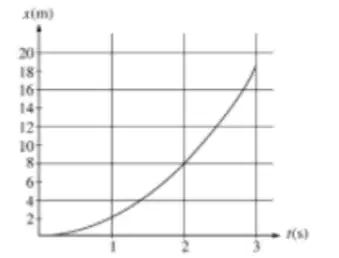
The graph above represents position x versus time t for an object moving in a straight line toward the right. Which of the following correctly describes the motion of this object?
The object’s speed is increasing because of unbalanced forces
The object’s speed is increasing because of balanced forces
The object’s speed is decreasing because of unbalanced forces
The object’s speed is decreasing because of balanced forces
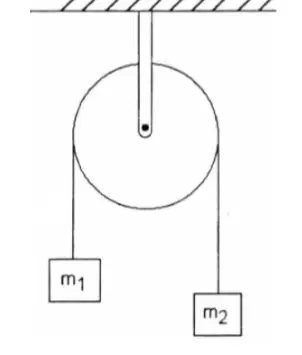
A group of students sets up an Atwood Machine where m₁ = 4 kg and m₂ = 6 kg but the machine accelerates faster than they want for the experiment. Which of the following masses would have exactly half the acceleration of this first Atwood Machine?
m₁ = 2 kg, m₂ = 6 kg
m₁ = 3 kg, m₂ = 4 kg
m₁ = 2 kg, m₂ = 3 kg
m₁ = 9 kg, m₂ = 11 kg
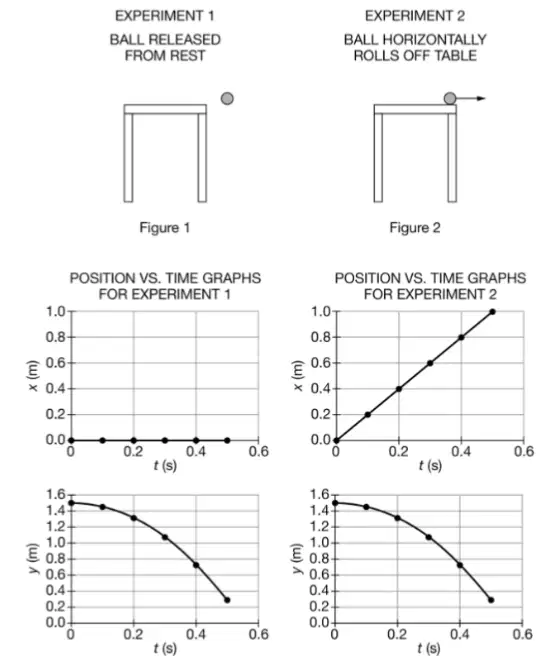
Which of the following conclusions can the student draw from the graphs, and why? Use the information and graphs provided for reference.
The horizontally rolled ball travels a greater horizontal distance and takes a longer amount of time to reach the ground.
The released ball travels with a slower speed and takes a longer amount of time to reach the ground.
Since both balls have zero horizontal acceleration, they reach the ground at the same time.
Since the balls have the same vertical position at any given time, they reach the ground at the same time.
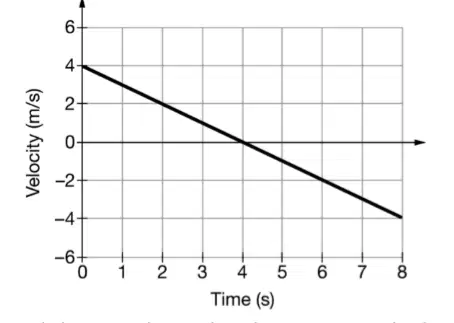
Use the graph below for question 5. An object is sliding to the right along a straight line on a horizontal surface. The graph shows the object’s velocity as a function of time. Which of the following statements correctly describes the motion of the object?
The object has zero acceleration
The object turns around (changes direction) at t = 4 sec
The object’s speed is decreasing from t=4 sec to t=8 sec
The object has a displacement of 64 m during the time shown
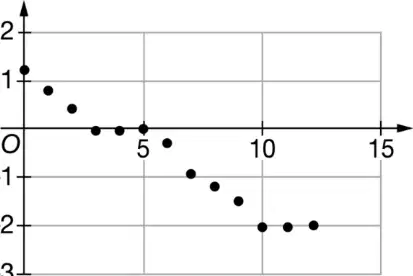
Use the graph below for question 6. An engineer measures the velocity v of a remote-controlled cart on a straight track at regular time intervals. When is the car moving at constant, non-zero velocity?
3 s ≤ t < 5 s
5 s ≤ t < 7 s
7 s ≤ t < 10 s
10 s ≤ t < 12 s
Two objects, X and Y, accelerate from rest with the same constant acceleration. Object X accelerates for twice as long as Object Y. Which of the following is true of these objects at the end of their respective periods of acceleration?
Object X is moving at the same speed as object Y.
Object X is moving four times faster than object Y.
Object X has traveled twice as far as object Y.
Object X has traveled four times as far as object Y.
An object begins at position x = 0 and moves one-dimensionally along the x-axis with a velocity v expressed as a function of time t according to the graph above. When does the object come back to its starting point (x = 0)?
between t = 0 and t = 10 sec
between t = 10 and t = 20 sec
between t = 20 and t = 30 sec
between t = 30 and t = 40 sec
If an object is thrown vertically upward, the direction and magnitude of its acceleration while it is in the air is
upward and increasing
upward and constant
downward and increasing
downward and constant
A rock is thrown with a horizontal velocity of 6 m/s from a cliff that is 20 m above level ground. The rock travels a horizontal distance $d$ in time $t$ before hitting the ground. Air resistance is negligible. On a second throw the rock has an initial horizontal velocity of 12 m/s. How does the flight of the second throw compare to the first throw?
Time = t and distance = d
Time = 2t and distance = 2d
Time = t and distance = 2d
Time = 2t and distance = d
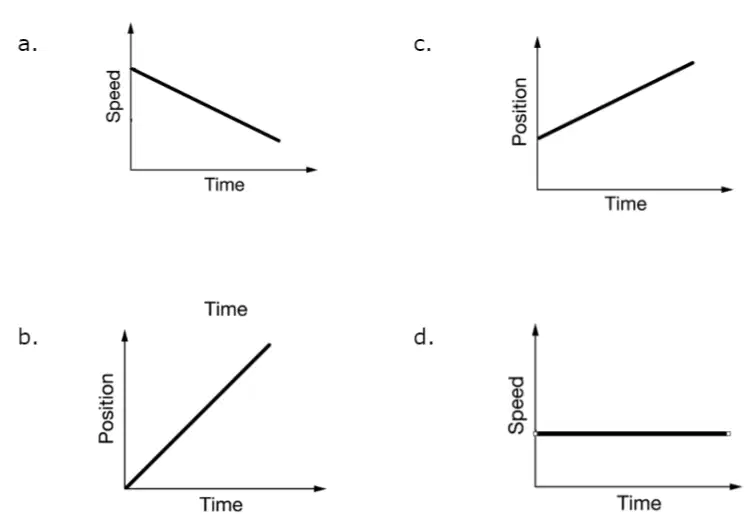
An object undergoes a constant acceleration as it travels along a straight, horizontal section of a track. Which of the following graphs could represent the motion of the object?
Graph a
Graph b
Graph c
Graph d
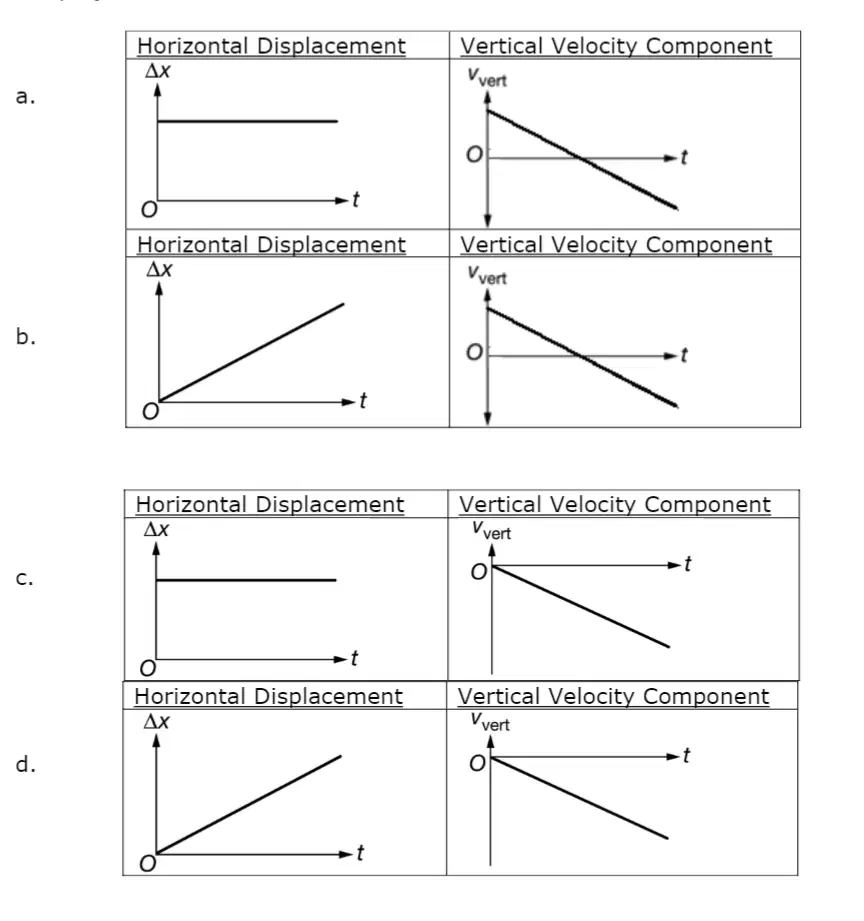
At time t=0, a projectile is launched from the top of a cliff at an angle of 30° above the horizontal. Which of the following pairs of graphs best represents the horizontal displacement Δx and the vertical velocity component Vvert of the projectile as a function of time t?
a. Graph pair a
b. Graph pair b
c. Graph pair c
d. Graph pair d
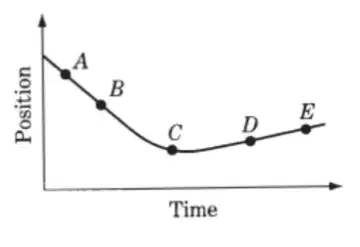
Use the graph below for question 13. The motion of an object along a straight line is represented by the position versus time graph above. At which point on the graph is the speed of the object the smallest?
A
B
C
D
E
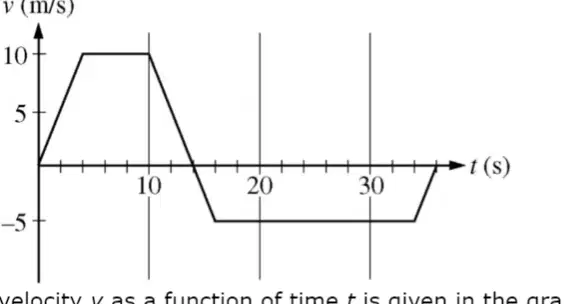
Use the graph below for questions 14-15. An object’s velocity v as a function of time t is given in the graph above. The object moves in a straight line. Which of the following statements is NOT true about the motion of the object?
The object is moving with constant velocity from t = 4 s to t = 10 s.
The object’s initial and final positions are the same.
The object is slowing down from t = 14 s to t = 16 s.
The object is slowing down from t = 34 s to t = 36 s.
When does this object experience balanced forces (zero net force)?
t = 0 s to t = 4 s
t = 4 s to t = 10 s
t = 10 s to t = 14 s
t = 14 s to t = 16 s
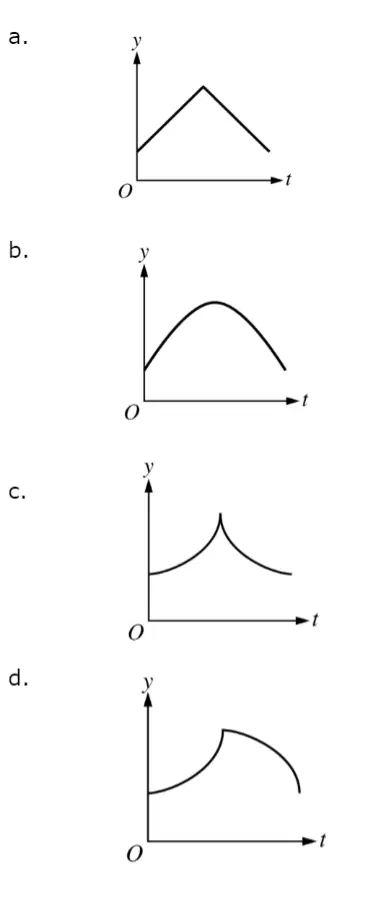
A person throws a marble straight up into the air, releasing it a short height above the ground and catching it at that same height. If air resistance is negligible, which of the following graphs of position y (height) versus time t is correct for the motion of the marble as it goes up and then comes down?
Option a
Option b
Option c
Option d
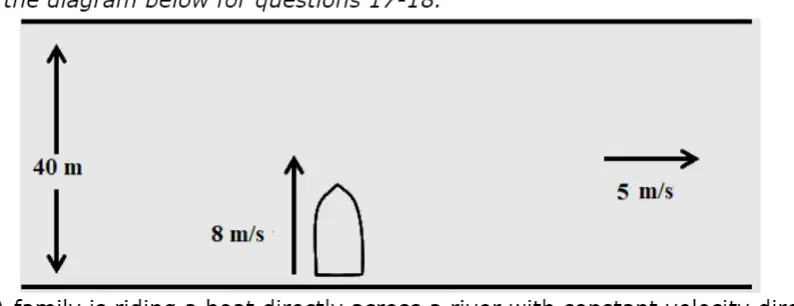
Use the diagram below for questions. A family is riding a boat directly across a river with constant velocity directed up, as shown in the diagram above. While the boat crosses the river, the river current pushes the boat toward the right a horizontal distance d. How long will it take for the boat to cross the river?
8 sec
5 sec
4 sec
3 sec
Another family makes an identical trip in a boat that is only able to travel at a speed of 4 m/s. How will the horizontal distance the second boat moves to the right during the trip across the river compare to the first boat?
½ d, because the boat speed has been cut in half
2d, because the boat speed has been cut in half
d, because the river current is the same
d, because the trip across the river takes the same amount of time
At time t=0, a cart is at x=10 m and has a velocity of 6 m/s in the negative x-direction. The cart has a constant acceleration of 3 m/s² in the positive x-direction. What is the velocity of the cart at t=3 s?
15 m/s in the negative x-direction
15 m/s in the positive x-direction
9 m/s in the positive x-direction
3 m/s in the positive x-direction
Use the information below for this question. A ball is kicked from flat ground with an initial speed of 20 m/s at an angle of 60° (vₓ=10 m/s, vᵧ=19 m/s) to the ground. Air resistance is negligible. What is the ball’s speed at the instant it reaches its maximum height above the ground?
0 m/s
10 m/s
19 m/s
20 m/s
Use the information below for this question. A ball is kicked from flat ground with an initial speed of 20 m/s at an angle of 60° (vₓ=10 m/s, vᵧ=19 m/s) to the ground. Air resistance is negligible. The time the ball will be in the air, before returning to the ground, is closest to nearly
1 s
2 s
4 s
6 s
A student performs an experiment in which the horizontal position of a toy car is recorded on ticker tape from a device that places dots on the tape in equal time intervals. The time interval between each recorded dot is 1 sec and the toy car moves toward the right. Which of the following correctly describes the motion of the toy car?
A toy car that initially increases its speed, travels at a constant speed, and then increases its speed again.
A toy car that initially increases its speed, travels at a constant speed, and then decreases its speed.
A toy car that initially decreases its speed, stops, and then increases its speed.
A toy car that initially decreases its speed, travels at a constant speed, and then increases its speed.
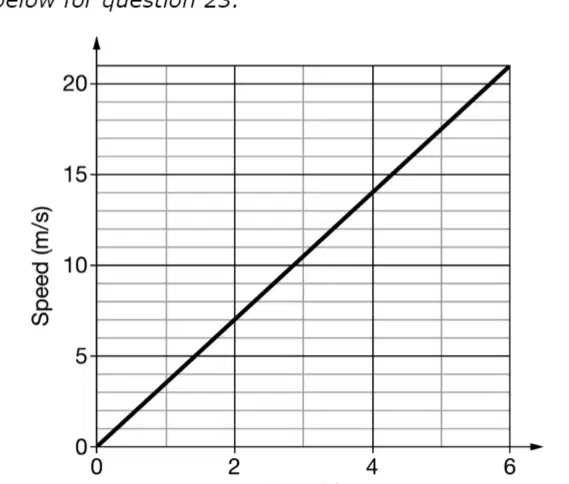
Use the graph below for this question. An object of mass 10 kg is released from rest above the surface of a planet such that the object’s speed as a function of time is shown by the graph above. The force due to gravity exerted on the object is most nearly
3.5 N
7.0 N
35 N
70 N
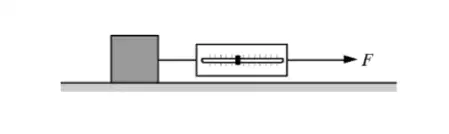
Use the diagram below for this question. A block with mass M is pulled to the right with force F, resulting in an acceleration A. Friction between the block and the surface is negligible. If a block of mass 2M is pulled with a force 2F, what is the acceleration of the new block?
½ A
A
2A
4A
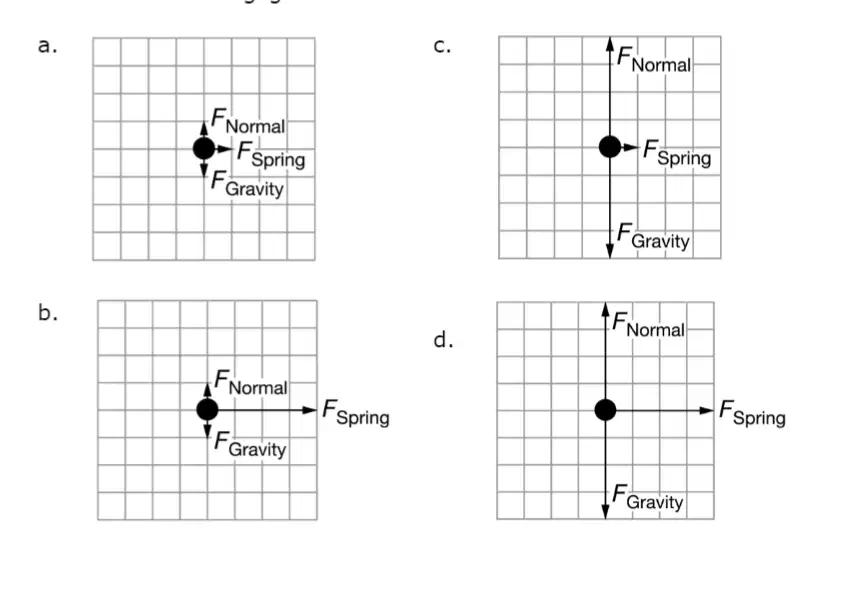
A block is pulled along a surface by a spring scale that exerts a force F on the block. The mass of the block is 4kg, and the spring scale reads 10N. Which of the following free-body diagrams can be used to show the magnitude and direction of all the forces exerted on the block as it is pulled along the surface? Friction is negligible.
Diagram a
Diagram b
Diagram c
Diagram d
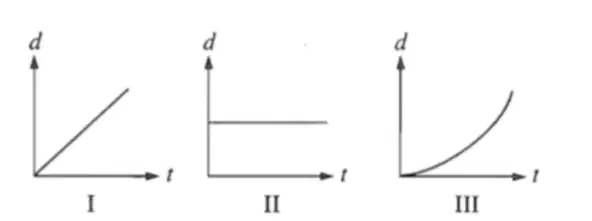
Three objects can only move along a straight, level path. The graphs below show the position d of each of the objects plotted as a function of time t. The sum of the forces on the object is zero in which of the cases?
II only
III only
I and II only
I and III only
I, II, and III
An elevator carrying a person of mass m is moving upward and slowing down. How does the magnitude F of the force exerted on the person by the elevator floor compare with the magnitude mg of the gravitational force on the person?
F < mg
F = mg
F > mg
F can be greater than or less than mg, depending on the speed of the elevator.
A ball is dropped onto the floor and bounces upward. Which of the following claims are correct about the force that the ball exerts on the floor compared to the force that the floor exerts on the ball when the ball and the floor are in contact?
The ball exerts a greater force on the floor because the ball travels with a high speed, whereas the floor is at rest.
The ball exerts a greater force on the floor because the ball is accelerating.
The magnitude of the forces exerted by both objects is the same because the gravitational force exerted by the ball on the floor and the gravitational force exerted on the floor by the ball must be the same.
The magnitude of the forces exerted by both objects is the same because the ball and the floor cannot exert forces of different magnitudes on each other.
An object is pulled by a horizontal tension force along flat ground. The object is speeding up with a constant acceleration. The object experiences a force of friction. Which of the following could be true about the force on this object?
The force of friction between the ground and the object is less than the tension force.
The force of friction between the ground and the object is equal to the tension force.
The force of friction between the ground and the object is greater than the tension force.
The force of friction and the tension force act in the same direction.
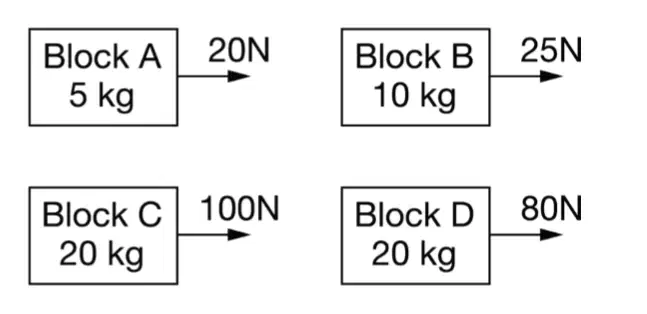
Given the net forces on and the masses of the blocks shown above, which of the following correctly lists the blocks in order of Greatest to Least Acceleration?
Block A > Block B > Block C = Block D
Block C > Block D > Block B > Block A
Block C > Block B > Block D = Block A
Block C > Block D = Block A > Block B
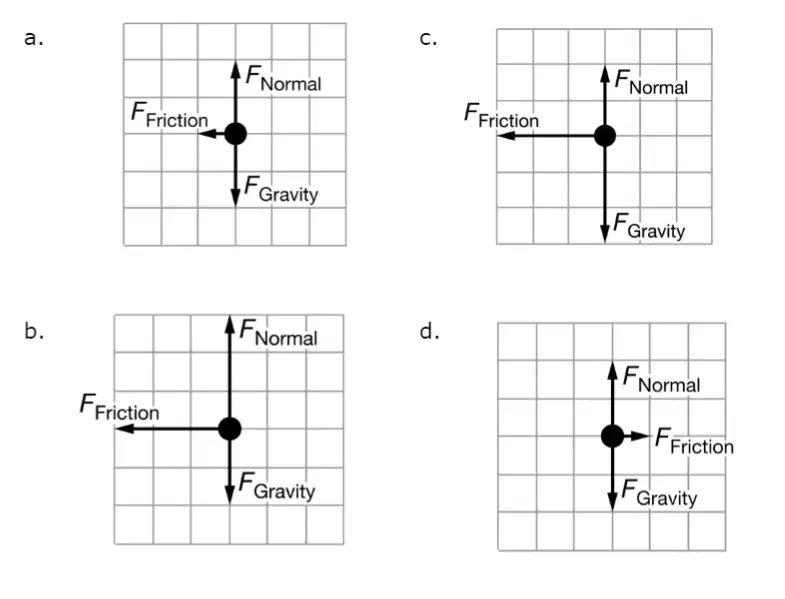
An object slides across a horizontal surface such that it slows down due to the force of friction that is exerted on the object. The object and the direction of its displacement are shown in the figure. Which of the following free-body diagrams could represent the forces that are exerted on the object?
A
B
C
D
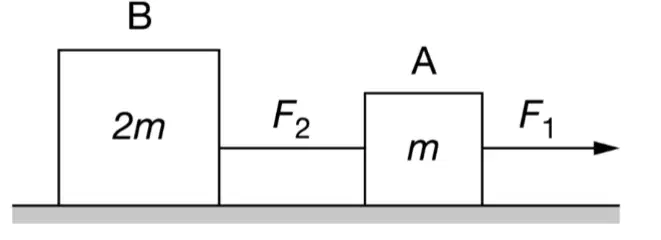
Use the diagram below for this question. Two blocks are being accelerated by a Force $ F_1 $, as shown in the diagram above. The force of the string pulling block B forward has magnitude $ F_2 $. Which of the following claims correctly describes the relationship between the magnitude of the forces acting on the blocks?
F_1 is equal to F_2.
F_1 is greater than F_2.
F_2 is greater than F_1.
Not enough information to answer.
A person is running on a track. Which of the following forces propels the runner forward?
The normal force exerted by the ground on the person
The normal force exerted by the person on the ground
The force of friction exerted by the ground on the person
The force of friction exerted by the person on the ground
Three vehicles travel the same circular turn of an unbanked road: Car A – has a mass of M and travels at a constant speed of V Car B – has a mass of M and travels at a constant speed of 2V Truck C – has a mass of 2M and travels at a constant speed of ½ V The force of friction that Car A requires to travel the circular turn without skidding is F. How does the required friction force of Car B compare to Car A?
½ F
F
2F
4F
Three vehicles travel the same circular turn of an unbanked road: Car A – has a mass of M and travels at a constant speed of V Car B – has a mass of M and travels at a constant speed of 2V Truck C – has a mass of 2M and travels at a constant speed of ½ V The force of friction that Car A requires to travel the circular turn without skidding is F. How does the required friction force of Truck C compare to Car A?
½ F
F
2F
4F

