Wayground logo

Free Printable Worksheets

Font size

S
M
L
XL
Worksheets

Earth Science Post Test Review Pt 2

Total questions: 25

Worksheet time: 32mins

Name
Class
Date
1.
What is the highest elevation on this map?
a)
Over 320 meters
b)
Over 450 meters
c)
Over 220 meters
d)
Over 380 meters
2.
Which topographic map matches formation C?
a)
1
b)
2
c)
3
d)
4
3.

The place on the Earth's surface, above the origin of the earthquake.

a)

Epicenter

b)

Focus

c)

Surface

d)

Crust

4.
What type of fault is this?
a)
Normal
b)
Reverse
c)
Strike-slip
5.

The apparent deflection of air from a straight line into a curved path due to Earth's rotation.

a)

The Ozone Effect

b)

The Coriolis Effect.

c)

The Greenhouse Effect.

d)

The Haber Effect.

6.
What causes wind?
a)
convection currents
b)
conduction currents
c)
radiation currents
d)
tropical currents
7.
Dull, silky, waxy, pearly, and earthy are terms that best describe which property of minerals?
a)
luster
b)
color
c)
streak
d)
cleavage
8.
The color of a mineral in powder form is called the mineral's 
a)
hardness
b)
specific gravity
c)
luster
d)
streak
9.
Which gas in our atmosphere is most abundant?
a)
Argon
b)
Oxygen
c)
Nitrogen
d)
Carbon Dioxide
10.

Acid precipitation/rain can be traced back to

a)

the burning of fossil fuels.

b)

the use of electrostatic precipitators.

c)

thermal inversions.

d)

the release of particulate matter into the atmosphere.

11.

The ozone layer is damaged by (a)  

Choose from the below words
CFCs
Increase in greenhouse gases
Increased global temperatures
Sulfuric and nitric acids
12.
Which natural resource is a renewable energy resource?
a)
coal
b)
oil (petroleum)
c)
natural gas
d)
sun
13.

Can be traced back to the point of origin.

a)

Point Source Pollution

b)

Non-point source pollution

14.
This weather instrument is a...
a)
anemometer
b)
barometer
c)
wind vane
d)
thermometer
15.
This instrument measures air pressure.
a)
anemometer
b)
barometer
c)
rain gauge
d)
thermometer
16.
This is the symbol for a... 
a)
Occluded Front
b)
Stationary Front
c)
Warm Front
d)
Cold Front 
17.
Identify the type of front that is shown in the image.
a)
Occluded Front
b)
Cold Front
c)
Stationary Front
d)
Warm Front
18.
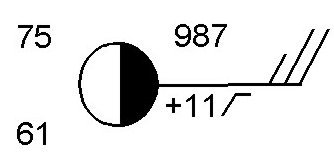
What is the temperature at this station
a)
75 degrees
b)
61 degrees
c)
987 degrees
d)
11 degrees
19.

What is the barometric pressure for this station?

a)

009.6 mb

b)

909.6 mb

c)

109.6 mb

d)

1009.6 mb

e)

096 mb

20.

What is the wind direction

a)

Northeast

b)

Northwest

c)

Southeast

d)

Southwest

21.

How do clouds form?

a)

Water evaporates and condenses on condensation nuclei to form clouds

b)

Water from condensation nuclei evaporates to the sky to form clouds

c)

Water condenses onto other clouds when clouds run into one another

22.

If a cloud has "cirro-" or "-cirrus" in its name, it means:

a)

curl of hair; wispy; high-altitude; icy

b)

mid-altitude

c)

heaped; puffy; instability

23.

If a cloud has "alto-" in its name, it means:

a)

curl of hair; wispy; high-altitude; icy

b)

mid-altitude

c)

heaped; puffy; instability

24.

What type of cloud is in the picture?

a)

Cirrus

b)

Cumulus

c)

Stratus

d)

Cumulonimbus

25.

Calculate the density of the cube.

a)

2 g/cm3

b)

4 g/cm3

c)

6 g/cm3

d)

8 g/cm3