
Font size
 Worksheets
Graph Transformations of Logarithmic Functions
Total questions: 42
Worksheet time: 4hrs 56mins
Using the parent function y=log3x what would the graph of y=log3(x+5) look like?
Horizontal shift left 5 units
Horizontal shift right 5 units
Vertical shift up 5 units
Vertical shift down 5 units
Using the parent function
y=log6x what would the graph of y=log6x+9 look like?Horizontal Shift to the right 9 units
Horizontal shift to the left 9 units
Vertical shift 9 units up
Vertical shift 9 units down
Describe the graph of f(x) = log x changed to
f(x) = log(x + 21) - 50
translate right 21 units and 50 units down
translate left 21 units and 50 units down
translate right 21 units and 50 units up
translate left 21 units and 50 units up
What is the change in the graphs from f(x) to g(x)?
Right nine and down seven
Left nine and down seven
Left nine and up seven
Right nine and up seven
Describe the transformations from the parent function y=log6x to y = - log 6 (x - 1) - 5
Reflection about the x-axis; shift left one and up five
Reflection about the x-axis; shift left one and down five
Reflection about the y-axis; shift right one and down five
Reflection about the x-axis; shift right one and down five
Write the equation of the function f(x)=log3x after the following transformations:
Translate 6 units left and 4 units up.
g(x)=log3(x+6)+4
g(x)=log3(x+4)-6
g(x)=log3(x-6)+4
g(x)=3log(x+6)+4

What is the transformation of the logarithmic function
f(x)=log (x+3)−1
left 3, right 1
right 3, down 1
right 3, up 1
left 3, down 1

f(x)=log5(x+4) - 2
Describe the transformation
translation 4 units to the right, 2 units down
translation 4 units to the left, 2 units down
translation 4 units to the up, 2 units right
translation 4 units to the up, 2 units left

Describe the transformation on
g(x)=log2(x−3)The graph has been shifted 3 units up
The graph has been shifted 3 units to the right
The graph has been shifted 2 units right
The graph has been shifted 3 units left
Write the equation of the function f(x)=log(x+5)-6 after the following transformations:
Translate 3 units left and 2 units up.
f(x)=log(x+2)+2
f(x)=log(x+2)-4
f(x)=log(x+8)-4
f(x)=log(x+8)+2
Describe the transformations from the parent function f(x)=log6x to g(x)=−log6(x−1)−5
Reflection about the x-axis; shift left one and up five
Reflection about the x-axis; shift left one and down five
Reflection about the y-axis; shift right one and down five
Reflection about the x-axis; shift right one and down five
Which graph is logarithmic


Which graph best represents the following logarithmic function?
y=log4x


What is the x-intercept of log7(x)?
(2, 0)
(-1, 0)
(0, 1)
(1, 0)
Which graph best represents the following logarithmic function?
y=log4x
What is the asymptote for the logarithmic function
f(x)=log(x−1)
x=1
x=-1
y=1
y=-1
Which graph is logarithmic

Choose the equation of the graph shown.


Choose the equation of the graph shown.


Describe domain of the function shown: y=log2(x+1)
(-∞,∞)
(-1,∞)
(-1,3)
(∞, -1)
Describe range of the function shown: y=log2(x+1)
(-∞,∞)
(-1,∞)
(-1,3)
(∞, -1)
Write the equation of the function f(x)=log3x after the following transformations:
Translate 6 units left and 4 units up.
g(x)=log3(x+6)+4
g(x)=log3(x+4)-6
g(x)=log3(x-6)+4
g(x)=3log(x+6)+4


What is the domain of log(x)?
(-∞, ∞)
[0, ∞)
(0, ∞)
(∞, -∞)

What is the range of log(x)?
(-2, 4)
(-∞, ∞)
(-∞, 0)
(∞, -∞)
Graph log7(x − 2)


graph log7(x+2)+3


g(x)=log3(x+1)−4 What is the domain of the function?
(−4,∞)
(1,∞)
(−∞,∞)
(−1,∞)
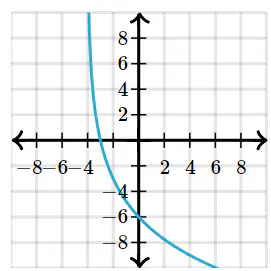
What is the interval where the graph is decreasing?
f(x)=log2(x+1)
(-∞,∞)
(-4,∞)
(-4,9)
(∞, -4)
What is the interval where the graph is increasing?
f(x)=log2(x+1)
(-∞,∞)
(-1,∞)
(-1,3)
(∞, -1)
loga x
This function always passes thru coordinate:
(0, 1)
(1, 0)
(0, a)
(a, 0)
What does K represent in this equation?
(x) = log b (x + h) + k
domain
vertical shift
horizontal shift
base
Which graph best represents the following logarithmic function?
y=log2x

