
 Worksheets
Engine Types 152
Total questions: 45
Worksheet time: 23mins
Who developed the first 4-stroke running engine in 1878?
Karl Benz
Henry Ford
Nikolaus A Otto
Rudolf Diesel
What is a benefit of using a 3-cylinder engine over a 4- or 6-cylinder engine?
More components
Larger size
Less weight
Higher cost
Which type of vehicles commonly use 3- or 4-cylinder engines?
Large trucks
Small vehicles
Motorcycles
Airplanes
What is a downside of having fewer cylinders in an engine?
Increased smoothness
More components
Less smooth operation
Higher fuel consumption
How do manufacturers overcome the lack of smoothness in 3-cylinder engines?
Increase engine size
Use an additional balance shaft
Add more cylinders
Reduce engine power
What is the engine capacity of the Ford EcoBoost 3 cylinder engine?
1.0 litre
1.5 litre
2.0 litre
1.2 litre
How much horsepower does the Ford EcoBoost 3 cylinder engine produce?
100 BHP
115 BHP
130 BHP
90 BHP
What is the camshaft driven from?
The crankshaft at full crankshaft speed
The crankshaft at half crankshaft speed
The piston at full piston speed
The piston at half piston speed
Which of the following is NOT operated by the camshaft?
Exhaust valves
Ignition distributor
Alternator
Oil pump
What is the primary function of the crankshaft?
To convert rotary motion into reciprocating motion
To convert reciprocating motion into rotary motion
To connect the piston to the camshaft
To open and close the valves
What connects the piston to the crankshaft?
Camshaft
Crankshaft
Connecting rod
Cylinder head
What is usually contained in a casting fitted on the top of the cylinder block?
Combustion chamber, exhaust ports, inlet ports, water ways, oil way
Crankshaft, pistons, spark plugs, fuel injectors
Radiator, fan, alternator, battery
Transmission, differential, axles, wheels
What material is commonly used to manufacture the cylinder block?
Aluminium alloy
Plastic
Wood
Glass
What is the function of pistons in a cylinder?
Allow air or air-fuel mixture to flow in, compress the mixture, force exhaust gas out, provide downward movement
Store fuel, ignite the mixture, cool the engine, lubricate the parts
Transmit power to the wheels, change gears, support the vehicle, absorb shocks
Measure speed, display fuel level, control air conditioning, play music
What are the two types of valves mentioned in the document?
Inlet and outlet
Inlet and exhaust
Exhaust and outlet
Intake and outlet
What is the term used for the lowest point that the piston will reach in the cylinder?
TDC
BDC
Cylinder bore
Stroke
What does TDC stand for in engine design?
Top Dead Centre
Total Dead Centre
Top Drive Centre
Total Drive Centre
What does the term 'cylinder bore' refer to?
The length of the piston
The diameter of the cylinder
The height of the cylinder
The width of the piston
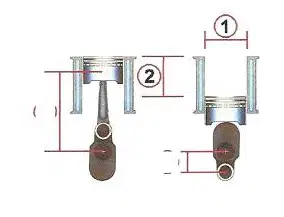
What is indicated by '2' in the diagram related to engine design?
Cylinder bore
Stroke
TDC
BDC
What is the usual fuel for engines that use compression ignition?
Petrol
Diesel
Natural gas
Ethanol
In a spark ignition engine, what causes the air and fuel to burn?
High pressure
A spark
Friction
Heat from the sun
How many main types of engine are there ?
One
Two
Three
Four
During the induction stroke of a four-stroke engine, what happens?
The piston moves up the cylinder
The inlet valve opens and the piston moves down
Both valves remain closed
A spark occurs at the spark plug
What happens during the exhaust stroke in a diesel engine?
The inlet valve opens and the piston moves down.
The exhaust valve opens and the piston moves up the cylinder.
The fuel is injected at low pressure.
The piston remains stationary.
In a diesel engine, how is the fuel ignited?
By a spark plug.
By high pressure injection near the end of the power stroke.
By heating the air in the cylinder.
By an external flame.
What is 'valve lead' in the context of engine strokes?
Both valves remain closed.
The inlet valve opens as the piston nears the end of the exhaust stroke.
The exhaust valve closes early.
The piston moves down without any valve action.
What is 'valve overlap' in engine operation?
Only the inlet valve is open.
Only the exhaust valve is open.
Both the inlet and exhaust valves are open as the piston passes TDC.
Both valves remain closed.
What is a major environmental issue with the two-stroke engine?
It uses too much fuel.
It requires frequent maintenance.
The oil is burnt with the fuel mixture.
It is too noisy.
Which of the following is NOT a characteristic of the two-stroke engine?
It has fewer moving parts than a 4-stroke engine.
It has a valve gear, timing chains, and camshaft.
It operates on a 'total loss' lubrication system.
It is less fuel efficient than a 4-stroke engine.
What happens during the downward stroke above the piston in a two-stroke engine?
The exhaust port is uncovered and burned gases flow out.
The piston covers the transfer port.
The spark plug ignites the mixture.
The air and fuel mixture flows into the crankcase.
What is a characteristic of the Rotary engine?
High revving and smooth operation
Large power unit
Commonly used in modern vehicles
Manufactured by Ford
During the upward stroke below the piston, what occurs in a two-stroke engine?
The lower edge of the piston uncovers the inlet port.
The piston closes the inlet port.
The exhaust port is uncovered.
The spark plug ignites the mixture.
Why was the total loss lubrication system not environmentally friendly?
It used too much oil
It was difficult to manage pollutants
It was too expensive
It required frequent maintenance
What shape is the rotor that rotates inside the chamber?
Circular
Square
Triangular
Hexagonal
What happens when the rotor uncovers the inlet port?
The exhaust gases are released
The air and fuel mixture enters
The rotor stops rotating
The spark plug ignites
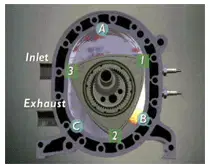
Which phase occurs in Chamber A during the first diagram?
Compression
Induction
Power
Exhaust
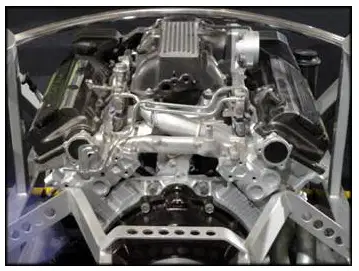
How are the cylinders arranged in a vee engine layout?
In a single line
In two banks
In a circular pattern
In a triangular formation
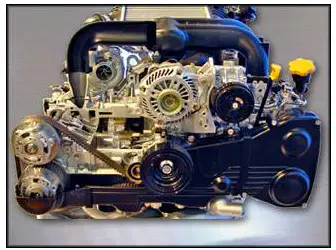
What is a characteristic of a flat engine design?
Cylinders are positioned vertically.
Cylinders are positioned horizontally.
Cylinders are positioned diagonally.
Cylinders are positioned in a V shape.
What is the main advantage of a naturally aspirated induction method?
It uses a turbocharger for increased power.
It relies on atmospheric pressure for air induction.
It requires a mechanical supercharger.
It uses an electric pump for air induction.
Which type of pressure charger is driven by the exhaust gas?
Mechanical supercharger
Electric supercharger
Exhaust turbocharger
Hydraulic supercharger
What is the formula for calculating the compression ratio?
Swept volume / Clearance volume
Swept volume + Clearance volume / Clearance volume
Clearance volume / Swept volume
Swept volume - Clearance volume / Clearance volume
What does the term "cylinder capacity" refer to?
The volume of air and fuel in the carburetor
The total volume of all cylinders in an engine
The volume of the fuel tank
The volume of the exhaust system
What is the unit used to measure torque?
Kilograms (kg)
Newton metres (Nm)
Horsepower (hp)
Litres (L)
At what speed does maximum power usually occur in an engine?
At a very low engine speed
At a fairly high engine speed
At idle speed
At maximum torque speed
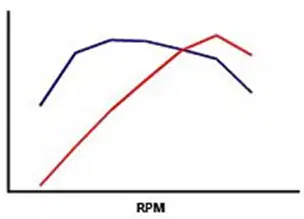
What does the graph in the image represent?
Relationship between speed and fuel efficiency
Example torque and power graph
Temperature and pressure graph
Voltage and current graph

