
NEW
Font size
 Worksheets
Economics Quiz
Total questions: 70
Worksheet time: 35mins
Shoeleather costs arise when higher inflation rates induce people to
spend more time looking for bargains.
spend less time looking for bargains.
hold more money.
hold less money.
The federal funds rate is the
percentage of face value that the Federal Reserve is willing to pay for Treasury Securities.
percentage of deposits that banks must hold as reserves.
interest rate at which the Federal Reserve makes short-term loans to banks.
interest rate at which banks lend reserves to each other overnight.
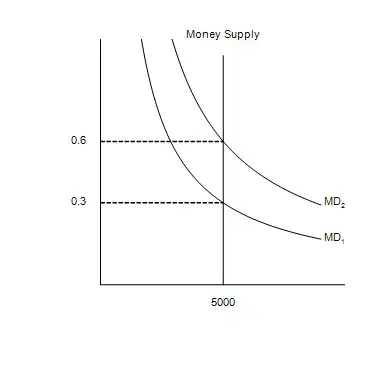
Refer to Figure 31-2. If the relevant money-demand curve is the one labeled MD₁, then the equilibrium value of money is
0.3 and the equilibrium price level is 3.3.
3.3 and the equilibrium price level is 0.3.
0.3 and the equilibrium price level cannot be determined from the graph.
3.3 and the equilibrium price level cannot be determined from the graph.
Most economists believe the principle of monetary neutrality is
relevant to both the short and long run.
irrelevant to both the short and long run.
mostly relevant to the short run.
mostly relevant to the long run.
To explain the long-run determinants of the price level and the inflation rate, most economists today rely on the
quantity theory of money.
price-index theory of money.
theory of hyperinflation.
disequilibrium theory of money and inflation.
The costs of changing price tags and price listings are known as
inflation-induced tax distortions.
relative-price variability costs.
shoeleather costs.
menu costs.
Inflation can be measured by the
change in the consumer price index.
change in money demand.
percentage change in the consumer price index.
change in the money supply.
The nominal interest rate is 9 percent and the real interest rate is 6 percent. What is the inflation rate?
15 percent
3 percent
0.3 percent
–6 percent
Which of the following is consistent with the idea that high money supply growth leads to high inflation?
The quantity theory and data from classic hyperinflations that occurred during the 1920s in Austria, Hungary, Germany, and Poland.
The quantity theory but not evidence from classic hyperinflations that occurred during the 1920s in Austria, Hungary, Germany, and Poland.
Evidence from classic hyperinflations that occurred during the 1920s in Austria, Hungary, Germany, and Poland but not the quantity theory.
Neither the quantity theory nor evidence from classic hyperinflations that occurred during the 1920s in Austria, Hungary, Germany, and Poland.
If Y and V are constant and M doubles, the quantity equation implies that the price level
more than doubles.
changes but less than doubles.
doubles.
An associate professor of physics gets a $200 a month raise. With their new monthly salary they can buy more goods and services than they could buy last year.
Their real and nominal salary have risen.
Their real and nominal salary have fallen.
Their real salary has risen and their nominal salary has fallen.
Their real salary has fallen and their nominal salary has risen.
When prices are falling, economists say that there is
deflation.
inflation.
a contraction.
an expansion.
The claim that increases in the growth rate of the money supply increase nominal interest rates but not real interest rates is known as the
Friedman Effect.
Hume Effect.
Fisher Effect.
inflation tax.
Which of the following is included in both M1 and M2?
Traveler's checks, demand deposits, and savings deposits
Currency and money market mutual funds
Currency, demand deposits, and savings deposits
Currency, demand deposits, and other checkable deposits
Which of the following is not an example of monetary policy?
The Federal Open Market Committee decides to sell bonds.
The Federal Open Market Committee decides to buy bonds.
The Federal Reserve reduces the reserve requirement.
The Federal Reserve facilitates bank transactions by clearing checks.
If the price level increased from 120 to 142, then what was the inflation rate?
1.2 percent
0.8 percent
18.3 percent
22.0 percent
The inflation tax refers to
the revenue a government creates by printing money.
higher inflation which requires more frequent price changes.
the idea that, other things the same, an increase in the tax rate raises the inflation rate.
The velocity of money is
the rate at which the Fed puts money into the economy.
the same thing as the long-term growth rate of the money supply.
the money supply divided by nominal GDP.
the average number of times per year a dollar is spent.
When the Consumer Price Index decreases from 105 to 100
less money is needed to buy the same amount of goods, so the value of money rises.
more money is needed to buy the same amount of goods, so the value of money rises.
less money is needed to buy the same amount of goods, so the value of money falls.
more money is needed to buy the same amount of goods, so the value of money falls.
The price level is a
relative variable.
dichotomous variable.
real variable.
nominal variable.
The existence of money leads to
greater specialization in production, but not to a higher standard of living.
a higher standard of living, but not to greater specialization.
greater specialization and to a higher standard of living.
neither greater specialization nor to a higher standard of living.
Collective bargaining refers to
the process by which the government sets exemptions from the minimum wage law.
setting the same wage for all employees to prevent conflict among workers.
firms colluding to set the wages of employees below equilibrium.
the process by which unions and firms agree on the terms of employment.
The shoeleather cost of inflation refers to the
redistributional effects of unexpected inflation.
time spent searching for low prices when inflation rises.
waste of resources used to maintain lower money holdings.
increased cost to the government of printing more money.
When inflation causes relative-price variability, consumer decisions
are distorted and the ability of markets to efficiently allocate factors of production is impaired.
are distorted, but markets are still able to efficiently allocate factors of production.
are not distorted, but the ability of markets to efficiently allocate factors of production is impaired.
are not distorted and markets are still able to efficiently allocate factors of production.
The idea that nominal variables are heavily influenced by the quantity of money and that money is largely irrelevant for understanding the determinants of real variables is explained by the
velocity concept.
Fisher effect.
classical dichotomy.
Mankiw effect.
Which of the following increase when the Fed makes open market purchases?
Currency and reserves
Currency but not reserves
Reserves but not currency
Neither currency nor reserves
Khia and Danuta buy the same sweatshirt, but each in the wrong size. Khia proposes a size swap with Danuta. This is an example of
barter, since the sweatshirt in the correct size represent a medium of exchange.
barter, since the sweatshirt in the correct size have intrinsic value to both Khia and Danuta.
money, since the sweatshirt in the correct size do not have any intrinsic value.
money, since the sweatshirt in the correct size represent a medium of exchange.
If the reserve ratio is 4 percent, then the money multiplier is
0.04.
25.
2.5.
4.
The labor-force participation rate measures the percentage of the
total adult population that is in the labor force.
total adult population that is employed.
labor force that is employed.
labor force that is either employed or unemployed.
When the market for money is drawn with the value of money on the vertical axis and the quantity of money on the horizontal axis, if the Fed sells bonds then the
money supply and the price level increase.
money supply and the price level decrease.
money supply increases and the price level decreases.
money supply decreases and the price level increases.
Which of the following is not included in M1?
Currency
Demand deposits
Small time deposits
Traveler's checks
In the fourteenth century, the Western African Emperor Kankan Musa traveled to Cairo where he gave away much gold, which was in use as a medium of exchange. We would predict that this increase in gold
raised both the price level and the value of gold in Cairo.
raised the price level and decreased the value of gold in Cairo.
lowered the price level and increased the value of gold in Cairo.
lowered both the price level and the value of gold in Cairo.
Which of the following does the Federal Reserve not do?
Conduct monetary policy
Act as a lender of last resort
Conduct fiscal policy
Serve as a bank regulator
Which of the following functions as both a store of value and a medium of exchange?
Cash and stocks
Cash but not stocks
Stocks but not cash
Neither cash nor stocks
The measure of the money stock called M1 includes
wealth held by people in currency.
credit cards.
wealth held by people in money market mutual funds.
everything that is included in M2 plus some additional items.
The unemployment rate is computed as the number of unemployed
divided by the labor force, all times 100.
divided by the number of employed, all times 100.
divided by the adult population, all times 100.
times the labor-force participation rate, all times 100.
If an economy uses silver as money, then that economy's money
was commodity money.
had no intrinsic value.
was fiat money.
had no store of value.
Which of the following lists is included in what economists call "money"?
Cash
Cash and stocks and bonds
Cash and stocks and bonds and real estate
Cash and stocks and bonds and real estate and all other assets
Which of the following groups meets to discuss changes in the economy and determine monetary policy?
Congress
The Federal Open Market Committee
The President of the United States
The Board of Directors from each of the 12 regional Federal Reserve Banks
Right-to-work laws
guarantee workers the right to form unions.
give workers in a unionized firm the right to choose whether to join the union.
prevent employers from hiring permanent replacements for workers who are on strike.
prevent workers from being fired because of increases in wages brought about by collective bargaining.
Last year, Jane spent all of her income to purchase 200 units of corn at $5 per unit. This year, she spent all of her income to purchase 180 units of corn at $6 per unit.
Jane's nominal income and real income decreased this year.
Jane's nominal income decreased this year, but her real income increased.
Jane's nominal income and real income increased this year.
Jane's nominal income increased this year, but her real income decreased.
Changes in nominal variables are determined mostly by the quantity of money and the monetary system according to
both the classical dichotomy and the quantity theory of money.
the classical dichotomy, but not the quantity theory of money.
the quantity theory of money, but not the classical dichotomy.
neither the classical dichotomy nor the quantity theory of money.
The principle of monetary neutrality implies that an increase in the money supply will increase
real GDP and the price level.
real GDP, but not the price level.
the price level, but not real GDP.
neither the price level nor real GDP.
Assuming the Fisher Effect holds, and given U.S. tax laws, an increase in inflation
increases the real interest rate and the after-tax real rate of interest.
increases the real interest rate and the after-tax real rate of interest.
does not change the real interest rate but raises the after-tax real rate of interest.
does not change the real interest rate but reduces the after-tax real rate of interest.
If velocity = 6, the quantity of money = 2,400, and the price level = 2.25, then the real value of output is approximately Y=MV/P
$1,067.
$5,400.
$2,398.
$6,400.
Which of the following is not correct?
a. Most people who become unemployed will soon find jobs.
b. In an ideal labor market, wages would adjust to ensure that all workers are always fully employed.
c. The unemployment rate occasionally falls to zero.
d. There are always some workers without jobs, even when the overall economy is doing well.
Which of the following statements is true regarding interest in reserves?
a. Interest in reserves make reserve requirements necessary.
b. Interest in reserves make reserve requirements unnecessary.
c. Since 2008, interest on reserve is fixed at 2% per month.
d. Since 2000, the Fed fixed interest on reserve at zero.
In Belgium, Norway, and Sweden, the percentage of workers who belong to unions is
a. almost zero.
b. less than it is in the United States.
c. about the same as it is in the United States.
d. greater than it is in the United States.
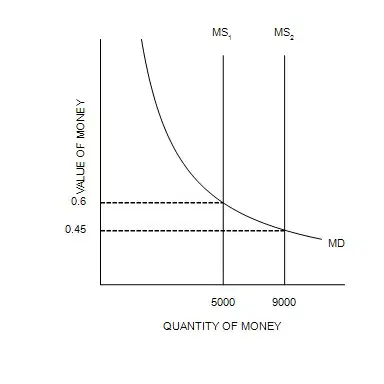
Refer to Figure 31-3. Which of the following events could explain a shift of the money-supply curve from MS₁ to MS₂?
An increase in the value of money
A decrease in the price level
An open-market purchase of bonds by the Federal Reserve
The Federal Reserve sells bonds
Xena quit her job because she was unhappy at work. Alvina was laid off from her landscaping job because her company was downsizing. Who is eligible for unemployment insurance benefits?
Both Xena and Alvina
Xena but not Alvina
Alvina but not Xena
Neither Xena nor Alvina
A bank has $8,000 in deposits and $6,000 in loans. It has loaned out all it can, given the reserve requirement. It follows that the reserve requirement is
Deposits- loans
Reserves / deposits
2.5 percent.
33.3 percent.
25 percent.
75 percent.
Suppose that the Bureau of Labor Statistics reported that there were 59 million people over age 25 whose highest level of education was some college or an associate degree. Of these, 42.6 million were employed and 10.2 million were unemployed. What were the labor-force participation rate and the unemployment rate for this group?
Labor Force= Employed + Unemployment
Labor Force Participation rate= Labor Force / Total Population
Unemployment Rate = Unemployed / labor force x 100
19.3% and 89.5%
89.5% and 19.3%
111.7% and 19.3%
89.5% and 111.7%
If the money multiplier is 3 and the Fed wants to increase the money supply by $900,000, it could
buy $300,000 worth of bonds.
buy $225,000 worth of bonds.
sell $300,000 worth of bonds.
sell $225,000 worth of bonds.
Economists generally argue that
neither high inflation nor moderate inflation is very costly.
costs of both high and moderate inflation are quite large.
high inflation is costly, but costs of moderate inflation are not nearly as large as the public believes.
costs of moderate inflation are nearly zero whereas high inflation is quite costly.
The First Bank of Roswell
Assets Liabilities
Reserves $30,000 Deposits $200,000
Loans 170,000
Suppose the bank faces a reserve requirement of 10 percent. Starting from the situation as depicted by the T-account, a customer deposits an additional $60,000 into their account at the bank. If the bank takes no other action it will
have $64,000 in excess reserves.
have $4,000 in excess reserves.
be in a position to make new loans equal to a maximum of $6,000.
be unable to make any new loans.
Which of the following helps to explain why the "inflation fallacy" is a fallacy?
Increases in the price level can be created by increases in money demand.
Nominal incomes tend to rise at the same time that the price level is rising, leaving real income unchanged.
As the price level rises, the value of a dollar falls.
Inflation only changes real variables.
The money supply increases when the Fed
lowers the discount rate. The increase will be larger the smaller the reserve ratio is.
lowers the discount rate. The increase will be larger the larger the reserve ratio is.
raises the discount rate. The increase will be larger the smaller the reserve ratio is.
raises the discount rate. The increase will be larger the larger the reserve ratio is.
Which of the following statements regarding the Federal Open Market Committee is correct?
Only the five voting regional Fed presidents attend the meetings.
All regional Fed presidents attend and vote at the meetings.
All regional Fed presidents attend the meetings, but only five get to vote.
Regional Fed presidents may neither attend nor vote the meetings.
Sectoral shifts in demand for output
create structural unemployment.
immediately reduce unemployment.
increase unemployment due to job search.
do not affect demand for labor.
Providing training for unemployed individuals is primarily intended to reduce
frictional unemployment.
seasonal unemployment.
structural unemployment.
cyclical unemployment.
Refer to Scenario 30-1. Suppose the Bank of Tazi loaned the banks of Tazi $20 million. Suppose also that both the reserve requirement and the percentage of deposits held as excess reserves stay the same. By how much would the money supply change?
$420 million
$400 million
$80 million
$20 million
If there is inflation, then a firm that has kept its price fixed for some time will have a
high relative price. Relative-price variability rises as the inflation rate rises.
high relative price. Relative-price variability falls as the inflation rate rises.
low relative price. Relative-price variability rises as the inflation rate rises.
low relative price. Relative-price variability falls as the inflation rate rises.
When the market for money is drawn with the value of money on the vertical axis and the quantity of money on the horizontal axis, the money demand curve slopes
upward, because at higher prices people want to hold more money.
downward, because at higher prices people want to hold more money.
downward, because at higher prices people want to hold less money.
upward, because at higher prices people want to hold less money.
In 2010, the U.S. government was running a large deficit. Some were concerned that pressure might be put on the Federal Reserve to purchase government bonds to help the government finance this deficit. If the Fed were to buy government bonds to help the government finance its expenditures, then the price level would
fall, so the value of money would fall.
fall, so the value of money would rise.
rise, so the value of money would fall.
rise, so the value of money would rise.
Katarina puts money into an account. One year later she sees that she has 6 percent more dollars and that her money will buy 4 percent more goods. The nominal interest rate was
10 percent and the inflation rate was 6 percent.
6 percent and the inflation rate was 2 percent.
4 percent and the inflation rate was 2 percent.
10 percent and the inflation rate was 4 percent.
If the reserve requirement is 10 percent, which of the following pairs of changes would both allow a bank to lend out an additional $10,000?
The Fed buys a $10,000 bond from the bank or someone deposits $10,000 in the bank.
The Fed buys a $10,000 bond from the bank or the Fed lends the bank $10,000.
The Fed sells a $10,000 bond to the bank or someone deposits $10,000 in the bank.
According to the assumptions of the quantity theory of money, if the money supply increases by 2 percent, then
a. nominal and real GDP would rise by 0.20 percent.
b. nominal GDP would rise by 2 percent; real GDP would be unchanged.
c. nominal GDP would be unchanged; real GDP would rise by 2 percent.
d. neither nominal GDP nor real GDP would change.
Cyclical unemployment refers to
a. the relationship between the probability of unemployment and a worker's experience level.
b. short-run fluctuations around the natural rate of unemployment.
c. the portion of unemployment created by wages set above the equilibrium level.
d. the difference between the structural and frictional unemployment rates.
Kamila worked part-time for a family business without pay. Alex is waiting to be recalled to a job from which she was laid off. Who does the Bureau of Labor Statistics count as "unemployed"?
a. Alex but not Kamila
b. Kamila but not Alex
c. Both Kamila and Alex
d. Neither Kamila nor Alex
The inflation tax falls mostly heavily on those who hold
a. a lot of currency and accounts for a large share of U.S. government revenue.
b. a lot of currency but accounts for a small share of U.S. government revenue.
c. little currency and accounts for a large share of U.S. government revenue.
d. little currency but accounts for a small share of U.S. government revenue.

