
Font size
 Worksheets
Semester Exam 7th Grade Science
Total questions: 33
Worksheet time: 22mins
If you do not understand a direction or part of a laboratory procedure, you should
figure it out as you do the lab
try several methods until something works
ask the teacher before proceeding
skip it and go on to the next part
The following activity is permitted in the laboratory:
chewing gum
eating
drinking
None of the above.
Before you leave the science room, you should
clean your work area and equipment.
return all equipment to the proper storage area.
wash your hands with soap and water.
All of the above.
You have been injured in the laboratory (cut, burned, etc.). First you should
visit the school nurse after class
see a doctor after school
tell the teacher at once
apply first aid yourself
Horseplay, practical jokes, or pranks in the classroom are
always against the rules
okay
not dangerous
okay if you are working alone
There are two types of changes that substances can undergo: physical changes and chemical changes. Which of these is always evidence that a change is a chemical change?
production of bubbles
change in volume
formation of a new substance
increase in temperature
Changes to substances can be chemical changes or physical changes. Which of the following examples demonstrates a chemical change?
milk becoming sour when it stands on a kitchen counter
water boiling to form steam
crystals forming in saltwater as water evaporates
sugar dissolving in a cup of hot tea when it is stirred
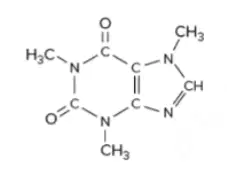
The diagram shows one molecule of caffeine. A caffeine molecule has 8 atoms of Carbon, 10 atoms of Hydrogen, 4 atoms of Nitrogen, and 2 atoms of Oxygen. What are the elements found in this compound in alphabetical order.
(a)
During a lab investigation, students measured the distance a toy car moved along a track. During one trial, the toy car moved 13 m in 5 s. Calculate the average speed of the toy car in meters per second.
(a)
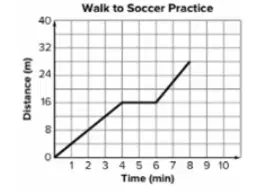
The distance-time graph represents a soccer player's walk from school to the field for practice. Which statements BEST interpret the player’s motion? Select TWO correct answers.
The player started out fast and then slowed down near the field.
The player moved at a constant speed throughout the entire trip.
The player did not move for an interval of 2 minutes during the trip.
The player walked to the field and then returned to the starting position.
The player moved faster between 6 and 8 minutes than during the first 4 minutes.
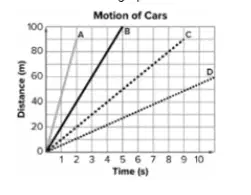
The distance-time graph shows the motion of four cars. Which statement BEST compares the motion of these cars?
Car A had the slowest speed.
Car D traveled the greatest distance.
Car B had a faster speed than Car C.
Car C had a slower speed than Car D.
A scientist observed that an ant took 6 seconds to walk 60 mm. The ant’s average speed was (a) mm/s.

The picture below shows a hot air balloon in flight. Which type of heat transfer plays the largest role in the changing height of the hot air balloon in the sky?
Convection, because as the heat from the flame is increased, less dense air fills and lifts the balloon
Conduction, because as the heat from the flame is increased, heat can move into the balloon without traveling through particles
Condensation, because as the heat from the flame is decreased, water droplets form on the sides of the balloon, making it heavier
Radiation, because as the heat from the flame is decreased, the flow of energy is able to pull the balloon down
Sunlight is always shining on some part of Earth's surface. What happens to most of the solar energy that reaches Earth?
It is trapped by greenhouse gases.
It is reflected back into space by clouds.
It is absorbed by clouds in the atmosphere.
It is absorbed or reflected by the land, water, and air.
Convective circulation results from heat coming from which part of the earth?
The oceans
The core
The lithosphere
The lower mantle
The particles of a substance are arranged in a definite geometric pattern and are constantly vibrating. This substance is in its —
gas phase
liquid phase
solid phase
plasma phase
What happens to the kinetic energy of particles in a substance when its temperature increases?
It decreases
It remains the same
It increases
It becomes zero
Which of the following scenarios is an example of conduction?
A fire warming the air in a room
Heat being distributed throughout the water in a kettle
Frying a hamburger on a hot pan
A laser causing a log to catch fire
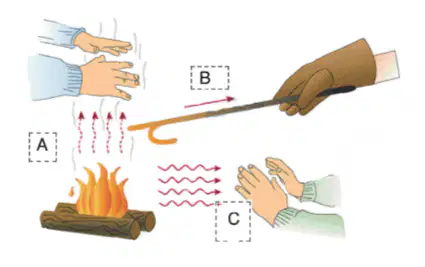
The image shows heat being transferred from a campfire. Which letter/s represents conduction?
(a)
In 1915, German scientist Alfred Wegener proposed the theory of continental drift. Wegener found that continents were slowly drifting around the surface of Earth. Later scientists were able to explain the processes that drive continental drift by looking at the phenomenon of –
seafloor spreading.
the origin of life.
global warming.
radiocarbon dating.
One of their main sources of data evidencing continental drift theory is a –
large group of similar plant and animal fossils
set of seismology readings from deep sea trenches
set of surveys showing the distribution of island arcs
group of samples of new oceanic crust from ocean basins
Which interaction at plate boundaries is MOST LIKELY to form a mountain range on land?
Two oceanic plates pull apart.
Two continental plates collide.
A continental plate and an oceanic plate pull apart.
A continental plate and an oceanic plate slide past each other.
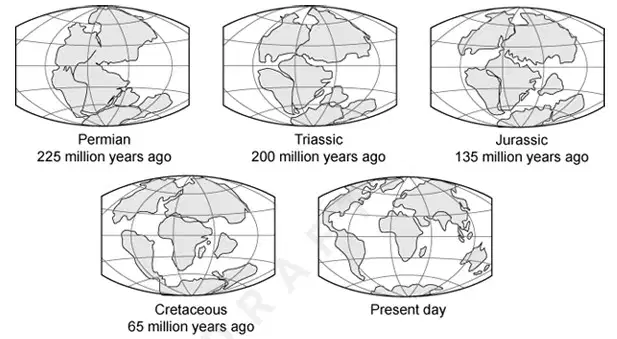
The pictures show the change in Earth's geography. Using the picture, Earth's geography has been affected by —
global warming
tectonic movement
alluvial fans
subduction zones
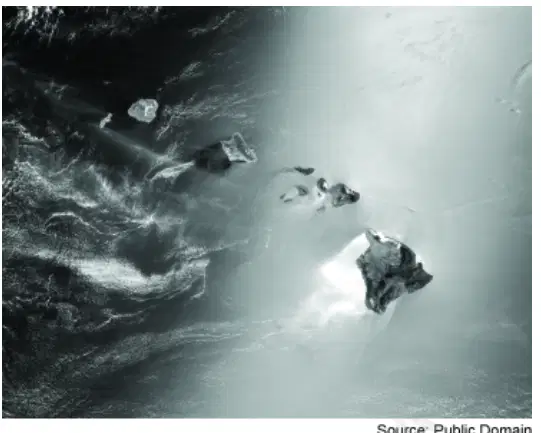
The picture below shows an aerial view of the Hawaiian islands, which were formed in a geological hotspot in Earth's mantle. The Hawaiian islands were formed in this geological hotspot because —
tectonic plates shifted over time, allowing lava to reach Earth's surface and produce volcanoes.
tectonic plates shifted over time, creating ocean basins that lava filled until it created volcanoes.
a divergent plate boundary, known for frequent volcanic activity, provided the magma needed to form new crust material.
a subduction plate boundary, known for frequent volcanic activity, provided the magma needed to form new crust material.
Ocean basins are formed under the surface of the water on the sea floor. What process forms an ocean basin?
Two crustal plates freezing
Two crustal plates moving apart
Two crustal plates colliding
Two crustal plates melting
Convection cells cause lithospheric plates to move away from –
subduction zones
deep-sea trenches
mid-oceanic ridges
mountain ranges
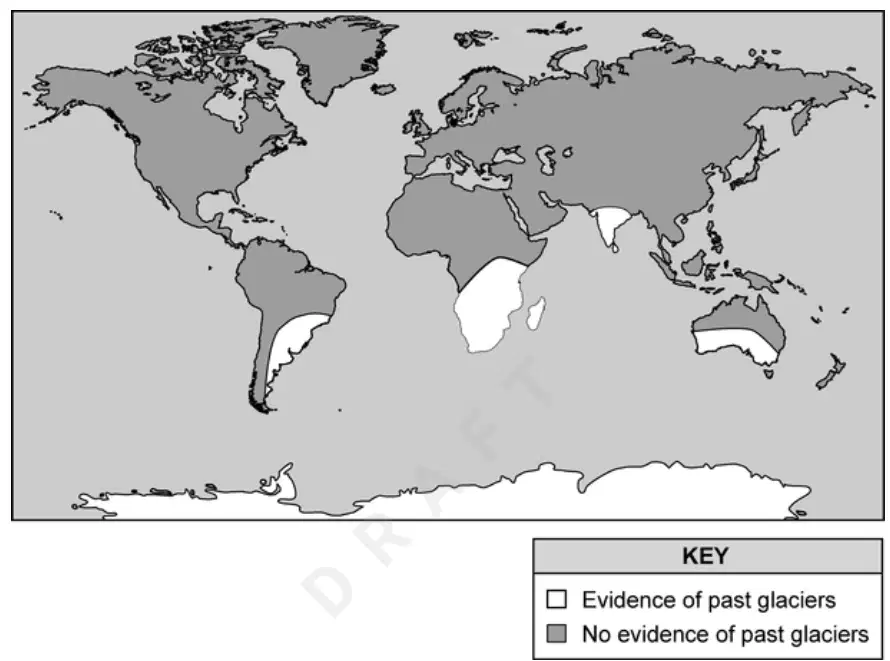
Which theory is supported by this information?
The theory of a frozen Earth
The theory of glacial formation
The theory of plate tectonics and continental drift
The theory of natural selection and plate formation
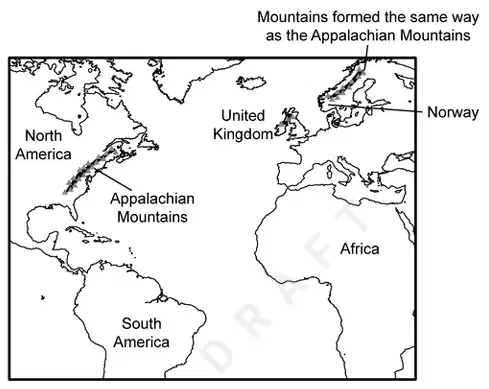
The map below shows evidence of mountains that formed at the same time and in the same way in different parts of the world. Which of the following is not supported by this information?
The theory of plate tectonics
The idea that continents drift over time
The idea that mountains form at plate boundaries
The theory of natural selection
An important Earth process is the phenomenon known as seafloor spreading. It begins as a rift that forms when an area of Earth's crust becomes hotter and less dense, resulting in the appearance of cracks. As the rift opens wider, new crust forms between the separating fragments. However, despite the creation of new crust due to the seafloor spreading, Earth's diameter remains about the same. What can you conclude from this?
New crust is usually eroded as quickly as it is created.
Seafloor spreading occurs at a very slow rate.
There are also areas on Earth's surface where crust is destroyed.
When the seafloor becomes wider, continents become narrower.
Four students push carts filled with sports equipment across the gym. Each student pushes with the same amount of force. Which cart has the greatest change in speed?



