
 Worksheets
Physics final
Total questions: 102
Worksheet time: 5hrs 6mins
(Ch. 2) The use of inclined planes for Galileo's experiments helped him to
discover the concept of energy.
discover the concept of momentum.
eliminate the acceleration of free fall.
discover the property called inertia.
(Ch. 2) Which of the following are in equilibrium? (You may select more than one answer.)
A car travelling at a steady speed of 60 mph on a straight road
A car going in a straight road but slowing down for a traffic light
A car turning a curve at a constant 30 mph speed
A ball sitting on table
When you stand on TWO bathroom scales with one foot on each scale and your weight evenly distributed, each scale will read
zero
half your weight
twice your weight
your weight
(Ch. 2) The earth moves about 30 km/s relative to the sun. When you jump upward in front of a wall, the wall does not slam into you. This is because the wall
has too little gravity to influence you
has negligible inertia compared with the Sun
and you are moving at the same horizontal speed before, during, and after your jump
moves in an opposite direction to you.
(Ch. 2) A cart is pulled by a pair of 20 N forces that are perpendicular to each other, one to the West, the other to the South. What is the net force on the cart?
0 N
40 N
28 N
20 N
36 N
(Ch. 2) If an object is at rest on a surface, we can tell that
the net force acting on the object is zero.
gravity is the only force acting on the object.
there is no force acting on the object
no support force is acting on the object
(Ch. 2) If you toss a coin straight upward in a train that is speeding up quickly, the coin will land
in your hand
in front of you
behind you
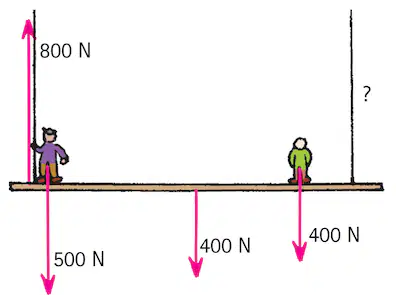
(Ch. 2) The scaffold is in mechanical equilibrium. The forces by the two painters, the weight of the scaffold, and the tension by the left rope on the scaffold are as shown. How much is the tension by the right rope?
800 N
none of the above
500 N
300 N
(Ch. 3) You throw a rock upward with a speed of 30 m/s. How long until the rock reaches its maximum height?
1 s
2 s
3 s
4 s
5 s
(Ch. 3) Which undergoes greater acceleration: a car that speeds from 55 km/h to 60 km/h in 10 s or a bicycle that goes from 0 km/h to 5 km/h in 5 s?
the car
the bicycle
both the same
need more information
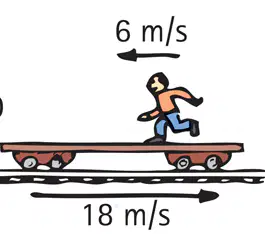
(Ch. 3) The person in the figure is running along a flatcar that is moving at the velocity shown in the figure below. What's his speed relative to the ground?
24 m/s
6 m/s
12 m/s
18 m/s
(Ch. 3) When a truck is turning a corner at a constant speed, (You may choose more than one answer.)
its velocity is constant
its acceleration is NOT zero.
its acceleration is zero
its velocity is NOT constant
(Ch. 3) A vehicle decelerates, when (You may choose more than one answer.)
it's moving to the South and its acceleration points to the South
it's moving to the East and its acceleration points to the West
it's moving to the North and its acceleration points to the South
it's moving to the West and its acceleration points to the West
(Ch. 3) The distance that a freely-falling object falls from rest in 3 seconds is
5 m
20 m
30 m
45 m
60 m
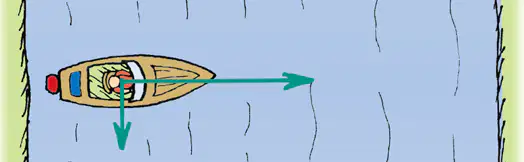
(Ch. 3) A motorboat that normally travels at 4 km/h in still water heads directly across a 3 km/h flowing river. The resulting speed of the boat with respect to the river bank (ground) is about
3 km/h
4 km/h
5 km/h
10 km/h
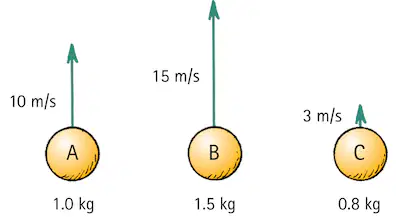
(Ch. 3) Neglecting air resistance, which ball has the greatest acceleration one second after being thrown?
A
B
C
All the same
(Ch. 4) A cart on wheels full of corn kernels is pushed along a track with a constant force. Neglect all forces of friction. Much to the delight of the mice, there is a hole in the bottom of the cart and the corn dribbles out along the track. After a while, the mass of the cart and remaining corn is half of the original value. Which of the following is true of the cart now?
The acceleration will remain constant even though the mass is changing because acceleration is independent of mass, it only depends upon the force applied
The acceleration is now double what it was before the corn dribbled out
The acceleration is now half what it was before the corn dribbled out
The acceleration is zero through out the trip as the cart is in dynamic equilibrium
(Ch. 4) A 3 kg-box is accelerating forward in a straight line on a flat table with a horizontal 30 N-push against a 15 N-friction. What's the acceleration of the box?
5 m/s2
15 m/s2
6 m/s2
10 m/s2
(Ch. 4) A feather and bowling ball are in a closed room. When air is in the room what will likely happen when they are simultaneously dropped from the ceiling?
The feather reaches terminal velocity quickly and then falls slowly at a constant speed
The ball reaches terminal velocity first and thus reaches the floor first.
The ball and the feather fall at the same rate and reach the floor together
The feather does not reach terminal speed in the length it falls.
(Ch. 4) A dog that weighs 70 N on Earth has a mass of about
7 kg
3.5 kg
700 kg
70 kg
(Ch. 4) While an object that weighs 25 N is falling at terminal speed,
its velocity increases steadily
its acceleration is g=10 m/s2.
the net force on the object is 25 N
the air resistance it encounters is equal to 25 N.
(Ch. 4) When an object is in nonfree fall, before it reaches terminal speed, which of the following quantities increases with increasing speed?
Weight of the object
Acceleration of the object
Net force on the object
Air drag on the object
Gravity on the object
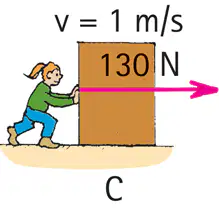
(Ch. 4) The crate is in equilibrium. The push by the girl and the speed of the crate are as shown. How much is the friction on the crate by the floor?
130 N
129 N
120 N
none of the above
(Ch. 4) A light woman and a heavy man jump from a helicopter together with the same-size parachutes. Who will have a greater terminal speed?
The light woman
The heavy man
Both should arrive at the same time
Not enough information
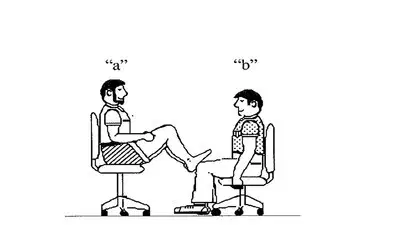
(Ch. 5) In the figure below, student "a" has a mass of 95 kg and student "b" has a mass of 77 kg. They sit in identical office chairs facing each other. Student "a" places his bare feet on the knees of student "b", as shown. Student "a" then suddenly pushes outward with his feet, causing both chairs to move. During the push and while the students are still touching one another:
neither student exerts a force on the other
student "a" exerts a force on student "b", but "b" does not exert any force on "a"
each student exerts a force on the other, but "b" exerts the larger force
each student exerts a force on the other, but "a" exerts the larger force
each student exerts the same amount of force on the other
(Ch. 5) A player catches a ball. If action is the force of the ball against the player's glove, reaction is the
friction of the ground against the player's shoes
muscular effort in the player's arms
player's grip on the glove
the force of the glove against the ball

(Ch. 5) A truck's engine is off and it is pushed by a car to the right and they're moving together. The truck is more massive than the car. Which of the following statements is true?
The car exerts a larger force on the truck than the truck exerts on the car
The car exerts the same amount of force on the truck as the truck exerts on the car
The truck exerts a larger force on the car than the car exerts on the truck
(Ch. 5) Which of the following is FALSE about action-reaction forces?
Neither exists without each other
They are equal in magnitude
They are opposite in directions
They are acting on the same object
(Ch. 5) Earth pulls down on you with a gravitational force that you call your weight. Do you pull up on Earth with the same amount of force?
No, the contact force from the ground cancels the force of Earth on you.
Earth exerts a much greater force on you than you exert on Earth
Yes, you pull up on Earth with the same amount of force
No, the contact force from the ground cancels the force by you on Earth
(Ch. 5) A cannon recoils while firing a cannonball. The speed of the cannon's recoil is relatively small because the
cannon has much more mass than the cannonball
force against the cannon is smaller than force against the ball
both of them
neither of them
(Ch. 5) When a cat is sitting on a chair, gravity pulls the cat downward and the chair supports it upward. Do the gravity and the support force make a pair of action and reaction?
Yes, they make a pair of action and reaction.
No, they don't make a pair of action and reaction.
(Ch. 5) A mouse slides down on a ramp. Which of the following increases with increasing slope of the ramp?
The component of the weight of the mouse that is parallel to the slope
The component of the weight of the mouse that is perpendicular to the slope
The normal force on the mouse
None of the above.
(Ch. 6) A 20-kg mass moving at a speed of 5 m/s has a momentum of
25 kg m/s
80 kg m/s
4 kg m/s
100 kg m/s
(Ch. 6) In the absence of external forces, momentum is conserved in
inelastic collision only
elastic collision only
both elastic and inelastic collisions
neither elastic nor inelastic collision
(Ch. 6) A freight train rolls along a track with considerable momentum, if its total mass is halved and it rolls twice as fast, its momentum will be
twice
4x as much
unchanged
none of the above
(Ch. 6) A 5 kg bicycle moving at 4 m/s brakes to a stop in 2 s. What's the average braking force?
10 N
40 N
12 N
8 N
(Ch. 6) When a dish falls, will the force on the dish be less if it lands on a carpet than if it lands on a hard floor
No, force will be the same on a carpet as on a hard floor
Yes, force will be less on a carpet
No, force will be less on a hard floor
(Ch. 6) Assume a fast-moving car can be stopped by either a cement wall or a large haystack. Compared to hitting a cement wall, when the fast-moving car hits a large haystack, it experiences
greater change in momentum
less change in momentum
the same change in momentum
(Ch. 6) If you push with twice as much force on an object for twice as much time, the impulse delivered to the object will be
doubled
quadrupled
halved
not changed
(Ch. 6) A fish swims toward and swallows a smaller fish at rest. If the larger fish has a mass of 5 kg and swims 2 m/s toward a 2-kg fish, what is the velocity of the larger fish immediately after lunch? Ignore the effects of water resistance.
5/3 m/s
5/6 m/s
2 m/s
5/7 m/s
10/7 m/s
(Ch. 7) A 45-kg sack is lifted 2 meters from the ground and a 25-kg sack is lifted 3 meters in the same time. Which gains more gravitational potential energy?
the 25-kg sack
the 45-kg sack
the same
(Ch. 7) The bob of a simple pendulum has its maximum kinetic energy at the
midpoint between top and bottom
top of its swing
bottom of its swing
at all points along its path of swing
(Ch. 7) Compared with driving at 40 km/h, how much distance do you need to stop when you are driving at 80 km/h?
4 times as much distance
half as much distance
6 times as much distance
2 times as much distance
(Ch. 7) A machine does 5000 J of work in 20 s. What is the power of the machine?
250 W
1,000 W
10,000 W
25 W
(Ch. 7) When a load of gravel is lifted straight upward, does gravity do work on it?
No, it does NO work
Yes, it does positive work
Yes, it does negative work
(Ch. 7) How much work is done in lifting a 600-N barbell 2 m above the floor in 5 seconds?
1500 J
3000 J
1200 J
1000 J
(Ch. 7) When the speed of a truck becomes twice as much, which of the following also doubles?
its kinetic energy
its momentum
Neither of them
Both of them
(Ch. 7) How much net work is done on a 2-kg object when it speeds up from 0 m/s to 6 m/s?
6 J
12 J
36 J
18 J
32 J
(Ch. 8) Consider two cases.
Case 1: you are balancing a meter stick by supporting the end with the tip of your finger.
Case 2: you are balancing a meter stick by supporting the end with the tip of your finger, but now there is a mass attached to the other end.
Which is easier?
case 1
case 2
both the same
(Ch. 8) When ice skaters draw their arms or legs inward, they
increase their rotational inertia so as to reduce their rotational speed
decrease their rotational inertia so as to increase their rotational speed
increase their rotational inertia so as to increase their rotational speed
decrease their rotational inertia so as to reduce their rotational speed

(Ch. 8) A steel ball is attached to a string and is swung in a circular path in a horizontal plane as illustrated in the accompanying figure. At the point P indicated in the figure, the string suddenly breaks near the ball. If these events are observed from directly above as in the figure, which path would the ball most closely follow after the string breaks?
path A
path B
path C
path D
path E
(Ch. 8) A 50 N child and a 100 N child are sitting on a balanced seesaw. The 100 N child is sitting 0.5 m from the fulcrum. How far from the fulcrum is the 50 N child sitting?
2 m
1.5 m
0.5 m
1 m
.25 m
(Ch. 8) On a rotating disc, ladybug A sits close to the rotational axis while ladybug B sits at the outer edge. Then
Ladybug A has a greater rotational speed, but both have the same tangential speed
Ladybug A has a greater tangential speed, but both have the same rotational speed
Ladybug B has a greater rotational speed, but both have the same tangential speed
Ladybug B has a greater tangential speed, but both have the same rotational speed
(Ch. 8) Calculate the tension in a horizontal string that whirls a 2-kg toy in a circle of radius 0.5 m when it moves at 3 m/s on a frictionless icy surface
24 N
15 N
36 N
30 N
(Ch. 8) Which of the following experiences a centrifugal force?
A passenger in a car that turns a corner quickly.
The water escapes out of the holes of a spinning tub of a washing machine.
A bug moves off a fast rotating turntable.
None of these. Centrifugal force is not real.
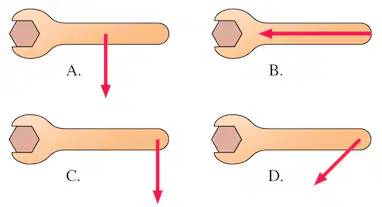
(Ch. 8) A nut needs to be tightened with a wrench. Which force shown in the figure will apply the greatest torque to the nut?
case A
case B
case C
case D
all the same
(Ch. 9) Inside a freely-falling runaway elevator, your
apparent weight is zero
acceleration is zero
gravitational interaction with Earth is zero
all of them
(Ch. 9) If the distance between two asteroids doubled, how would the the gravitational force between those two asteroids be affected?
The force would be double what it was
The force would be half what it was
The force would be a quarter what it was
The force would be four times what it was
(Ch. 9) When an object is in a state of weightlessness, that means
its gravity is zero
it has no support force
the net force on it is zero
its reading on a weighing scale is equal to its gravity
(Ch. 9) If you weigh yourself in an elevator, you'll weigh less when the elevator
moves upward
accelerates upward
accelerates downward
moves downward and decelerates
(Ch. 9) If the gravitational force between an object and Earth is 50 N,
the weight of the object is 50 N.
the weight of the object is 5 N.
the weight of the object is 500 N.
None of the above
(Ch. 9) Astronauts in the international space station appear to float in space. Which of the following best describes the reason?
Astronauts have no mass in orbit, and being massless they appear to float
Astronauts have no apparent weight in orbit because they are falling together with their space station
No net force is acting on astronauts in orbit and they have zero acceleration
They float because there is no gravity in space.
(Ch. 9) If the masses of two planets are each somehow doubled, the force of gravity between them
quadruples
doubles
reduces by half
becomes one-quarter as much
(Ch. 9) You're riding a roller coaster that is going around a vertical loop-the-loop. You feel heavier at the bottom of the loop because
Your apparent weight is equal to your actual weight
Your apparent weight is less than your actual weight
Your apparent weight is greater than your actual weight
(Ch. 10) A projectile is launched upward at an angle of 60° from the horizontal and strikes the ground a certain distance downrange. If air resistance is neglected, for what other angle of launch at the same speed would this projectile land just as far away?
10°
20°
30°
45°
(Ch. 10) A projectile falls beneath the straight-line path along which it would follow if there were no gravity. How much distance does it fall below this line in the first second?
5 m
10 m
20 m
30 m
(Ch. 10) Why is it important that satellites are launched to altitudes of 150 kilometers or higher?
To be far enough away that gravity is negligible
To reduce the curvature of the orbit
To keep above the highest mountains
To avoid air resistance
(Ch. 10) A ball is thrown upward at an angle to the horizontal and caught when it returns to its initial height. Compared with its initial speed and neglecting air resistance, the speed with which it is caught is
less
more
the same
(Ch. 10) As soon as a bowling ball rolls off the edge of a table its horizontal component of velocity
increases quickly
decreases quickly
remains constant
(Ch. 10) The Moon does not crash into Earth because
Earth's gravitational field is very weak at the Moon
gravitational pull of other planets keeps the Moon up.
Moon has a sufficient tangential speed
Moon has less mass than Earth
(Ch. 10) A ball is tossed upward at an angle to the horizontal. Neglecting air drag, the acceleration along its path is
zero
straight downward
straight upward, then straight downward
straight upward
(Ch. 10) When you toss a projectile sideways, it curves as it falls. It will be an Earth satellite if the curve it makes
matches the curved surface of Earth
results in a straight line
spirals out indefinitely
None of the above
(Ch. 12) If the volume of an object were doubled while its mass remained the same, its density would
be four times as great
stay the same
be half
double
(Ch. 12) If an elephant were scaled up to triple its size while retaining its present proportions, its strength-to-weight ratio would be
1/9 as much
3 times as much
9 times as much
1/3 as much
(Ch. 12) Compared to a bar of pure gold, the density of a pure gold ring is
the same
more
less
depends on volume
(Ch. 12) Which is more elastic, steel or rubber?
rubber
steel
the same
(Ch. 12) A 6 cm long spring extends to 10 cm when a 1 kg load is suspended from it. What would be its length if a 2 kg load were suspended from it?
10 cm
12 cm
14 cm
16 cm
(Ch. 12) If a rabbit were scaled up to triple its size while retaining its present proportions, its surface area to volume ratio would be about
1/9 as much
1/3 as much
9 times as much
3 times as much
(Ch. 12) When a load is placed on the middle of a horizontal beam that is supported at each end, the upper part of the beam undergoes
tension
compression
both
neither
(Ch. 12) If you were scaled down to the size of a squirrel, your terminal speed would
remain the same
be higher
be lower
(Ch. 13) Which is the same for two identical books on a table, one lying flat and the other standing on an end?
the force they exert to the table
the pressure they exert to the table
both of these
neither of these
When a fish increases the size of its air bladder, the buoyant force on the fish
decreases
increases
remains the same
(Ch. 13) If an object suspended by a scale shows a weight of 5 N in air, and 2 N when submerged in water, the buoyant force on the submerged object is
2 N
3 N
5 N
8 N
(Ch. 13) Compared to the buoyant force on a log that is floating in the water, the buoyant force on the same log that is floating in the oil is
greater
less
the same
Two metal blocks are submerged in the water. One is a 4-cm3 cube of lead (ρlead = 11.3x 10³ kg/ m3 ) and the other is an 8-cm3 cube of aluminum (ρaluminum = 2.70x 10³ kg/ m3 ). Upon which is the buoyant force greater?
The 4-cm3 cube of lead
The 8-cm3 cube of aluminum
Both the same
Need more information
(Ch. 13) If the cross-sectional area of the large piston in a hydraulic press is 100 times as large as that of the small piston, a 3-kg load on the small piston will support a load of
100 kg on the large piston
300 kg on the large piston
900 kg on the large piston
None of the above
(Ch. 13) An object is completely submerged in a liquid. Which quantity depends on the depth of the object in the liquid?
The pressure on the object
The buoyant force on the object
Both of them
Neither of them
(Ch 13) Does a wooden log float higher in water or oil?
in water
in oil
the same
(Ch. 14) The energy source responsible for molecular motions in Earth's atmosphere is
the Sun
atmospheric tides
their own natural kinetic energy
None of these
(Ch. 14) About how high can water at sea level be theoretically lifted by a vacuum pump?
there's no limit
76 cm
10.3 m
(Ch. 14) Inside the same room, buoyancy of air is greater on
Archimedes' principle
Bernoulli's principle
force of suction
surface tension
atmospheric pressure
(Ch. 14) A piston in an airtight pump is pushed down so that the volume of the air chamber is halved while the temperature remains unchanged. What is the change in pressure?
It quadruples
It doubles
It halves
It remains the same
(Ch. 14) When you blow air between a pair of closely-spaced Ping-Pong balls suspended by strings, the balls will swing
away from each other
toward each other
stay still
(Ch. 14) A helium-filled balloon released in the atmosphere will continue to rise UNTIL
atmospheric pressure on the bottom and top of the balloon are equal
the buoyancy by the atmosphere is greater than its own weight
the weight of displaced air equals its own weight
it reaches an altitude of about 30 km
(Ch. 15) A substance that cools down faster than others has a
higher specific heat capacity
lower specific heat capacity
neither of these
(Ch. 15) How is heat similar to and different from internal energy?
They are both forms of energy, but heat is energy that flows, whereas internal energy is energy internal to a substance.
Heat is not a form of energy, whereas internal energy is
Heat and internal energy are two names for the same thing
They are both forms of energy, but heat is kinetic energy, whereas internal energy is potential energy
(Ch. 15) Calculate the heat released by 2 kg of water when its temperature decreases from 4ºC to 2ºC. (specific heat of water is 4200 J/kg ºC)
4200 J
16800 J
2100 J
8400 J
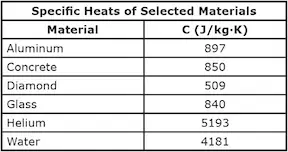
(Ch. 15) According to the table shown below, which requires the most heat, raising 1kg of aluminum, 1 kg of diamond, or 1 kg of glass through the same temperature range?
1kg of glass
1 kg of diamond
1kg of aluminum
the same for all
(Ch. 15) If you add the same amount of heat to a half cup of water and a full cup of water. The change in the temperature of the half cup of water is about
half as much as that of the full cup
the same as that of the full cup
twice as much as that of the full cup
none of the above
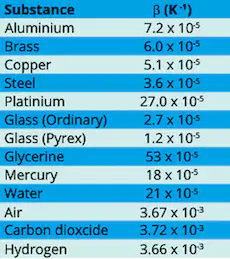
(Ch. 15) The table shows the coefficients of volume thermal expansion. According to the table, which of the following contracts the most per unit volume for the same decrease in temperature, a block of brass, a block of copper, or a block of steel?
block of brass
block of copper
block of steel
all the same
(Ch. 15) Which of the following is FALSE?
Heat spontaneously flows from a higher-temperature substance to a lower-temperature substance
Heat never spontaneously flows from a lower-temperature substance to a higher-temperature substance
Heat spontaneously flows from a higher internal energy substance to a lower internal energy substance
Heat flows between objects in thermal contact until they reach the same temperature
(Ch. 15) Which will release more heat to the environment, 5-kg hot water at 70 ºC or a 5-kg iron brick at the same temperature in the same room?
the water
the iron block
both the same

