
 Worksheets
T1: Functions and Transformation
Total questions: 60
Worksheet time: 3600secs
Determine the range for the function
f(x) = 3(2)x-4 + 5
[5,∞)
(5,∞)
[4,∞)
(4,∞)
f(x)=3(2)x-4+5
Given the original exponential function defined by y=4x, how would the graph change if the function were:
y=2(4)x-3+1?
Vertically stretched by a factor of 2, right 3, and up 1
Vertically compressed by a factor of 1/2, left 3 and down 1
Vertically compressed by a factor of 1/2, right 3, and down 1
Vertically stretched by a factor of 2, left 3, and up 1
y = -2 I x - 3 I + 3
f(x)=-2(3)x+4-8 ?

Which is the equation of the function shown?
f(x)=x+41+3
f(x)=x−41−3
f(x)=x−31−4
f(x)=x+31+4
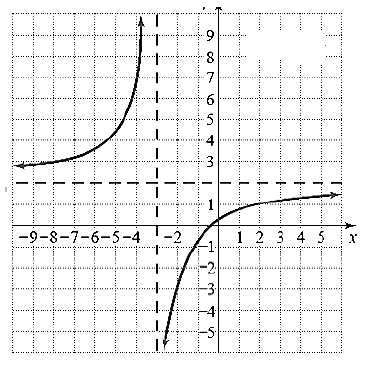
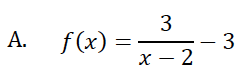
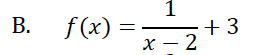
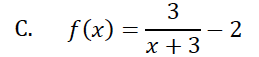
Which of the following represents the graph below?

What is the domain for the following function?
All real numbers except 2.
All real number except -2.
All real numbers except 4.
All real numbers.

What is the range for the following function?
All real numbers.
All real numbers except for -2.
All real numbers except for 2.
All real numbers exceptt for 4.
What is the equation of the Vertical Asymptote of y=x−43+2
x=2
y=2
x=4
y=4
No Vertical Asymptote

What is the horizontal asymptote of the function?
y = 7
y = -7
y = 6
y = -6

Determine the equation for the graph.
y=2x−4
y=−x−4
y=2x
y=2x+4
What is the domain of this function?
y=x−1−3
x ≥ 1
x ≤ 1
x ≥ -3
x ≥ -1
x ≤ -3


Which of the following parent functions have a range of [0,∞) ? Select all that apply.


Which of the following parent functions does not have a domain
(−∞,∞) ?


Determine if the function graphed has a maximum or a minimum value and identify that value.
maximum at -1
minimum at -1
maximum at 4
minimum at 4

Which is not true?
The graph is a reflection of the parent funtion y=x1
An equation for the function is y=x−1−1
There is a vertical asymptote at
x=−1
There is a horizontal asymptote at y=0
Which characteristic is NOT true for the function: y=x−82+6
The domain is (−∞, −8)∪ (−8, ∞)
The range is (−∞, 6)∪ (6, ∞)
The graph is stetched vertically
There is a vertical asymptote at x=8
Which is the graph of y=−x−21 ?


Which equation matches the graph?
y=x+31−1
y=x−31−1
y=−x+31−1
y=−x−31−1

What is the domain?
[-2, 3]
[-2, 3)
(-2, 3]
[-3, 4]
(-3, 4]

What is the range?
(−∞, −3]
[3, −∞)
(−∞,3]
None of the answer choices
[−3, ∞)

What is the domain?
(∞,−2]
[−2, ∞)
[-2,3]
(−∞, −2]
None of the answer choices

What is the slant (Oblique) asymptote for the equation
f(x) = (x2 - 4x + 2)/(x + 3)
y = x -1
y = x -7
y = -7x + 23
y = -2x + 2

What is the oblique asymptote for the function?
y = 12
y = x - 5
y = x-5 + 12/(x+2)
y = 12/(x+2)

What type(s) of asymptotes does this function have? (Check all that apply.)
Vertical
Horizontal
Oblique

Which of the following represents the graph of f(x)=x2−161 ?


f(x)=x2−x−20x2−25 Identify the hole(s) in the graph.
x=4
x=−4 AND x=5
x=5
x=−5
There are no holes
h(x)=3x(x+3)(x−6)(x+7)x(x−3)(x−6)(x+3)
Identify the x-value of the hole(s).
x=0
x=-3
x=6
x=-7
x=3
f(x)=(x−3)(x−5)(x+7)(x−3)(x+1)
Select all of the true statements.
A hole occurs where x=3
vertical asymptote at x=3
vertical asymptote at x=5
A hole occurs where x=5
Does this function have any vertical asymptotes? If so, what are their equations? y=(x−4)(x+3)(x−4)(x+7)
No vertical asymptotes.
One vertical asymptote: x = 4
Two vertical asymptotes: x = -3 and x = -7
Three vertical asymptotes: x = -3, x = 4, and x = -7
What is the x-intercept of f(x)=x2−25x2−2x−15?
x = 5
x = 3
x = -3
x = -5
What is the y-intercept of
f(x)=x+3x2−3x?y = 3
y = 1
y = 0
y = -2
What is the horizontal asymptote of
f(x)=x−53x+1?y = 5
y = 3
y = 1
y = 0
What is the x-intercept of
f(x)=xx−1 ?x = -1
x = 0
x = 1
all real numbers


What are the domain and range?
Domain: -5 ≤ x < 5
Range: 3 ≤ y < 6
Domain: -5 ≤ x < 5
Range: 0 ≤ y < 6
Domain: -5 < x ≤ 5
Range: 3 ≤ y < 6
Domain: -5 < x ≤ 5
Range: 0 ≤ y < 6

What are the domain and range?
Domain: x ≤ 8
Range: y ≥ -5
Domain: x ≤ 8
Range: y ≥ 3
Domain: x ≥ 8
Range: y ≥ 3
Domain: x ≥ 8
Range: y ≥ -5


Which of the following graphs depicts the following exponential function:
f(x) = 2x - 2


What could the equation of the exponential function in the graph be?
y = 2x + 2
y = (1/2)x + 2
y = 1/2(4)x + 2
y = 2x - 2

What is the equation for this graph?
y=3(2)x
y=2(3)x
y=4(2)x
y=2(5)x

What is the horizontal asymptote?
y =2
y =-2
x=-2

What is the range of the function?
(0, ∞)
(−∞,0)
all real numbers

Which statement is true about the function shown in the graph?
The function is a growth and reflected
The function is a growth and not reflected
The function is a decay and reflected
The function is a decay and not reflected

Which statement is true about the function shown in the graph?
The function is a growth and reflected
The function is a growth and not reflected
The function is a decay and reflected
The function is a decay and not reflected
What is the domain of the graph of f(x) = 6(0.25)x ?
All real numbers
x > 0
y > 0
x > 6

Which graph is representative of the equation?


Which exponential equation could represent the graph shown?
f(x)=3x+2
f(x)=3x−2
f(x)=3(x+2)
f(x)=3(x−2)

y=x
y=x
y=∣x∣
y=x2


