
 Worksheets
Semester Exam Review
Total questions: 100
Worksheet time: 50mins
Name
Class
Date
1.
How are the origins of Hinduism and Buddhism similar?
a)
Both were founded at the same time.
b)
Both began in the same modern-day country.
c)
Both a caste system for social classes.
d)
Both considered Siddhartha Gautama as the principal founder.
2.
What political change was brought about by the fighting of the Hundred Years War?
a)
Peasants gained privileges by serving in new national armies.
b)
Powerful monarchies consolidated power as nation-states emerged.
c)
Knights built large independent armies to overthrow corrupt monarchies.
d)
Religious leaders emerged as powerful local leaders in France and England.
3.
Why did the Crusades contribute to the end of the medieval era in Europe?
a)
Trade was revived leading to the decline of the manorial economy.
b)
Islamic fighters defeated Christian knights and took control of Europe.
c)
Christians split between Western Roman Catholicism and Eastern Greek Orthodoxy.
d)
European knights were given Church lands in exchange for ¬ghting in the Holy Lands.
4.
Why is the government of ancient Egypt considered a theocracy?
a)
The government has a representative legislature.
b)
Wealthy elite control most parts of government.
c)
Leadership passes from father to son.
d)
The pharaoh is considered a god-king.
5.
How are the origins of Hinduism and Buddhism similar?
a)
Both were founded at the same time.
b)
Both began in the same modern-day country.
c)
Both implemented a caste system for social classes.
d)
Both considered Siddhartha Gautama as the principal founder.
6.
Which lasting impact did Hammurabi's Code have on law?
a)
Laws were made more consistent and predictable.
b)
Laws were created by a representative group.
c)
Laws no longer suggested punishments.
d)
Laws needed to be interpreted by impartial judges.
7.
Why was Egypt called the "Gift of the Nile?"
a)
Irrigation from the Nile provided for farming in a desert region.
b)
Protection from the Nile kept invaders from entering from the north.
c)
Fish and wildlife from the Nile were traded with neighboring civilizations.
d)
Egyptians believed the gods had placed the Nile in Egypt as a sign of supremacy.
8.
Siddhartha Gautama's quest for personal enlightenment began with -
a)
observing suffering in the world.
b)
developing a guide to meditation.
c)
rejecting the idea of monotheism.
d)
taking political power from the king.
9.
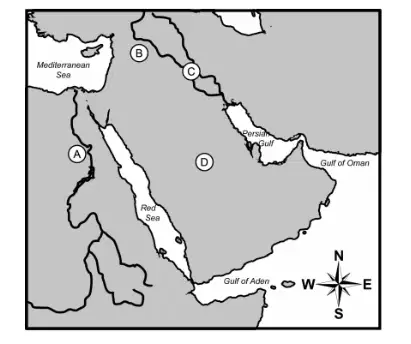
Which letter indicates the area of Mesopotamia?
(a)
10.
Christianity's spread throughout the Roman Empire was facilitated by -
a)
laws passed by Julius Caesar during the Pax Romana.
b)
merchants and soldiers who traveled the Silk Road.
c)
a network of roads and common language used in the region.
d)
the cooperation of the Jews living in the Eastern Mediterranean.
11.
What best describes Indian culture during the rule of the Gupta Empire?
a)
Buddhist traditions dominated, while Hindu customs were viewed unfavorably.
b)
Hindu culture flourished with many works of art and literature being produced.
c)
Cultural pursuits were prohibited so people could spend their time in meditation.
d)
Indian scholars were persecuted by political leaders who felt threatened by their ideas.
12.
Which belief system gained prominence in India during the Mauryan Empire?
a)
Buddhism
b)
Hinduism
c)
Christianity
d)
Confucianism
13.
What pair of Greek mathematicians made great advances in geometry?
a)
Euclid and Pythagoras
b)
Diogenes and Eratosthenes
c)
Aristotle and Zeno
d)
Archimedes and Hipparchus
14.
How did the early Christian Paul contribute to the spread of Christianity?
a)
As a missionary, he traveled around the Roman Empire converting people to Christianity.
b)
As a Roman senator, he pushed for the toleration of Christianity within the Empire.
c)
As a powerful priest in Rome, he persuaded Roman leaders to adopt Christianity.
d)
As leader of the Christian Church in Jerusalem, he established the first structure of Christianity.
15.
The establishment of a Hellenistic empire by Alexander is considered a great achievement because it -
a)
allowed for Christianity to emerge in a peaceful Greek empire.
b)
promoted the early development of democracy in Greece.
c)
brought about the establishment of the first Greek city-states.
d)
facilitated the spread and preservation of Greek knowledge.
16.
What classical Greek political practice was adopted by the classical Romans?
a)
Allowing a supreme court of impartial judges.
b)
Creating a system of public baths for sanitation.
c)
Granting citizaens the right to participate in government through the voting process.
d)
Establishing a council of the 500 largest landowners to serve as advisers to legislators.
17.
In what area has the Justinian Code had the most lasting impact?
a)
Justice
b)
Morality
c)
Taxation
d)
Diplomacy
18.
The medieval Church was a unifying force in Europe after the fall of Rome because it offered -
a)
indulgences for sinners.
b)
stability and security.
c)
redistribution of wealth.
d)
multiple sets of beliefs.
19.
Under the manorial system, nobles were required to provide serfs with what?
a)
Food
b)
Education
c)
Protection
d)
Livable wage
20.
What was one event that made 1215 a significant historical year?
a)
England developed a law code based on Roman laws.
b)
King John was forced to acknowledge the rights of his subjects by signing the Magna Carta.
c)
William of Normandy conquered the Anglo-Saxon in Britain.
d)
Europe began to break into nation-states under monarchies.
21.
The unifying of the Frankish kingdom by Clovis likely contributed to -
a)
the use of Latin in Roman Catholic services.
b)
the decline of scholarship and formal education.
c)
the abdication of the last western Roman emperor.
d)
the increasing role of Roman Catholicism in Europe.
22.
A vassal is expected to show loyalty to a lord by -
a)
farming a plot of land.
b)
collecting tolls and taxes.
c)
providing military service.
d)
arranging loans at no interest.
23.
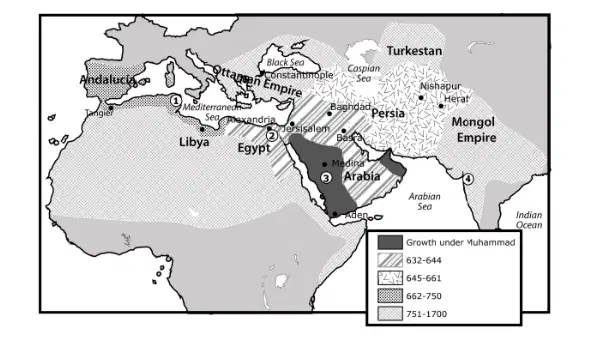
Which number on the map is the Islamic holy city of Mecca?
a)
1
b)
2
c)
3
d)
4
e)
5
24.
One result of Mongol expansion across Eurasia during the Middle Ages was -
a)
a revival of art and literature.
b)
a birth of new religious influences.
c)
a chaotic, unstable political climate.
d)
a vast, unified empire of many cultures.
25.
What factor contributed to favorable interactions among Muslim, Jewish, and Christian societies in Europe during the Middle Ages?
a)
A common written language
b)
A decline in farming production
c)
A mutual desire for profitable trade
d)
A religious expectation to recruit converts
26.
One factor that shaped the practice of slavery in the Islamic world was -
a)
the prohibition of enslaving fellow Muslims.
b)
the need for manual labor on Arabian farms.
c)
the Jewish tradition of freeing injured enslaved people.
d)
the construction of trading centers for Bedouin caravans.
27.
One factor that favored the spread of Islam to West Africa was -
a)
trade along gold-salt routes.
b)
Tang control of the Silk Road.
c)
the vast expanse of the Sahara.
d)
the use of Arabic in the Qur'an.
28.
In what way did the spread of the Black Death change the manorial system in Europe?
a)
The death of many knights led to an end of feudal warfare.
b)
Fear of the disease led many to stop attending Church services.
c)
Monarchs were blamed for spreading the disease and attacked.
d)
Population loss allowed peasants to leave the manor to seek jobs.
29.
Which set of accomplishments occurred during the Song dynasty of China?
a)
Magnetic compass, Paper money, Movable-type printing
b)
Tea cultivation, Algebra, Geometric mosaics
30.
One impact on Asia of the Tang dynasty reunifying China was —
a)
the collapse of Mongol rule in East Asia
b)
the spread of Buddhism to Japan and Korea
c)
the closing of the Silk Road to European traders
d)
the diffusion of Mandarin to Korea and Vietnam
31.
How did the revival of Confucian teachings by Tang leaders in China affect women?
a)
Women served as prominent scholars in Chinese universities.
b)
Women gained new opportunities by passing the civil service exams.
c)
Women lost social status evidenced by the practice of foot binding.
d)
Women gained respect as teachers for the civil service examinations.
32.
The spread of Islam brought political changes to Southwest Asia by —
a)
establishing tribute states in the areas conquered by the Muslim armies
b)
building libraries, hospitals and universities in large cities such as Alexandria
c)
converting Arabs, Christians, Persians, and Jews to Islam to avoid paying taxes
d)
unifying North Africa, Arabia, Persia and Asia Minor under a centralized authority
33.
How were the advances of the Muslim world preserved for future generations?
a)
Scribes and monks recorded and saved multiple copies of the information.
b)
Christian scholars traveled to Islamic universities to study the information.
c)
Libraries and institutions such as the House of Wisdom stored information.
d)
Nomadic Arab tribes carried the information with them on various conquests.
34.
In the fifteenth century, the Ming dynasty excelled at —
a)
mining
b)
weaponry
c)
shipbuilding
d)
clock making
35.
One result of Mongol expansion across Eurasia during the Middle Ages was —
a)
a revival of art and literature
b)
. a birth of new religious inuences
c)
a chaotic, unstable political climate
d)
a vast, unified empire of many cultures
36.
Which of the following best summarizes the effects of Mongol invasions on the
Islamic world?
a)
Mongols destroyed the Islamic faith while they controlled the Islamic world, but were soon destroyed themselves by the rise of the Ottoman Turks.
b)
Mongols captured Baghdad and ended Seljuk Turk rule. Their control fell apart because they could not rule the distant region, allowing the Ottoman Turks to come to power.
c)
Mongols controlled much of the Islamic region and were converted to Islam while they were in power. They left because the Seljuk Turks became powerful.
d)
Mongols were more interested in India and the spice trade than in the Islamic world, so they left Baghdad and moved eastward to control South Asia.
37.
One contribution of Muslim scholarship in Spain to the intellectual life of Europe was —
a)
the introduction of a movable-type printing press
b)
the creation of a uni¬ed body of Islamic and Christian law
c)
the and translation of Greek and Roman texts
d)
the development of the Cyrillic alphabet for Slavic languages
38.
How did Muslim expansion into India differ from expansion across North Africa?
a)
Islam banned household and ¬eld slavery in North African societies.
b)
Islam recruited popular Hindu leaders to rule over local government.
c)
Islam replaced the strict structure of the Hindu caste system in India.
d)
Islam coexisted separately from the Indian religion of Hinduism.
39.
One factor contributing to a golden age of Indian society during Mughal rule was —
a)
taxation on Hindu and non-Muslim pilgrims
b)
the ancient language of Sanskrit
c)
invasions by Turkish warlords from Central Asia
d)
religious toleration for Hindus and non-Muslims
40.
One factor that shaped the practice of slavery in the Islamic world was —
a)
the prohibition of enslaving fellow Muslims
b)
the need for manual labor on Arabian farms
c)
the Jewish tradition of freeing injured enslaved people
d)
the construction of trading centers for Bedouin caravans
41.
One factor that favored the spread of Islam to West Africa was —
a)
trade along gold-salt routes
b)
. Tang control of the Silk Road
c)
the vast expanse of the Sahara
d)
the use of Arabic in the Qur’an
42.
One result of Mongol domination of Russian principalitites was —
a)
the birth of a golden age of art and literature in Kiev
b)
the rise of the princes of Moscow as a regional power
c)
the decline of the influence the Russian Orthodox Church
d)
the collapse of Islamic control of Baghdad and Afghanistan
43.
One result of the Mongol conquests of the Islamic heartland includes the —
a)
collapse of Constantinople
b)
spread of serfdom to the Middle East
c)
declining influence of Islam within Arabia
d)
rise of the Ottoman Turks as a regional power
44.
The language of Swahili is a mixture of Bantu and Arabic languages spoken by people
living along the east coast of Africa. This development was largely a result of —
a)
the geographic barrier of the Sahara
b)
the growing influence of Islamic traders
c)
the diffusion of Islam along gold-salt routes
d)
the declining power of sub-Saharan kingdoms
45.
Which of the following inventions were first introduced by Tang and Song China?
Select TWO correct answers.
a)
gunpowder
b)
porcelain
c)
the abacus
d)
the compass
e)
the lateen sail
46.
What social contribution did the Moors make to Spanish society prior to 1450?
a)
Islamic scholars made advances in medicine, science, and technology and preserved knowledge from the Greeks and Romans.
b)
Islamic scholars did not share their knowledge and isolated themselves from the Spanish.
c)
The population of Islamic scholars was negatively impacted by the Black Death and knowledge was lost.
d)
Islamic scholars persecuted all other religions in Spain, creating a totalitarian form of government.
47.
What is the historical signi¬cance of Justinian's Law Code?
a)
It served as the ¬rst written legal constitution.
b)
It promoted the idea of the king as the primary legal authority.
c)
It introduced the ideas of legalism and retribution for crimes.
d)
It preserved the Roman legal customs for later Western civilizations.
48.
Which of the following developed in the Islamic world and spread to Europe?
a)
Calendar
b)
Geometry
c)
Metric system
d)
Medical science
49.
Which social group of European feudal society showed to a lord by
providing military service?
a)
Artisans
b)
Kings
c)
Serfs
d)
Vassals
50.
Under the manorial system, nobles were required to provide serfs with which of the
following?
a)
Food
b)
Education
c)
Protection
d)
Livable wage
51.
The compass was invented in China during the Song dynasty, 960 to 1279. More
than 400 years later it was used by European explorers to —
a)
navigate the oceans
b)
observe the moon
c)
interpret mathematical equations
d)
build elaborate palaces
52.
The of the Frankish kingdom by Clovis likely contributed to —
a)
the use of Latin in Roman Catholic services
b)
the decline of scholarship and formal education
c)
the abdication of the last western Roman emperor
d)
the increasing role of Roman Catholicism in Europe
53.
Which factor contributed to the division of Western and Eastern Churches into
Roman Catholicism and Eastern Orthodoxy?
a)
Declining interest in the Crusades
b)
Growing power of Islamic caliphates
c)
Opposing opinions on Christian theology
d)
dwindling trade across European kingdoms
54.
A vassal is expected to show to a lord by —
a)
farming a plot of land
b)
collecting tolls and taxes
c)
providing military service
d)
arranging loans at no interest
55.
One way monasteries contributed to the spread of Christianity in Europe was by —
a)
being outposts for missionary work
b)
copying ancient manuscripts by hand
c)
cataloging different varieties of plants
d)
teaching farming techniques to villagers
56.
Christianity and Islam were important in the of Europe
following the collapse of the Roman Empire because both —
a)
commanded believers to act morally
b)
served as unifying inuences on culture
c)
attracted many nonbelievers to convert
d)
provided a model for political organization
57.
A common belief held by Jews, Christians and Muslims is the idea that —
a)
only one God should be worshiped
b)
a chosen group will receive salvation
c)
any individual can be a religious leader
d)
the souls of believers are reincarnated
58.
For early Christians following Church teachings involved observance of —
a)
golden rules
b)
pillars of faith
c)
eightfold rituals
d)
holy sacraments
59.
Religious Muslims practice their faith by to the —
a)
Five Pillars
b)
Golden Rule
c)
Eightfold Path
d)
Gospel teachings
60.
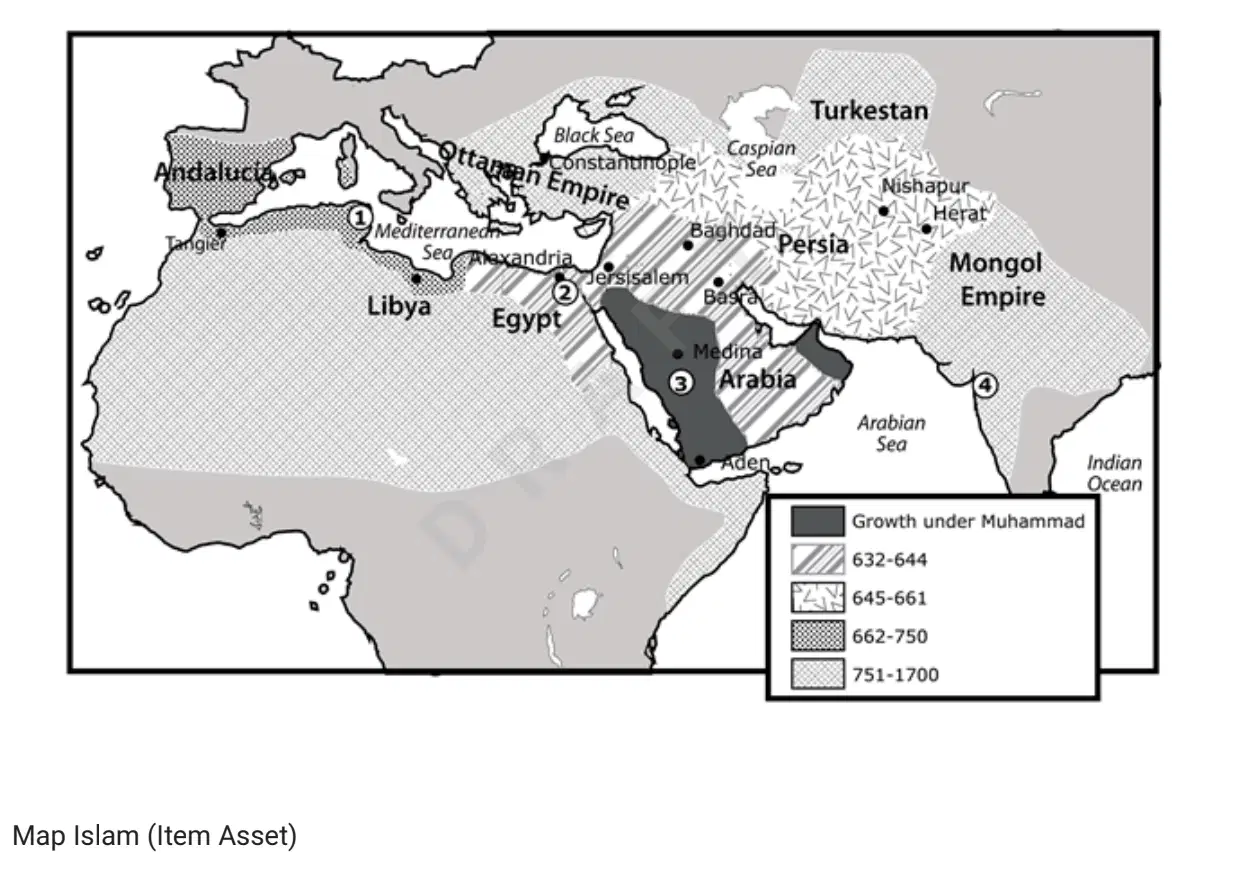
Which number on the map is the Islamic holy city of Mecca?
a)
1
b)
2
c)
3
d)
4
61.
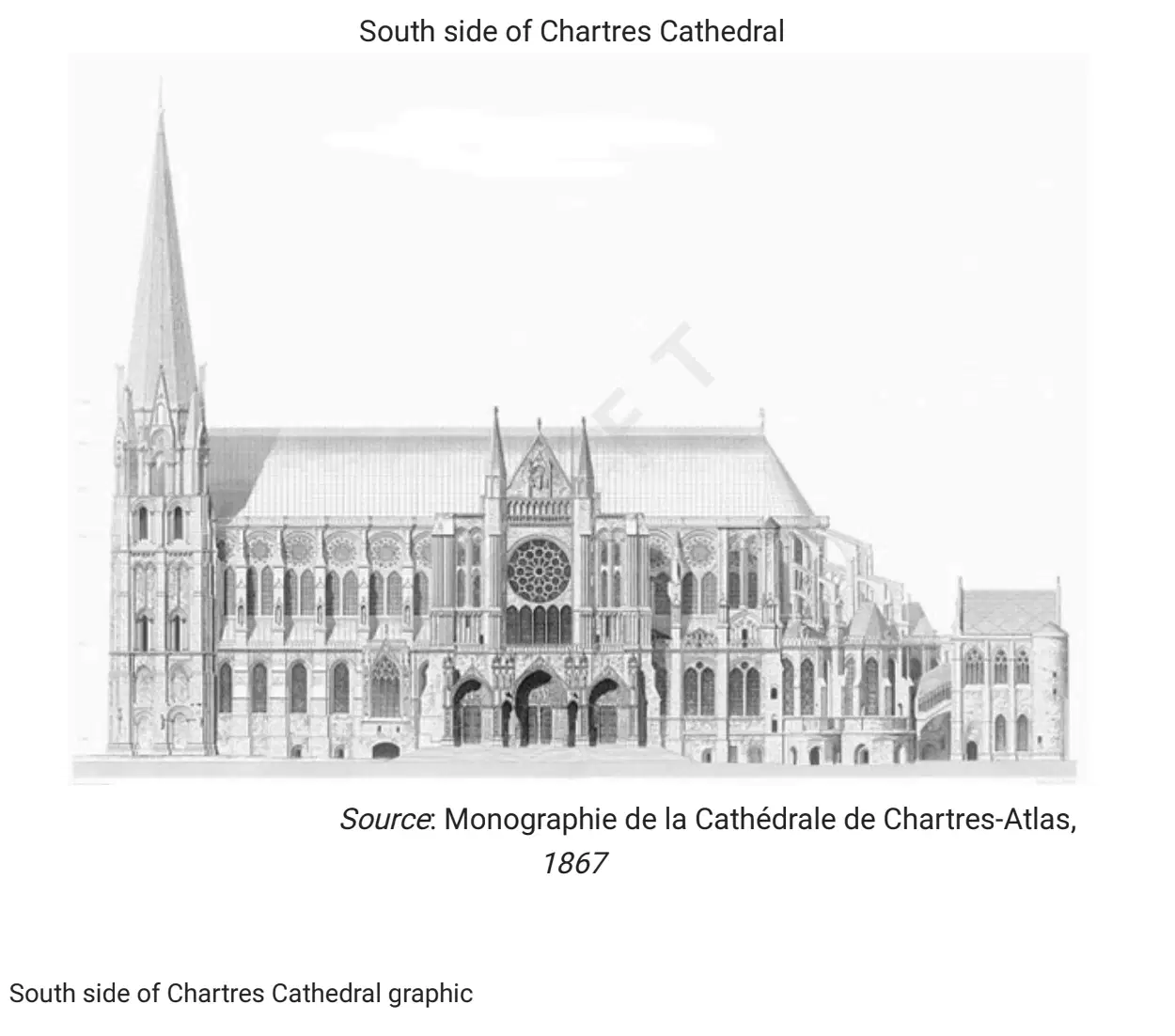
The architecture style of the pictured building reects the influence of the Catholic Church by —
a)
keeping the inner space dark in solemn reverence
b)
creating an impression of reaching towards heaven
c)
using the ceilings for mosaics of Biblical stories
d)
reviving the Greek golden ratio of balanced proportions
62.
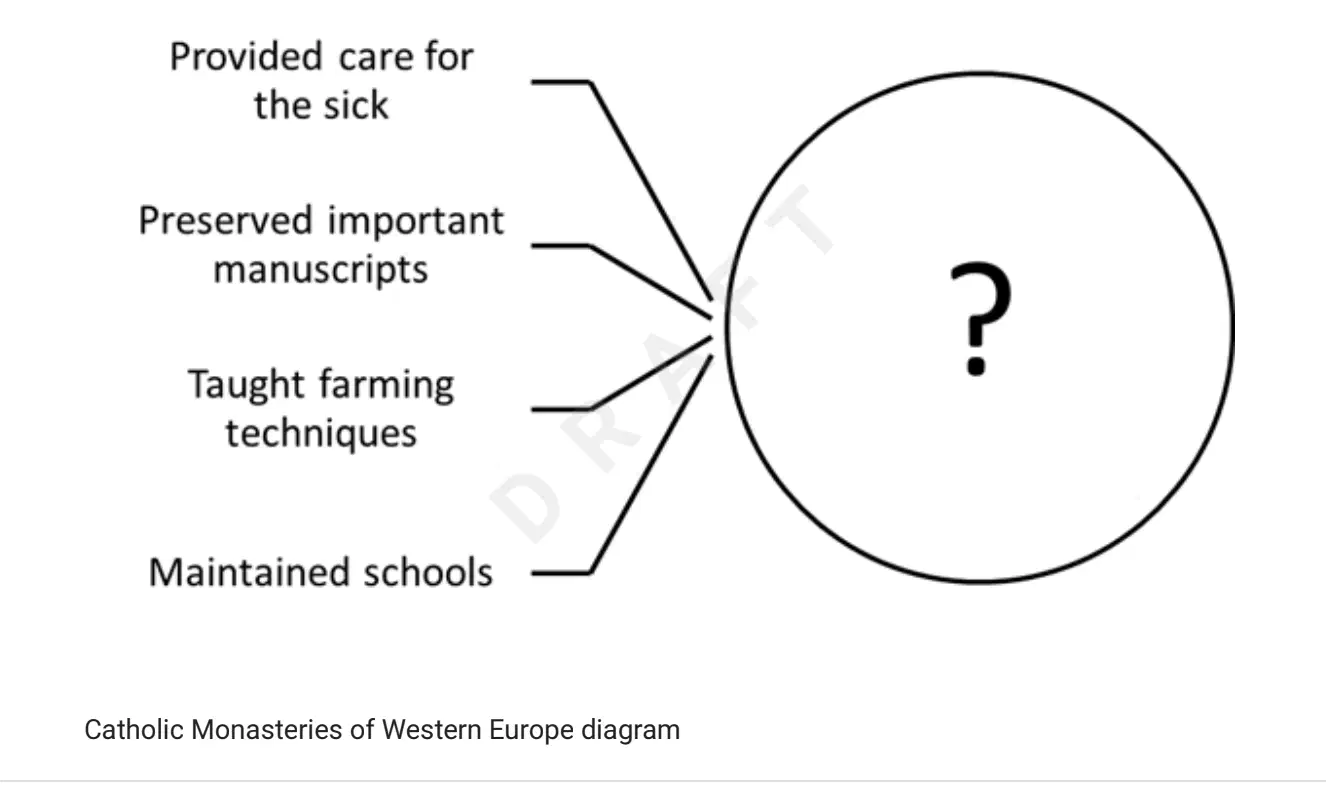
Which of the following best completes the diagram?
a)
Manor Lords of European Feudal States
b)
Serfdom in the European Manor System
c)
Catholic Monasteries of Western Europe
d)
Medieval Universities in Italian City-States
63.
Which objective is a primary goal of Confucianism?
a)
F. Separate society into distinct social classes
b)
G. Restore social order through proper behavior
c)
H. Gain salvation through belief in a personal god
d)
J. Achieve a higher spiritual state through self-sacri¬ce
64.
Which of the following best explains how river valley civilizations the
development of Classical civilizations?
a)
The belief in monotheism was by the river valley civilizations.
b)
The idea of religious freedom was by the river valley civilizations.
c)
The tradition of hunting and gathering was introduced by the river valley civilizations.
d)
The foundations of political centralization were established by the river valley civilizations.
65.
Which pair of Greek mathematicians made great in geometry?
a)
Euclid and Pythagoras
b)
Diogenes and Eratosthenes
c)
Aristotle and Zeno
d)
Archimedes and Hipparchus
66.
What Roman legal concept is in legal proceedings in the United States
today?
a)
The burden of proof is on the accused.
b)
The accused has a right to legal counsel.
c)
The state uses religious leaders as judges.
d)
The accused is innocent until proven guilty.
67.
Which type of government of early Greece often of a small group of
wealthy people in power?
a)
Oligarchy
b)
Tyranny
c)
Republic
d)
Democracy
68.
Which promoted trade and the of the Persian
Empire?
a)
Use of standardized metal coins
b)
Creation of a universal code of laws
c)
Division of the empire into administrative provinces
d)
Construction of the remarkable gardens of the palace in Babylon
69.
Which classical civilization created the decimal system and numeral writing used in
the world today?
a)
Han China
b)
Gupta India
c)
Persian Empire
d)
Classical Greece
70.
How did the Han Dynasty create a centralized government and complex
bureaucracy in China?
a)
Elected groups of twenty families were chosen to serve as advisers to the emperor.
b)
Laws were passed restricting the size of the government and the number of officials
c)
A system of civil services exams was established for the selection of government o®cials.
d)
A series of civil wars was fought and victorious generals became governors in the provinces.
71.
Why did the Mauryan Empire under the leadership of Ashoka?
a)
Ashoka passed laws that were so strict, no one dared to rebel.
b)
Ashoka divided the empire into smaller city-states ruled by his brothers and sons.
c)
Ashoka instituted a period of peace and open trade after his conversion to Buddhism.
d)
Ashoka forced many to convert to Buddhism and exiled rebellious Hindus from India.
72.
Which of the following best describes Indian culture during the rule of the Gupta
Empire?
a)
Buddhist traditions , while Hindu customs were viewed .
b)
Hindu culture with many works of art and literature being produced.
c)
Cultural pursuits were so people could spend their time in meditation.
d)
Indian scholars were persecuted by political leaders who felt threatened by their ideas.
73.
Zoroastrianism is an early monotheistic religion from which classical
civilization?
a)
Han China
b)
Persia
c)
Greece
d)
Gupta India
74.
Which of the following is a idea of Hinduism?
a)
Followers should worship one god.
b)
All believers are equal in the eyes of God.
c)
Society is organized into rigid social classes.
d)
Salvation is by following strict dietary laws.
75.
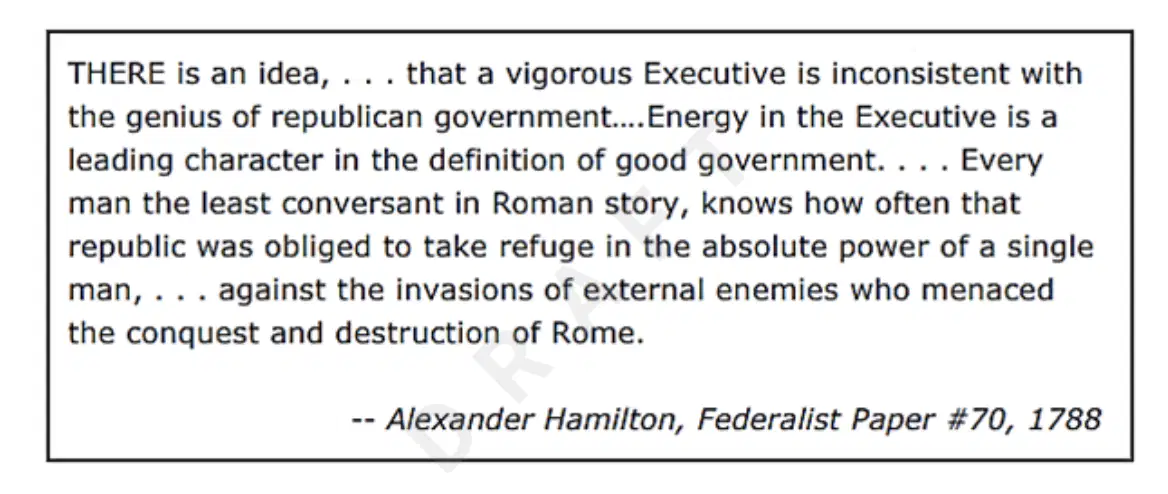
Based on the information in the excerpt, which of the
Roman republic is in the U.S. government?
a)
Judges
b)
A president
c)
Legal codes
d)
Legislative bodies
76.
Which of the following best describes the factors that the collapse
of the Roman Empire and Han China?
a)
Internal rebellions led by peasant groups eventually in the overthrow of both empires.
b)
Corruption in the government, social and eventually doomed both empires.
c)
A failure to along with high tariffs on trade in a trade system and eventual of the two empires.
d)
Adoption of new religious practices among the political leaders created and eventual in the empires.
77.
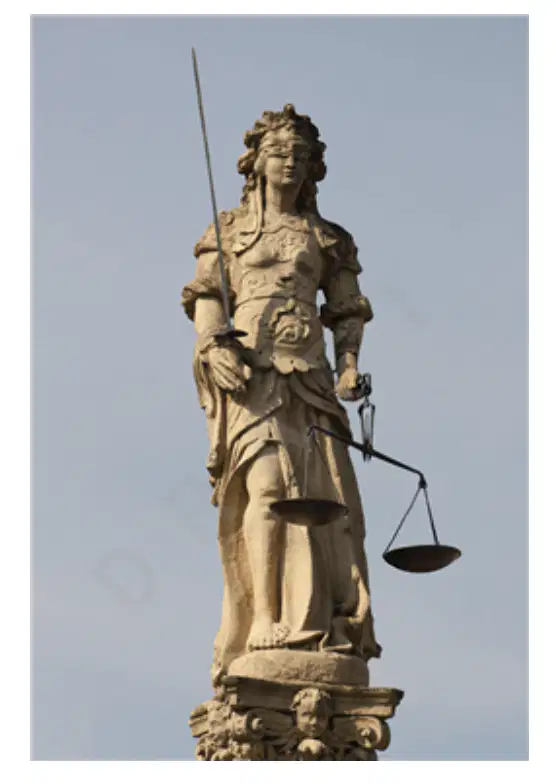
Statues such as this are commonly found in many countries which
their cultural roots to western civilization because it reects the
a)
tradition of laws and legal principles as the basis of social order
b)
of fairness in western cultural sporting competitions
c)
polytheist teachings that western religious traditions
d)
importance western culture places on the equality of men and women
78.
How did Judaism differ from many other early religions the classical
period?
a)
Judaism strict dietary laws.
b)
Judaism a belief in one God.
c)
Judaism on the interpretations of religious scholars.
d)
Judaism encouraged missionaries to convert non-believers.
79.
Which of the following was a political of many civilizations during
the Classical Era (500BC-600AD)?
a)
Voting rights were given to more and more people.
b)
Representative governments evolved throughout the world.
c)
Small feudal kingdoms spread across Eurasia.
d)
Complex empires with bureaucracies developed
80.
● Two consuls ruled as the chief leaders in all civil and military matters
● Praetors oversaw civil and criminal courts
● The Senate debated and advised on new laws
● The Assemblies could vote for new laws
The characteristics listed above best reflect the efforts of the Roman
Republic
to
a)
reduce tension between plebeians and patricians
b)
maintain effective borders against barbarian invasion
c)
separate power among different government branches
d)
divide power between provincial and central authorities
81.
Which of the following is one change that directly resulted from the development of farming approximately 10,000 years ago?
a)
It led to the production of stone tools.
b)
It led to the creation of settled communities.
c)
It led to the expansion of political rights for women.
d)
It led to the growth in the number of nomadic groups
82.
Which ancient civilization was the first to use city planning and sewer systems?
a)
China
b)
Egypt
c)
Indus Valley
d)
Mesopotamia
83.
Which river valley civilization is considered to have been the first to use geometry and the first to create a solar calendar?
a)
China
b)
Egypt
c)
Indus Valley
d)
Mesopotamia
84.
Why was Egypt called the "Gift of the Nile"?
a)
Irrigation from the Nile provided for farming in a desert region.
b)
Protection from the Nile kept invaders from entering from the north.
c)
Fish and wildlife from the Nile were traded with neighboring civilizations.
d)
Egyptians believed the gods had placed the Nile in Egypt as a sign of supremacy.
85.
The physical geography of China influenced development in the Huang He valley because —
a)
waterfalls on the river made it difficult to navigate affecting trade in the area
b)
earthquakes in the region caused destruction creating a need for stable government
c)
large deposits of iron ore attracted invaders to the region resulting in constant warfare
d)
mountains to the west of the river valley protected the region creating cultural isolation
86.
Which example demonstrates the process of technological diffusion?
a)
The Sumerians created a number system based on 60.
b)
The Indus valley civilization built cities in a grid fashion.
c)
The Chinese introduced coined money into their economy.
d)
The Egyptians used chariots to drive the Hyksos from power.
87.
Hammurabi’s Code became a model for later law codes because it introduced the idea of —
a)
governments having a judicial branch
b)
equal punishments for all social classes
c)
consistency and predictability in the law
d)
laws needing to be interpreted by judges
88.
The use of pottery and textiles are related to which characteristic of early civilizations?
a)
Class structure
b)
Specialized workers
c)
Complex institutions
d)
Advanced recordkeeping
89.
The growth of trade and commerce within early settlements contributed to the emergence of –
a)
government
b)
herding
c)
poetry
d)
temples
90.

Which letter indicates the area of Mesopotamia?
a)
A
b)
B
c)
C
d)
D
91.

a)
North America
b)
South America
c)
Asia
d)
Africa
92.

a)
Europe
b)
Asia
c)
Africa
d)
Australia
93.

a)
Pacific Ocean
b)
Atlantic Ocean
c)
Arctic Ocean
d)
Indian Ocean
94.

a)
Asia
b)
Africa
c)
Australia
d)
South America
95.

a)
North America
b)
South America
c)
Antarctica
d)
Asia
96.

a)
Atlantic Ocean
b)
Arctic Ocean
c)
Pacific Ocean
d)
Indian Ocean
97.

a)
South America
b)
Asia
c)
Africa
d)
Europe
98.

a)
Arctic Ocean
b)
Indian Ocean
c)
Atlantic Ocean
d)
Pacific Ocean
99.

a)
Asia
b)
North America
c)
Europe
d)
Africa
100.

a)
Indian Ocean
b)
Pacific Ocean
c)
Atlantic Ocean
d)
Arctic Ocean
100 %

