
Font size
 Worksheets
2024 ESL Factors Affecting Reaction Rates
Total questions: 55
Worksheet time: 1hrs 5mins
Why does a higher concentration increase the rate of reaction?
it increases the amount of reactants
it lowers the activation energy
it increases the energy of particle collisions
it increases the frequency of particle collisions
Increasing the temperature gives particles more __________.
Time
Energy
Space
Frequency
Activation energy is minimum amount of energy needed for the reactions to begin.
Adding a catalyst ___________ the activation energy.
Raises
Lowers
Doesn't affect
Inreases

Powdered sugar has a greater ______ _____ than a solid cube of
sugar.
Surface Area
Catalyst
Temperature

Which group of particles shows that increasing surface area increases collisions among particles?
Left side
Right side
Cannot be determined by either picture
How does increasing pressure affect the rate of reaction in gases?
It changes the state of the reactants
It increases the rate of reaction by increasing collision frequency
It has no effect on the rate of reaction
It decreases the rate of reaction
Which of the following will decrease the rate of a chemical reaction?
Adding a catalyst
Increasing the surface area of reactants
Increasing the concentration of reactants
Decreasing the temperature
Select FOUR factors that affect the rate of reaction:
temperature
concentration
surface area
volume
catalyst
Select ALL factors that increase the rate of a reaction?
increasing temperature
increasing concentration
increasing surface area
increasing particle size
adding a catalyst
As the frequency of ______________ increases, the rate of reaction increases.
Time
Reactions
Collisions
Reactants
Which of the following will slow down a chemical reaction?
Lower concentration
Increase temperature
Increase particle size
Add a catalyst
First lets review!!
What are some signes that a chemical reaction has taken place?
change in shape
bubbles of gas appear
melting
dissolving
In an endothermic reaction, energy is
absorbed
released
If a chemical reaction is ENDOTHERMIC, the temperature would...
stay the same
increase
decrease
In an exothermic reaction, energy is
absorbed
released
If a chemical reaction is EXOTHERMIC, the temperature would...
stay the same
increase
decrease

_____ reactions usually feel cool
endothermic reaction
exothermic reaction

Rocket launch
endothermic
exothermic
Which of the following is an example of an exothermic reaction?
A) Photosynthesis
B) Melting ice
C) Burning wood
D) Dissolving salt in water
How many Hydrogens are in 2H2O?
2
4
6
1
How many Oxygens are in 6H2O?
2
12
6
How many Carbons are in 3CO2?
3
6
2
Balanced or Not?
H2 + Cl2 ---> 2HCl
Balanced
Unbalanced

What does the following represent?
coefficient
subscript
elements
What is the part of the chemical equation in green called?
Fe + S --> FeS
products
reactants
yield
chemical formula
How many total atoms are in H2SO4?
3
5
6
7
Coefficients in chemical formulas...
Multiply just the first atom
Add to the subscripts at the end of the molecule
Multiply elements without subscripts
Multiply EVERYTHING!
How can chemical reactions occur?
Only quickly
Only slowly
Quickly or slowly
Neither quickly nor slowly
Law of conservation of mass states the amounts of atoms in the reactants and the products...
Increase
Decrease
Stay the same
No correct answer
If a reaction starts with a total 75 g of reactants it should produce
a total of 40 g of products
a total of 75 g of products
a total of 180 g of products
No correct answer
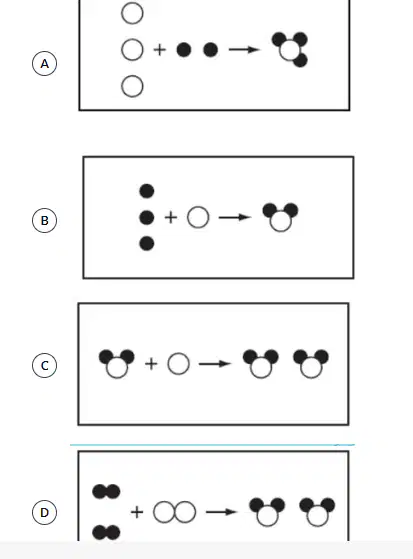
Which shows the law of conservation of mass?
a
b
c
d
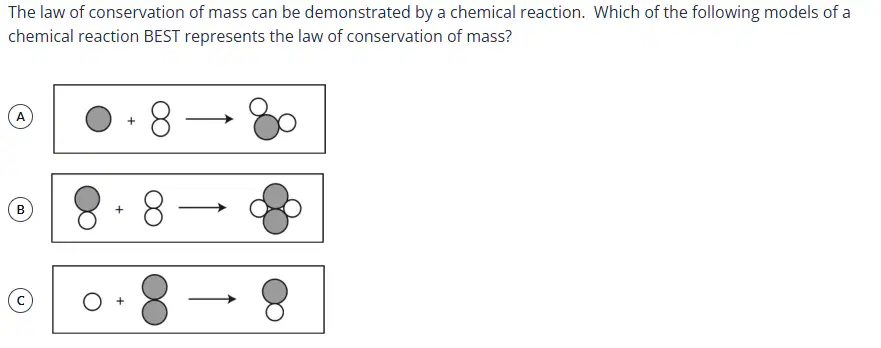
a
b
c
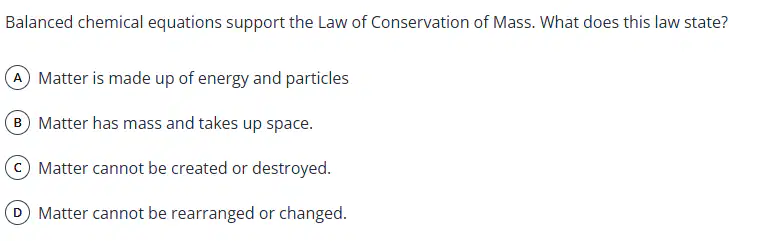
a
b
c
d
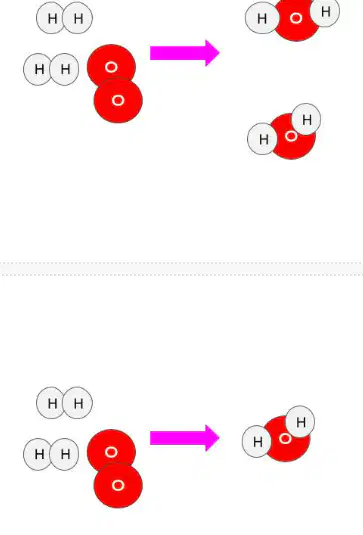
Which is balanced and shows the law of conservation of mass?
top
bottom
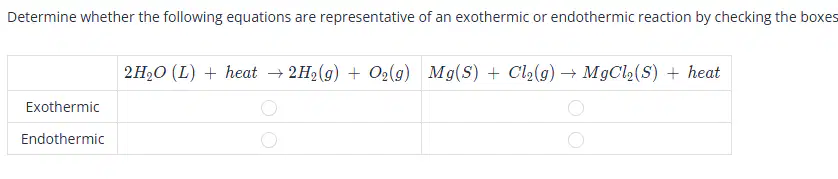
choose 2 answers
The left equation is endothermic
The right equation is endothermic
The left equation is exothermic
The right equation is exothermic

endothermic examples
exothermic examples
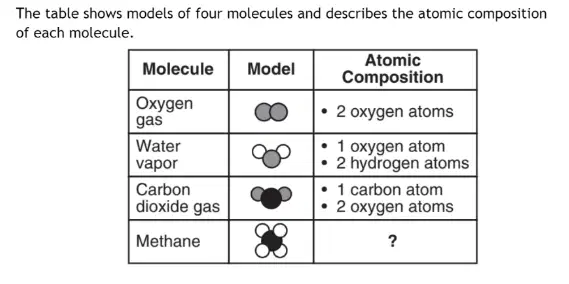
4 oxygen atoms
1 carbon atom
1 oxygen atom
4 hydrogen atoms
1 hydrogen atom
4 oxygen atoms
1 carbon atom
4 hydrogen atoms
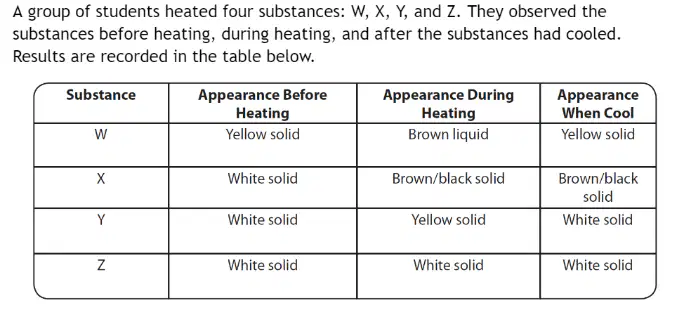
Which substance underwent a chemical reaction?
w
x
y
z
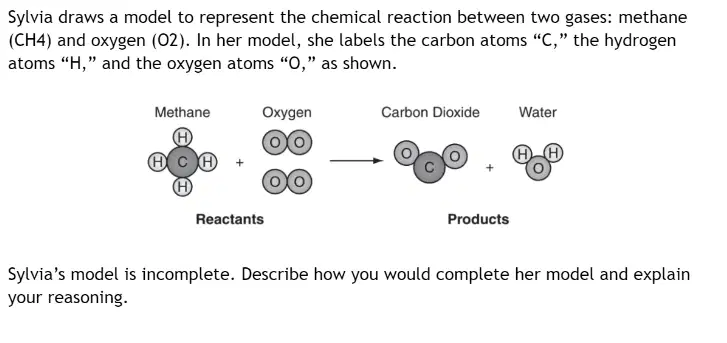
add 1 more carbon dioxide compound
add 2 more water molecules
add 2 more carbon dioxide compounds
add 1 more water molecule
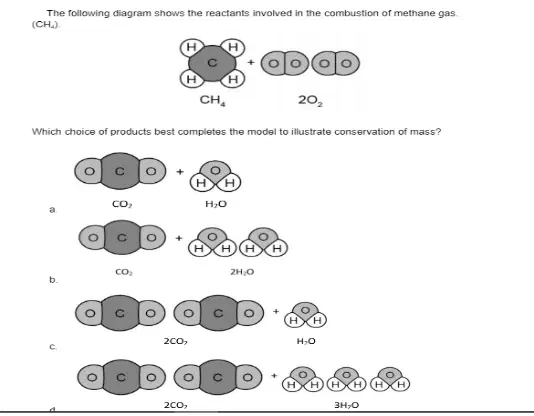
a
b
c
d
Fe + H2O → Fe3O4 + H2
Zn + HCl → ZnCl2 + H2
O2(g) + 2 H2 (g) → 2 H2O (g) + Energy
endothermic
exothermic
6 CO2+ 6 H2O + Energy → C6H12O6 + 6 O2
endothermic reaction
exothermic reaction

The Y-axis shows reaction rates. Which graph has a higher rxn rate?
blue line
red line

