
NEW
Font size
 Worksheets
Biology HN SEMSTER 1 Review
Total questions: 60
Worksheet time: 38mins
Howard and Leah conducted an experiment to test their hypothesis that male eggs of the American alligator only hatch at high temperatures. They concluded very high temperatures killed unhatched alligators. What comment(s) would you make to Howard and Leah regarding their conclusions?
Their conclusion is supported by the data.
They should reject their hypothesis.
They should accept their hypothesis.
They did not sample very many eggs.
In terms of the scientific method, the purpose of an experiment is to:
Form a hypothesis.
Test a hypothesis.
Form a conclusion.
Develop data.
By the end of prophase, all of the following has occurred EXCEPT:
The nuclear membrane has broken down.
Centrioles and spindle fibers have appeared.
DNA has become more tightly coiled into rod-shaped structures.
Chromosomes have lined up in the middle of the cell.
Anything to which an organism reacts is a:
Response.
Resolution.
Irritability.
Stimulus.
If a substance consists of only one kind of atom, it is a:
Isotope.
Element.
Ion.
Neutrino.
A covalent bond is formed by:
Sharing electrons.
Transferring electrons.
Losing electrons.
Gaining electrons.
The total number of protons and neutrons determines an atom's:
Atomic mass.
Atomic number.
Order.
Charge.
An atom that gains one electron from another atom has a _______ charge.
1+
1-
2+
2-
A biological molecule that acts as an acid will do which of the following in water?
Donate a hydroxide ion to the solution.
Remove hydrogen ions from the solution.
Donate a proton (H⁺) to the solution.
Remain unchanged.
Polysaccharides are split apart to form monosaccharides in a reaction known as:
Hydrolysis.
Dehydration synthesis.
Monomerization.
Polymerization.
Among the following, the term that includes the other three is:
5-carbon sugar.
Nucleotide.
Nitrogenous base.
Phosphate group.
Which of the following solutions would have the highest concentration of hydroxide ions (OH⁻)?
Pure water (pH 7).
Lemon juice (pH 2).
Blood (pH 7.4).
Household ammonia (pH 11).
Many lipids are formed by the attachment of three:
Fatty acids to a glycerol.
Hydroxyl groups to a glycerol.
Cholesterols.
Fatty acids to carboxyl groups.
Proteins, unlike carbohydrates, contain:
Nitrogen.
Oxygen.
Approximately how much energy is transferred from one trophic level to the next in a typical energy pyramid?
100%.
50%.
25%.
10%.
Cellular respiration is an example of _____ energy.
Exergonic.
Endergonic.
Potential.
Kinetic.
The maximum size of a cell is limited by:
The number of organelles it contains.
The surface area available for exchange with its environment.
The materials it needs to build proteins.
The space required by its nucleus.
Different amino acids contain a different:
Amino group.
R group.
Carboxyl group.
H group.
How many different amino acids are there?
4.
20.
64.
100.
If a cell has 8 chromosomes, how many chromosomes will it have after interphase?
4.
6.
8.
16.
Which of the following factors is most responsible for limiting the size of cells?
The availability of nutrients in the environment.
The surface area-to-volume ratio.
What property of water allows it to resist changes in temperature, making it important for maintaining homeostasis?
A. Cohesion.
B. Adhesion.
C. High specific heat.
D. Solubility.
Which part of the cell membrane is responsible for its selective permeability?
A. The lipid bilayer.
B. The carbohydrate chains.
C. The integral proteins.
D. The cholesterol molecules.
What would happen to a red blood cell placed in a hypotonic solution?
A. It would shrivel due to water loss.
B. It would swell and possibly burst.
C. It would remain unchanged.
D. It would lose solutes to the environment.
Which of the following best describes the relationship between photosynthesis and cellular respiration?
A. Photosynthesis is an energy-releasing process, while cellular respiration is energy-storing.
B. The products of photosynthesis serve as the reactants for cellular respiration.
C. Both processes occur in the chloroplast.
D. Photosynthesis and cellular respiration are completely unrelated.
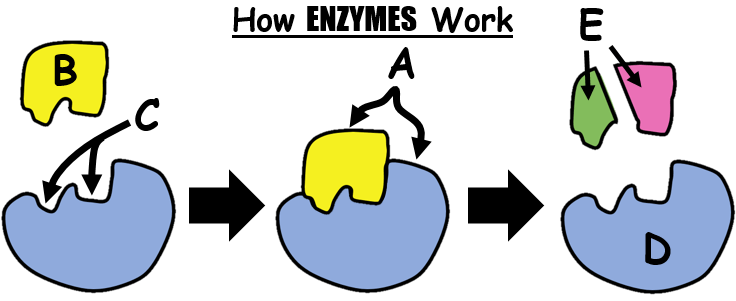
Why do enzymes only catalyze specific reactions?
A. Because their active site has a specific shape that fits only one substrate.
B. Because they are consumed in the reaction.
C. Because they require high temperatures to function.
D. Because they bind to any molecule with a charge.
What role do decomposers play in the flow of energy in ecosystems?
A. They produce energy-rich molecules.
B. They recycle nutrients back into the ecosystem.
Which phase of the cell cycle ensures that DNA is correctly replicated?
G1 phase.
S phase.
G2 phase.
M phase.
During osmosis, water moves across a membrane toward the solution with:
Lower solute concentration.
Higher solute concentration.
Equal solute concentration.
No solute concentration.
Why is carbon essential to all living things?
It can form four covalent bonds, allowing for complex molecules.
It is the most abundant element in the atmosphere.
It can act as a solvent for biological reactions.
It directly provides energy to cells.
Which of the following processes directly converts solar energy into chemical energy?
Cellular respiration.
Fermentation.
Photosynthesis.
Decomposition.
What is the primary function of ribosomes in a cell?
To store genetic material.
To produce proteins.
To break down waste products.
To generate ATP.
How does ATP release energy to drive cellular processes?
By breaking its phosphate bonds.
By forming new phosphate bonds.
By being stored in the nucleus.
By absorbing water molecules.
What would happen to an ecosystem if producers were removed?
Decomposers would thrive.
Consumers would eventually run out of energy sources.
Energy transfer would increase due to fewer trophic levels.
Biodiversity would increase.
Which type of macromolecule is responsible for speeding up chemical reactions in cells?
Lipids.
Proteins.
Nucleic acids.
Carbohydrates.
Which cellular organelle is responsible for packaging and distributing proteins?
Mitochondria.
Nucleus.
Golgi apparatus.
Lysosome.
What would happen if the DNA sequence in a gene is altered?
The resulting protein might function differently or not at all.
The organism would immediately die.
The ribosome would stop working.
The amino acid sequence would remain unchanged.
Why is the phospholipid bilayer well-suited for forming the cell membrane?
It is rigid and impermeable to all substances.
It has hydrophobic tails and hydrophilic heads that regulate material flow.
It allows free movement of ions across the membrane.
It reacts with water to generate energy.
Which type of solution would cause a plant cell to become turgid?
Hypertonic.
Hypotonic.
What is the primary function of the lysosome?
Protein synthesis.
Digestion of macromolecules.
Energy production.
DNA replication.
Which of the following is a function of the cell membrane?
To store genetic information.
To produce energy for the cell.
To regulate the movement of substances in and out of the cell.
To synthesize proteins.
What is the role of chlorophyll in photosynthesis?
To transport water.
To absorb light energy.
To release oxygen.
To break down glucose.
Which of the following best describes an enzyme?
A nucleic acid that stores genetic information.
A protein that speeds up chemical reactions.
A lipid that stores energy.
A carbohydrate that provides structure.
A peptide bond is
the monomers of a protein
the monomer of a nucleic acid
made of BNA and RNA
the bond that holds amino acids together
What is an independent variable?
the variable that changes because another variable changes
independent variables are only found on pie charts.
a variable most often found on the y-axis
the variable the experimenter manipulates or has control over

What is the Dependent Variable?
Amount of Protein Digested
Temperature

What is the calculated scale of the X Axis if the graph is 10 x 10?
5
2
.5
1

The hydrogen atoms in water have slight _____ charges.
neutral
negative
positive

The fact that water can stick to other substances is called:
Ph
Adhesion
Cohesion
Insulation

What is the pH range of an acid?
4-6
1-7
1-6
8-14
A base in solution____
A. Neutralizes the solution
B. Produces hydrogen ions
C. Produces hydroxide ions
D. Lowers the solution's ions
E. Is where the hydrogen army stays

Which of the cells depicted in the line graph are most likely cancerous.
A
B
C
D
DNA is a recipe for your genes. What happens when your DNA is exposed to Sunlight (UV Rays)
You are blessed by zeus
You sparkle like the vampires in twilight
Which of the following are the reactants of respiration?
O2 + CO2
H2O + Glucose
Glucose + O2
H2O + CO2 + Sunlight
What is the primary role of mitochondria in a cell?
To store calcium ions.
To generate ATP through cellular respiration.
To synthesize proteins.
To detoxify harmful substances.
Which of the following is a characteristic of prokaryotic cells?
They have a complex cytoskeleton.
They contain multiple chromosomes.
They lack membrane-bound organelles.
They have a nucleus.
What is the function of the endoplasmic reticulum in a cell?
To produce lipids and proteins.
To break down cellular waste.
To store genetic information.
To transport oxygen.

