
 Worksheets
Physical Science Midterm 2024-2025
Total questions: 43
Worksheet time: 22mins
Name
Class
Date
1.

What is the independent variable in the graph below?
a)
Speed (m/s)
b)
Time (s)
2.
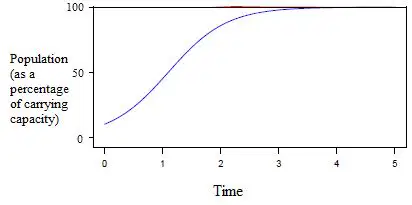
What is the dependent variable in the graph below?
a)
Population (as a % of carrying capacity)
b)
Time
3.
Two groups of students were tested to compare their speed working math problems. Each group was given the same problems. One group used calculators and the other group computed without calculators. What is the control in this experiment?
a)
Two groups of students.
b)
Speed working math problems.
c)
Each group was given the same problems.
d)
Group with calculators.
e)
Group without calculators.
4.
An experiment was performed to determine how the amount of coffee grounds could affect the taste of coffee. The same kind of coffee, the same coffee maker, the same amount and type of water, the same perking time, and the same electrical sources were used. The statement saying, "the same coffee maker " is an example of
a)
the independent variable.
b)
the dependent variable.
c)
a constant.
d)
the control.
5.
The graph above represents an
a)
endothermic change because as time goes by temperature increases.
b)
endothermic change because as time goes by temperature decreases.
c)
exothermic change because as time goes by temperature increases.
d)
exothermic change because as time goes by temperature decreases.
6.
Vaporization (boiling) is occurring at
a)
0 C.
b)
50 C.
c)
100 C.
7.
In this type of phase change, particles are
a)
speeding up
b)
slowing down
8.
The graph above represents an
a)
endothermic change because as time goes by temperature increases.
b)
endothermic change because as time goes by temperature decreases.
c)
exothermic change because as time goes by temperature increases.
d)
exothermic change because as time goes by temperature decreases.
9.
In this type of phase change, particles are
a)
moving closer toghter
b)
spreading further apart
10.
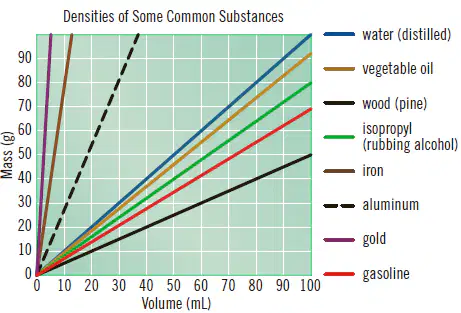
According to the graph, which item would most likely float on top of water?(less dense)
a)
Gold
b)
Aluminum
c)
Iron
d)
Gasoline
11.
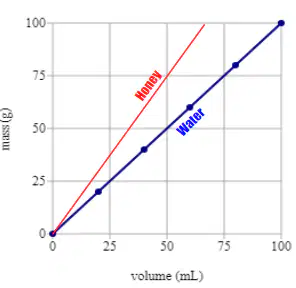
According to the graph which object is more dense?
a)
Honey
b)
Water
12.
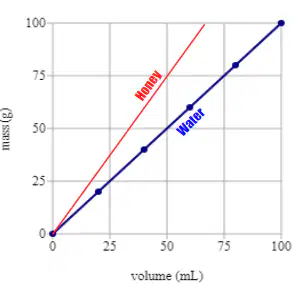
If the mass of water is 50 g, what is it's volume?
a)
0 mL
b)
25 mL
c)
50 mL
d)
75 mL
13.
Using your answer from the calculation above; if you were given a liquid with a density of 1g/mL, would you expect sulfur to sink or float in that liquid?
a)
Sink
b)
Float
14.
An example of an element is
a)
Italian Dressing
b)
Iron (Fe)
c)
Water (H2O)
d)
Glucose (C6H12O6)
15.
Matter is anything that has ______ and takes up ______
a)
Mass; Space
b)
Elements; Compounds
c)
Homogeneous; Heterogeneous
d)
Weight; Atoms
16.

Is the following image homogeneous or heterogeneous?
a)
Homogeneous
b)
Heterogeneous
17.
The term homogeneous means that
a)
The mixture is mixed evenly; there are no chunks
b)
The mixture is not mixed evenly; there are chunks
c)
It is an element which is a pure substance
d)
It is a compound which is a pure substance
18.

The model below represents the atom
a)
Flourine
b)
Chlorine
c)
Argon
d)
Bromine
19.
Barium (Ba) has ___________ protons. (use your periodic table)
a)
56
b)
137
c)
81
20.
Argon (Ar) has ____________ neutrons. (use your periodic table)
a)
18
b)
39.9
c)
40
d)
22
21.
Assuming Calcium (Ca) is neutral, how many electrons does it have? (use your periodic table)
a)
20
b)
40
c)
60
22.
An element has 27 protons. Which element is it?
a)
Aluminum
b)
Cobalt
c)
Silicon
d)
Manganese
23.

The model below represents which element?
a)
Magnesium
b)
Sodium
c)
Vanadium
d)
Potassium
24.
According to the periodic table above, Sodium contains _________ neutrons.
a)
15
b)
12
c)
22.990
25.
According to the periodic table above, Carbon contains _________ protons.
a)
14
b)
6
c)
12.0107
26.
According to the periodic table above, a neutral atom of Argon contains _________ electrons.
a)
18
b)
22
c)
39.948
27.
On the periodic table above, Hydrogen, Lithium, Sodium, and Potassium all belong to the same group (family) because
a)
they are all metals.
b)
they are all nonmetals.
c)
they have the same number of protons.
d)
they have the same number of valence electrons.
28.
The element calcium is located in period (ROW) 4. How many energy levels does it have?
a)
1
b)
2
c)
3
d)
4
29.

Choose the correct Bohr Model for Aluminum
a)
A
b)
B
c)
C
30.
As you move down the periodic table and to the left, which of the following increases? Select all that apply.
a)
Atomic Radius
b)
Atomic Mass
c)
Ionization Energy
31.
For a nonmetal, reactivity increases as you move ______ and to the _____.
a)
Up, right
b)
Down, right
c)
Up, left
d)
Down, left
32.
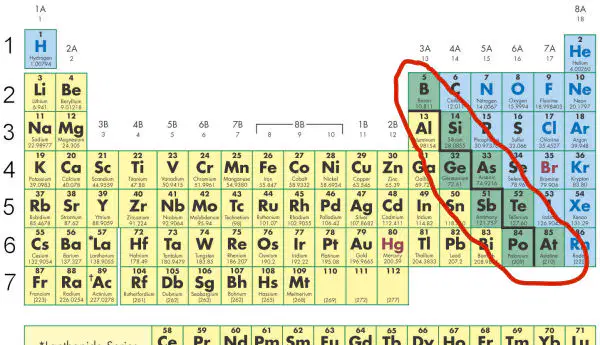
The following area on the periodic table can be described as what?
a)
Metal
b)
Nonmetal
c)
Metalloid
33.
A substance is shiny, able to be formed into shapes (malleable), and a good conductor. This substance is most likely a ______.
a)
Metal
b)
Nonmetal
c)
Metalloid
34.
What element is located in period 2, group 2?
a)
Lithium
b)
Beryllium
c)
Hydrogen
d)
Carbon
35.
An element has 15 protons, 17 electrons, and 15 neutrons. What is the atomic mass?
a)
30 amu
b)
15 amu
c)
2 amu
d)
0 amu
36.
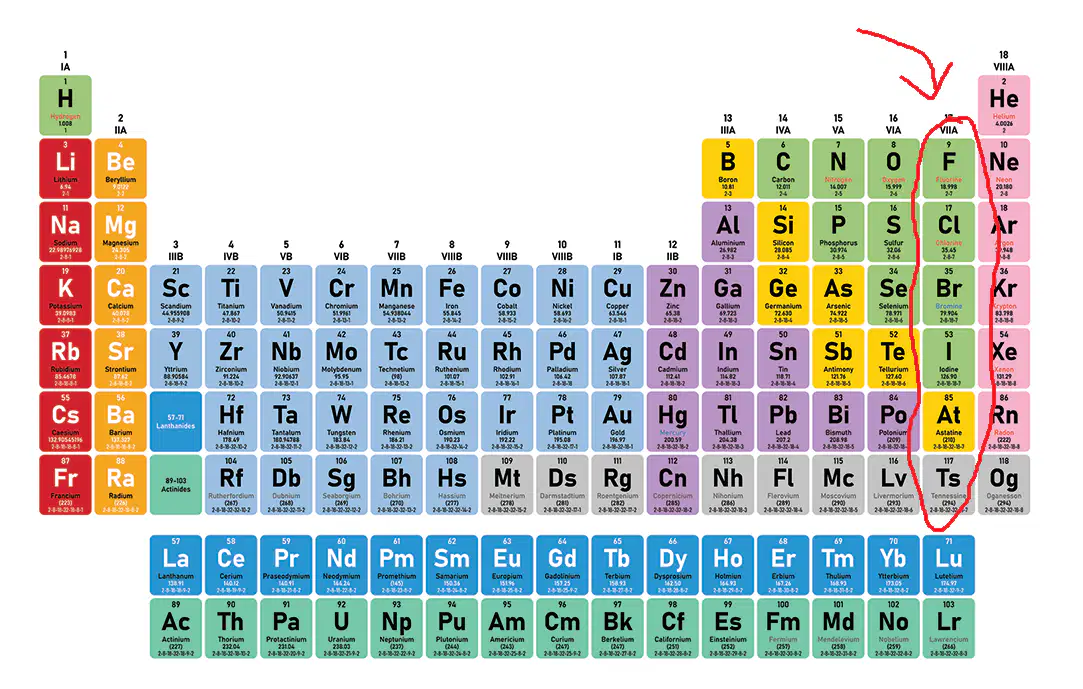
What is the name of this group on the periodic table?
a)
Alkali Metals
b)
Boron Group
c)
Noble Gasses
d)
Halogens
37.
What is the most reactive metal?
a)
Fluorine
b)
Francium
c)
Sodium
d)
Sulfur
38.
What element has the smallest atomic mass?
a)
Radon
b)
Hydrogen
c)
Oganesson
d)
Helium
39.
Why is group 18 not included for reactivity?
a)
Reactivity isn't the vibe
b)
They have a full electron shell and do not bond with other molecules
c)
They are very reactive
d)
They are always found in nature
40.

Which of the following INCREASE as you move up and to the right of the periodic table. Select all that apply.
a)
Ionization
b)
Electronegativity
c)
Atomic Mass
d)
Atomic Radius
e)
Reactivity of Nonmetals
41.
How many valence electrons does Beryllium have?
a)
1
b)
2
c)
3
d)
4
42.
How many valence electrons for Sodium (Na)?
a)
1
b)
3
c)
4
43.
How many valence electrons for Chlorine (Cl)?
a)
1
b)
7
c)
8
100 %

