
 Worksheets
US History Semester 1 Final
Total questions: 40
Worksheet time: 20mins
Name
Class
Date
1.
As part of the Pendleton Civil Service Act of 1883, people who wanted a federal job had to
a)
pass a civil service exam.
b)
donate money to a political party.
c)
demonstrate opposition to the spoils system.
d)
be interviewed by a member of the president's cabinet.
2.
How did trench warfare affect soldiers during World War I?
a)
It resulted in fewer casualties but poor conditions for soldiers.
b)
It kept the pace of the war slow, resulting in less trauma for soldiers.
c)
It led to worse conditions for soldiers but helped shorten the war.
d)
It led to higher casualties and poor conditions for soldiers.
3.
Why did President Wilson ask Congress to declare war on Germany in 1917 despite his earlier efforts to keep the United States out of World War I?
a)
He realized the U.S. economy could profit from a war in Europe.
b)
He was concerned about the German aggression outlined in the Zimmermann Note.
c)
He felt pressure to join the war from the U.S. Congress.
d)
He thought the United States should better support its European allies.
4.
Which factor helped pull so many European nations into the outbreak of World War I?
a)
the social diversity of the United States
b)
the elaborate system of alliances
c)
the establishment of multiethnic empires
d)
minority revolutions against oppressive regimes
5.
Which event contributed to the start of World War I in Europe?
a)
the assassination of Archduke Franz Ferdinand
b)
the sinking of the Lusitania by German U-boats
c)
the publication of the Zimmermann note
d)
the United States deciding to be neutral
6.
Which of these features could be found along the entire length of the Western Front?
a)
tanks
b)
trenches
c)
poison gas
d)
fortresses
7.
The Great Migration refers to the movement of which group of Americans?
a)
working women
b)
African Americans
c)
Mexican Americans
d)
white males
8.
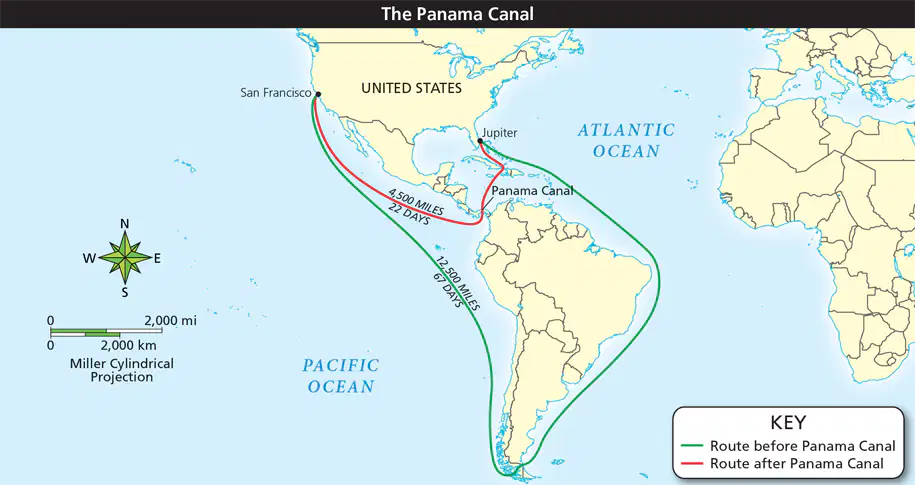
Based on the map, how did the Panama Canal affect the United States?
a)
U.S. consumers bought fewer goods from South America.
b)
Railroads declined as businesses shipped goods by sea.
c)
The United States reduced exports to South America.
d)
Goods from the east shipped more quickly to the west.
9.
What did W.E.B. Du Bois believe about African Americans and racial relations in the United States?
a)
African Americans should use violence in their fight for civil rights.
b)
African Americans would eventually be granted rights if they waited patiently.
c)
Prejudice against African Americans was equally severe throughout the nation.
d)
African Americans should immediately demand equal treatment under the law.
10.
What was the primary effect of the Supreme Court ruling in Plessy v. Ferguson?
a)
It led to greater opportunities for minorities.
b)
It legalized segregation in many parts of the country.
c)
It permanently divided the Progressive Party.
d)
It made the sale of alcohol illegal in the United States.
11.
What role did muckrakers play in the Progressive Movement?
a)
They enforced new laws that were passed to limit corruption.
b)
They worked for large corporations to protect their employers' interests.
c)
They dramatized the need for reform through articles and novels.
d)
They worked in factories disposing of the waste created by industry.
12.
How did the United States gain control of Hawaii?
a)
The United States Congress declared war against Hawaii.
b)
Hawaiian Queen Liluokalani signed a treaty with President Harrison.
c)
Disgruntled Hawaiian officials petitioned President Harrison to take control of Hawaii.
d)
U.S. Marines assisted rebels to overthrow the Hawaiian government.
13.
Which resource discovered near Alaska caused an immediate increase in the settlers entering the territory in the nineteenth century?
a)
oil
b)
coal
c)
gold
d)
silver
14.
How did President Roosevelt help to make the United States a world power?
a)
He strengthened and asserted U.S. military power.
b)
He sent troops to China to demand access to trade markets.
c)
He peacefully negotiated the construction of the Panama Canal.
d)
He improved education in the United States in order to pursue peaceful diplomacy.
15.
Why did the United States propose the Open Door Policy?
a)
The United States wanted China to pay an indemnity.
b)
The United States wanted to establish colonies in China.
c)
The United States wanted to establish free trade with China.
d)
The United States wanted China to install a democratic government.
16.
What problem did the muckraker Upton Sinclair seek to expose in The Jungle?
a)
child labor in the textile industry
b)
poor working conditions in the meatpacking industry
c)
political corruption in Congress
d)
cramped living conditions in tenements
17.
“. . . I had a big washing and ironing to do, house to straighten out, bread to bake etc. and when Sat night came about 5 P.M. I had to lay down was just about give out. And my feet hurt me so I could scarcely stand. The balls of them even swelled. Mon and Tues this week we have worked in the garden, as the weeds have grown pretty bad. Then we washed this morning. I have been so tired since we got back. Seems like I can’t get rested, but has been too much push work I guess.”
—Estella Stilgebouer, letter to Ella Roesch
Prairie Settlement: Nebraska Photographs and Family Letters, 1862-1912,
http://www.loc.gov/teachers/classroommaterials/connections/prairie-settlement/file.html
Based on this letter from a woman settler, which phrase best describes life for settlers on the Plains?
a)
free and liberating
b)
difficult for most
c)
harder for men than women
d)
adventurous and easier than elsewhere
18.
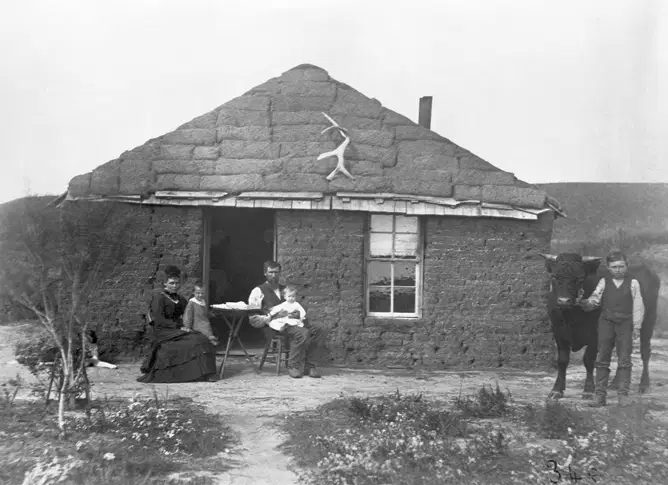
The people who lived in this sod house were most likely
a)
Mexican Americans.
b)
farmers who moved from the East.
c)
American Indians on reservations.
d)
Chinese railroad workers.
19.
How did the Plains Indians' use of the buffalo reflect their view of the resources that the land provided?
a)
They showed that they valued buffalo hunting as a sport by killing hundreds of buffalo at a time.
b)
They showed that they valued buffalo as a commodity by selling only their hides to European-Americans.
c)
They showed respect for natural resources by using every part of the buffalo for vital needs.
d)
They showed that the buffalo were not useful to them by driving them off the plains to start farms.
20.
How did Chinese immigrants contribute to the opening of the West?
a)
by working mostly as cowboys on the open range
b)
by helping to build the transcontinental railroads
c)
by lobbying for passage of the Homestead Act
d)
by introducing improved agricultural technology
21.
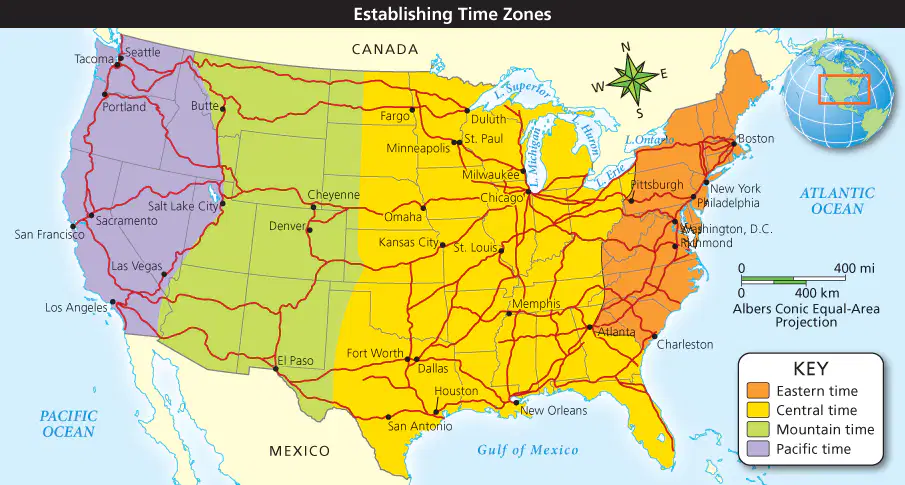
Look at the map of the U.S. rail system in the late 1800s. How did organizing regions of the country into time zones make rail travel and transport easier?
a)
It allowed for more rail lines to connect cities.
b)
It increased the number of travelers between zones.
c)
It made train schedules easier to set and follow.
d)
It color coded the ground so you knew what time zone you were in.
22.
How did the “new” immigrants of the late 1800s differ from earlier immigrants to the United States?
a)
"New" immigrants more often settled on farms, but earlier immigrants more often settled in cities.
b)
"New" immigrants often came from southern and eastern Europe, but earlier immigrants came from northern and western Europe.
c)
"New" immigrants came to the United States speaking English, but earlier immigrants had to learn the language when they arrived.
d)
"New" immigrants often were younger, but earlier immigrants often were older.
23.
What were the “push” and “pull” factors that led people to immigrate to the United States?
4 lines
24.
Which of the following is the clearest example of how immigrants during this period contributed to American culture as they adapted to their new lives?
a)
Many immigrants learned English when they came to the United States.
b)
Most immigrants lived in cities.
c)
Immigrants brought new foods to American cuisine.
d)
Immigrants worked in factories making clothing.
25.
During the Gilded Age, how did economic change lead to a culture of consumerism?
a)
Americans purchased hand crafted goods that demonstrated their wealth and social position.
b)
Americans bought new and cheaper products and services that made life easier for ordinary people.
c)
Americans established businesses that exported technological innovations to other countries.
d)
Americans developed innovations in banking and investment that provided more discretionary income.
26.
Labor unions generally formed as a result of
a)
business owners' desire for workers to organize.
b)
federal legislation mandating workers' rights.
c)
workers' desire to improve working conditions and increase wages.
d)
workers' pressure on the government to enact safety regulations.
27.
Between 1860 and 1900, a primary cause of migration from rural to urban areas was
a)
a rise in crop prices.
b)
lack of rural housing as building slowed.
c)
increasing economic opportunity in cities.
d)
government resettlement policies.
28.
A higher standard of living for the middle class was increasingly identified with
a)
the ability to hold a job in a factory.
b)
the opportunity to earn a college degree.
c)
the ability to purchase mass-produced products.
d)
the opportunity to buy a second home.
29.
In general how did forms of entertainment change in the late 1800s and early 1900s?
a)
They expanded as more people had the money and leisure time to enjoy them.
b)
They became more restricted, as only the wealthy had access to expensive new technologies.
c)
They were available only to native-born Americans and closed to immigrants.
d)
They were increasingly aimed at adults, with few activities that were appropriate for children.
30.
Which of the following best describes "nativism"?
a)
A policy that supports the rights of indigenous people.
b)
A political movement that promotes the interests of immigrants over native-born citizens.
c)
A belief system that emphasizes the importance of cultural diversity.
d)
A political stance that prioritizes the interests of native-born citizens over immigrants, often advocating for immigration restrictions.
31.
What is "Americanization"?
a)
The process of immigrants adopting American customs and practices to integrate into society.
b)
A movement to promote American political ideals internationally.
c)
The study of American history.
d)
A term for the American economy.
32.
What is one method that some southern states used to limit voting by African Americans?
a)
loyalty oaths
b)
literacy tests
c)
school segregation
d)
amendments
33.
Which amendment to the U.S. Constitution granted citizenship to African Americans?
a)
the Thirteenth Amendment
b)
the Fourteenth Amendment
c)
the Fifteenth Amendment
d)
the Sixteenth Amendment
34.
What was the main reason why it was so expensive to operate a school system in the South?
a)
the powerful influence of religious groups
b)
the policy of segregation practiced in the South
c)
the widespread corruption introduced by so-called "scalawags"
d)
the influx of thousands of so-called "carpetbaggers" from the North
35.
Land distribution in the South led to many economic problems. How was land distributed after the Civil War?
a)
Most land was owned by wealthy white people.
b)
Land was evenly divided between white and African American owners.
c)
Most land was owned by northern migrants who came south after the war.
d)
Land was divided into tiny plots among many owners.
36.
Distinguish between the primary purposes of the Thirteenth, Fourteenth, and Fifteenth Amendments.
4 lines
37.
The Compromise of 1877 granted Rutherford B. Hayes the presidency in exchange for
a)
major tax cuts for southern states.
b)
removal of all remaining federal troops in the South.
c)
reparations for damage caused in the South during the Civil War.
d)
additional electoral votes awarded to southern states in the next election.
38.
What are public lands where Native Americans were required to live by the federal goverment?
a)
reservations
b)
land grants
c)
plains
d)
adobes
39.
What was the method of ranching in which the rancher allowed his or her livestock to roam and graze over a vast area of grassland?
a)
open-range system
b)
closed-range system
c)
long-range system
d)
close-range system
40.
What was the practice of the political party in power giving jobs and appointments to its supporters, rather than to people based on their qualifications?
a)
spoils system
b)
open-range system
c)
humble system
d)
earned system
100 %

