
 Worksheets
Unit 1 - Astronomy
Total questions: 35
Worksheet time: 18mins
Name
Class
Date
1.
(1) Which of the following characteristics distinguishes jovian planets (gas giants) from terrestrial planets?
a)
A. They have solid surfaces
b)
B. They are smaller in size
c)
C. They have thicker atmospheres composed primarily of hydrogen and helium
d)
D. They are located closer to the Sun
2.
(2) Why is the nebular hypothesis important in understanding the formation of our solar system?
a)
A. It explains the formation of galaxies.
b)
B. It predicts the existence of black holes.
c)
C. It provides a framework for understanding the formation of planets and the Sun.
d)
D. It describes the evolution of life on Earth.
3.
(3) Arrange the following steps in the correct sequence according to the nebular theory of solar system formation:
I. Formation of a protostar from gravitational collapse.
II. Condensation of solid particles in the protoplanetary disk.
III. Formation of planetesimals through accretion.
IV. Formation of a protoplanetary disk from a rotating nebula.
a)
A. IV, I, III, II
b)
B. I, II,III, IV
c)
C. II, IV, III, I
d)
D. I, IV, II, III
4.
(4) Which of the following groups correctly classifies the planets in the solar system according to their size and location?
a)
A. Terrestrial planets: Mercury, Venus, Earth, Mars; Jovian planets: Jupiter, Saturn, Uranus, Neptune
b)
B. Terrestrial planets: Jupiter, Saturn, Uranus, Neptune; Jovian planets: Mercury, Venus, Earth, Mars
c)
C. Terrestrial planets: Jupiter, Saturn, Uranus, Neptune; Jovian planets: Mercury, Venus, Earth, Mars
d)
D. Terrestrial planets: Mercury, Venus, Earth, Mars; Jovian planets: Uranus, Neptune, Jupiter, Saturn
5.
(5) What role does gravity primarily play in the formation of astronomical objects such as stars and planets?
a)
A. It causes nuclear fusion reactions.
b)
B. It prevents collisions between objects.
c)
C. It causes the collapse of gas and dust clouds.
d)
D. It produces electromagnetic radiation.
6.
(6) Compared to the distance between Earth and Mars, the distance between Jupiter and Saturn is ______.
a)
A. much smaller
b)
B. about the same
c)
C. just slightly less
d)
D. much larger
7.
(7) Which natural phenomenon occurs as a result of Earth rotating on its axis?
a)
A. Movement of tectonic plates
b)
B. Deep ocean currents
c)
C. Seasonal changes
d)
D. Day and night
8.
(8) How does the tilt of Earth’s axis affect the season?
a)
A. By changing the amount of direct solar energy reaching the surface of Earth
b)
B. By influencing the rate of chemical reactions occurring in the atmosphere
c)
C. By deflecting the harmful rays of radiation emitted by the sun
d)
D. By changing the speed of the rotation of Earth
9.
(9) Which statement describes the motion of Earth around the sun?
a)
A. The speed of Earth is constant regardless of its distance from the sun.
b)
B. Speed increases the closer Earth is to the sun and decreases the farther it is from the sun
c)
C. The speed of Earth is constant because the distance remains the same between earth and the sun
d)
D. Speed increases the farther Earth is from the sun and decreases the closer it is to the sun
10.
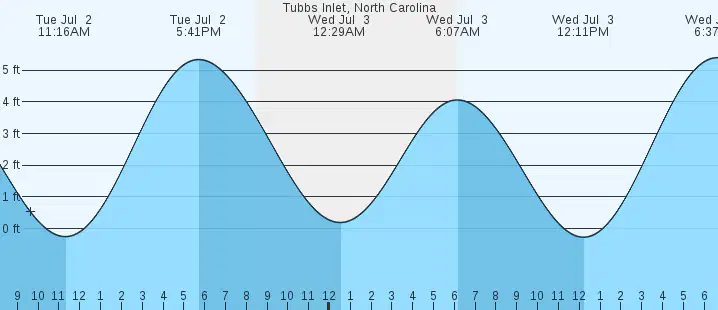
(10) According to the Tides Chart below which best describes the pattern of tides shown
a)
A. Two high tides and two low tides each day
b)
B. One high tide and one low tides each day
c)
C. Three high tides and three low tides each day
d)
D. One high tide and two low tides each day
11.
(11) Which of the following best explains why spring tides occur during both the new moon and full moon phases?
a)
A. The Earth's rotation slows down during these phases, causing more extreme tides.
b)
B. The gravitational forces of the moon and sun align to either combine their effects or directly oppose each other, leading to higher high tides and lower low tides.
c)
C. The moon is closest to Earth during these phases, enhancing its gravitational pull on the oceans.
d)
D. The sun's gravitational force is negated during these phases, allowing the moon's gravity to have a greater effect on the tides.
12.
(12) How does the barycenter, the center of mass between the Earth and the Moon, influence the motions of Earth?
a)
A. It causes Earth to have a perfectly circular orbit around the Sun.
b)
B. It results in the Earth and Moon orbiting a common point in space, slightly inside Earth's surface, leading to slight wobbling motions.
c)
C.It only affects the tides on Earth, with no impact on its orbital motion.
d)
D. It shifts the center of gravity of Earth, making its rotation faster
13.
(13) Which describes the difference between nuclear fission and nuclear fusion?
a)
A. Nuclear fission is the process that produces the radiant energy of stars, and nuclear fusion splits a heavier nucleus into smaller nuclei.
b)
B. Nuclear fission splits a heavier nucleus into smaller nuclei, and nuclear fusion is the process that produces the radiant energy of stars.
c)
C. Nuclear fission produces the energy in the core of Earth, and nuclear fusion produces energy in nuclear power plants.
d)
D. Nuclear fission produces energy in nuclear power plants, and nuclear fusion produces the energy in the core of Earth.
14.
(14) Which of the following statements correctly describes the relationship between the wavelength of light and its energy on the electromagnetic spectrum?
a)
A. As the wavelength of light increases, its energy decreases.
b)
B. As the wavelength of light increases, its energy increases.
c)
C. The wavelength of light has no effect on its energy.
d)
D. As the wavelength of light decreases, its energy remains constant.
15.
(15) Which of the following correctly orders the types of electromagnetic waves from lowest to highest energy?
a)
A. Radio Waves, Microwaves, Infrared, Visible light, Ultraviolet, X-rays, Gamma Rays
b)
B. Microwaves, Infrared, Radio waves, Ultraviolet, Visible light, X-rays, Gamma rays
c)
C. Microwaves, Radio waves, Infrared, Visible light, Ultraviolet, X-rays, Gamma rays
d)
D. Gamma rays, X-rays, Ultraviolet, Visible light, Infrared, Radio waves, Microwaves
16.
(16) Which of the following correctly matches the layer of the Sun with the primary process that occurs there?
a)
A. Core - Nuclear fusion, Photosphere - Convection, Corona - Heat radiation
b)
B. Core - Heat radiation, Photosphere - Nuclear fusion, Corona - Convection
c)
C. Core - Nuclear fusion, Photosphere - Heat radiation, Corona - Solar wind generation
d)
D. Core - Convection, Photosphere - Heat radiation, Corona - Nuclear fusion
17.
(17) Which best describes the interaction between Earth's magnetic field and the ozone layer?
a)
A. Earth's magnetic field is generated by the ozone layer's absorption of ultraviolet radiation.
b)
B.The ozone layer is responsible for deflecting charged particles from the Sun, while Earth's magnetic field absorbs harmful ultraviolet radiation
c)
C. Earth's magnetic field shields the ozone layer from cosmic rays, allowing it to regenerate ozone molecules.
d)
D. The ozone layer absorbs harmful ultraviolet radiation, while Earth's magnetic field deflects charged particles from the Sun.
18.
(18) How does the energy released from nuclear fusion in the Sun's core support life on Earth's surface?
a)
A. The fusion process directly provides chemical energy for cellular respiration in organisms.
b)
B. Fusion-generated solar wind interacts with Earth's magnetosphere to create the ozone layer.
c)
C. Solar radiation from fission powers the water cycle, essential for global agriculture.
d)
D. Solar radiation from fusion powers the water cycle, essential for global agriculture.
19.
(19) What is an effect of lower levels of solar radiation striking Earth?
a)
A. Increased incidences of skin cancer
b)
B. Decreased rates of photosynthesis
c)
C. Increased phytoplankton activity
d)
D. Decreased carbon dioxide levels
20.
(20) Which of the following accurately describes how incoming solar radiation interacts with the lithosphere, atmosphere, hydrosphere and biosphere?
a)
A. Solar radiation is absorbed primarily by the lithosphere, which converts it into geothermal energy, while the atmosphere filters UV rays and the hydrosphere reflects light.
b)
B. Solar radiation interacts similarly with all spheres, causing uniform absorption and reflection patterns across the lithosphere, atmosphere, hydrosphere, and biosphere.
c)
C. Solar radiation is absorbed differently by each sphere: the lithosphere absorbs heat, the atmosphere absorbs UV rays, the hydrosphere reflects light, and the biosphere converts energy into chemical bonds through photosynthesis.
d)
D. Solar radiation affects only the atmosphere, leading to temperature changes, while the lithosphere, hydrosphere, and biosphere remain unaffected.
21.
(21) Why is the greenhouse effect essential for life on Earth?
a)
A. It prevents harmful UV radiation from reaching the Earth's surface.
b)
B. It increases the oxygen content in the atmosphere.
c)
C. It regulates global temperatures, preventing extreme heat and cold.
d)
D. It speeds up the process of photosynthesis in plants.
22.
(22) How does heat from the sun get to Earth?
a)
A. by radiation, using electromagnetic waves to transfer the heat
b)
B. by convection, using liquids and gases to transfer the heat
c)
C. by conduction, using solids to transfer the heat
d)
D. by absorption, using primary waves to transfer the heat
23.
(23) Which factor primarily determines the amount of direct sunlight received at different latitudes on Earth?
a)
A. Earth's revolution around the Sun
b)
B. Earth's tilt on its axis
c)
C. Earth's rotation on its axis
d)
D. Earth's distance from the Sun
24.
(24) Which phenomenon is directly influenced by the reflection of solar radiation by Earth's ice caps and glaciers?
a)
A. Ocean acidification
b)
B. Desertification
c)
C. Albedo effect
d)
D. Ozone depletion
25.
(27) Determine the role of gravity in the formation of the Solar System
a)
A. It caused matter to clump together, forming the Sun, planets and moons
b)
B. It created matter for the Sun, planets and moons
c)
C. It caused matter to move apart, producing orbits
d)
D. It destroyed matter, clearing space for the Solar System
26.
(28) What occurs after the gravitational collapse of a molecular cloud in the nebular theory?
a)
A. Formation of a protostellar disk due to conservation of angular momentum.
b)
B. Formation of gas giants through rapid accretion of hydrogen and helium.
c)
C. Formation of rocky planets through collision and sticking of planetesimals.
d)
D. Fusion reactions in the central protostar leading to the formation of a main sequence star.
27.
(29) Which process occurs in the later stages of the nebular theory?
a)
A. Formation of the Sun (protostar) at the center of the disk.
b)
B. Collision and aggregation of planetesimals.
c)
C. Fusion of hydrogen atoms in the Sun's core.
d)
D. Differentiation of elements into layers within planets.
28.
(36) Which layer of the Sun is primarily responsible for the Sun's visible light and heat emission?
a)
A. Chromosphere
b)
B. Photosphere
c)
C. Corona
d)
D. Core
29.
(37) Which of the following is the correct order from the outermost layer of the sun to the innermost layer of the sun?
a)
A. Inner Core, Radiative Zone, Convection Zone. Photosphere, Chromosphere, Corona
b)
B. Corona, Chromosphere, Convection Zone, Photosphere, Inner Core, Radiative Zone
c)
C. Inner Core, Convection Zone, Radiative Zone, Chromosphere, Photosphere, Corona
d)
D. Corona, Chromosphere, Photosphere, Convection Zone, Radiative Zone, Inner Core
30.
(38) Which layer of the Sun is primarily composed of hydrogen and helium undergoing nuclear fusion reactions?
a)
A) Chromosphere
b)
B) Photosphere
c)
C) Inner Core
d)
D) Corona
31.
(39) Which layer of the Sun occupies the largest volume?
a)
A) Core
b)
B) Radiative Zone
c)
C) Convective Zone
d)
D) Photosphere
32.
(40) Why is incoming solar radiation crucial for photosynthesis in plants?
a)
A) It provides the necessary heat for plant growth
b)
B) It supplies the energy needed to convert carbon dioxide and water into glucose and oxygen
c)
C) It protects plants from harmful ultraviolet rays
d)
D) It attracts pollinators to the plants
e)
Option 5
33.
(41) On cloudy days, the rate of photosynthesis in the farm's plants is likely to :
a)
A) Decrease, because less light reduces the energy available for photosynthesis
b)
B) Increase, because less light reduces stress on the plants
c)
C) Remain the same, because plants store enough energy to last through cloudy days
d)
D) Stop completely, because photosynthesis requires direct sunlight
34.
(42) Which of the following is a direct effect of reduced photosynthesis due to lower incoming solar radiation?
a)
A) Increased water absorption by plant roots
b)
B) Decreased production of glucose and oxygen in the plants
c)
C) Enhanced growth and flowering of plants
d)
D) Higher resistance to pests and diseases
35.
(43) If the farmer wants to simulate the effects of sunny days during periods of low sunlight, which method could be most effective?
a)
A) Increasing the water supply to the plants
b)
B) Applying fertilizers more frequently
c)
C) Covering the plants to protect them from sunlight
d)
D) Using artificial grow lights to supplement natural sunlight
100 %

