
 Worksheets
DNA & Protein Synthesis Semester Test Review
Total questions: 45
Worksheet time: 33mins
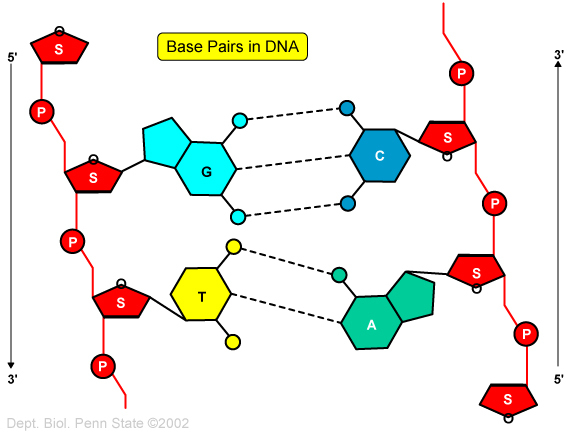
If a DNA molecule is 22% adenine in any organism, which percentage of thymine will that DNA molecule contain?
22%
28%
44%
56%

The diagram below shows an enzyme unwinding DNA strands for replication. What is the outcome for each DNA strand at the end of replication?
Each strand will degrade to form a different type of nucleotide.
Each strand will be translated to build protein molecules.
Each strand will separate to make two single-stranded DNA molecules.
Each strand will serve as a template for producing a complementary DNA strand.

Which image correctly represents a strand of human DNA?
Option A
Option B
Option C
Option D
Pick the complementary DNA strand to the following: A T C A G A
T A G T C T
U A G U C A
A T C A G A
G C T G A G
What are the three parts of a nucleotide?
Sugar, Phosphate, and Hydrogen
Phosphate, Base, and Sugar
Base, Adenine, and Sugar
Base, Hydrogen bond, and Phosphate

The image shows a section of one strand of a DNA molecule during replication. Which answer choice below correctly shows the strand after DNA replication?
A
B
C
D

The Universal Genetic Code Table can be used to determine the gene product of a given nucleotide sequence. Place the amino acid abbreviations that correspond to the nucleotide sequence when it is translated. AUG-GAC-ACA-GGG-GCU
(a)
An RNA sequence includes 15 codons. How many amino acids does this sequence encode?
3
5
15
45

An RNA codon chart is shown. For which amino acid sequence does the RNA sequence UUUCCUCAA code?
leucine-threonine-glutamic acid
phenylalanine-proline-glutamine
phenylalanine-proline-histidine
serine-histidine-glutamine
Which DNA sequence results in an identical, new sequence during both replication and transcription?
ACTC
TCTC
AGAG
ACAC
The DNA sequence ACTCG produces which mRNA sequence during transcription?
TGAGC
UGAGC
ACTCG
ACUCG
Transcription of the sequence TTAAG produces which sequence?
TTAAG
UUAAG
AAUUC
AATTC
In order to digest milk, the human body must manufacture a protein called lactase. When the digestive system requires lactase, it manufactures the protein based on information stored in what molecule?
DNA
ATP
CO₂
H₂O
The nucleus contains DNA. Which statement best describes how DNA controls the working of the cell?
It codes for proteins.
It inhibits division of cells.
It helps in energy transformation.
It regulates traffic in and out of the cell.
What type of mutation adds or deletes a base from a sequence of nucleotides?
silent
missense
nonsense
frameshift

An RNA codon chart is shown. What is the correct amino acid sequence that is coded from the RNA sequence UGG CAG AUU?
val-gly-trp
met-his-ser
tyr-pro-asn
trp-gln-ile

Compare the original and the mutated mRNA strands. What type of mutation occurred?
missense
nonsense
silent
Two segments of DNA have the exact same number of each nucleotide. Do they necessarily code for the same protein?
Yes, hereditary information is passed through the number of cytosine nucleotides in a gene.
Yes, hereditary information is passed through the percentage of each nucleotide in a gene.
No, hereditary information is passed through the order of the nucleotides in a gene.
No, hereditary information has no relationship to the nucleotides in a gene.

Which statement explains the relationship between DNA and the hemoglobin in red blood cells?
The DNA sequence mutates to allow the hemoglobin to carry oxygen.
The DNA sequence folds at the proper location to shape the hemoglobin.
The DNA sequence is built from the RNA determined by the hemoglobin.
The DNA sequence encodes the amino acid sequence that forms the hemoglobin.
Which statement best explains how RNA supports the production of hemoglobin proteins?
Mutations in the structure of the protein cause changes in the RNA sequences.
RNA sequences from the same chromosomes produce identical protein structures.
RNA sequences direct the correct order of amino acids that join to form the protein.
Blood type determines which sequences become RNA, amino acids, and hemoglobin proteins.
A mutation in the hemoglobin gene results in a change in the amino acid sequence of the hemoglobin protein. How does this relate to protein synthesis?
The mutation changes the mRNA codon, which leads to a different amino acid being added to the protein.
The mutation causes the ribosome to stop protein synthesis early.
The mutation alters the tRNA anticodon, preventing translation from occurring.
The mutation has no effect on protein synthesis since it occurs in the DNA.

The monomer of DNA is known as:
Nucleolus
Nucleic acids
Nucleus
Nucleotide


Which process results in the formation of messenger RNA from a DNA template?
Translation
Mutation
Transcription
Replication
What is the function of tRNA during protein synthesis?
It unwinds the DNA helix.
It transcribes DNA into RNA.
It synthesizes new DNA strands.
It carries amino acids to the ribosome.
Which component of a nucleotide is responsible for encoding genetic information?
Sugar molecule
Hydrogen bond
Phosphate group
Nitrogenous base
Which process converts the information in mRNA into a sequence of amino acids?
Replication
Transcription
Translation
Mutation
What is the role of ribosomes during protein synthesis?
They store genetic information.
They unwind the DNA helix.
They transport tRNA molecules.
They link amino acids together to form polypeptides.
Which type of RNA carries the genetic code from DNA to the ribosome?
rRNA
tRNA
mRNA
snRNA

Which portion of the nucleotide in the image is the Nitrogenous base?
A
B
C

A polypeptide is a sequence of ____________________ held together by a ______________ bond.
amino acids; peptide
fatty acids; ionic
proteins; hydrogen
fatty acids; covalent


AUG-GGC-ACC-UCA-UGA

Students are given data from an investigation that identified some of the chemical elements present in four different samples.
Which sample was most likely DNA?
Sample 1
Sample 2
Sample 3
Sample 4


The amino acid chain formed will eventually lead to the formation of.....
a protein
a new cell
DNA
RNA


This enzyme is responsible for reading the DNA template and adding complementary base pairs.
DNA helicase
RNA polypeptase
RNA ligase
DNA polymerase

What is the above image showing?
transcription
translation
mitosis
DNA replication
DNA replication results in two DNA molecules _________
each with two new strands of DNA.
each with two original strands of DNA.
each with one new strand and one original strand of DNA.

If the mRNA codon is AUG, what amino acid would the tRNA bring?
Met
GLu
Ala
Phe

