
 Worksheets
Eye Anatomy and Function Assessment
Total questions: 48
Worksheet time: 31mins
Select the statement below that is NOT true with regards to the process of light adaptation
Visual acuity is diminished
Rhodopsin is uncoupled from light transduction
Retinal sensitivity decreases
The activity of rods is reduced by rapid bleaching of rhodopsin
The cells of the retina in which action potentials are generated in the ______.
amacrine cells
ganglion cells
bipolar cells
rods and cones
A condition where distant objects focus in front of the retina, rather than on its own, it is called ________.
hyperopia
myopia
glaucoma
diplopia
As light travels through the eye, it passes through several structures or chambers before reaching the retina. Which list below gives those structures in the correct order?
cornea, pupil, lens, anterior chamber, posterior segment
cornea, pupil, anterior chamber, lens, posterior segment
cornea, lens, pupil, anterior chamber, posterior segment
cornea, anterior chamber, pupil, lens, posterior segment
The visible light portion of the electromagnetic spectrum fits between ________.
X-Rays and UV waves
microwaves and radio waves
infrared and microwaves
UV and infrared waves
The eye muscle that rotates the eye upward and turns the eye laterally is the _____.
lateral rectus
medial rectus
inferior oblique
superior oblique
The ability to see objects clearly but not close up is properly called _______.
myopia
hyperopia
diplopia
presbyopia
Which statement about malnutrition- induced night blindness is most accurate?
The impaired vision is caused by reduced cone function
Vitamin supplements can reverse degenerative changes
The most common cause is vitamin D deficiency
Visual pigment content is reduced in cones more than rods
Color vision has much greater resolution than night vision (vision that is mostly in shades of gray). Which of the following is the best explanation for why this is so?
There are several types of cone photoreceptors, each of which enrich the clarity and resolution of vision
A larger proportion of the brain's visual cortex is active during the day when our cone photoreceptors are most active
A single cone photoreceptor often connects to a single bipolar cell and a single ganglion cell while as many as 100 rods will converge to a single ganglion cell
There are many more cone photoreceptors in the eye than rod photoreceptors
The blind spot of the eye is caused by _______
more rods than cones within the retina
an absence of photoreceptors where the optic nerve leaves the eye
an absence of cones in the foveae
the macula interrupts the nerve pathway
Conscious perception of vision probably reflects activity in the ________.
superior colliculus
chiasma
occipital lobe of the cortex
thalamus
What structure regulates the amount of light passing to the visual receptors of the eye?
lens
aqueous humor
cornea
iris
Ordinarily, it is NOT possible to transplant tissues from one person to another, yet corneas can be transplanted without tissue rejection. This is because the cornea ________.
does not contain connective tissue
is not a living tissue
has no blood supply
has no nerve supply
What is the main function of the rods in the eye?
accommodation for near vision
vision in dim light
depth perception
color vision
There are three layers of nuerons in the retina. The axons of which of these nureron layers form the optic nerves?
cone cells
rod cells
bipolar cells
ganglion cells
Which of the following is the best explanation for our perception of color?
Cones come in three types, each sensitive to different wavelengths of light.
Rods contain a single kind of visual pigment?
As many as 100 cones may converge on the ganglion cell
The foveae are densely packed with cones
Nutrients are delivered, and waste products are carried away from the cells of the posterior segment of the eye by blood vessels. However, the cells in the cornea and lens (in the anterior segment) are avascular. Which is the best explanation for how these cells are maintained?
The metabolic activity of these cells is very low. They produce little waste and need few nutrients.
The aqueous humor is continuously replenished and flows from the ciliary process to drain in the scleral venous sinus.
The nutrients and waste products of the anterior segment diffuse into and through the vitreous humor of the posterior segment/
These cells, like the cells of the corneal layer of the integument are not living cells.
Humans can see several thousand shades of color but have cone photoreceptors that are sensitive to only three (perhaps four) wavelengths of light. What is the best explanation for why we see so many colors?
Colors are added and enhanced in the primary visual cortex of the brain.
Shades of color are purely phychological and learned by association with age, infants only seeing black and white.
Color perception is achieved by activation of various combinations between the three cone types
Color perception is dependent on the millions of rods as well as cone photoreceptors.
In a person who is color blind, which of the following would you most expect to see?
an inability to regenerate 110 cis- retinal after bleaching
a loss of their peripheral vision
a loss of functions in the rods of their retina
absence of green or red cones in their foveae
Which of the following best describes the function of the iris?
refracts light through the pupil
controls amount of light entering eye
gives the eye its color
adjusts the shape of the lens
A condition that can result from a deficency of vitamin A
Night blindness
Glaucoma
A condition often leading to blindness due to chronic persistent intraocular pressure
Night blindness
Glaucoma
Which of the following is the best explanation of why it is difficult to discriminate the color of an object at night?
Cones come in three types, each sensitive to different wavelengths of light
As many as 100 cones may converge on one ganglion cell
The foveae are densely packed with cones
At night, dialation of pupils stimulates the retina, where more rods are located rather than cones
The first "way station" in the visual pathway from the eye, after there has been partial crossover of the fibers in the optic chiasma, is the ________.
visual cortex
superior colliculi
temporal lobe
lateral geniculate body of the thalamus
The elasticity of the lens decreases with age. This leads to which of the following?
less accommodation of the lenses and difficulty focusing on nearby objects
lowered accommodation of the lenses and difficulty focusing on nearby objects
less light getting to the retina and diminished visual activity
a clouding of the lenses known as a cataract
Nerve fibers from the medical aspect of each eye _______.
divide at the chiasma, with some crossing and some not crossing
pass posteriorly without crossing over at the chiasma
cross over to the opposite side at the chiasma
go to the superior colliculus only
Which of the following could NOT be seen as one looks into the eye with an ophthalmoscope?
optic disc
foreva centralis
macula lutea
optic chiasma
Paralysis of which eye muscle would prevent the right eye from looking to the left?
Medial rectus
Superior rectus
Inferior rectus
Lateral rectus
Overlap in the visual fields of our eyes _______.
allows us to subconsciously estimate the distance of objects based on the different angles the image strikes our two retinas
is essentially a waste of brain processing for what is essentially the same image
gives us higher visual acuity for small detail by doubling the number of photoreceptors that are being stimulated
leaves a blind spot anterior to the nose and in the lateral fields of vision
If you shine a light into one eye both pupils will constrict. The best explanation for this is ______.
sensory input from the retinas of both eyes converges at the optic chiasm and information from each eye is delivered to both the left and right sides of the brain
a small portion of light always enters the other eye
information from one eye is directly and immediately transferred to the other eye to maintain alignment of the eyes
This, in fact, does not occur; information of both eyes is always seperated
Which of the following is true about photoreceptors?
If all cones are stimulated equally, all colors are absorbed by the cones and the color perceived is black
Three types of color- sensitive photoreceptors exist; red, green, and yellow
In dim light, images are focused directly on the rods in the fovea centralis
Rods adsorb light throughout the visual spectrum but confer only gray tone vision
The sensory layer of the eye
Aqueous humor
Fovea centralis
Retina
Lens
The structure most responsible for focusing light rays that enter the eye
Aqueous humor
Fovea centralis
Retina
Lens
Helps maintain the intraocular pressure; located in the anterior part of the eye
Aqueous humor
Fovea centralis
Retina
Lens
Area of greatest visual activity
Aqueous humor
Fovea centralis
Retina
Lens
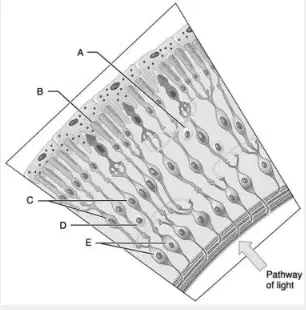
Ganglion cells
(a)
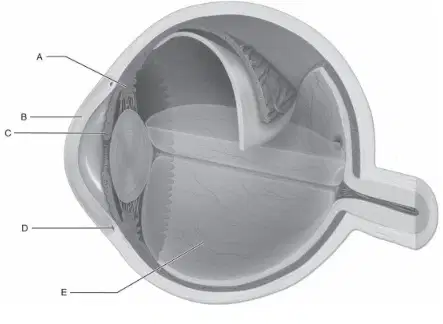
The only tissue in the body that can be transplanted from one person to another with little or no rejection
(a)
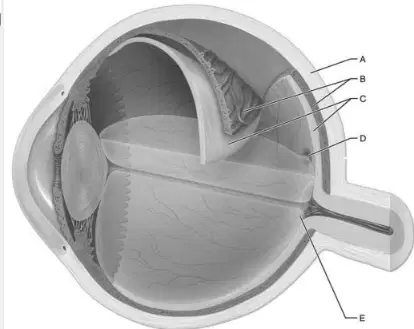
Contains only cones; provides detailed color vision
(a)
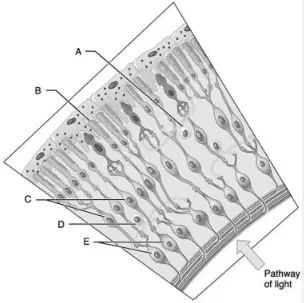
Horizontal Cell
(a)
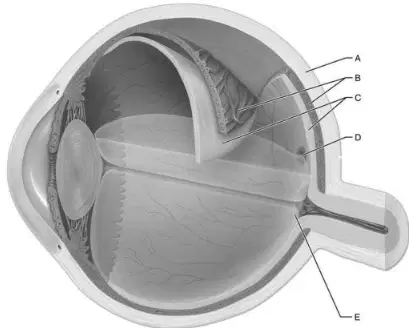
Contains millions of photoreceptors that transduce light energy
(a)
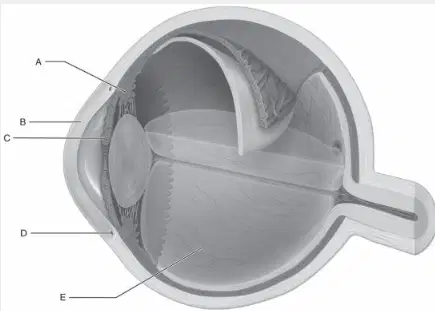
Controls lens shape
(a)
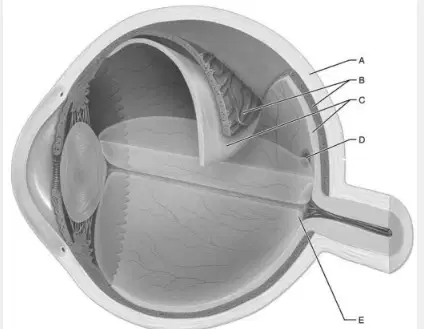
Protects and shapes the eyeball; provides a sturdy anchoring site for extrinsic eye muscles
(a)
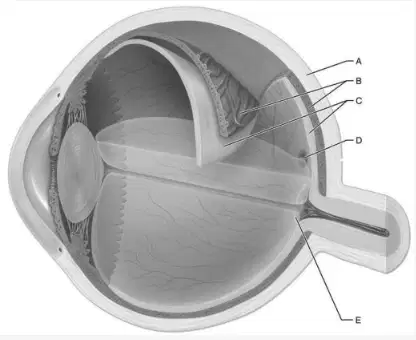
Lacks photoreceptors; where optic nerve exits the eye
(a)
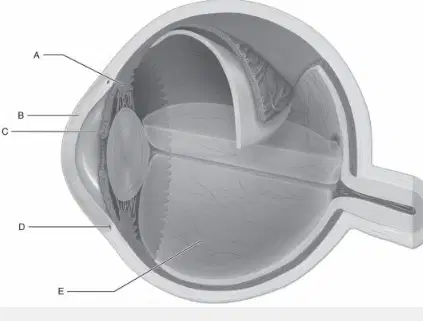
Acts as a redflezovely acctivated diaphram to vary pupil size
(a)
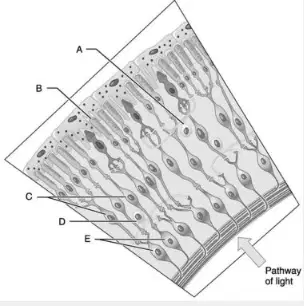
Bipolar Cells
(a)
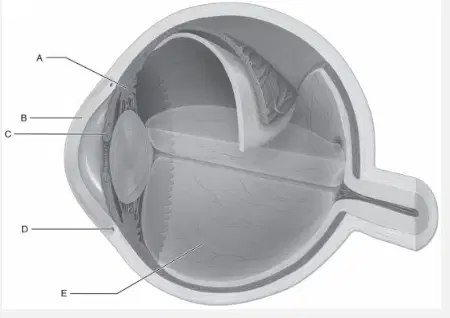
Viscous liquid that holds the neural layer of the retina firmly against the pigmented layer
(a)

Blood vessels that supply nutrition to all of the eye layers
(a)
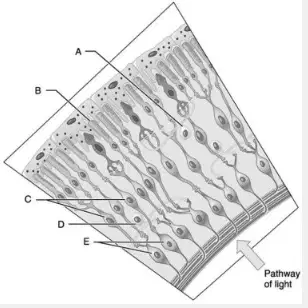
Rod.
(a)

