wayground logo

Free Printable Worksheets

Font size

S
M
L
XL
Worksheets

PSci Final Exam

Total questions: 250

Worksheet time: 8hrs 20mins

Name
Class
Date
1.

What type of reaction is this chemical equation: Cl2 + NaBr → NaCl + Br2

a)

synthesis

b)

decomposition

c)

single replacement

d)

double replacement

2.

What type of reaction is this chemical equation: Na + Br2 → NaBr

a)

synthesis

b)

decomposition

c)

single replacement

d)

double replacement

3.

What type of reaction is this chemical equation: KClO3 → KCl + O2

a)

synthesis

b)

decomposition

c)

single replacement

d)

double replacement

4.

What type of reaction is this chemical equation:

BaCl2 + Na2 SO4 → NaCl + BaSO4

a)

synthesis

b)

decomposition

c)

single replacement

d)

double replacement

5.

What type of reaction is this chemical equation:

Mg + O2 → MgO

a)

synthesis

b)

decomposition

c)

single replacement

d)

double replacement

6.

What type of reaction is this chemical equation:

Al2O3 → Al + O2

a)

synthesis

b)

decomposition

c)

single replacement

d)

double replacement

7.

What type of reaction is this chemical equation:

CuCl2 + H2S → CuS + HCl

a)

synthesis

b)

decomposition

c)

single replacement

d)

double replacement

8.

What type of reaction is this chemical equation:

HgO + Cl2 → HgCl + O2

a)

synthesis

b)

decomposition

c)

single replacement

d)

double replacement

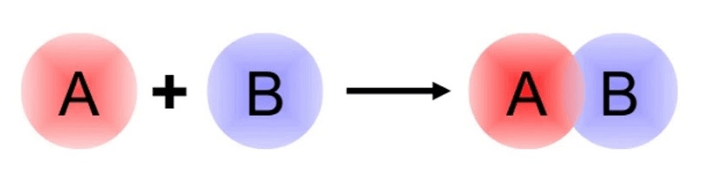
9.

What is the type of reaction shown above?

a)

Synthesis

b)

Decomposition

c)

Single Replacement

d)

Double Replacement

10.
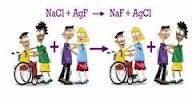
What type a reaction is taking place in this picture?
a)
Synthesis
b)
Decomposition
c)
Single Replacement
d)
Double Replacement
11.
This pictures simulates what type of reaction?
a)
Synthesis
b)
Decomposition
c)
Single Replacement
d)
Double Replacement
12.

What type of reaction involves 2 substances combining to form 1 new compound?

a)

Decomposition Reaction

b)

Single Displacement Reaction

c)

Double Displacement Reaction

d)

Synthesis Reaction

13.

What type of reaction involves the breaking down of a substance into simpler substances?

a)

Single Displacement Reaction

b)

Double Displacement Reaction

c)

Synthesis Reaction

d)

Decomposition Reaction

14.

James, Mason, and Ethan are working on a chemistry project. They need to balance the following equation for their experiment:

__ H3PO4 + __ KOH → __ K3PO4 + __ H2O

a)

1, 3, 1, 3

b)

3, 3, 1, 1

c)

3, 1, 3, 1

d)

6, 2, 6, 2

15.

Mia, Ava, and Sophia are in a chemistry class. Their teacher gave them a challenge to balance the following equation:

__ K + __ B2O3 → __ K2O + __ B

Can you help them find the correct coefficients?

a)

2, 3, 1, 6

b)

6, 1, 3, 2

c)

1, 2, 3, 6

d)

2, 6, 3, 1

16.

Abigail was conducting a chemistry experiment in her school lab. She was asked to balance the following equation:

__ HCl + __ NaOH __ → __NaCl + __H2O

Kai and Ava were observing her. Can you help them understand the correct balance?

a)

2, 2, 2, 3

b)

1, 2, 1, 2

c)

2,6,4,1

d)

1, 1, 1, 1

17.

Liam, Grace, and Michael are in a chemistry lab. They are given a task to balance the following equation:

__ Na + __ NaNO3 → __Na2O + __N2

They came up with different sets of coefficients. Can you tell which one is correct?

a)

6, 1, 2, 5

b)

10, 2, 6, 1

c)

5, 3, 1, 2

d)

20, 4, 12, 2

18.

Ava, Noah, and Avery are working on a chemistry project where they need to balance the following equation:

__ C + __ S8 → __ CS2

Can you help them find the correct coefficients?

a)

4, 4, 1

b)

2, 2, 1

c)

4, 1, 4

d)

2, 1, 2

19.

Arjun, Noah, and Grace are in a chemistry lab. They are given some Sodium (Na) and Oxygen (O2) and asked to combine them to form Sodium Oxide (Na2O). They are trying to figure out the correct ratio of Sodium to Oxygen to Sodium Oxide. Can you help them balance the equation?

__ Na + __ O2 → __Na2O

a)

4, 1, 2

b)

8, 2, 4

c)

3, 2, 2

d)

1, 2, 4

20.

Noah, Lily, and Kai are working on a chemistry project. They are trying to balance the following chemical equation:

__ N2 + __ O2 → __ N2O5

Can you help them find the correct coefficients?

a)

2, 5, 2

b)

5, 2, 2

c)

4, 10, 4

d)

6, 3, 4

21.

A solution is made by adding 22 g solute in 0.86 L of solvent. Determine the mass concentration.

a)

25.58 g/L

b)

20.93 g/L

c)

18.60 g/L

d)

30.00 g/L

22.

Determine the mass of the solute in grams. The mass/volume concentration of the solution is 40 g/100mL and the volume of the solution is 300 mL.

a)

120 g

b)

150 g

c)

100 g

d)

140 g

23.

5 g NaCl is added to 0.24 L of water to make a solution. Determine the mass concentration of the solution.

a)

20.83 g/L

b)

21.00 g/L

c)

22.50 g/L

d)

23.00 g/L

24.

A solution is made by adding 22 g solute in 0.86 L of solvent. The mass concentration is ____.

a)

25.58 g/L

b)

20.93 g/L

c)

18.60 g/L

d)

30.00 g/L

25.

36 grams of NaCl is added to water to make a solution of concentration 12 g/L. Determine the volume of the solution in liters. The volume is ____.

a)

3 L

b)

2 L

c)

4 L

d)

5 L

26.
What does it mean to dilute a solution?
a)
lower the concentration of solute per solvent
b)
increase the concentration of solute per solvent
27.

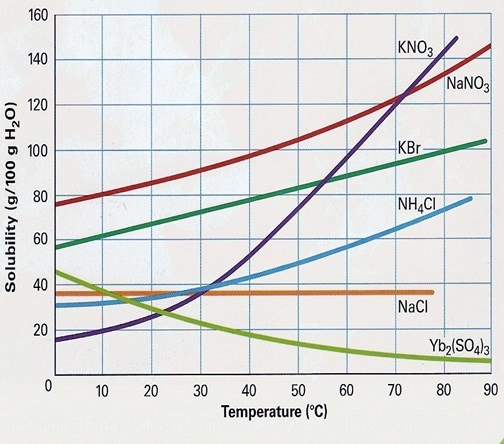
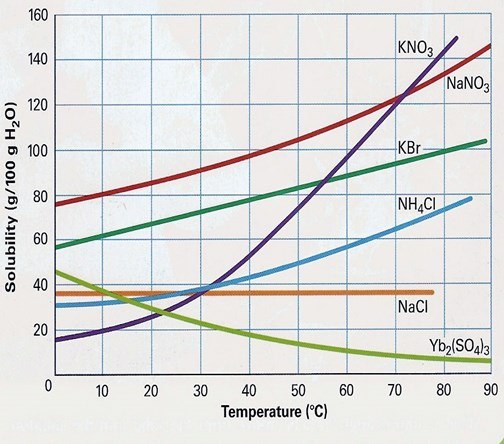
Which substance is least soluble at 0 ºC?

a)

KI

b)

KNO3

c)

KClO3

d)

Ce2(SO4)3

28.

How many grams are soluble in 100 g of water at 100 ºC?

a)

300 grams

b)

250 grams

c)

100 grams

d)

50 grams

29.

When 40 grams of NaCl is dissolved in 100 grams of water at 90 ºC, the solution can be correctly described as:

a)

supersaturated

b)

saturated

c)

unsaturated

30.
Which solute does not increase in solubility as temperature rises?
a)
NH3
b)
NaNO3
c)
KNO3
d)
NaCl
31.

Identify how many grams of KNO3 is required to make a saturated solution at 40'C.

a)

50 g

b)

45 g

c)

55 g

d)

33 g

32.

What will allow more solute to be dissolved in a solvent if the solute is a solid?

a)

adding more solute

b)

stiring

c)

cooling solution

d)

heat

33.
The universal solvent is ______. 
a)
sodium 
b)
acid 
c)
water 
d)
wind 
34.

At 30'C, which substance has the lowest solubility?

a)

KNO3

b)

KBr

c)

NaCl

d)

Yb2(SO4)3

35.
A colloid is a mixture that contains undissolved particles. 
a)
True
b)
False
36.
What type of mixture contains liquids that normally don't mix well?
a)
colloid
b)
emulsion
c)
alloy
d)
solution
37.
Oil and water is an example of what type of mixture?
a)
colloid
b)
alloy
c)
solution
d)
emulsion
38.
This type of mixture has particles that settle. 
a)
Suspension
b)
Colloid 
c)
Emulsion
d)
Solution 
39.

Solutions has ______________ sized particles, colloids have _________________ sized particles, and suspensions have _________________________ sized particles.

a)

small, medium, large

b)

large, medium, small

c)

medium, small, large

d)

medium, large, small

40.

Which solution is more concentrated?

Solution 1:

500 mL of water

100 g of salt


Solution 2:

500 mL of water

90 g of salt

a)

Solution 1

b)

Solution 2

c)

They have the same concentration

d)

I have no idea

41.
The pH scale measures...
a)
...the strength of an acid.
b)
...the strength of hydrogen ions.
c)
...the concentration of hydrogen ions.
d)
...the concentration of an acid
42.
Acid + base --> ?
a)
salt + hydrogen gas + water
b)
salt + carbon dioxide + water
c)
salt + water
d)
salt only
43.

What is the chemical formula for hydroxide?

a)

H3O+

b)

H3O-

c)

OH+

d)

OH-

44.

Mason and Abigail were conducting a science experiment. They were testing different solutions to see which one releases H+ in solution. Daniel suggested they test the following options. Which one should they choose?

a)

Base

b)

Acid

c)

Buffer

d)

Water

45.

Maya was conducting a chemistry experiment in her school lab. She noticed that a substance she used was releasing OH- ions into the solution. What type of substance was Maya likely using?

a)

Acid

b)

Base

c)

Neutral

46.

Nora, Ethan, and Aiden were conducting a science experiment in their school lab. They found that the water they used in their experiment was neutral. This was because

a)

it had more H+ ions than OH- ions, as Ethan suggested

b)

it had more OH- ions than H+ ions, as Aiden thought

c)

it did not produce any ions, as Nora hypothesized

d)

it had an equal amount of H+ and OH- ions in solution, as their science teacher explained

47.

Samuel was conducting a chemistry experiment in the lab. He had a few substances in front of him and he was wondering what would happen if he mixed an acid with one of them. Zoe suggested that acids react with

a)

water to produce bases and salts

b)

salts to produce bases and water

c)

neither bases, salts nor water

d)

bases to produce salts and water

48.

Kai found a substance in the chemistry lab and observed the following characteristics:


It had a very bitter taste when he put a small amount on his tongue

It felt slippery when Harper touched it

When Priya dissolved it in water, it produced OH- ions


How should they classify this substance?

a)

acid

b)

base

c)

enzyme

d)

fatty acid

49.

Arjun, Avery, and Aria were conducting a science experiment. They found a substance with the following characteristics:

Very sour taste

Feels soft to the touch

Produces H+ ions when dissolved in water

How should they classify this substance?

a)

acids

b)

bases

c)

enzyme

d)

fatty acid

50.

What factor increases the dissolution rate due to more surface area being exposed to the solvent?

a)

Granulated sugar compared to a sugar cube

b)

Adding a solute with a common ion

c)

Decreasing the temperature

d)

Using a non-polar solvent for a polar solute

51.

What process allows fresh solvent molecules to come into contact with the solute, speeding up dissolution?

a)

Condensation

b)

Evaporation

c)

Agitation or stirring

d)

Freezing

52.

How does temperature affect the dissolution process?

a)

Increases molecule movement, aiding dissolution

b)

Decreases molecule movement

c)

Has no effect on dissolution

d)

Only affects gases

53.

Which factor does NOT directly affect the rate of dissolution?

a)

Surface area of the solute

b)

Temperature of the solvent

c)

Agitation of the solution

d)

Color of the solvent

54.

Which of the following statements is true?

a)

An unstable daughter isotope decays into a stable parent isotope.

b)

An unstable parent isotope decays into a stable daughter isotope.

c)

A stable daughter isotope decays into an unstable parent isotope.

d)

A stable parent isotope decays into an unstable daughter isotope.

55.

An isotope has a half life of 20 years. If it starts with a sample of 100g, how much of it will be left after 80 years?

a)

25 grams

b)

50 grams

c)

6.25 grams

d)

12 grams

56.

After 2 half lives have passed, what percent of the parent isotope is left?

a)

25%

b)

50%

c)

75%

d)

100%

57.
Barium-122 has a half-life of 2 minutes. A fresh sample weighing 80 g was obtained. If it takes 10 minutes to set up an experiment using barium-122, how much barium-122 will be left when the experiment begins?
a)
0.25g
b)
2.5g
c)
25g
d)
80g
58.
The half-life of strontium-90 is 25 years. How much strontium-90 will remain after 100 years if the initial amount is 4.0 g?
a)
3.0g
b)
0.25mg
c)
0.3g
d)
0.25g
59.
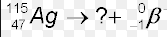
Which type of nuclear radiation is being emitted here?
a)
Alpha
b)
beta
c)
gamma 
d)
none
60.
What element is the ?
a)
Ag-115
b)
Cd-115
c)
Pd-115
d)
Not Listed
61.
Which type of nuclear radiation is being emitted here?
a)
alpha
b)
beta
c)
gamma
d)
none
62.
If Gadolinium-150 goes through alpha decay, the resulting element has a new atomic mass of _____.
a)
150
b)
148
c)
146
63.

In the symbol 20682Pb what does 206 stand for?

a)

Number of neutrons

b)

Atomic number

c)

Mass Number

d)

Atomic Mass

64.
What is the symbol for an alpha particle?
a)
42He
b)
0-1e
c)
0+1 e
d)
10n
65.
Balance the following equation:
146C --> 0-1e + ________
a)
145B
b)
146C
c)
147N
d)
42He
66.
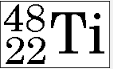
How many protons does this isotope of titanium have?
a)
48
b)
22
c)
26
d)
70
67.

What is the missing element on the right side of the equation?

a)

Polonium

b)

Lead

c)

Radium

68.

What is an Isotope?

a)

Atoms that have the same number of protons but different numbers of neutrons. Isotopes are chemically identical, but some may be radioactive while others are not.

b)

A beta particle

c)

Numbers that explain the chemical.

69.

What is fission?

a)

Used to indicate protons and neutrons.

b)

High energy that is emitted from a radioactive nucleus.

c)

Breaking a large nucleus into smaller nuclei.

70.

What is fusion?

a)

Releases more energy than nuclear energy.

b)

Combining smaller nuclei together to form larger nuclei.

c)

A nuclear power plant.

71.
A car travels 30 miles/hr for 3 hours, calculate the distance it will travel
a)
90 miles
b)
10 miles
c)
600 miles
d)
90 km
72.
Find the velocity of a plane that traveled 3000 miles west in 5 hours.
a)
65 mph west
b)
6 mph west
c)
600 mph west
d)
6000 mph west 
73.
A truck driving at 60 miles per hour travels 150 miles. How long is it driving for?
a)
9000 hours
b)
0.4 hours
c)
210 hours
d)
2.5 hours
74.
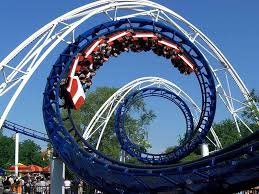
A roller coasters accelerates from an initial velocity of of 6.0 m/s to a final velocity of 70 m/s over 4 seconds.  What's the acceleration?
a)
24 m/s2
b)
18 m/s2
c)
16 m/s2
d)
16 m/s
75.
A drag racer accelerated from 0 m/s to 200 m/s in 5 s.  What was the acceleration?
a)
0 m/s
b)
40 m/s2
c)
-40 m/s2
d)
40 m/s
76.
If a car going 30 m/s approaches a traffic jam and the driver hits the brakes, how long will it take for them to slow to a stop with at a rate of -6.25m/s2
Which equation will help you solve this problem?
a)
V= (a•t) + vi
b)
V= vf- (a•t)
c)
a = (vf-vi)/t
d)
t = (vf-vi)/a
77.
Why does a car accelerate as it round a corner at a constant speed?
a)
Its direction changes
b)
It doesn't
c)
It slows down
d)
Its speeds up  
78.
A golf ball rolls up a hill towards the hole. If the golf ball starts with a speed of 2 m/s and slows at a constant rate of 0.5 m/s2, what is its velocity after 2 s?
a)
0 m/s
b)
0.5 m/s
c)

3 m/s

d)
1.5 m/s
79.
Which runner stopped for a rest?
a)
Albert
b)
Bob
c)
Charlie
80.
Which runner won the race?
a)
Albert
b)
Bob
c)
Charlie
81.

Billy runs 400 meters to Andy's house, turns around, and runs 400 meters back home. What is Billy's displacement?

a)

0 meters

b)

400 meters

c)

800 meters

d)

1600 meters

82.

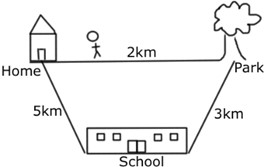
Jerry walked from home to school, then from the school to the park. What is his total displacement?

a)

2 km

b)

5 km

c)

8 km

d)

10 km

83.

Two people walk across a parking lot. Their paths are shown in the image. Who traveled with a larger displacement?

a)

Person A

b)

Person B

c)

They both had the same displacement.

84.
The Free Body Diagram above shows the forces acting on a hockey puck in motion to the right.  Which of the following describe the motion of the hockey puck?
a)
the hockey puck moves to the right with constant velocity
b)
the hockey puck is slowing down
c)
the hockey puck is speeding up
d)
the hockey puck moves is a circle
85.
A 400 N girl standing on a dock exerts a force of 100 N on a 10,000 N sailboat as she pushes it away from the dock. How much force does the sailboat exert on the girl?  
a)
25 N 
b)
100 N 
c)
 400 N
d)
10,000 N
86.
A group of students are pulling a bucket of mass 10.0 kg from the bottom of the well by tying a rope to the bucket and pulling upwards. Use g = 10 m/s2 to simplify calculations.
What is the weight of the bucket?
a)
0
b)
10
c)
100
d)
200
87.

These two individuals are pushing a 5500 kg car with a horizontal force of 300 N. What is the Normal Force of the car?

a)

53,900 N

b)

300 N

c)

2940 N

d)

30.6 N

88.

These two chaps are moving this 200 kg box with a horizontal force of 600 N. What is the magnitude of the Normal Force?

a)

5880 N

b)

600 N

c)

1960 N

d)

61 N

89.

A soccer ball is sitting in the middle of a field. The ball will remain at rest until an outside force like a players foot or the wind acts upon it. Which of Newton's laws is represented by this?

a)

1st

b)

2nd

c)

3rd

90.

Think about pushing a shopping cart and a car. If you apply the same amount of force to both, the shopping cart will travel fast, but the car will hardly move. To move the car yo would need a larger force. Which of Newton's laws is being represented?

a)

1st

b)

2nd

c)

3rd

91.

Sally jumps on her trampoline. She exerts a force on the trampoline and the trampoline exerts an equal but opposite force back on Sally. This represents

a)

Law 1

b)

Law 3

c)

Law 2

92.

What Newtons law does this picture represent

a)

Newtons 1st law

b)

Newtons 2nd law

c)

Newtons 3rdt law

d)

Newtons 4rth law

93.

Which law explains that it would take more force to push the car than the lawnmower?

a)

1st

b)

2nd

c)

3rd

94.

When you are running. your foot exerts force on the ground and the ground exerts force back onto you. Which of Newton's laws is represented

a)

1st

b)

2nd

c)

3rd

95.
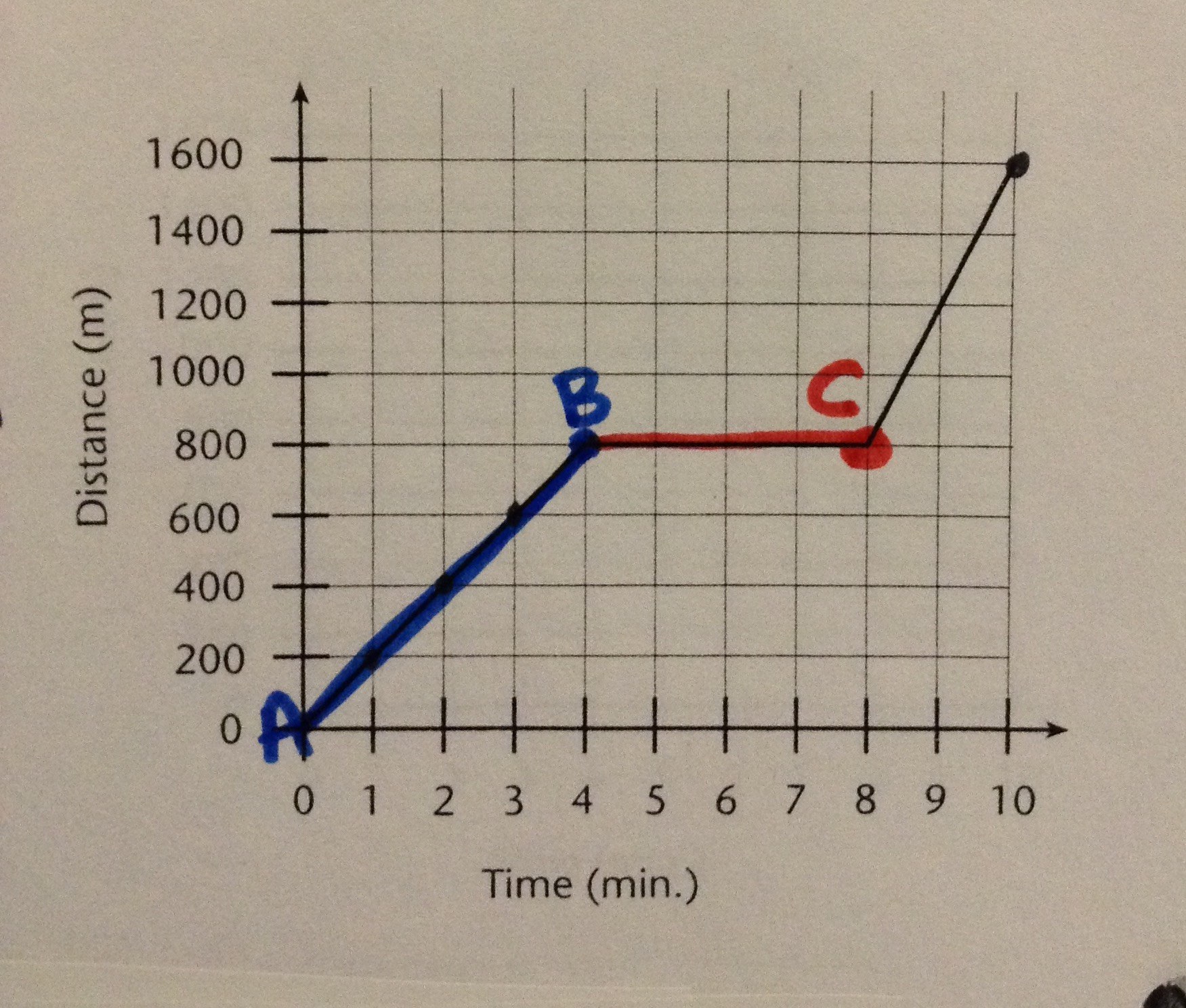
 The graph shows Ashley riding her bike to Maria's house. 
What was her average speed for the ENTIRE trip?
a)
1600 m/min
b)
200 m/min
c)
160 m/min
96.

How would you find the average speed from 0 - 40 seconds?

a)

10/40 = 0.25 m/s

b)

40/10 = 4 m/s

c)

slope = 10/20 = 0.5 m/s

d)

slope = 0/20 = 0 m/s

97.

How would you find the average velocity from 40-100 seconds?

a)

-10/60 = -0.167 m/s

b)

10/60 = 0.167 m/s

c)

0/60 = 0 m/s

d)

-40/60 = -0.67 m/s

98.
What are electromagnetic waves?
a)
sound waves
b)
electric & magnetic fields (energy) that travel through empty space very quickly
c)
Someone's name
d)
things like longitudinal waves
99.
The height of the wave from the rest position is known as the _____________.
a)
amplitude
b)
crest
c)
trough
d)
wavelength
100.
How much of the electromagnetic spectrum is visible?
a)
All of it
b)
None of it
c)
Most of it
d)
Only a small part
101.
The distance between two crests or two troughs of a wave is called:
a)
frequency
b)
amplitud
c)
wavelength
d)
hertz
102.
High frequency waves have _________ wavelengths.
a)
varying
b)
long
c)
the same
d)
short
103.
As the frequency of an electromagnetic wave increases, the amount of energy in that wave...
a)
increases.
b)
decreases.
c)
stays the same.
104.
Which of the following electromagnetic waves has the lowest energy?
a)
gamma ray
b)
infrared wave
c)
visible light wave
d)
microwave
105.
How are electromagnetic waves different from other waves? 
a)
They have very short wavelengths 
b)
They transmit energy instead of matter 
c)
They can travel through empty space
d)
They can change direction by reflection 
106.
True or false: as you move along the spectrum, radio to gamma waves, the wavelengths decrease in size (get smaller)
a)
true
b)
false
107.
A wave with a large wavelength will have a ______ frequency and _____ energy
a)
high, low
b)
high, high
c)
low, high
d)
low, low
108.
Select the correct order of waves on the EMS from the longest wavelength to the shortest wavelength
a)
Radio, Micro, Infra, Visible, Ultra, X-ray, Gamma
b)
Gamma, X-ray, Ultra, Vis, Infra, Micro, Radio
c)
Vis, Micro, Infra, Ultra, X-ray, Gamma, Radio
d)
Micro, Radio, Vis, Infra, Ultra, X-ray, Gamma
109.
Which has the LONGEST wavelength and, therefore, the lowest frequency/energy
a)
Gamma Rays
b)
Radio Waves
c)
Visible Light
d)
Infrared rays
110.
Which has the SHORTEST wavelength and, therefore, the highest frequency/most energy
a)
Radio waves
b)
Ultraviolet Rays
c)
Gamma Rays
d)
X-rays
111.
Which section of the spectrum is the ONLY one we can see?
a)
X-rays
b)
Visible Light
c)
Gamma Rays
d)
Ultraviolet Rays
112.
The relationship between wavelength and frequency is λ=c/f.  Calculate the wavelength of light that has a frequency of 5.2 x 10¹² 1/s. The speed of of light is 3.0x 10⁸ m/s.
a)
5.8 x 10 -5 m
b)
5.8 x 10 -7 m
c)
5.19 x 10 14 m
d)
1.56 x 10 23 m
113.
Solve this problems using the equation: 
C = λν
If an AM radio station broadcasts at
9.95 x 10⁵ Hz, what is the wavelength of this radiation?
a)
6.59 x 10⁻²⁸ m
b)
1.01 x 10⁻⁶ m
c)
3.32 x 10⁻³ m
d)
302 m
114.

Calculate the wavelength of light that has a frequency of 5.2 x 10¹² Hz

a)

5.8 x 10 -5 m

b)

5.8 x 10 -7 m

c)

5.19 x 10 14 m

d)

1.56 x 10 23 m

115.
What are the units of frequency?
a)
m/s
b)
s
c)
Hz
d)
m
116.

IRAS, the Infrared Astronomy Satellite launched by NASA in 1983, had a detector that measured infrared or heat radiation from different regions of space. What is the frequency of infrared light that has a wavelength of

1.10 X 10⁻⁶ m?

a)

3.67 x 10⁻¹⁵ Hz

b)

3.67 x 10⁻³ Hz

c)

2.73 x 10² Hz

d)

2.73 x 10¹⁴ Hz

117.

A wave has a frequency of 10 hz and a wavelength of 4 m. What is the velocity of the wave?

a)

24 m/s

b)

40 m/s

c)

2.5 m/s

118.

What kind of wave is pictured below?

a)

compressional wave

b)

transverse wave

c)

sound wave

d)

mechanical wave

119.
What do we call the bottom of a transverse wave?
a)
crest
b)
trough
c)
wavelength
d)
amplitude
120.
What do we call the top of the wave?
a)
crest
b)
trough
c)
amplitude
d)
frequency
121.
What happens when you increase the amplitude of a sound?
a)
it makes the sound louder
b)
it makes the sound travel faster
c)
it increases the wavelength of the sound
d)
it increases the frequency of the sound
122.
Waves that require a medium are called 
a)
mechanical waves
b)
transverse waves
c)
light waves
d)
gamma rays
123.
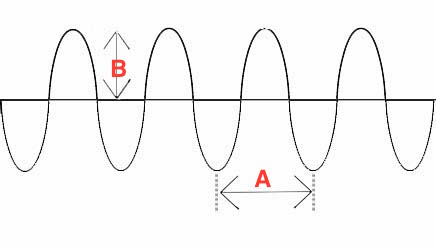
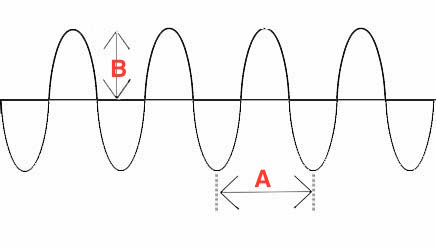
What property of the wave is represented by the letter "B"?
a)
amplitude
b)
crest
c)
trough
d)
wavelength
124.
What property of this wave is represented by the letter "A"
a)
amplitude
b)
crest
c)
trough
d)
wavelength
125.
What do waves carry from place to place?
a)
Energy, but not matter or particles
b)
Energy and matter or particles
c)
Matter or particles but not energy
d)
Neither energy nor matter or particles
126.
Which of the following is NOT a mechanical wave?
a)
sound
b)
light
c)
ocean
d)
seismic
127.
What is the measure of how many waves pass a point in a second?
a)
frequency
b)
wavelength
c)
midpoint
d)
crest and trough
128.
Amplitude is a measure of how much _________ the wave is carrying
a)
energy
b)
matter
c)
medium
d)
frequency
129.
The longer the _____________  the ______________ the frequency.
a)
wavelength, lower
b)
wavelength, higher
c)
amplitude, lower
d)
amplitude, higher
130.
Which wave has a greater frequency?
a)
A
b)
B
131.
The units for frequency are measured in _____________.
a)
hertz
b)
seconds
c)
m/s
d)
grams
132.
You can't hear sounds in outer space because there is no
a)
matter
b)
light
c)
energy
d)
heat
133.
One end of the rope is vibrated to produce a wave with a wavelength of .25 m.  The Frequency of the wave is 3.0 Hz.  What is the speed of the wave?
a)
3.00 m/s
b)
2.50 m/s
c)
.75 m/s
d)
1.25 m/s
134.
 A wave has frequency of 50 Hz and a wavelength of 10 m. What is the speed of the wave?
a)
500 m/s
b)
50 m/s
c)
5 m/s
d)
0.5 m/s
135.
A wave has wavelength of 10 m and a speed of 340 m/s. What is the frequency of the wave?
a)
34 m/s
b)
3400 Hz
c)
3400 m/s
d)
34 Hz
136.

All waves carry ______________.

a)

Sound

b)

Light

c)

Matter

d)

Energy

137.

What kind of wave is pictured below?

a)

compressional wave

b)

transverse wave

c)

sound wave

d)

longitudinal wave

138.

What type of wave is pictured?

a)

Transverse wave

b)

Longitudinal wave

c)

Wave, what wave?

d)

Slinky wave

139.

How would you describe the movement of energy in a transverse wave?

a)

Perpendicular

b)

90 to the movement of the source

c)

Parallel

d)

Same direction as the movement of the source

140.

How would you describe the movement of energy in a longitudinal wave?

a)

Perpendicular

b)

90 to the movement of the source

c)

Parallel

d)

Same direction as the movement of the source

141.

What is A?

a)
crest
b)
trough
c)
compression
d)
rarefaction
142.
What do we call the part of a compressional wave that is spread a part?
a)
compression
b)
rarefaction
c)
crest
d)
trough
143.
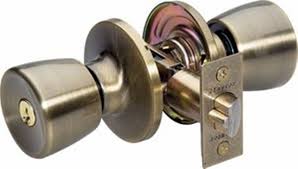
Identify this simple machine
a)
Lever
b)
Wheel & Axle
c)
Inclined Plane
d)
Screw
144.
Two examples of a pulley...
a)
knife & axe blade
b)
lightbulb & screw
c)
flagpole hoist & window blinds
d)
catapult & teeter totter
145.
Which of the following does a simple machine do?
a)
allows the users to apply less force over a longer distance
b)
reduce the amount of force needed to do work
c)
change the direction of the applied force
d)
all of the above
146.
What do you call a machine made up of two or more simple machines?
a)
complicated machine
b)
compound or complex machine
c)
comprehensive machine
d)
constructive machine
147.
An inclined plane wrapped around a rod forms this simple machine 
a)
lever
b)
pulley
c)
screw
d)
wedge 
148.
An axe is an example of a
a)
pulley
b)
inclined plane
c)
screw
d)
wedge 
149.
A seesaw is an example of a  
a)
wedge
b)
lever 
c)
inclined plane 
d)
pulley 
150.
Which is not a type of simple machine?
a)
spring
b)
screw
c)
pulley
d)
wedge
151.
What type of simple machine is this?
a)
wheel and axle
b)
gear
c)
lever
d)
inclined plane
152.
The transfer of energy that occurs when a force makes an object move is known as 
a)
effort
b)
potential 
c)
kinetic 
d)
work 
153.
A flat sloping surface that connects lower and higher elevations. It makes raising objects easier.  
a)
wedge
b)
screw
c)
lever
d)
inclined plane 
154.
Name this simple machine.
a)

Lever

b)

Wedge

c)

Pulley

d)

Inclined Plane

155.
How does a pulley make work easier? 
a)

It changes the direction of the input force.

b)

It changes the distance over which the input force is applied.

c)

It changes the amount of the input force applied 

d)

It changes direction and increases the effect of your input force

156.

What is the formula for calculating work done when a force is applied to move an object a certain distance?

a)

W=F×dW = F \times d

b)

W=FdW = \frac{F}{d}

c)

W=F+dW = F + d

d)

W=FdW = F - d

157.

A lever is used to lift a 200 N weight. If the effort force applied is 50 N, what is the actual mechanical advantage of the lever?

a)

2

b)

3

c)

4

d)

5

158.

Explain why the ideal mechanical advantage of a machine is always greater than the actual mechanical advantage.

a)

Because of friction and other losses

b)

Because ideal conditions are always met

c)

Because machines are perfect

d)

Because effort force is always greater

159.

Calculate the work done if a force of 10 N is applied to move an object 5 meters.

a)

15 J

b)

25 J

c)

50 J

d)

100 J

160.

A pulley system has an ideal mechanical advantage of 5. If the resistance force is 100 N, what is the effort force required?

a)

10 N

b)

20 N

c)

25 N

d)

50 N

161.

What is the resistance force if a machine has an actual mechanical advantage of 3 and an effort force of 30 N?

a)

60 N

b)

90 N

c)

100 N

d)

120 N

162.

A ramp is used to lift a box to a height of 2 meters. If the length of the ramp is 10 meters, what is the ideal mechanical advantage of the ramp?

a)

2

b)

3

c)

4

d)

5

163.

What is the effort distance if a lever has an actual mechanical advantage of 4 and a resistance distance of 2 meters?

a)

0.5 meters

b)

1 meter

c)

4 meters

d)

8 meters

164.

If a machine has an ideal mechanical advantage of 6 and the effort force is 10 N, what is the resistance force?

a)

10 N

b)

30 N

c)

60 N

d)

100 N

165.

A construction crew lifts approximately 600 lb of material several times during a day from a flatbed truck to a 50 ft rooftop. A block and tackle system with 45 lb of effort force is designed to lift the materials. What is the required actual mechanical advantage of the system?

a)

1.1

b)

13.3

c)

12

d)

11

166.

Machines can change the     of a force.

(a)  

167.
In order for Work to happen, what 2 things must occur?
a)
Mass and Displacement
b)
Force and Mass
c)
Force and Work
d)
Force and displacement
168.
How many joules of work are done against a cart when a force of 50 N pushes it 1 kilometer away?
a)
7000 J
b)
5000 J
c)
5500 J
d)
6600 J
169.
Work of 2000 J is required to push an object 1.5 km. What is the force?
a)
2.5 N
b)
1.3 N
c)
1.6 N
d)
12 N
170.
How much work is being done with 200 N of force over 426 meters?
a)
85,200 J
b)
45,620 J
c)
90,480 J
d)
62,329 J
171.
If 150 Joules of work is needed to move a box 10 meters, what force was used? 
a)
1500 N
b)
15 N
c)
1.5 N
d)
150 N
172.
Work is done when a weightlifter holds a barbell still above his head.
a)
True
b)
False
173.

You push against the back of your friends car that is stuck. You push and be become very tired, but the car does not move. Did you do work?

a)

Yes, work was done

b)

No, work wasn't done

174.
If 68 Joules were necessary to move a 4 Newton crate, how far was the crate moved?
a)
272 m
b)
17 m
c)
4.05 m
d)
272 cm 
175.

Is this an example of work?

a)

Yes

b)

No

176.

What is the unit of measurement for work?

a)

meters

b)

newtons

c)

m/s

d)

Joules

177.

Is this an example of work?

a)

Yes

b)

No!

178.

Newtons are the unit for _____________.

a)

Work

b)

Distance

c)

Acceleration

d)

Force

179.

A push or a pull

a)

Work

b)

Force

c)

Acceleration

d)

Speed

180.

For work to be done on an object, the direction and force have to be going the same direction.

a)

True

b)

False

181.

Picking up a box is an example of____________

a)

Work

b)

Not Work

182.

Pushing a box across the floor is an example of

a)

Work

b)

Not Work

183.

You exert 200 J of work by pulling on an object with 20 N of force. What distance is the object moved?

a)

.01 m

b)

10 m

c)

10 J

d)

4,000 m

184.

You throw a baseball a distance of 20 meters.

a)

Work

b)

Not Work

185.

You lift a suitcase to put in the overhead luggage compartment of a plane.

a)

Work

b)

Not work

186.

You push against a brick wall until you are exhausted. The wall does not move.

a)

Work

b)

Not work

187.

You carry a heavy bag of cat litter home from the pet store.

a)

Work

b)

Not work

188.

You slam a tennis ball across the net and score the winning point.

a)

Work

b)

Not work

189.

You study all night for the science SOL.

a)

Work

b)

Not work

190.

Your finger pushes down on the RETURN key on a computer.

a)

Work

b)

Not work

191.

You move a shovelful of snow from the driveway to the lawn.

a)

Work

b)

Not work

192.

You and a friend push a heavy piano, causing it to move about 10 centimeters.

a)

Work

b)

Not work

193.

You stand for half an hour in the freezing cold waiting for the bus to come.

a)

Work

b)

Not work

194.

Carrying groceries into the house.

a)

Work

b)

Not work

195.

Sitting on a bar stool.

a)

Work

b)

Not work

196.

Holding a baby.

a)

Work

b)

Not work

197.

Pushing a box 10 meters across the floor.

a)

Work

b)

Not work

198.

Lifting weights 5 meters over your head.

a)

Work

b)

Not work

199.

Pushing on a car but it does not move.

a)

Work

b)

Not work

200.

Picking up a book off a table.

a)

Work

b)

Not work

201.

A man pulling his boat out of the water from a boat launch.

a)

Work

b)

Not work

202.

A child pushing his baby brother in a stroller.

a)

Work

b)

Not work

203.

A brother carries his little sister, who weighs 24kg, across a field 20 meters.

a)

Work

b)

Not work

204.

When you lift a 10 lb object up 1 m and then carry it 100 m forward, which direction is your force?

a)

Down

b)

Up

c)

Forward

d)

Backward

205.

When you lift a 10 lb object up 1 m and then carry it 100 m forward, which distance matches the direction of your force?

a)

1 m up

b)

1 m down

c)

100 m forward

d)

100 m backward

206.

When you lift a 10 lb (44.5 N) object up 1 m and then carry it 100 m forward, what work is done?

a)

1000 J

b)

4450 J

c)

10 J

d)

44.5 J

207.
In a neutralization reaction, what are the products of a reaction between an acid and a base?
a)
Another acid and base
b)
Carbon dioxide and a salt
c)
Water and a salt
d)
Either two acids or two bases
208.
The pH scale measures...
a)
...the strength of an acid.
b)
...the strength of hydrogen ions.
c)
...the concentration of hydrogen ions.
d)
...the concentration of an acid
209.

A hydrogen ion, H+, is the same as a(n):

a)

neutron

b)

electron

c)

proton

d)

hydroxide ion

210.
Bleach is a strong base, what is the pH level of bleach?
a)
13
b)
14
c)
1
d)
2
211.
Which of the following is a base?
a)
orange juice
b)
water
c)
vinegar
d)
dishwashing detergent
212.
 Which of the following is an acid?
a)
shampoo
b)
baking soda
c)
orange juice
d)
water
213.
The pH of a solution is tested, and it is found to be a basic solution. Of the following choices, what could the pH have been?
a)
3
b)
9
c)
7
d)
5
214.
Human blood has a pH between 7.35 and 7.45. Which of the following best describes human blood?
a)
strongly acidic
b)
slightly acidic
c)
strongly basic
d)
slightly basic
215.
Many cleaning solutions are bases. Which of the following is a property of most bases?
a)
feels slippery
b)
white color
c)
can only be liquid
d)
tastes sour
216.
Tastes bitter.
a)
Acids
b)
Bases
c)
Salts
d)
All
217.
Explain what happens when a strong acid and a strong base are poured into the same container.
a)
they form separate layers
b)
they mix physically but not chemically
c)
they break apart into separate elements
d)
they react chemically to form a salt
218.
Which of the following is true about acids and bases?
a)
The lower the pH, the stronger the acid
b)
the higher the pH, the stronger the acid
c)
The lower the pH, the more neutral the acid
d)
The higher the pH, the weaker the base
219.
Which type of ion does a base produce when it is dissolved in water?
a)
oxide
b)
oxygen
c)
hydrogen
d)
hydroxide
220.
Which of these pH values would indicate that a solution is a weak base?
a)
4
b)
5.6
c)
8
d)
13
221.
When dissolved in water, acids produce:
a)
bases
b)
salts
c)
hydrogen ions
d)
hydroxide ions
222.
On the pH scale what numbers are acids?
a)
8-14
b)
0-7
c)
7
d)
1
223.
On the pH scale what numbers are neutrals?
a)
8-14
b)
0-7
c)
7
d)
1
224.
A dog runs on the sidewalk 9 mi/hr.
a)
Speed
b)
Acceleration
c)
Velocity
225.
While going to school, a student walks an average of 5 km/hr west for 12 blocks.
a)
Speed
b)
Acceleration
c)
Velocity
226.
Which of the following is a unit of speed?
a)
km/hr
b)
hr
c)
km
d)
s
227.
Which of the following is a unit of speed ?
a)
sec
b)
mi
c)
m/s
d)
min
228.
Acceleration only takes place when things speed up. 
a)
True
b)
False
229.
You are walking in a straight line at a consistent speed. Do you have acceleration? 
a)
no
b)
yes 
230.
As you walk you make a right turn. Do you have acceleration? 
a)
yes 
b)
no
231.
You are walking and start to slow down. Do you have acceleration? 
a)
yes
b)
no 
232.

What is Acceleration?

a)

Speeding up

b)

Slowing down

c)

How fast something is moving

d)

Changing direction

233.
The equation for finding average acceleration is
a)
(final velocity - initial velocity)
÷ time
b)
(initial velocity - final velocity) 
∞ time
c)
initial velocity + final velocity + time
d)
initial velocity + final velocity - time
234.
A dog runs with an initial speed of 7.5 m/s on a waxed floor.  It slides to a stop in 15 seconds.  What is the acceleration?
a)
-7.5 m/s
b)
-7.5 m/s2
c)
-0.5 m/s2
d)
7.5 mi//hr
235.
The metric unit for acceleration is ______.
a)
m
b)
m/s
c)
m/s2
d)
s
236.
A car driving at 50 miles per hour drives for 2 hours. What distance did it cover?
a)
50 miles
b)
25 miles
c)
100 miles
d)
75 miles
237.
What does this graph represent?
a)
Constant speed
b)
Acceleration
c)
Not moving
238.
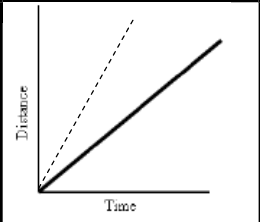
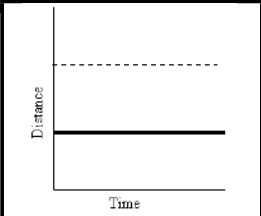
What does this graph represent?
a)
Constant Speed
b)
Acceleration
c)
Not moving
239.
What does this graph represent?
a)
Constant speed
b)
Acceleration
c)
Not moving
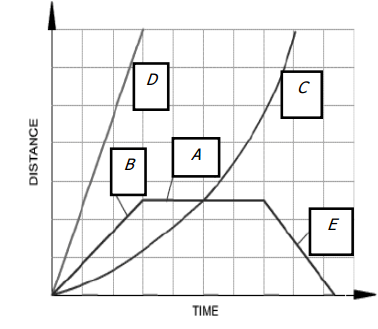
240.
What is happening at E?
a)
Stationary
b)
Accelerating
c)
Fast steady speed; moving away from the starting position
d)
Steady speed; returning to start position
241.
Which runner had a head start?
a)
A
b)
B
c)
C
242.
 Every morning, Tom walks along a straight road from his home to the bus stop. Below, is a graph representing Tom’s trip to school.
-
 What is the distance covered through the second segment, which is between 50 seconds, and 70 seconds?
a)
40 meters
b)
60 meters
c)
80 meters
d)
20 meters
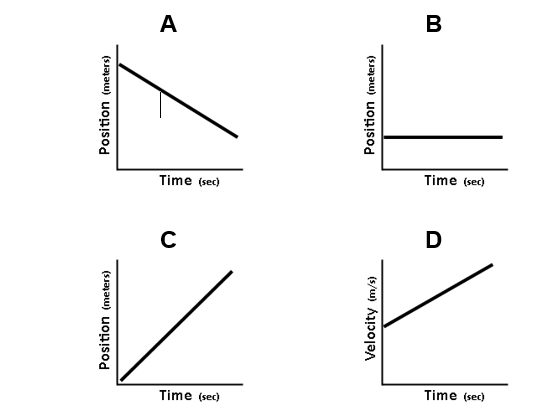
243.
Which graph shows the object standing still?
a)
A
b)
B
c)
C
d)
D
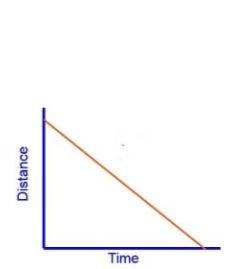
244.

What is this line of this graph showing?

a)

moving away from starting point at a constant speed

b)

moving back towards the starting point at a constant speed

c)

acceleration (getting faster)

d)

deceleration (getting slower)

245.

Billy runs 400 meters to Andy's house, turns around, and runs 400 meters back home. What is Billy's distance?

a)

0 meters

b)

400 meters

c)

800 meters

d)

1600 meters

246.

Jerry walked from home to school, then from the school to the park. What is his total distance?

a)

2 km

b)

5 km

c)

8 km

d)

10 km

247.

From the figure, what is the displacement?

a)

20 meters

b)

25 meters

c)

15 meters

d)

25 meters NE

248.
Ronaldo runs across a soccer field, moving 10 meters north, then 8 meters west. His displacement would be:
a)
10.2 m, NW
b)
12.8 m, NW
c)
15.4 m, NW
d)
18.0 m, NW
249.
Because displacement has a magnitude and direction it is called a ______. 
a)
distance
b)
vector
c)
arrow
d)
length
250.
A person walks 50 meters directly north, stops, and then travels 32 meters directly south.  What is their displacement?
a)
82 meters
b)
18 meters
c)
28 meters