
 Worksheets
SOCSCI 112: Final Exam
Total questions: 71
Worksheet time: 32mins
What do you call the tool or the "line" that demarcates the Global North and the Global South?
Equator Line
Brandt Line
Willy Line
Which among the following countries is not part of Southeast Asia?
India
Philippines
Thailand
The North–South divide is broadly considered a socio-economic and political divide.
True
False
Many of the people in the Global South faces poverty, war and oppression.
True
False
The phrase “Global South” refers broadly to the regions of Latin America, Asia, Africa, and Oceania.
True
False
The world is divided into countries that claim sovereignty over a territory or territories.
True
False
North-South divide can be seen in ___________.
economy
poverty
development
all of the above
The Global South is a term that has been emerging in transnational and postcolonial studies to refer to what may also be called the ________________.
Less developed countries
Developed Regions
Third World Countries
A & C
Which of the following are not global south regions?
Latin America.
Asia
Australia
Africa
North-South divide can be seen in the following except______.
Literacy
Life expectancy
development
geographical location
Globalization has not been a one-way street. It is also considered that the region is generative of many aspects of the globalization process.
True
False
All belongs to Global South except:
Singapore, Philippines, Thailand, China, Ecuador, Argentina, Mexico, Japan
Thailand
China
Ecuador
Japan
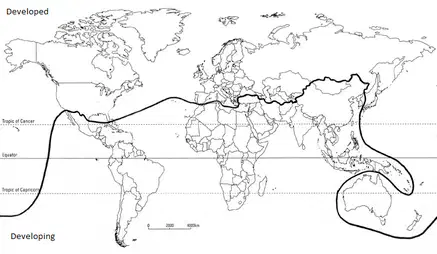
The ______ in 1980, created a partition between the 'developed' North and 'developing' South.
The Brandt Line
The global line
Global North and South Divider
The Brandt line, proposed by ______ (the German Chancellor) in 1980, created a partition between the 'developed' North and 'developing' South.
Willy Brandt
Mark Brandt
William Brandt
William Brandt
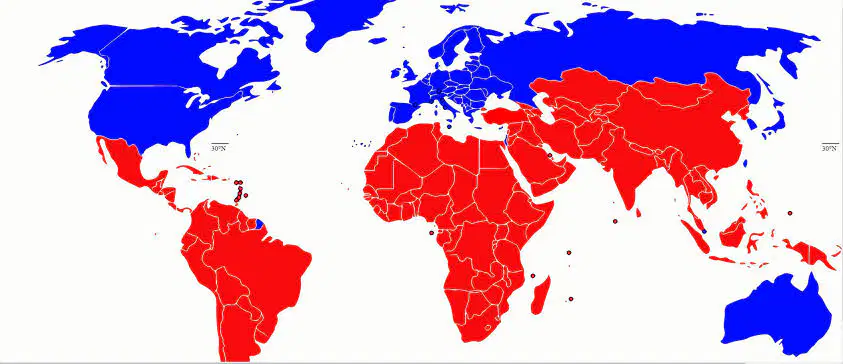
Blue color represents:
Global North
Global South
Which organization is a regional grouping of nation states predominantly occupying the South East Asian locale?
APT
ASEAN
EAS
APEC
It is is a generic term for all human-invented technology that extends the range, speed, or channels of communication (Griffin, 2012).
media
digital
A form of media that is consisting of paper and ink, reproduced in a printing process that is traditionally mechanical
print media
broadcast media
Media such as radio and television that reach target audiences using airwaves as the transmission medium
Digital Media
Broadcast Media
It is also know as new media.
Digital Media
Broadcast Media
He coined the term “global village” in 1964.
Marshall McCLuhan
Marshall McLuhan
He coined the term “global village” in 1964.
Marshall McCLuhan
Marshall McLuhan
This takes place when a country dominates others through its media exports, including advertising messages, films, and television and radio programming.
Cultural Imperialism
Media Culture
This is the development of new culture by merging two or more than two different cultures through a period of contact and interaction.
cultural hybridization
cultural homogenization
Cultural homogenization is an aspect of cultural globalization, which refers to the reduction in cultural diversity.
TRUE
FALSE
In the twentieth century, global media simply means technology/digital media.
TRUE
FALSE
What is the oldest and most enduring medium of communication?
Digital
Oral
Script
What was the consequence of the advent of the printing press?
Decrease in literacy
Increase in information control
Revolutionized every aspect of life
Weakening of cultural exchange
What do media corporations actively bring about in terms of culture?
Cultural Exchange
Cultural Conflict
Cultural Differentialism
Cultural Convergence
What is one of the main challenges in global media cultures?
Lack of creativity in local content
Unequal access to digital resources
Decline in global media usage
None of the above
It is a set of beliefs, practices and values that guide the behavior and worldview of a group of people.
Belief
Culture
Religion
Superstitions
Religion is not influenced by globalization.
True
False
Christianity is not considered to be a major world religion.
True
False
Hinduism is one of the five major world religions.
True
False
Religion is globalization because it can be spread efficiently with the help of technology.
True
False
Globalization led the spread of religious ideas and practices around the world.
True
False

The interconnection of the world today is often referred to as
Nationalism
Communism
Globalization
Isolationism
Globalism and Religion have a good relationship
True
False
What is the oldest living religion on Earth?
Buddhism
Christianity
Hinduism
Judaism
What is the primary role of religion in global conflicts?
Source of conflict
Source of peace
Cultural exchange
Economic development
Which religion has the most followers?
Christianity
Islam
Hinduism
Buddhism
How are younger generations using technology to connect with others?
By using social media
By attending religious services
By practicing meditation
By studying religious texts
Most of today's major global cities are also world cities.
True
False
Check all that applies: What are the challenges of Global Cities?
Inequality
Resources
Technology
Environmental Threats
Governance
Check all that applies: What are the salient features of Global Cities?
International and national connectivity
International cuisine
International Culture
International Infrastructure
Global Economic and political importance
Check all that applies: Global Cities Key indicators
I. Skyscrapers
II. Large metropolitan area
III. Personal wealth, e.g., number of billionaires
I and II only
Check all that applies: Global Cities
Tokyo
New York
Shanghai
Melbourne
Manila
What is the term that describes the movement of people from one place to another?
Traveling
Urbanization
Migration
Globalization
All are characteristics of Global City EXCEPT one:
The cultural diversity of the people
Existence of a center of economy
Taking risks.
Global reach performance
Which of the following best describes the primary function of global cities in the 21st century?
They primarily serve as cultural heritage sites.
They act as nodes of interconnectedness in global trade and finance.
They focus on agricultural development.
They are mainly residential areas.

What does the term 'sustainable' mean?
The implementation of eco-friendly technologies.
A balance between meeting today's needs with those of the future
The use of alternative energies

The sustainable development goals come into effect on 1 January 2016. When are they due to expire?
2030
2050
2100
2020

How many sustainable development goals are there?
27
17
5
7
Which of the following is not a sustainable development goal?
Eliminate racism in all its forms
Climate action
Clean water and sanitation
Good health and well-being

To which countries are the sustainable development goals designed to apply?
Low and middle-income countries, not high-income countries
All countries
Only countries where 50% of the population live below the poverty line
Only countries in Sub-Saharan Africa

Which SDG is considered the greatest global challenge?
Global energy system transformation
Eradicate poverty worldwide
Education for all

Who monitors the achievement of the SDGs?
The national governments control themselves
A UN commission evaluates implementation on the basis of an annual SDG progress report by the UN Secretary-General
A specially founded SDG body by the USA

[GOAL 2] Do we produce enough food to feed the whole world?
No, we need to produce more
Yes, but it is unequally distributed and not
everyone has access
That depends on the year
Who implements the SDGs?
UN
ASEAN
World Health Organization
World Trade Organization

What does this icon represent?
life below water
sustainable cities and communities
climate action
life on land

What does this symbol stand for?
affordable and clean energy
sustainable cities and communities
climate action
life on land
What year were the Sustainable Development Goals created?
2015
2000
1995
2018 during pandemic
How can individuals practice responsible consumption?
Practice mindful purchasing, choose sustainable products, reduce waste, and support local businesses.
Purchase only imported goods
Ignore product labels and certifications
Buy products based on advertisements
What are the characteristics of sustainable cities?
High levels of traffic congestion
Efficient public transport, green spaces, renewable energy use, waste reduction, and community engagement.
Excessive reliance on fossil fuels
Limited access to clean water
What is the primary goal of Climate Action?
To mitigate climate change and promote sustainability.
To focus solely on economic growth without considering environmental impacts.
To promote fossil fuel usage and discourage renewable energy.
To increase carbon emissions and reduce environmental awareness.
How can businesses promote responsible consumption?
Encourage fast fashion trends
Limit product availability
Increase product prices
Educate consumers, offer eco-friendly products, implement recycling programs, and promote minimalism.
What technologies can improve access to clean water?
Water filtration systems, solar-powered pumps, rainwater harvesting, desalination, mobile purification units.
Chemical fertilizers
Plastic water bottles
Water softeners
What strategies can be implemented to reduce plastic waste?
Encouraging single-use plastics
Recycling programs, promoting reusable products, and raising public awareness.
Increasing plastic production
Limiting access to recycling facilities
What are effective methods for promoting community health?
Implementing health education programs, improving access to healthcare services, and fostering community engagement.
Restricting access to health information
Promoting unhealthy lifestyle choices
Limiting community participation in health initiatives
What strategies can be implemented to reduce plastic waste?
Encouraging single-use plastics
Implementing recycling programs, promoting reusable products, and raising public awareness.
Increasing plastic production
Limiting access to recycling facilities
How can gender equality impact economic growth?
Gender equality positively enhances workforce diversity, increasing productivity, and improving overall economic participation.
Gender equality has no effect on workforce diversity.
Gender equality decreases overall economic participation.
Gender equality leads to higher unemployment rates.

