
 Worksheets
Waves Unit Review
Total questions: 51
Worksheet time: 44mins
The height of a wave
Wavelength
Amplitude
Crest
Trough
Period
The distance between one crest to another crest on a wave
Wavelength
Amplitude
Crest
Trough
Period
The amount of time it takes to complete one wave or cycle
Frequency
Period
Wave Speed
Wavelength
Amplitude
The number of waves (cycles) that pass a given point in one second of time
Frequency
Period
Wave Speed
Wavelength
Crest
The highest point on a wave
Frequency
Period
Amplitude
Trough
Crest
The lowest point on a wave
Frequency
Period
Amplitude
Trough
Crest
A wave vibrating at right angles to the direction of travel. (E.g wave vibrates up and down, but travels left to right)
Transverse Wave
Normal Wave
Mechanical Wave
Longitudinal Wave
Perpendicular Wave
A wave vibrating in the same direction of travel (e.g waves vibrates left to right, wave moves left to right)
Transverse Wave
Normal Wave
Mechanical Wave
Longitudinal Wave
Perpendicular Wave
A wave that travels through a medium (matter)
Transverse Wave
Normal Wave
Mechanical Wave
Longitudinal Wave
Perpendicular Wave
A wave is a disturbance that transfers ________ from one place to another.
Matter
Mass
Energy
What types of waves can travel through empty space AND mediums?
Longitudinal
Mechanical
Electromagnetic
Which 2 types of waves require a medium to travel?
Electromagnetic
Mechanical
Light
Sound
Which of the following is a mechanical wave?
X-ray
Infrared
Radio waves
Sound
What medium do sound waves travel fastest through?
Solids
Liquids
Gases

The height of a wave from its resting point (B).
Frequency
Wave speed
Wavelength
Amplitude
As wavelength decreases, the crests of the wave:
become wider
become shorter
get closer together
get farther apart
If a wave has a long wavelength, it will have __________ energy.
High
Medium
Low
If a wave has a short wavelength, it will have __________ energy.
High
Medium
Low
If a wave has a high frequency, it will have __________ energy.
High
Medium
Low
If a wave has a high amplitude, it will have __________ energy.
High
Medium
Low

Which letter represents amplitude? (a)

Which wave has the shortest wavelength?
1
2
3
4

Which wave has highest frequency?
A
B
C
D

Letter G represents...
Compression
Rarefaction
Wavelength
Amplitude.

Which of these waves has the longest wavelength?
P
Q
R
S

Which of these waves has the smallest amplitude?
P
Q
S
T

Letter B represents...
rarefaction
compression
wavelength
amplitude
Sound waves are an example of
S-waves
transverse waves
longitudinal waves
EMR waves

Which statement is correct about the wave shown in the diagram?
It is a transverse wave because the particles are moving perpendicular to the motion of the wave.
It is a transverse wave because the particles are moving parallel to the motion of the wave.
It is a longitudinal wave because the particles are moving perpendicular to the motion of the wave.
It is a longitudinal wave because the particles are moving parallel to the motion of the wave.

The two waves are similar in...
frequency
amplitude
wavelength
energy

Which wave is carrying more energy?
The blue wave because it has a larger amplitude.
The blue wave because it has higher frequency.
The red wave because it has higher amplitude.
The red wave because it has higher frequency.
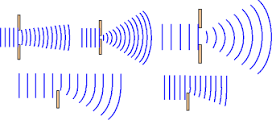
Diffraction
Interference
Refraction
Reflection
Absorption

Reflection
Refraction
Diffraction
Interference
Absorption

Constructive Interference
Destructive Interference
Reflection
Refraction
When a wave strikes an object and bounces off of it
Absorption
Diffraction
Refraction
Reflection

absorption
diffraction
reflection
refraction
interference

The angle of incidence is _________ the angle of reflection


refraction
diffraction
angle of reflection
angle of incidence

refraction
diffraction
angle of reflection
angle of incidence


As objects move in space, their wavelengths change. This phenomenon is called the...
Coriolis Effect
Doppler Effect
Movement Effect
Black Hole Effect
What is the Doppler Effect?
A change in frequency due to the relative motion of a wave source and an observer
When a wave overlaps with another wave
When a wave bounces off of another object
When a wave bends due to traveling through a different medium
Light can change color due to the Doppler Effect.
True
False

The pitch of a sound wave relates to the wave's _________________.
Amplitude
Frequency
Wavelength
Period

