
 Worksheets
SCLT Q2 review
Total questions: 24
Worksheet time: 13mins
What is species richness?
When an area has a high diversity in species
When an area has species that share an area evenly
When species have similar niches that separate limited resources
When one organism harms another organism while it benefits
What is symbiosis?
Close ecological relationship between two or more organisms of different species that live in direct contact with one another
A relationship between an organism that benefits from another organism that is unaffected by the first organism
A relationship between two organisms that both benefit from one another
When an area has a diversity in species
What symbiotic relationship is the following displaying? Colonial birds clean the teeth of alligators, who in turn protect the birds from predators in the wetlands.
mutualistic
commensalistic
parasitic
predator
Which of the following will NOT affect species richness?
Mining of the area
The adding of a new species to the area
The removal of a plant species in the area
Heavy metal contamination in the water supply
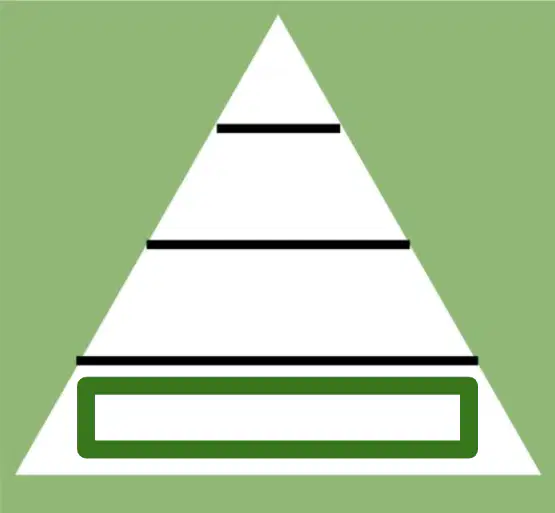
What kind of organism would be found in the identified trophic level?
herbivores
secondary consumers
primary consumers
Cancer is caused by the...
Mutated germ cell from parent to offspring
Mutated somatic cell from parent to offspring
Synthesis of DNA
The uncontrolled growth/division of cells
Succession is a series of steps in which...
(a)
Which of the following is NOT a phase in interphase of the cell cycle?
Gap 1 (G1)
Gap 2 (G2)
M phase
S phase
Which checkpoint in the cell cycle is responsible for checking that DNA has been properly replicated?
G2 checkpoint
S phase checkpoint
M phase checkpoint
G1 checkpoint
Which of the following describes species evenness?
When an area has a high diversity in species
When an area has species that share an area evenly
When species have similar niches that separate limited resources
When one organism harms another organism while it benefits
Primary succession begins with...
With soil still on the ground
A disturbance that leaves organisms like grasses and mosses behind
No soil
A disturbance that leaves soil behind
What symbiotic relationship is the following displaying? Copepods attach themselves to Greenland shark corneas and feed on the eyes, causing them to go blind.
parasitic
mutualistic
commensalitic
competition
G1 phase is in charge of cell…
growth
dna replication
synthesis of dna
mitosis
Biodiversity is…
The limitation of different species represented in an ecosystem or given area
The relative abundance of each species in an ecosystem
The variety of species within an ecosystem
All living or once living components of an ecosystem
Describe the competition in terms of ecosystems.
Name three limited resources for a population of blue jays.
What stage in the cell cycle leads to DNA synthesis?
M phase
S phase
G1 Phase
G2 Phase
From what source do plants absorb their energy?
Water
Sun
Soil
Acid rain

This is an example of a(n)...
Logistic growth graph
Exponential growth graph
Survivorship curve
Slope growth curve
A producer absorbs 32,000 J of energy from its environment. How much energy would an organism from the 2nd trophic level absorb?
3200 J
320 J
32000 J
3.2 J
Which of the following would NOT be a possible reason for cancer to occur in an individual?
All are possible reasons for cancer to develop
toxic waste exposure
genetic mutation
UV exposure
The maximum population that can be supported by a particular environment in terms of resources is called
Carrying capacity
Biodiversity
Density-independent factors
density-dependent factors
Cells spend most of their lifetime in which phase?
Interphase
mitosis
M phase
S phase
T/F: Abiotic factors are any living or once living factors in an ecosystem.
True
False

