wayground logo

Free Printable Worksheets

Font size

S
M
L
XL
Worksheets

Schumacher- The Geography of Europe Test

Total questions: 53

Worksheet time: 18mins

Name
Class
Date
1.
Why is Europe called “a peninsula of peninsulas?”
a)
Because it is one large continent made up of many peninsulas
b)
Because it is a large peninsula that consists of many small peninsulas
c)
Because it is a center of historical significance
d)
Because it consists of many peninsulas on the Austrian continent
2.
Which of the following are part of the Northern Peninsulas?
a)
The Scandinavian Peninsula
b)
The Iberian Peninsula
c)
The Balkan Peninsula
d)
All of the above
3.
Which of the following make up Europe’s southern peninsulas?
a)
The Scandinavian, Balkan, and Iberian
b)
The Iberian, Italian, and Balkan
c)
The Scandinavian and Jutland
d)
All of the above
4.

The largest mountain range in Europe is called the (a)   .

Choose from the below words
Appalachian
Apennine
Balkan
Alps
5.
Which of the following European rivers touches nine countries?
a)
The Nile
b)
The Rhine
c)
The Danube
d)
All of the Above
6.
Which of the following resources are found in Europe?
a)
Coal
b)
Iron-ore
c)
Oil and natural gas
d)
All of the above
7.
What is the most predominant climate in Europe?
a)
Humid continental
b)
Mediterranean
c)
Marine West Coast
d)
Humid Subtropical
8.
What is the North Atlantic Drift?
a)
A drift of cold air that annually affects the climate in Europe
b)
A current of cold air from the northwest and outer peninsulas
c)
A breach of warm weather from the southern region
d)
A current of warm water from the tropics
9.
Where is the tundra climate found in Europe?
a)
In far northern Scandinavia, along the Arctic Circle
b)
At the northern tip of Iceland
c)
Around the Iberian Peninsula
d)
Under the Black Sea
10.
Which of the following are problems Europe faces today?
a)
Acid rain and deforestation
b)
Threats from pirates
c)
Declining literacy rates
d)
All of the above
11.
Hot, steady south winds from Africa
a)
Polder
b)
Sirocco
c)
Seaworks
d)
Mistral
e)
Terpen
12.
Seaworks such as dikes and high earthen platforms
a)
Polder
b)
Sirocco
c)
Seaworks
d)
Mistral
e)
Terpen
13.
Structures used to control the seas destructive impact on human life
a)
Polder
b)
Sirocco
c)
Seaworks
d)
Mistral
e)
Terpen
14.
A cold, dry north wind
a)
Polder
b)
Sirocco
c)
Seaworks
d)
Mistral
e)
Terpen
15.
Land reclaimed by draining
a)
Polder
b)
Sirocco
c)
Seaworks
d)
Mistral
e)
Terpen
16.

Match the following regions with their geographical classification.

a)

Mediterranean Europe

1.

Spain, Italy, Greece

b)

Western Europe

2.

France, Germany, Belgium

c)

Northern Europe

3.

The United Kingdom, Ireland, the Nordic countries

17.

(a)   experienced feudalism during the Middle Ages.

Choose from the below words
Mediterranean Europe
Western Europe
Northern Europe
18.
The Reformation started here
a)
Mediterranean Europe
b)
Western Europe
c)
Northern Europe
19.
Geographic advantages helped the region flourish at an early time.
a)
Mediterranean Europe
b)
Western Europe
c)
Northern Europe
20.
Helped develop a representative government.
a)
Mediterranean Europe
b)
Western Europe
c)
Northern Europe
21.
The Industrial Revolution started here
a)
Mediterranean Europe
b)
Western Europe
c)
Northern Europe
22.
The economy is centered around manufacturing such as coal and iron ore, along with high-tech service industries and the production of luxury goods.
a)
Mediterranean Europe
b)
Western Europe
c)
Northern Europe
23.
Region where the Renaissance started
a)
Mediterranean Europe
b)
Western Europe
c)
Northern Europe
24.
Centered in Rome, grew rapidly then declined
a)
The Roman Empire
b)
The Ottoman Empire
c)
The Byzantine Empire
d)
The Reformation
e)
Option 4
25.
Caused nations to set up colonies in other lands
a)
Roman Empire
b)
Reformation
c)
Feudalism
d)
Industrialization
26.
Name the Nordic countries.
a)
Denmark, Finland, Iceland, Norway, Sweden
b)
England, France, Spain
c)
Portugal and Spain
d)
Greece, Italy, Switzerland
27.
A political unit made up of a city and its surrounding land.
a)
Federation
b)
Feudal consul
c)
City-state
d)
Anarchist state
28.

Match the following types of government with their descriptions.

a)

Fascist

1.

A government led by a dictator with complete power

b)

European Union

2.

A political and economic union of member states

c)

Monarchy

3.

A government ruled by a king or queen

d)

Republic

4.

A government in which citizens elect representatives to rule in their name

29.
Caused by rivalry and competition in Europe
a)
World War I
b)
World War II
c)
Thirty Years' War
d)
The Troubles
30.
Promotes trade and provides financial support for European nations.
a)
The British Commonwealth
b)
The European Union
c)
The United Nations
31.
A political system in which lords own land in exchange for loyalty.
a)
Democracy
b)
Feudalism
c)
Monarchy
d)
Federation
32.
A period when many people joined the Protestant church
a)
Industrialization
b)
Feudalism
c)
Reformation
d)
Roman Empire
33.

A renewed interest in learning and the arts is known as the (a)   .

Choose from the below words
The Reformation
The Renaissance
The Freedom Movement
The Era of Exploration
34.
A series of holy wars that began in 1096.
a)
The Napoleonic Wars
b)
The Renaissance
c)
The Crusades
d)
The Thirty Years War
35.
Who launched the Age of Exploration?
a)
Italy and Greece
b)
England
c)
Portugal and Spain
36.
What are the dominant countries in western Europe?
a)
France and Germany
b)
France and Russia
c)
The Netherlands and France
d)
The United Kingdom and the Netherlands
37.

Northern Europe’s modern art/culture has been greatly influenced by (a)   .

Choose from the below words
Dante
Shakespeare
Lenin
Henry VIII
38.
Bach, Beethoven, and Mozart:
a)
Are famous musicians from countries in Western Europe
b)
Are musicians that moved to the United States from Europe
c)
Are an important source of folk art
d)
D. All of the above
39.
Great Britain:
a)
Helped develop a representative government
b)
Started the Industrial Revolution
c)
Build a global empire
d)
All of the above
40.
When Germany reunited:
a)
The Berlin Wall went up.
b)
East Germany became democratic.
c)
Stalin was removed from power.
d)
None of the above.
41.
Which countries are a part of the United Kingdom? Select all that are included:
a)
England
b)
Ireland
c)
Northern Ireland
d)
Scotland
e)
Wales
42.

The Euro is the currency of the European Union. (a)   .
Choose from the below words
True
False
43.
Brexit is when the United Kingdom left the European Union.
a)
True
b)
False
44.
Michelangelo, Leonardo da Vinci, and Magellan were all Renaissance artists.
a)
True
b)
False
45.
The Apennine Mountains run through the Iberian Peninsula.
a)
True
b)
False
46.
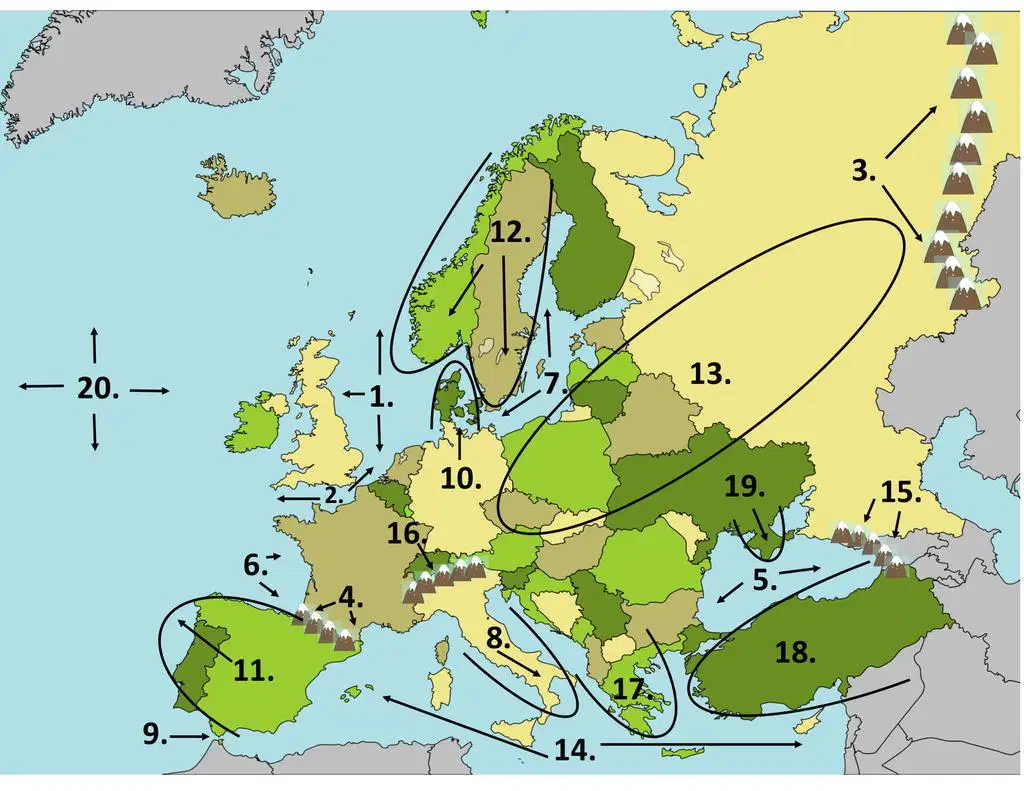
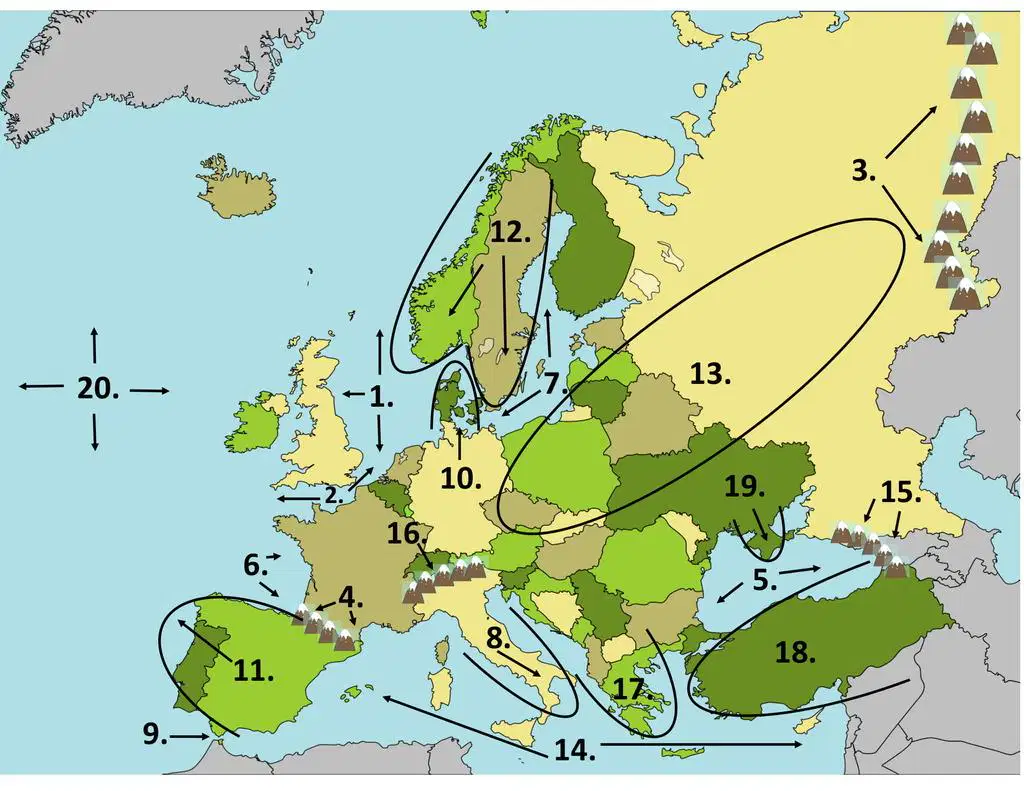
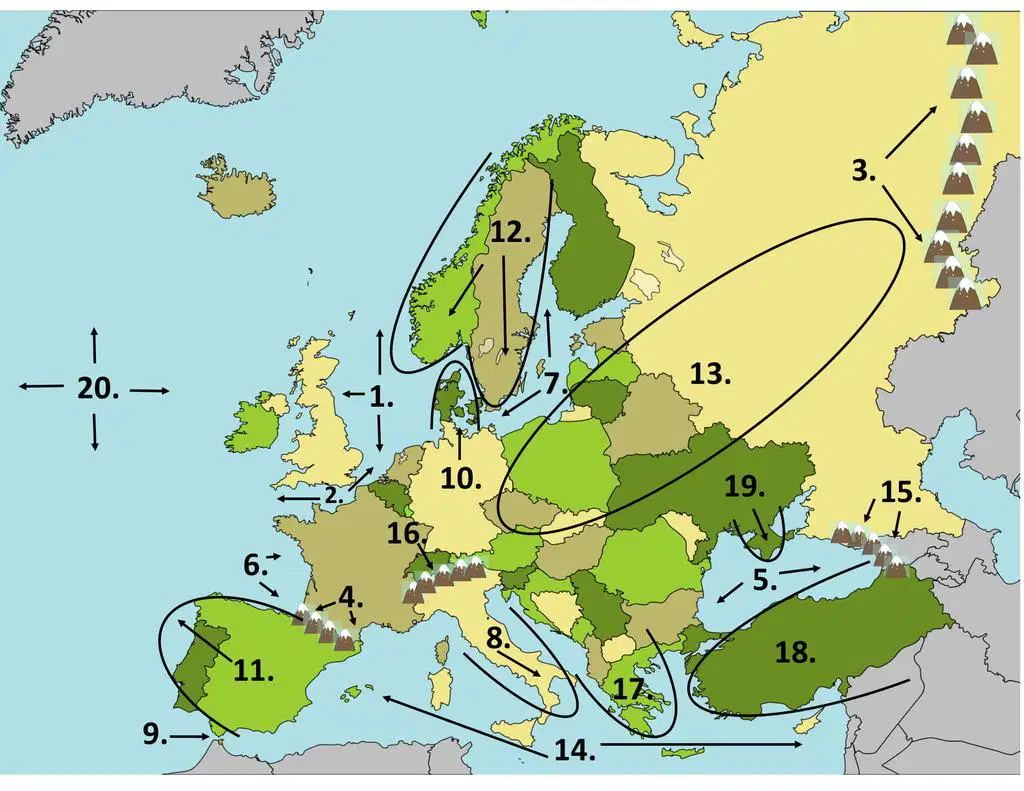
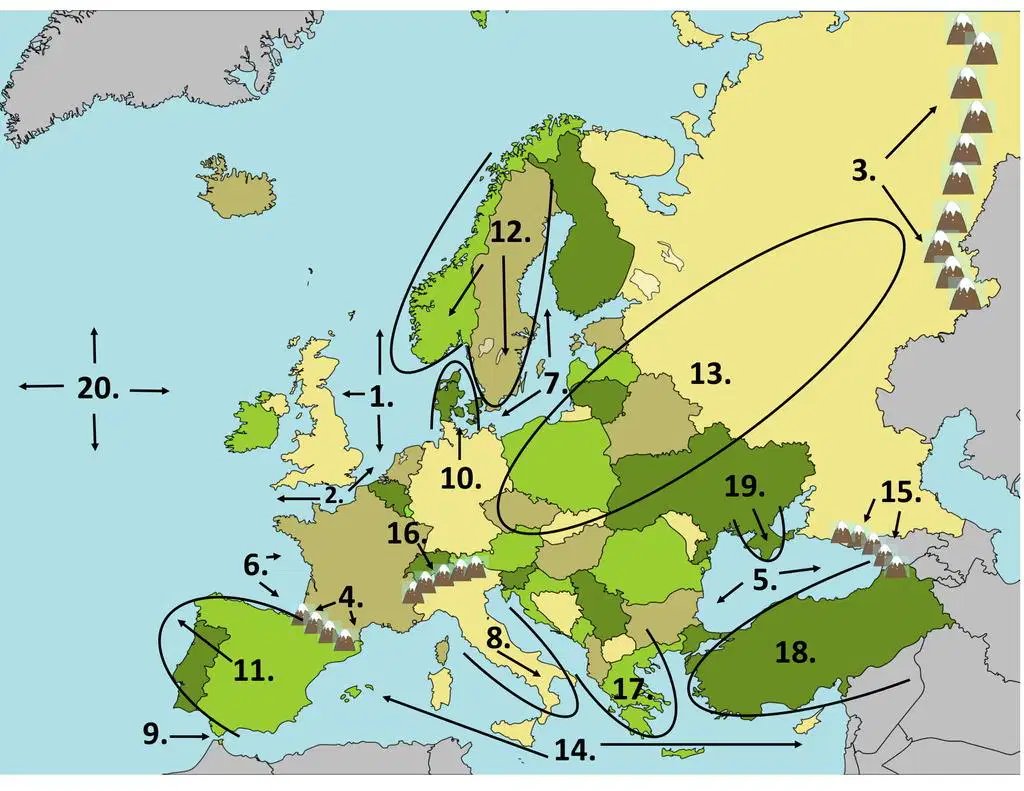
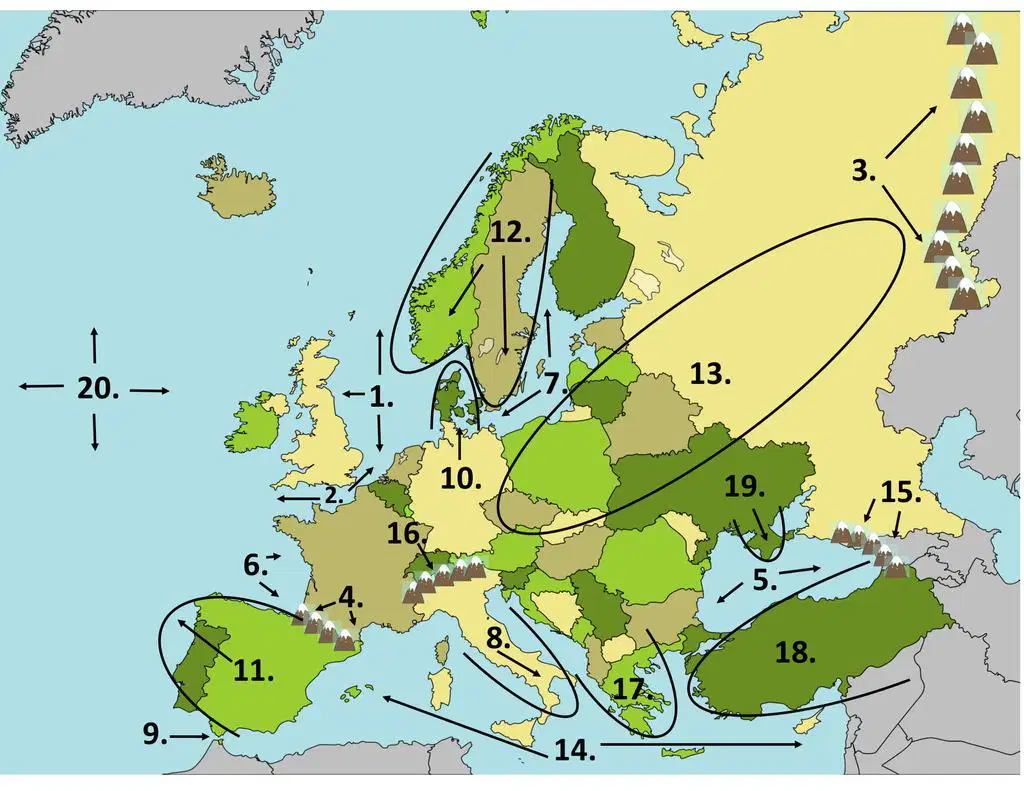
What physical features is depicted in #9?
a)
Strait of Gibraltar
b)
English Channel
c)
Adriatic Sea
d)
North Sea
e)
Alps Mountains
47.
What physical features is depicted in #16?
a)
Alps Mountains
b)
English Channel
c)
Adriatic Sea
d)
North Sea
e)
Strait of Gibraltar
48.

What physical features is depicted in #1?

a)
Alps Mountains
b)
English Channel
c)
Adriatic Sea
d)
North Sea
e)
Strait of Gibraltar
49.

What physical features is depicted in #4?

a)
Alps Mountains
b)
English Channel
c)

Pindus Mts.

d)
North Sea
e)

Pyrenees Mts.

50.
What physical features is depicted in #2?
a)
English Channel
b)
Adriatic Sea
c)
North Sea
d)
Strait of Gibraltar
e)
Alps Mountains
51.

What physical features is depicted in #6?

a)
English Channel
b)
Adriatic Sea
c)

Bay of Biscay

d)
Strait of Gibraltar
e)
Alps Mountains
52.
What physical features is depicted in #14?
a)
Mediterranean Sea
b)
English Channel
c)
Adriatic Sea
d)
North Sea
e)
Strait of Gibraltar
53.
What physical features is depicted in #12?
a)
Scandinavian Peninsula
b)
Adriatic Sea
c)
North Sea
d)
Strait of Gibraltar
e)
Alps Mountains