
NEW
Font size
S
M
L
XL
 Worksheets
BIOLOGY: 1st Partial Review
Total questions: 27
Worksheet time: 14mins
Name
Class
Date
1.
Which of the following options is NOT what people would have thought were the causes of an epidemic before the invention of the microscope?
a)
The town where the disease started is haunted by demons or witches.
b)
The town where the disease started is afflicted by an evil curse.
c)
The town where the disease started is being punished by God.
d)
The town where the disease started has a germ causing the infection.
2.
What is abiogenesis, also known as "spontaneous generation"?
a)
The belief that living things could be formed from non-living things.
b)
The belief that non-living things could be formed from living things.
c)
The belief that plants are not living things because they don't move.
d)
The belief that the meat from a dead animal is still a living thing.
3.
Who was the scientist who use the term "cells" for the first time?
a)
Robert Hooke
b)
Robert Downey Jr.
c)
Anton van Leeuwenhoek
d)
Captain Hook
4.
What was the name that Anton van Leeuwenhoek gave to the microorganisms he observed in water?
a)
Animalcules
b)
Germs
c)
Animaniacs
d)
Moleculanimals
5.
What is the level of organization of life made by a group of organs that work together to perform vital functions?
a)
Tissue
b)
Organ
c)
System
d)
Organism
6.
Which of the following is the correct form of one of the principles of the Cell Theory?
a)
Virus are the smallest units of life.
b)
All organisms are composed of more than one cell.
c)
All cells come from pre-existing cells.
d)
All organisms have organs.
7.
Before the postulation of the Germ Theory, people believed in the Miasma Theory. What did the Miasma Theory say was the cause of diseases instead of germs?
a)
Breathing bad or poisonous air was the cause of diseases.
b)
Drinking dirty water was the cause of the diseases.
c)
Sudden changes in temperature were the cause of diseases.
d)
Contamination of the soil and eating uncooked meat.
8.
Select the correct part of the microscope described: The lens that has the magnifying power necessary for specimen visualization (you change it by rotating the nosepiece).
a)
Objective
b)
Condenser
c)
Eyepiece
d)
Coarse focus knob
9.
Select the correct part of the microscope described: The moving part that opens and closes to allow you to adjust the amount of light from the illuminator that reaches the glass slide.
a)
Diaphragm
b)
Stage knob
c)
Nosepiece
d)
Coarse focus knob
10.
Select the correct part of the microscope described: The moving part that you can rotate in order to move the stage sideways to move the glass slide in search for something on the sample observed.
a)
Nosepiece
b)
Stage knob
c)
Coarse focus knob
d)
Diaphragm
11.
What is the total magnification power you have by using a standard eyepiece and observing a sample with the high power objective?
a)
40X
b)
400X
c)
100X
d)
1000X
12.
What objective should you use when observing bacteria through the microscope?
a)
Scanning objective
b)
Low power objective
c)
High power objective
d)
Oil immersion objective
13.
You have turned on the microscope, placed your glass slide with a sample on the stage, rotated the nosepiece to the correct objective and increased the brightness of the illuminator, but all you see when looking through the eyepiece is a black circle. What do you need to do?
a)
Open the diaphragm.
b)
Use the coarse focus knob.
c)
Move the stage knobs.
d)
Change the objective.
14.
What organ in our body is the nucleus in the cell comparable to?
a)
The brain
b)
The skeleton
c)
The skin
d)
The heart
15.
What organelle in eukaryotic cells is considered the powerhouse of the cell or its main source of energy?
a)
The mitochondria
b)
The cytoplasm
c)
The nucleus
d)
The ribosomes
16.
What molecule do the Ribosomes need to receive from the nucleolus in order to follow the instructions necessary for protein synthesis?
a)
Messenger RNA
b)
Gossip DNA
c)
Adenosine Triphosphate (ATP)
d)
Command RNA
17.
What organelle in the cells functions as a packaging and delivery system for proteins and lipids?
a)
The Golgi apparatus
b)
The mitochondria
c)
The nucleus
d)
The Rough Endoplasmic Reticulum
18.
Why is the Smooth Endoplasmic Reticulum (SER) called "Smooth", or what makes it different from the Rough Endoplasmic Reticulum (RER)?
a)
The SER doesn't have Ribosomes attached to it.
b)
The SER has less cisternae than the RER.
c)
The SER has Mitochondria attached to it.
d)
The SER has Ribosomes attached to it.
19.
Which of the following is NOT one of the functions of the lysosomes?
a)
Breaking down macromolecules for digestion.
b)
Destroying bacteria and viruses.
c)
Recycling old proteins in the cell.
d)
Delivering finished proteins to the outside of the cell.
20.
What is the structure of the cell membrane?
a)
A double layer or phospholipids.
b)
A double layer of adenosine triphosphates.
c)
A double layer of aminophosphates.
d)
A double layer of glycolipids.
21.
What is the characteristic of active transport that differentiates it from passive transport?
a)
Active transport requires the cell to spend energy for it to happen.
b)
Passive transport requires the cell to spend energy for it to happen.
c)
Active transport doesn't require the cell to spend energy for it to happen.
d)
Passive transport requires the cell to use ATP for it to happen.
22.
Describe the electrochemical gradient that passive transport and active transport follow:
a)
Active: High to low concentration + ENERGY. Passive: Low to high concentration.
b)
Active: Low to high concentration + ENERGY . Passive: High to low concentration.
c)
Passive: High to low concentration + ENERGY. Active: Low to high concentration.
d)
Passive: Low to high concentration + ENERGY. Active: High to low concentration.
23.
Which of the following molecules would NOT be transported by active transport?
a)
Carbohydrates
b)
Aminoacids
c)
Inorganic ions (Na+, K+, phosphates, sulfates, etc.)
d)
Carbon dioxide
24.
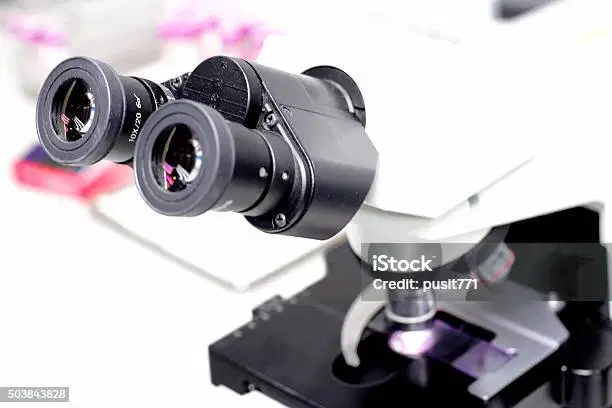
Select the part of the microscope that is shown in the picture.
a)
Condenser
b)
Objective
c)
Eyepiece
d)
Nosepiece
25.
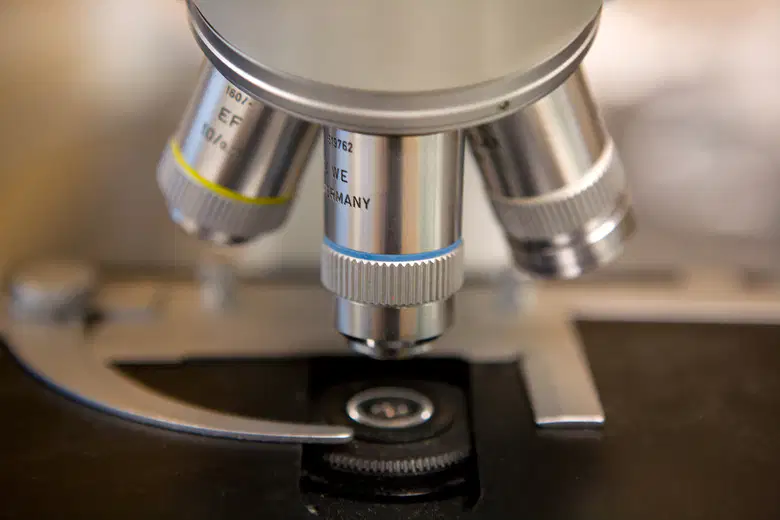
Select the part of the microscope that is shown in the picture.
a)
Coarse adjustment knob
b)
Objective
c)
Eyepiece
d)
Illuminator
26.
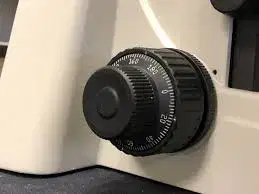
Select the part of the microscope that is shown in the picture.
a)
Coarse adjustment knob
b)
Objective
c)
Eyepiece
d)
Illuminator
27.
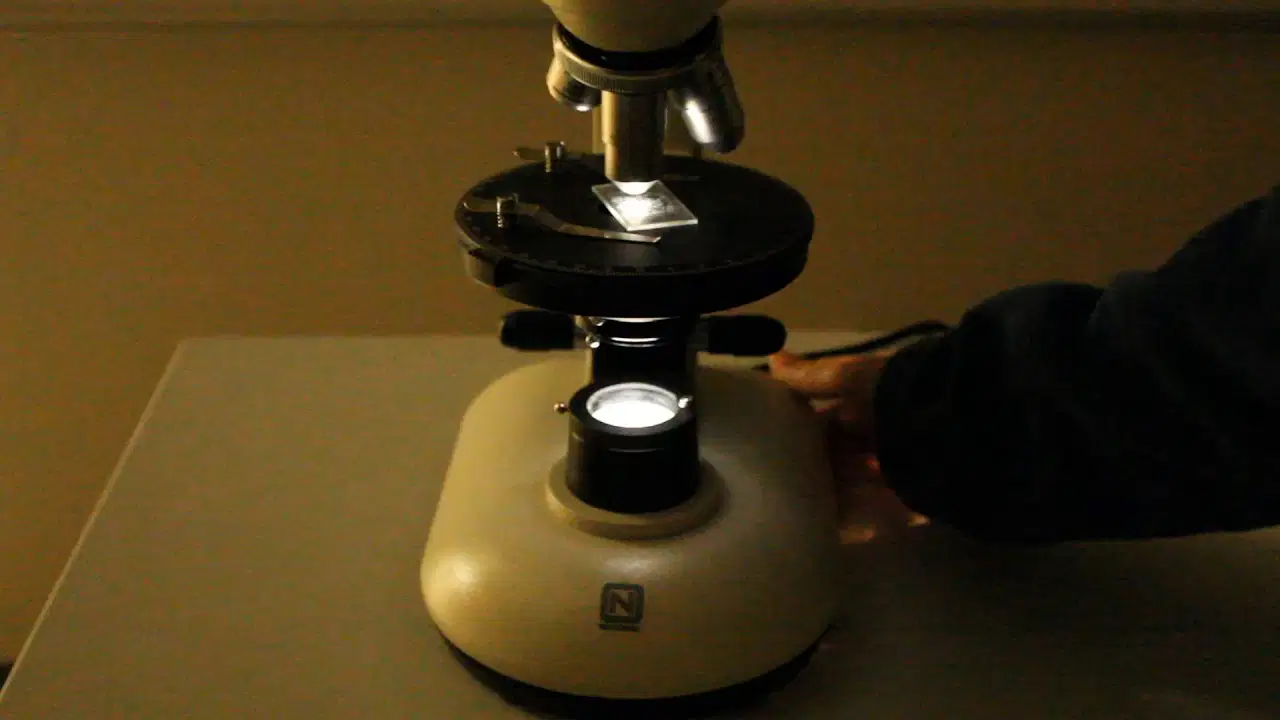
Select the part of the microscope that is shown in the picture.
a)
Coarse adjustment knob
b)
Objective
c)
Eyepiece
d)
Illuminator
Reset

