
 Worksheets
Phylogenic Trees
Total questions: 20
Worksheet time: 10mins
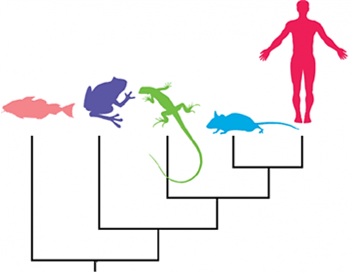
What is the human most closely related to?
Fish
mouse
Salamander
Human
What is the purpose of a cladogram?
To map the ancestral relationships and shared traits of different organisms.
To trace the inherited traits of a single species over time.
To check the likelihood of an offspring having a particular trait.
To monitor mutations that arise among different populations.

What is the common ancestor of Letters A, B, C, D, E?
1
2
3
4

Which group of animals on this tree are most closely related to birds?
Saurischian dinosaurs
Ornithischian dinosaurs
Crocodiles
None of these are related to birds
What is the common ancestor of Letters C and E?
1
2
3
4

The diagram below represents possible genetic relationships between groups of organisms.
Which statement is a valid conclusion that can be drawn from the diagram?
Insects are more complex than mammals.
Earthworms and sea stars have a common ancestor.
Snails appeared on Earth before corals.
Sponges were the last new species to appear on Earth.

According to this tree, which of these animal phyla are most closely related?
Arthropoda & Mollusca
Arthropoda & Chordata
Chordata & Mollusca
A “family tree” made by scientists to show relationships of ancestry and similar traits between organisms.
Cladogram
Scientific Family Tree
Pedigree
DNA Test
What is the human most closely related to?
Fish
mouse
Salamander
Human
What is the purpose of a cladogram?
To map the ancestral relationships and shared traits of different organisms.
To trace the inherited traits of a single species over time.
To check the likelihood of an offspring having a particular trait.
To monitor mutations that arise among different populations.

A
B
C
D
Which group of animals on this tree are most closely related to birds?
Saurischian dinosaurs
Ornithischian dinosaurs
Crocodiles
None of these are related to birds
According to this tree, which of these animal phyla are most closely related?
Arthropoda & Mollusca
Arthropoda & Chordata
Chordata & Mollusca
What is the common ancestor of Letters A, B, C, D, E?
1
2
3
4

Based on the cladogram of bats, which two species are the LEAST closely related
Cynopterus sphinx and Ptenochirus jagori
Haplonycteris fischeri and Dyacopterus spadiceus
Ptenochirus jagori and Ptenochirus minor
Cynopterus sphinx and Otopteropus cartilagonodus

Based on the figure, how long ago lived the most recent common ancestor of the European Brown Bear and the Asian Brown Bear?
470,000 years ago
220,000 years ago
330,000 years ago
140,000 years ago

Who is most closely related to Taxidea taxus?
Lutra lutra
Panthera pardus
Canis latrans
Canis lupus
Which of the following organisms is most closely related to reptiles?
Fish
Mammals
Birds
Amphibians
What does a phylogenetic tree represent?
The evolutionary relationships among various biological species.
The geographical distribution of species.
The genetic mutations within a single species.
The behavioral patterns of different species.
Which of these pairs of species share a more recent common ancestor?
Humans and chimpanzees
Humans and gorillas
Chimpanzees and orangutans
Gorillas and orangutans

