
Font size
 Worksheets
ML Quiz
Total questions: 136
Worksheet time: 1hrs 19mins
A scientist has six objects, three of type X and three of type Y, and wants to determine the weight of each type. The scientist decided to perform two weighings:
She weighs three X objects and one Y object and gets a total weight of 1100 grams.
She weighs one X object and three Y objects and gets a total weight of 1050 grams.
Which of the following linear systems describes the experiment above?
3x = 1100
3y = 1050
3x+3y = 1100
3x+3y = 1050
3x+y = 1050
x + 3y = 1100
3x+y = 1100
x + 3y = 1050
Which of the following matrices can be used to determine the singularity of the system of equations below?
2x+3y=15
2x+4y=16
2 2
3 4
2 15
2 16
3 15
4 16
2 3
2 4

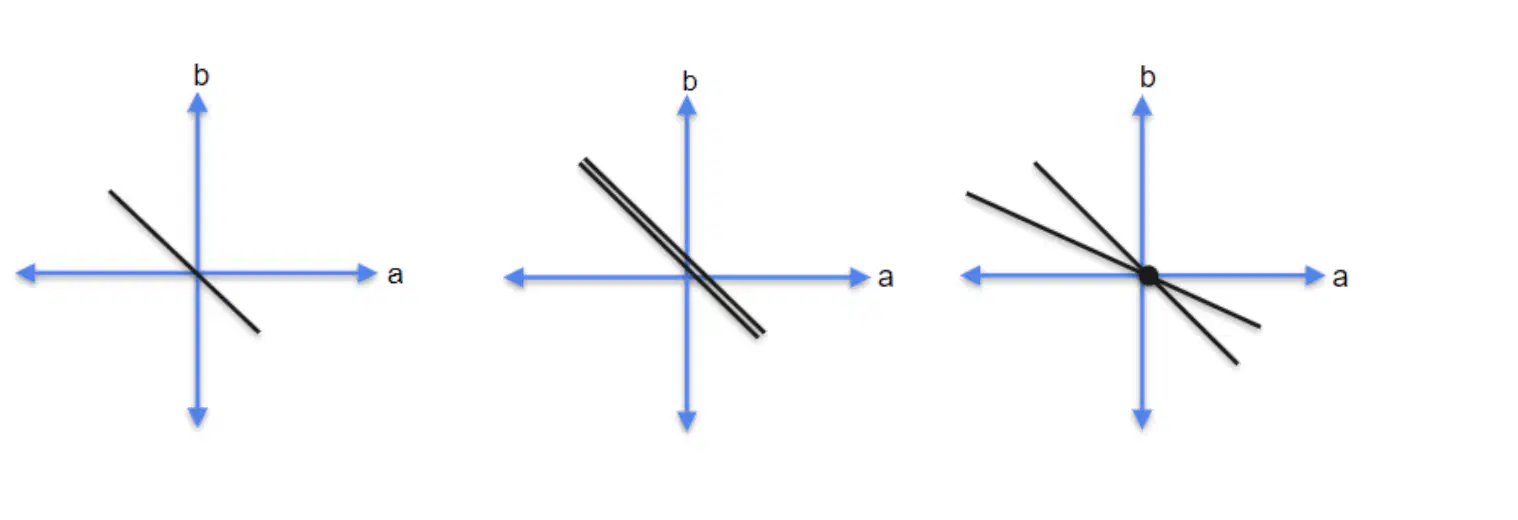
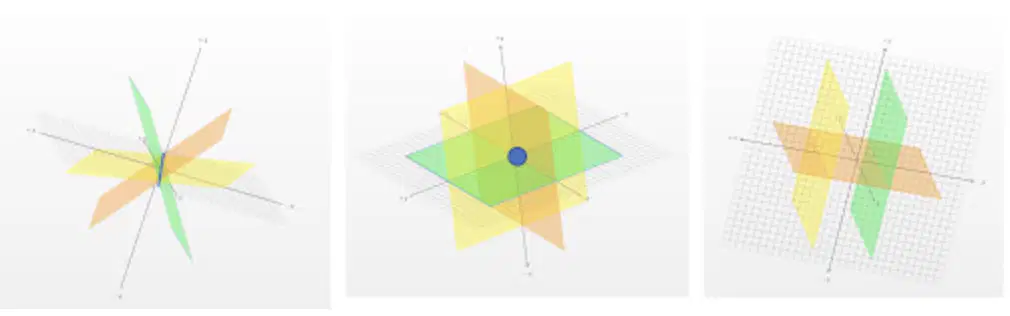
Consider the next three plots below.
Now, consider the next three system of equations below.
System 1 :
3x−2y=1 x+y=3
System 2 :
3x+3y=2 x+9y=6
System 3
x+3y=4 x+3y=3
Each plot represents one of the systems described. Choose the correct option.
Plot 1 represents System 3
Plot 2 represents System 1
Plot 3 represents System 2
Plot 1 represents System 1
Plot 2 represents System 3
Plot 3 represents System 2
Plot 1 represents System 2
Plot 2 represents System 1
Plot 3 represents System 3
Plot 1 represents System 1
Plot 2 represents System 2
Plot 3 represents System 3
Plot 1 represents System 3
Plot 2 represents System 2
Plot 3 represents System 1
Question 1
Calculate the determinant of the following matrix. Is the matrix singular or non-singular?
A=[2 3
2 4]
Hint: To find the determinant apply the formula ad−bc. A matrix of determinant 0 is singular, while a determinant different than 0 represents a complete system, thus a non-singular matrix.
det (A) = 2. The matrix is non-singular.
det (A) = 0. The matrix is singular.
det (A) = 2. The matrix is singular.
det (A) = — 2. The matrix is singular.
Determine if this matrix has linearly dependent or independent rows.
[1 2
2 3]
Linearly independent
Linearly dependent
It can't be determined
A company produces three items: aprons, bags and coasters. The company wants to know how long it takes to produce each item.
On the first day, the company spent 5 hours to make 5 aprons, 10 bags, and 10 coasters.
On the second day, the company spent 7 hours to make 10 aprons, 5 bags, and 15 coasters.
On the third day, the company spent 6 hours to make 4 aprons, 6 bags, and 5 coasters.
Which of the following systems of equations represents the correct information in the above system of sentences?
5a+10b+10c=5
10a+5b+15c=7
4a+6b+5c=6
5a+10b+10c=5
10a+5b+15c=7
10b+5b+6b=5
5a+10a+4a=7
10c+15c+5c=6
5a+10b+10c=0
10a+5b+15c=0
4a+6b+5c=0
Consider the following system of equations:
3x+2y+z = 10
x+y+2z = 5
5x−6y+3z = 2
Which of the following matrices can be used to study the singularity of the system of equations above?
3 2 1
1 1 2
5 -6 3
3 2
1 1
5 -6
3 2 1 10
1 1 2 5
5 -6 3 2
2 1 2
1 2 1
0 0 0
Calculate the determinant of the following matrix:
1 2 1
2 1 1
−1 2 1
−2. Singular.
2. SIngular
-2. Non-singular
0.Singular
Determine if the following matrix has linearly dependent or independent rows.
1 2 3
3 2 1
2 2 1
Linearly independent.
Linearly dependent.
It cannot be determined.
Consider the following matrix.
2 1 5
1 2 1
x y z
For which values x, y and z does the matrix have linearly dependent rows?
x=1
y=3
z=3
x=3
y=3
z=6
x=1
y=2
z=3
Calculate the determinant of the following matrix.
A= 1 2 3
0 2 2
1 4 5
det(A)=0 .The matrix is singular.
det(A)=0. The matrix is non-singular.
det(A)=5 The matrix is non-singular.
Select which of the following are true for non-singular matrices.
In a non-singular matrix, one row can be a multiple of another one.
In a non-singular matrix, rows are linearly independent.
Correct
Non-singular matrices have linearly independent rows.
In a non-singular matrix, rows are linearly dependent.
In a non-singular matrix there is only a unique solution for the represented system of equations.
In a non-singular matrix, one row can be a multiple of another one.
In a non-singular matrix, rows are linearly independent.
In a non-singular matrix, rows are linearly dependent.
In a non-singular matrix there is only a unique solution for the represented system of equations.
Solve the following system of equations using the method of elimination and select the correct answer:
х+у=4
-6х+2у=16
х=1, у=3
the system has no solution
x=-1, y=5
the system has infinitely many solutions
x=0, y=0
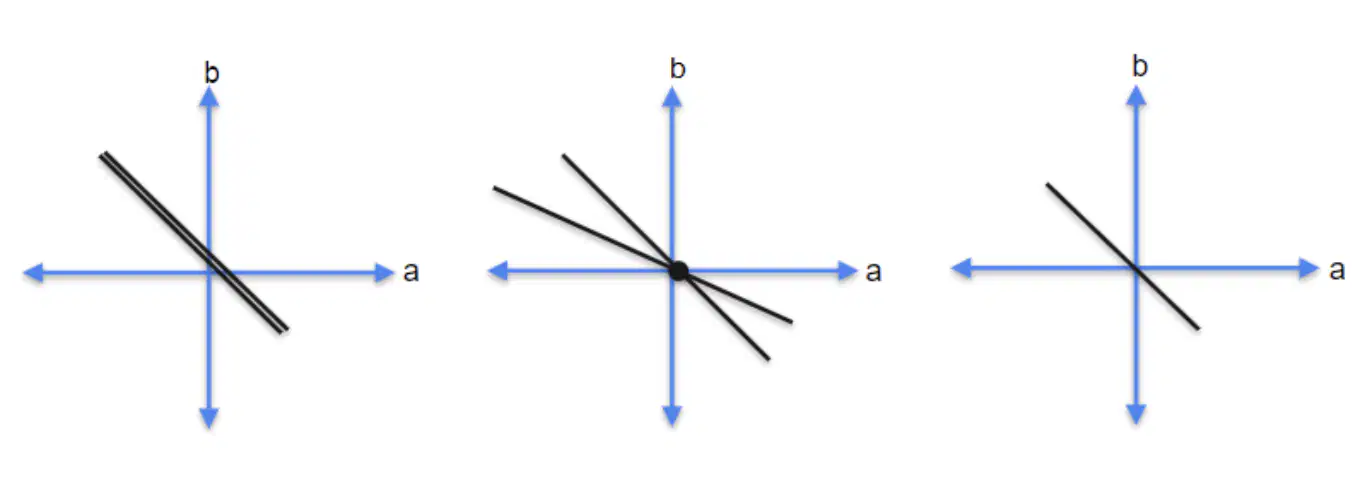
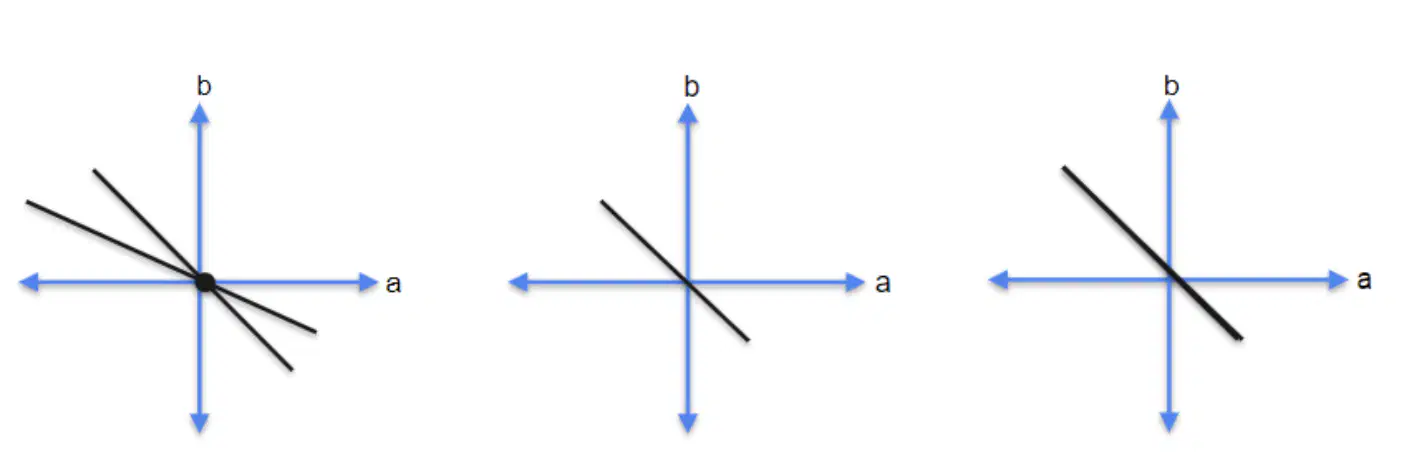
Choose the sequence of lines that represents a linear system such that the systems have, in this order:
Zero solution
Just one solution
Infinitely many solutions
Calculate the determinant of the following matrix and determine if it is singular or non-singular:
-3 8 1
2 2 -1
-5 6 2
36. Non-singular
-80. Non-singular
-20. Non-singular
0. Non-singular
0. Singular
Calculate the determinant of the following matrix and determine if it is singular or non-singular:
A= 4 -3
7 -8
det(A)=-11. The matrix is non-singular.
det(A)=-11. The matrix is singular.
det(A)=-53. The matrix is non-singular.
det(A)=-53. The matrix is singular.
Determine if the provided matrix has linearly dependent or independent rows (a,b,c,d,e,f are real numbers):
a b c
d e f
2a-d 2b-e 2c-f
Hint: Can one row in the matrix be obtained as a result of operations on the other rows?
Independent
Dependent
It cannot be determined
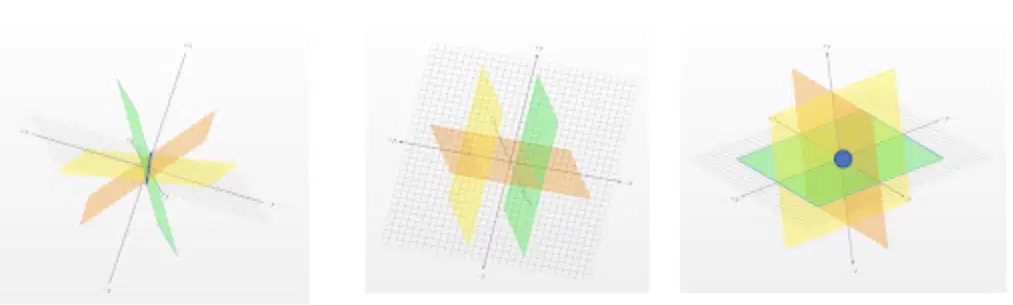
Select the correct sequence of graphs that represents a linear system with, respectively:
Zero solutions
Just one solution
Infinitely many solutions

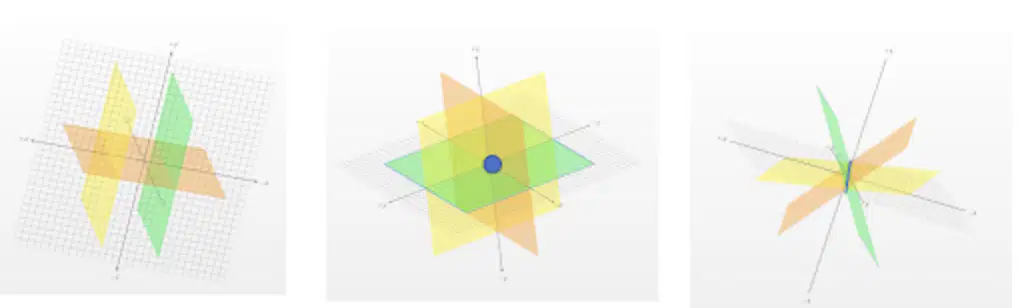
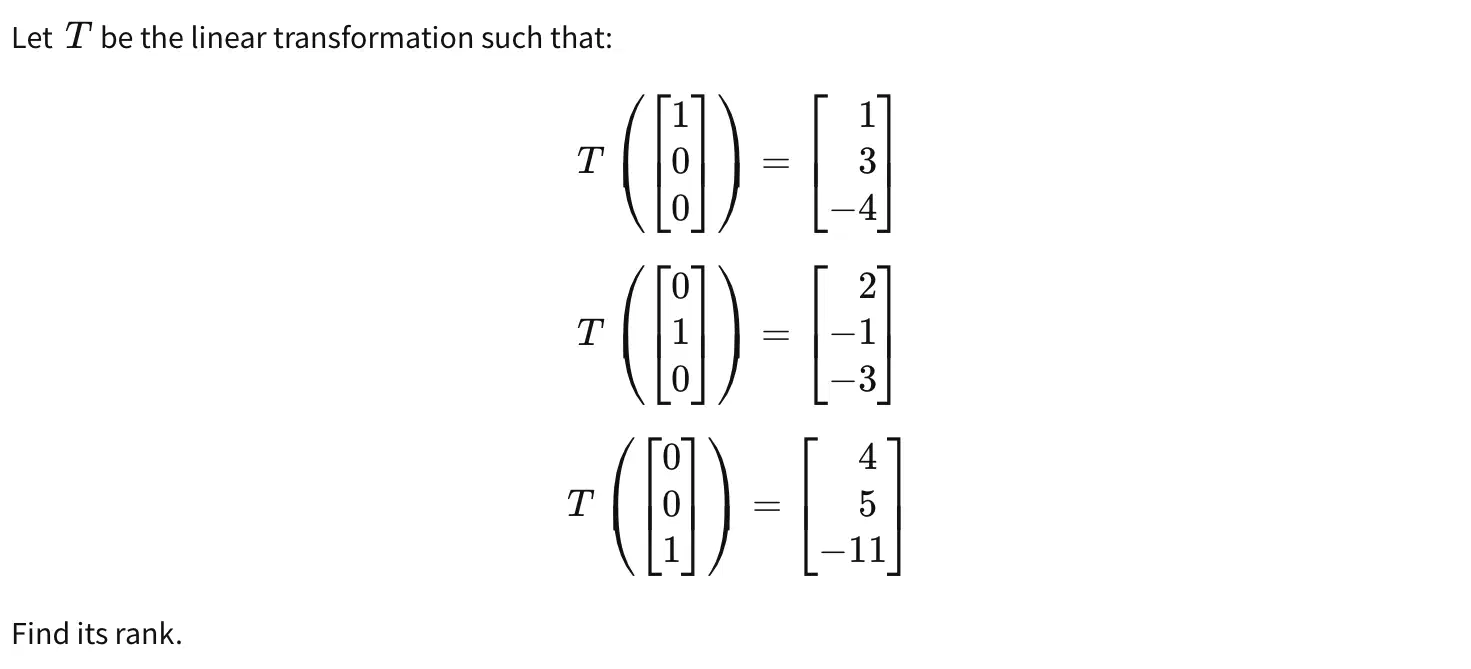
Find its rank
(a)
Let T be a linear transformation in the plane represented by the following matrix:
[1 0
2 3]
The rank of T is:
0
2
3
1
Consider the linear transformation T that maps the vectors (1,0) and (0,1) in the following manner:
T(0,1)=(2,5)
T(1,0)=(3,1)
The area of the parallelogram spanned by transforming the vectors (0,1) and (1,0) is:
(a)
Consider the following three matrices
M1= [2 1
3 1]
M2= [3 5
1 1]
M3= [2 3
4 5]
The determinant of M1⋅M2⋅M3M1⋅M2⋅M3 is equal to:
(a)
Which of the following operations, when applied to the rows of the matrix, do not change the singularity (or non-singularity) of the matrix:
Adding a nonzero fixed value to every entry pf the row.
Multiplying a row by nonzero scalar.
Switching rows.
Adding one row to another one.
Let M and N be two square matrices with the same size.
Check all statements that are true.
If M and N are non-singular matrices, then so is M⋅N
If M is singular, then M⋅N is singular for any matrix N.
If M⋅N is singular, then M and N are singular.
det(M+N)=det(M)+det(N)
Let M be the following 3×3 matrix:
[0 0 1
2 2 1
1 0 0]
Compute det(M^-1).
Please provide your solution in decimal notation not in fraction, using one decimal place.
(a)
In the following matrix:
x x
y z
x, y, and z are non-zero real numbers. If the matrix is non-singular, which of the following must be true:
x=y only if z!=x.
z=y.
z=x only if x=y.
Let M be a square matrix.
Check all that are true.
If M is non-singular, then so is M^(-1).
If det(M)=5, then det(M^n)=5^n
The determinant is the area of a parallelogram spanned by M and the vectors
[1 0]and [0 1]. Therefore, it is always positive.
If M has size n, then it has n distinct eigenvalues.
What is the span of the following vectors?
[2 1 1],
[1 0 2],
[1 0 1]
The entire 3 dimensional space
A plane in a 3 dimensional space
Which of the following options is true for a vector?
A vector has only a magnitude.
A vector has only direction.
A vector has a magnitude and direction.
A vector has shape and weight.

The value for det(M*N) is:
(a)
Consider the following matrix:
M=[3 2
5 8]
The covariance matrix related to this matrix is:
[2 6
6 18]
[0.5 -1.5
−1.5 4.5]
[36 46
46 68]
[10 −10
−10 10]
Select the characteristic polynomial for the given matrix.
M=[2 1
3 6]
λ2−8λ+15
λ2+8λ+15
λ2−8λ−1
λ3−8λ+15
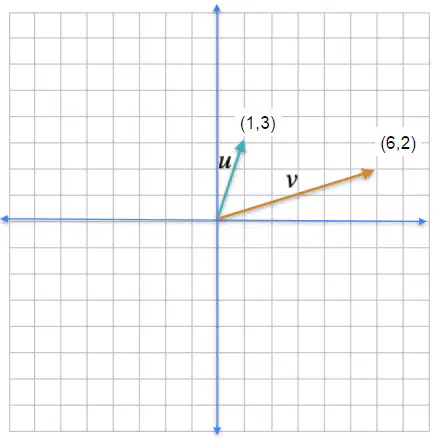
Compute the sum of the vectors u and v Hint: The sum vector is the diagonal in a parallelogram formed by the two vectors, u =(1,3) and v =(6,2).
u + v =3
u + v =20
u + v =(7, 5)
u + v =(6, 3)
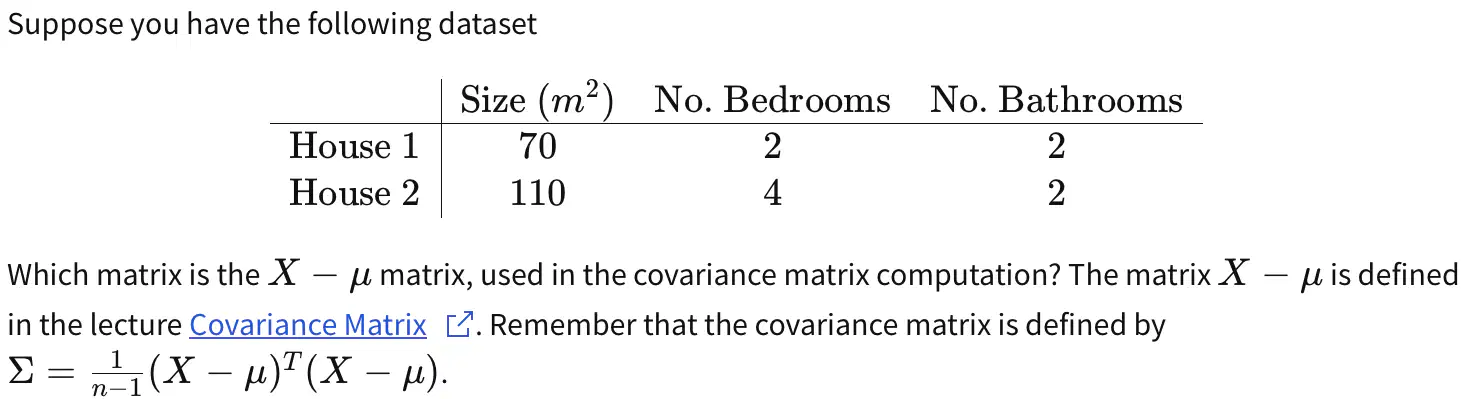
Suppose you have the following dataset
Size (m2)No. BedroomsNo. BathroomsHouse 17022House 211042House 1House 2Size (m2)70110No. Bedrooms24No. Bathrooms22
Which matrix is the X−μX−μ matrix, used in the covariance matrix computation? The matrix X−μX−μ is defined in the lecture Covariance Matrix. Remember that the covariance matrix is defined by Σ=1n−1(X−μ)T(X−μ)Σ=n−11(X−μ)T(X−μ).
X−μ=[ -20 -1 0
20 1 0]
X−μ= [70 2 2
110 4 2]
X−μ= [70 110
2 4
2 2]
X−μ= [ -20 20
-1 1
0 0]
Consider the following matrix
M=[3 0
−2 1]
Check all the options that represent the eigenvectors of this matrix.
[k
−k]
for any k real.
[0
k]
for any kk real.
[1
3]
[k
k]
for any k real
Compute the difference of the vectors u and v
u - v =(-1, 5)
u - v =3
u - v =(-5, 1)
u - v =(5, 1)
Calculate the dot product of the given vectors a⋅b and select the correct answer.
a =[-1 b =[-3
5 6
2 ] -4]
1
0
1
30
-3
30
-8
25
Which matrix is the X−μ matrix, used in the covariance matrix computation?
X−μ=[−20 −20 −1
−1 −0 −0]
X−μ= [70 2 2
110 4 2]
X−μ= [70 110
2 4
2 2]
X−μ= [ -20 20
-1 1
0 0]
For the dataset from question 9, what are the eigenvalues of the covariance matrix?
λ1=802, λ2=0, λ3=0
λ1=0, λ2=0
λ1=17027, λ2=0, λ3=0
Select all the options that are a basis for the 3D





Which of the following options is true for a vector?
A vector has a magnitude and direction
A vector has a shape and weight
A vector has only a magnitude
A vector has only direction

Which of the following is the correct representative system equation for the given dot product?
3x+5y+z=2
7x–2y+4z=1
−6x+3y+2z=20
3x+5y+z=10
7x–2y+4z=2
−6x+3y+2z=15
3x−2y+4z=10
7x–2y+4z=2
−6x+3y+2z=15
Which of the following is true, if a⋅a =0 and a⋅b =0?
a⋅a =1
a =0, b =any veactor
a = 0, b =0
a =0, b =0
Let y1=ax+by1=ax+b and y2=cx+dy2=cx+d, where a,b,c,d∈Ra,b,c,d∈R. Check all the sentences that are true.
The slope of y1 is a
The slope of y1 is - ab
if a > c then slope of y1 is greater than slope of y2
The slope of y1 does not depend on b
Which of the following sentences are true (check all that apply)?
If the slope of a function is constant, then the function is constant.
If the slope of a function is always positive, then the function is always positive.
Let f, g be real functions. If f′(x)>g'(x) then f(x)>g(x).
Let f be a real function. If f′(x)>0 for every x in R, then f is increasing.
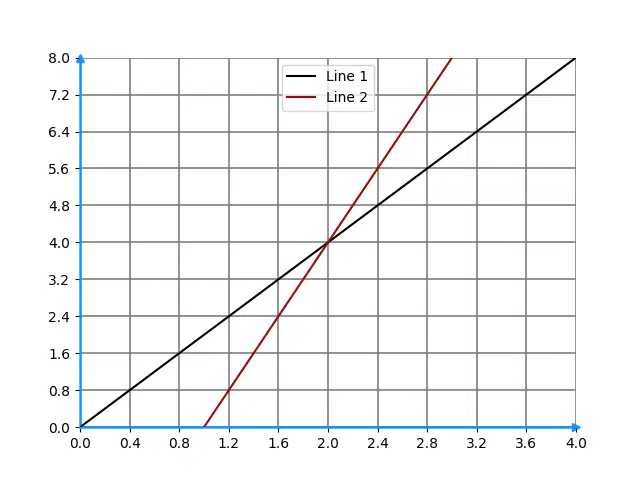
What can be said about their slopes at their intersection?
Slope(Line 1) > Slope(Line 2).
Slope(Line 1) < Slope(Line 2).
Slope(Line 1) = Slope(Line 2).
It is impossible to infer anything with the given information.
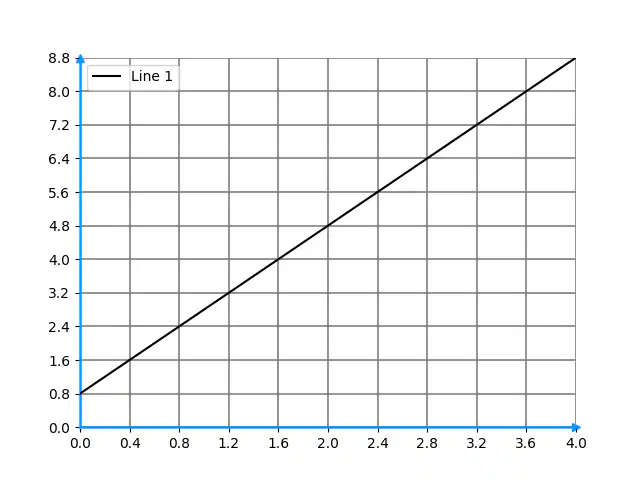
Given the following graph, what is the slope of the line? You can pick any two points to calculate the slope.
(a)

What can be said about the curve’s slopes at the red point, which we will call P1, P2, P3 and P4, corresponding to the red points in the graphs 1, 2, 3 and 4, respectively?
Slope(P1) > 0, Slope(P2) < 0, Slope(P3) does not exist, Slope(P4) = 0.
Slope(P1) < 0, Slope(P2) = 0, Slope(P3) > 0, Slope(P4) does not exist.
Slope(P1) < 0, Slope(P2) = 0, Slope(P3) does not exist, Slope(P4) does not exist.
Slope(P1) < 0, Slope(P2) = 0, Slope(P3) does not exist, Slope(P4) > 0.
Which of the following represents the derivative of a function f(x)f(x) (check all that apply)?
F(x)
f'(x)
f'( x2 )
dxdf(x)
∂f(x)f(x)
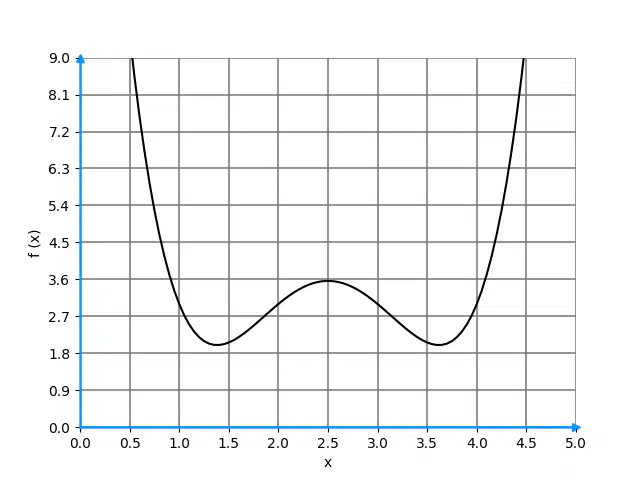
Regarding its derivative, f′(x), where x∈[0,5]: (check all that apply)
f′(x) is always positive.
f′(x) has three zeros, i.e, f′(x)=0 three times.
f′(x) has two zeros, i.e.,
f′(x)=0 twice.
f′(1)<0
f′(4)>0.
What is the derivative of 3x3−2x+1 ?
3x2−2
9x2−2+1
9x2−2
9x3−1
Suppose you have a game where you toss a coin 2020 times and win if you get, in this exact order, 16 heads and 4 tails. However, in this game, you can choose any coin and toss it 20 times.
Which of the following functions you need to maximize in order to find the best coin for this game? Consider p being the probability of a given coin being heads.
16log(p)+4log(p)
16log(p)+4log(1−p)
4log(p)+16log(1−p)
4log(1–p)+16log(1–p)
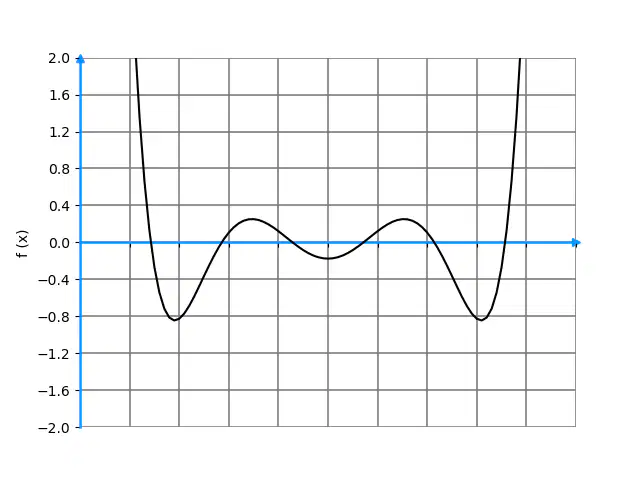
Let f(x)f(x) be a real valued function. How many zeros has its derivative f′(x)f′(x) in the domain plotted in the graph below?
(a)
If f(x) and g(x) are differentiable functions, then the derivative of f(x)g(x) is given by:
f′(x)⋅g(x)+g′(x)⋅f(x)
f′(x)⋅g′(x)+f(x)⋅g(x)
f′(x)⋅g(x)–f(x)⋅g′(x)
f′(x)⋅g′(x)
The rate of change of f(x)=x2+3 at x=6 is:
(a)
Using the chain rule, the derivative of e−x is:
e−x
−ex
−e−x
ex
Let f(x) be a positive real function and g(x)=log f(x)
∂x∂f(x)=∂x∂g(x)
If xmax is a point where f( xmax ) is a local maximum, then g(xmax) is also a local maximum.
If xmax is a point where f( xmax ) is a local maximum, then g( xmax ) is also a local minimum.
If f(x) is differentiable, then so is g(x).
Given that f(x ,y)= x2y+3x2 , find its derivative with respect to x
(a)
Question 2
Given that f(x ,y)=x*y2+2x+3y its gradient, i.e., ∇f(x,y) is:
[2x*y+3
y2 +2]
[2x*y
2*x+3]
[ y2+2
2x*y+3]
[2
0]
Let f(x ,y)= x2+2y2+8y .The minimum value of f is:
(a)
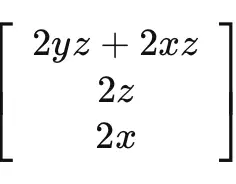
The gradient of f(x, y ,z)= x2+2x⋅y⋅z+z2
[2x + 2*y*z
2*x*z
2*x*y+2z]


About the Gradient Descent method, choose all that are true:
It always converges to a local minimum.
The result may vary depending on the initial point.
If it converges, then it converges to a global minimum.
It only works for differentiable functions.
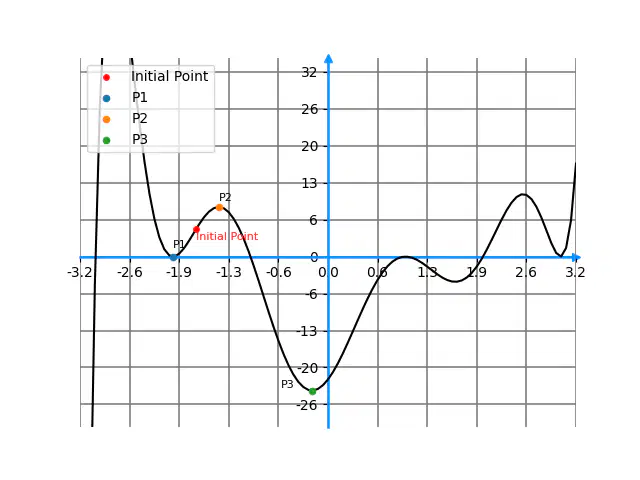
Given the Initial Point on the following graph, to which point will the Gradient Descent method converge?
P1
P2
P3
It won't converge
Let f(x ,y)=2x^2+3y^2−2*x*y−10x, the minimum value of f(x ,y) is
-15
3
1
What are the parameters that the Gradient Descent algorithm has? (check all that apply)
Initial point
Final point
Learning rate
Number of iterations
Let f(x ,y)=x^2+y^2−6x and ∇f(x ,y)=[2x−6 2y] and let the initial point x0=(0,1). Performing the gradient descent algorithm with learning rate = 0.1, the first iteration will lead us the point x1x1 which is:
x1=(0.6,0.8)
x1=(−6,2)
x1=(6,−1)
x1=(0,1)
Using Newton’s method, find an approximation recursive formula for 2
1
2
2
3
Regarding the previous question, suppose you don’t know any approximation for 2 and only that it is a positive real number such that x^2=2. Which value from the list below will result in the fastest convergence?
4
3
2
The initial value does not impact n the Newton's method convergence
Let’s continue investigating the method we are developing to compute the 2 . Remember that we used the fact that 2 is one of the roots of x2−2 . What would happen if we have chosen a negative value as initial point?
The algorithm would not converge.
The algorithm would converge to 2 .
The algorithm would converge to the negative root of x2−2
The algorithm would converge to 0.
Did you know that it is possible to calculate the reciprocal of any numberwithout performing division? (The reciprocal of a non-zero real number a is a1 ).
Setting a non-zero real number aa, use the function f(x)=a − x1=a−x−1 to find such formula.
This method was in fact used in older IBM computers to implement division in hardware!
So, the iteration formula to find the reciprocal of a, in this case, is:
xk+1=2xk−axk2
xk+1=2xk+axk2
xk+1=2xk−xk2
xk+1=xk−axk2
Suppose we want to find the minimum value (suppose we already know that the minimum exists and is unique) of x*log(x) where x∈(0,+∞). Using Newton’s method, what recursion formula we must use?
xk+1=xk−log(xk)+1xklog(xk)
xk+1=xk−xk2log(xk)
xk+1=xk−log(xk)
xk+1=xk−xk(log(xk)+1)
Regarding the Second Derivative Test to decide whether a point with f’(x)=0f’(x)=0 is a local minimum or local maximum, check all that apply.
If f’’(x)<0 then x is a local minimum.
If f’’(x)>0 then x is a local minimum.
If f’’(x)=0 then x is an inflection point.
If f’’(x)=0 then the test is inconclusive.
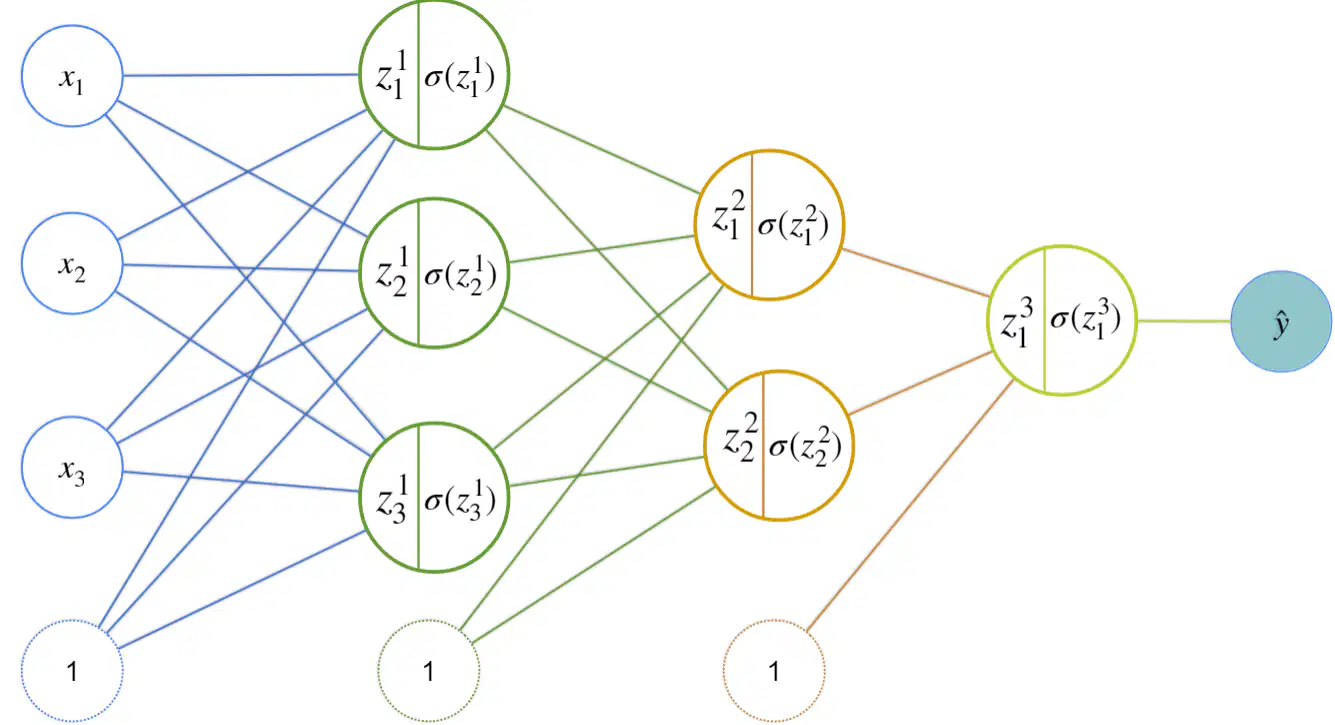
How many parameters has a Neural Network with:
Input layer of size 3
One hidden layer with 3 neurons
One hidden layer with 2 neurons
Output layer with size 1
An image is provided below:
11
8
23
3
Let f(x ,y)=x^2+y^3, then the Hessian matrix,H(x ,y) is:
H(x ,y)=[2x 3y^2
3y^2 2x]
H(x ,y)=[2 0
0 6y]
H(x ,y)=[0 2
6y 0]
H(x ,y)=[0 0
0 0]
Given the following Single Layer Perceptron with Sigmoid function as activation function, and log-loss as Loss Function (L), the value for ∂ω1∂L is:
-(y-y^)
-(y-y^) x1
-(y-y^) x2
1
Suppose you have a function f(x ,y) with ∇f(x0,y0)=(0,0) and such that
H(x0,y0)=[2 0
0 10]
Then the point (x0,y0) is a:
Local maximum.
Local minimum.
Saddle point.
We can’t infer anything with the given information.
You flip a fair coin two times. What is the probability of getting one head and one tail in any order?
21
43
41
You throw two dice and sum the result, what is the probability the sum is equal to 10?
361
181
121
6 1
You throw a six-sided dice 10 times, summing the result in each throw. What is the probability that the sum of results is greater than 10?
Hint: Use the complement rule
61
610(610−1)
65
6101
In an experiment, there are 100 patients. After taking medicine, 50 people experienced a headache and 50 people experienced a fever. The doctors want to find the probability that a patient may experience a headache or fever.
Which of the following statements is true?
Not enough information is to given to calculate
P(fever or headache)
P(fever or headache)=
P(fever)+P(headache)=1
P(fever or headache)= P(fever)*P(headache)=
0.25
A software company conducted a test on their new platform by exposing their users to two versions of the same product.
Number of users that were given version A: 4000
Number of user that were given version B: 5000
Number of users that experienced a bug: 3000
Number of users with version B that experienced a bug: 1500
What is the probability that a user tested Version B, given they experienced a bug during testing?
50%
20%.
40%
10%
In a bag of marbles, there are two disjoint events: AA represents selecting a red marble, and B represents selecting a blue marble. The probability of selecting a red marble is P(A)= 41 , and the probability of selecting a blue marble is P(B)= 31
What is the probability of selecting either a red or a blue marble, P(A∪B) , from the bag?
P(A∪B) = 125
P(A∪B) = 32
P (A∪B) = 127
P( A∪B )= 121
You throw 10 fair coins, what is the probability that coins do not result in all heads?
102102−1
1021
2101
210210−1
In a room, there are 200 people: 30 people only like soccer, 100 people only like basketball, and 70 people like both soccer and basketball.
What is the probability that a randomly selected person likes basketball given they like soccer?
Hint: Find P(B|S), where B is the event of liking basketball and S is the event of liking soccer.
73
207
21
107
Imagine there is a disease that impacts 1% of the population. Researchers devised a test so that people with the disease test positive 95% of the time. People who do not have the disease test negative 90% of the time. If an individual receives a positive test result for the disease, what is the probability that they truly have the disease or P(sick∣testpos∣) ?
Hint: In the description above, you were given P(sick), probability for true positive (or P(testpos∣sick∣) , and probability for true negative (or P(testneg∣ot sick∣) . Use this information to find P(not sick)and P(testpos∣not sick∣) .
Remember that Bayes’ theorem P(A∣B∣)=P(B)P(B∣A∣)⋅P(A) . Also, remember that you may write P(B)=P(B∣E∣)⋅P(E)+P(B∣not E∣)⋅P(not E) , where E is any event and not E=E’.
15.58%
8.76%
42.76%
90%
Which of the following are examples of continuous random variables? Select all that apply.
Weight of a package.
Temperature in degrees Celsius.
Time taken to run a 100-meter race.
Number of cars passing through a toll booth in an hour.
Height of students in a class.
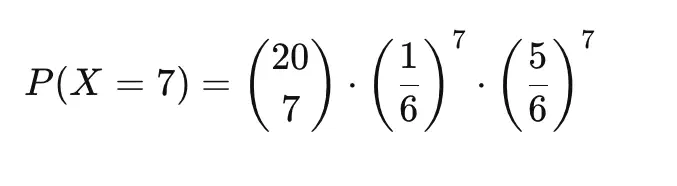
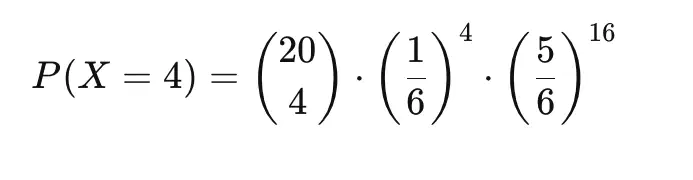
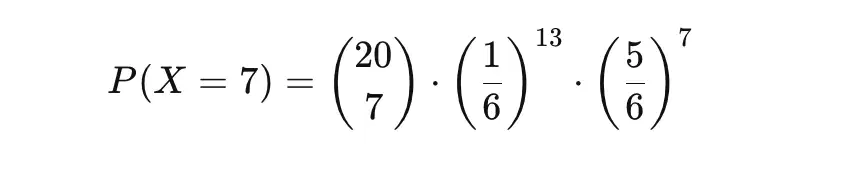
You roll a six-sided die 20 times and want to find the probability that the number 4 appears exactly 7 times. Which of the following equations correctly represents the probability distribution for this scenario?
P(X=7)=(720)(61)7⋅(65)13
Imagine you are tasked with modeling the heights of individuals in a diverse country. Which probability distribution would be most suitable for capturing
Normal Distribution
Uniform Distribution
Binomial Distribution

A taxi cab service analyzes the number of passengers in its daily rides. The table and graph below show the number of passengers, X, in a single taxi cab and the observed probabilities at a randomly selected time.
What is the probability that a randomly selected taxi ride will have less than or equal to 3 passengers?
P(X≤3)=0
P(X≤3)=0.25
P(X≤3)=0.40
P(X≤3)=0.60
P(X≤3)=0.75

Select the correct Cumulative Distribution Function based on the observed probabilities


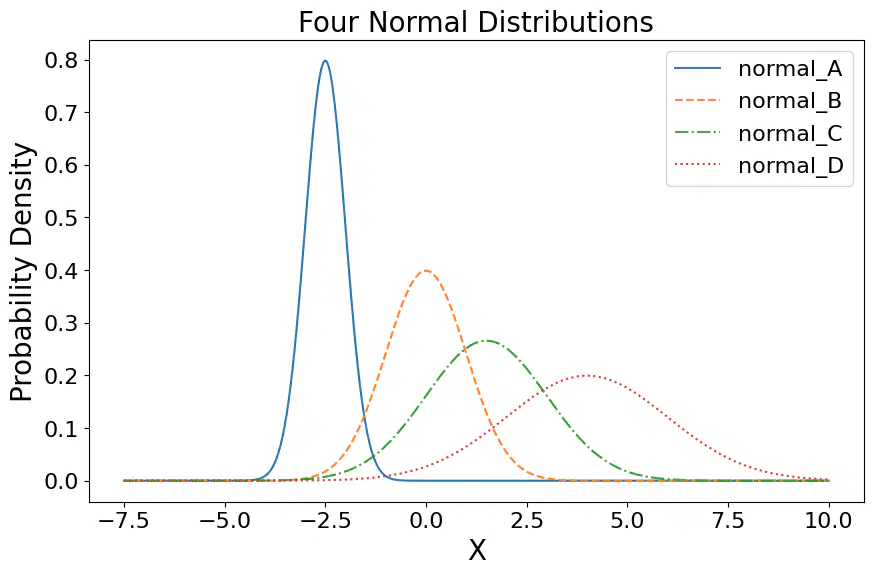
Consider the graph below, depicting four normal, or Gaussian, distributions labelled normal_A in blue, normal_B in orange, normal_C in green, and normal_D in red.
σnormalD>σnormalA
μnormalD>μnormalC
μnormalA>μnormalB
σnormalA>σnormalB
σnormalC>σnormalB
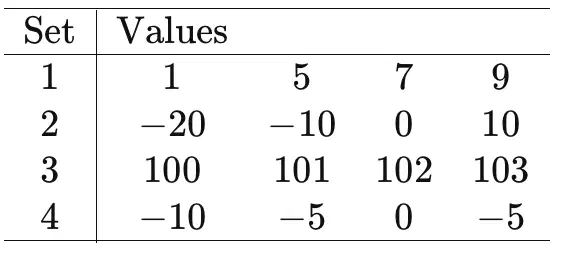
Consider the four sets of samples above. Which one has the smallest variance?
1
2
3
4
Consider two games, Game A and Game B, each with different probability distributions of winnings and losses. Game A has a probability of 31 to win $2 and a probability of 32 to lose $1. Game B has a probability of 21 to win $0.50, a probability of 41 to lose $0.50, a probability of 81 to win $5, and a probability of 81 to lose $2.
Game A's kurtosis is smaller than Game B's kurtosis.
Both Game A and Game B have the same kurtosis.
Game B's kurtosis is smaller than Game A's kurtosis.
Consider the following independent random variables:
X∼Normal(3, 12 )
Y∼Normal(2, 22 )
Then Z=X+Y∼Normal(μ,σ²), where μ,σ are equal to:
μ= 5 ,σ= 3
μ=5, σ= 5
μ=5, σ= 3
μ=5,σ=5
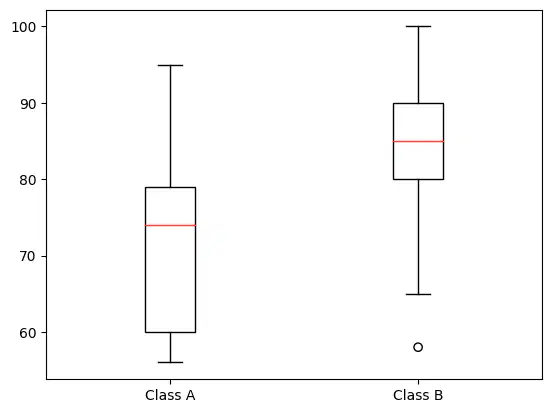
Which of the following statements is true?
Class A's interquartile range (IQR) is larger than Class B's interquartile range.
Class A's median score is higher than Class B's median score.
Class B's interquartile range (IQR) is larger than Class A's interquartile range.
Class B's median score is higher than Class A's median score.
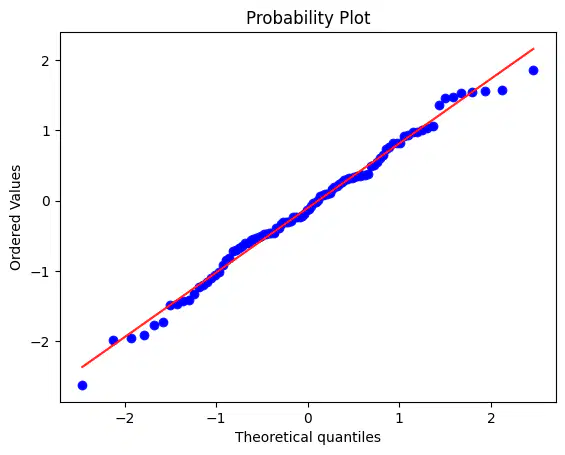
Which of the following statements is true?
The data has a higher variance than a normal distribution.
The data has a lower variance than a normal distribution.
The data looks normally distributed.
The data is not normally distributed.

What is the expected mean E[X] for this probability distribution?
μ=3.3
μ=3.0
μ=3.5
μ=6
What is the advantage of looking at the standard deviation instead of the variance?
The standard deviation is less affected by outliers than the variance.
The standard deviation has the same unit as the sample.
The standard deviation may be negative.
There are no advantages. They mean the same thing.

The box plot below shows the distribution of salaries for employees in three different company departments.
Based on the box plots above, which of the following statements are true? Select all that apply.
The median salary of department 2 is higher than the median salary of department 1.
The IQR of department 3 is smaller than department 1.
There are no outliers in department 2.
The range of salaries in department 3 is larger than the range of salaries in department 2.
Which of the following QQ plots represents a set of data that is more likely normally distributed?


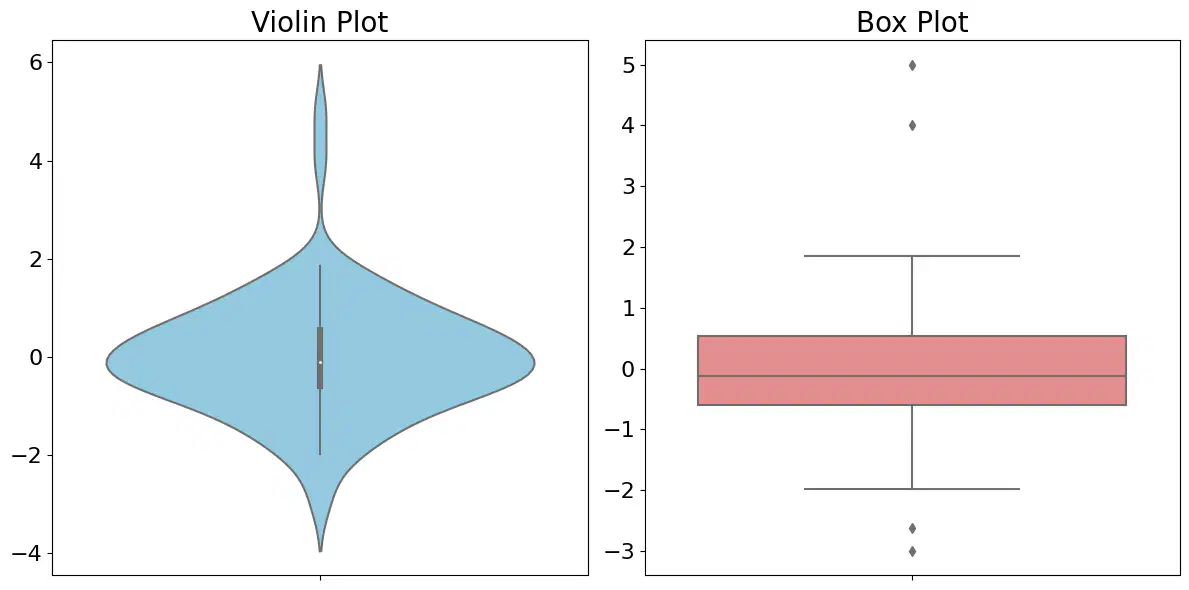
The violin plot and box plot below are visualizations of the same dataset. Based on the violin plot and box plot above, which of the following statements are true?
The interquartile range (IQR) is smaller in the violin plot compared to the box plot.
The dataset has a bimodal distribution.
Outliers are visible in the box plot but not in the violin plot.
The median of the dataset is approximately 0.
The dataset has a positive skewness.
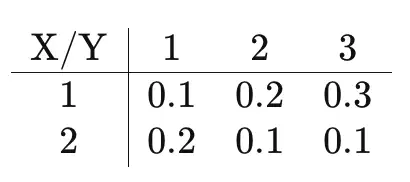
Suppose that the joint probability distribution of two random variables X and Y is given by the following table:
What is the probability that X and Y both take even values?
0.2
0.1
0.3
0.4
Which of the following statements are true regarding marginal and conditional distributions? Select all that apply.
To find the marginal distribution for a variable, probabilities are summed over all variable values, either by adding columns or rows in the joint distribution table.
Conditional distribution involves taking slices of the joint distribution to focus on specific conditions.
Marginal distribution summarizes the behavior of one variable at a time by aggregating over the other variable(s).
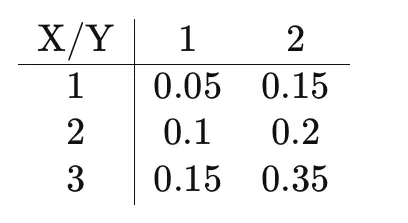
Suppose that the joint probability distribution of two random variables X and Y is given by the following table:
What is the conditional distribution P(X=3∣Y=1∣) ?
0.15
0.25
0.5
0.333
Which of the following statements regarding the correlation coefficient are true? Select all that apply.
It is a positive real number.
It can be any real number.
It measures how linearly correlated two variables are.
It is a real number between -1 and 1.
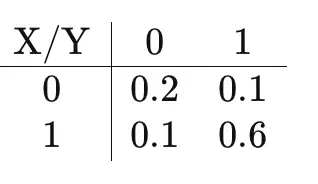
Suppose that the joint probability distribution of two random variables X and Y is given by the following table:
What is the covariance between X and Y?
−0.04
0.11
0.02
0.04
What is the difference between a sample and a population in statistics?
A sample is the entire group being studied, while a population is a subset of that group.
A population is the entire group being studied, while a sample is a subset of that group.
A population is a group from which a sample is drawn, and both terms can be used interchangeably.
Let S be a random sample, where S={5,2,7,10}. Calculate the population variance for the sample set.
2.9
6
8.5
34
A researcher conducts a study by taking independent random samples. Assuming the experiment meets the conditions of the Law of Large Numbers, which sample mean is the closest to the value of the population mean?
4.77
5.16
4.97
5.01
Which of the following best describes the Central Limit Theorem?
The Central Limit Theorem states that the mean of a population is always normally distributed.
The Central Limit Theorem states that, under certain conditions, as the sample size increases, the sample mean approaches the population mean.
The Central Limit Theorem states that, under certain conditions, as the sample size increases, the sampling distribution of the mean approaches a normal distribution, regardless of the distribution of the population.
The Central Limit Theorem states that as the sample size increases, the variance of the population decreases.
Consider the following population, P, where P={1,1,3,5,10}
And the following sample, S, where S={1,3}
What is the value of the sample mean?
4
It cannot be computed with the given information.
2
6
Which of the following statements about the Central Limit Theorem (CLT) is true?
The Central Limit Theorem suggests that the mean of a sample is always equal to the mean of the population.
The Central Limit Theorem states that the population mean will always be 0.
The Central Limit Theorem states that the distribution of sample means approaches a normal distribution as the sample size increases, regardless of the shape of the population distribution.
The Central Limit Theorem only applies to populations that already follow a normal distribution. It has limited relevance in cases where the population distribution is skewed or has outliers.
Which of the following methods can be used to estimate a population's variance, mean, and proportion?
Sample mean
Sample variance
Point estimation
Regression analysis
Suppose you have a dataset of points and want to fit a line to best represent the relationship between the variables. Which of the following statements about linear regression is true?
Linear regression connects two random points in the dataset to fit the data.
Linear regression is unrelated to finding the best fit line for a given dataset.
Linear regression aims to maximize the sum of squared distances between the points and the fitted line.
Linear regression minimizes the sum of squared distances between the points and the fitted line, providing the best fit to the data.
What is the purpose of regularization in machine learning?
Regulation favors more complex models to increase performance on the training data.
Regularization prevents overfitting by penalizing models with large coefficients or weights.
Regularization is used to increase the training error of a model, which can improve its generalization performance.
Regularization is used to improve the interpretability of a model by reducing its complexity.
Assume you have a dataset that generates a model M= 4x4+3x2+1 that best fits the data. What is the L2 regularization error value for the model M?
8
25
26
144
Which of the following best describes the way "priors" are used in Bayesian statistics?
After collecting data, prior beliefs are used to adjust the values of that data to better align with the patterns you expected to observe.
Priors are used before data is available to assist in making conclusions. After collecting data, priors can be discarded.
Priors are used to generate data in instances when direct observation of a phenomenon is impossible.
Prior beliefs are updated based on how well they align with the data observed.
Consider the following sample drawn from a Normal Distribution with unknown mean and unknown variance.
S={−1,0,1,2}
Select the Normal Distribution that is most likely to have been generated from sample S.
N(0.5,1.25)=N(0.5, 1.222 )
N(1,0)=N(1, 02 )
N(0,1)=N(0, 12 )
N(1.25,0.5)=N(1.12, 0.712 )
Suppose you flip a coin 10 times and obtain 6 heads and 4 tails. What function needs to be maximized to find the maximum likelihood estimate of the probability of getting heads on a single coin toss? Let p be the probability of getting heads.
L(p)= p61(1−p)41
L(p)= p6(1−p)4
L(p)= p4(1−p)6
L(p)= p10(1−p)0
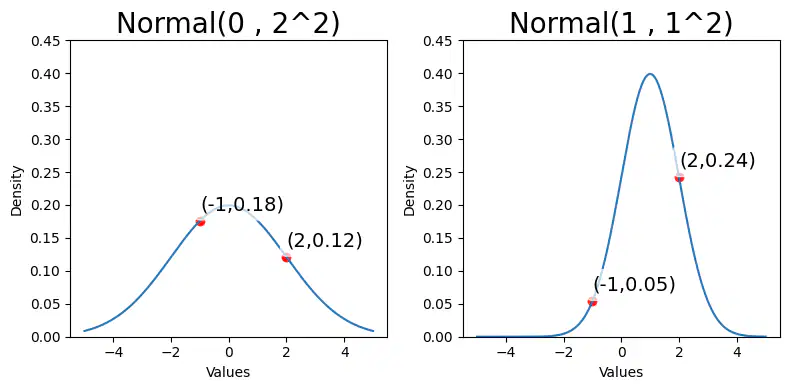
You have observations of the numbers [−1,2] and you want to determine which distribution they could have been sampled from. The first distribution is a normal distribution N(0,22) with a μ=0 and σ=2. The second distribution is a normal distribution N(1,12) where μ=1 and σ=1.
N(0, 22 )
N(1, 12 )
Cannot be determined.
Assume two Bayesian statisticians find a coin on the street and are trying to determine the likelihood that this coin will land on heads when flipped.
Bayesian 1 strongly believes that most coins are fair and begins with priors that are heavily concentrated around P(H)=0.5
Bayesian 2 assumes they know nothing about coins and begins with uniform priors with equal likelihood of every P(H) between 0 and 1.
In order to update their beliefs, they flip the coin 10 times, and get 3 heads and 7 tails.
Which of the following is the most likely value of their MAP beliefs once they've accounted for this data?
Bayesian 1: P(H)=0.49P(H)=0.49
Bayesian 2: P(H)=0.30P(H)=0.30
Bayesian 1: P(H)=0.51P(H)=0.51
Bayesian 2: P(H)=0.30P(H)=0.30
Bayesian 1: P(H)=0.30P(H)=0.30
Bayesian 2: P(H)=0.30P(H)=0.30
Bayesian 1: P(H)=0.30P(H)=0.30
Bayesian 2: P(H)=0.49P(H)=0.49
Which of the statements about confidence intervals is true?
Hint: margin of error= z2α⋅nσ
Assuming a fixed confidence level, halving the margin of error requires a sample twice as large.
Assuming a fixed margin of error, larger samples result in a larger confidence level.
Assuming a fixed confidence level, larger samples result in a smaller margin of error.
Assuming a fixed sample size, higher confidence results in a smaller margin of error
You have a sample size of 20 from a population with unknown mean and standard deviation. You measured that the sample mean X=50 and the sample standard deviation is s=10. What expression describes the margin of error for a confidence level of 95%?
z0.05⋅2010
t0.05⋅2050
t0.025⋅2010
z0.025⋅2050
In statistical hypothesis testing, which of the following statements correctly defines Type I and Type II errors?
Type I error occurs when we reject a null hypothesis that is true, while Type II error occurs when we accept a null hypothesis that is false.
Type I error occurs when we accept a null hypothesis that is true, while Type II error occurs when we reject a null hypothesis that is false.
Type I error occurs when we reject a null hypothesis that is false, while Type II error occurs when we accept a null hypothesis that is true.
Type I error occurs when we accept a null hypothesis that is false, while Type II error occurs when we reject a null hypothesis that is true.
When conducting a hypothesis test, after defining the null hypothesis (H0) and the alternative hypothesis (H1), what are the general steps to decide whether to reject the null hypothesis? Select the correct sequence of steps.
Calculate the test statistic, determine the significance level ( α ), calculate the p-value, compare the p-value with the significance level, and make a decision on the null hypothesis.
Set the significance level (α), calculate the test statistic based on sample data, calculate the p-value, compare the p-value with the significance level, and make a decision to reject or fail to reject (H0)
Calculate the p-value based on the test statistic, set the significance level (α), compare the p-value with the significance level, and decide on the null hypothesis.
Suppose you are conducting a hypothesis test to determine whether a new teaching method improves student performance.
The null hypothesis (H0) states that the teaching method has no effect, while the alternative hypothesis
(H1) suggests that the teaching method leads to higher student performance. You collect data from a sample of 50 students and calculate a test statistic of 1.98. The critical value at a significance level of 0.05 is 1.96. Should you reject the null hypothesis?
Yes, you reject the null hypothesis.
No, you do not reject the null hypothesis.
A company claims that their new energy drink decreases reaction times. To investigate this claim, a researcher conducts a hypothesis test using a sample of 40 participants. The average reaction time in the sample is 0.95 seconds, with a standard deviation of 0.12 seconds. The company states that the average reaction time without their energy drink is 1.05 seconds. The researcher wants to determine whether sufficient evidence supports the company's claim. Assuming a significance level of 0.05, what is the test statistic for this hypothesis test?
-5.27
-2.73
2.73
5.27
Based on the scenario in the previous question (question #7), which distribution would you use to find p-values for different levels of significance?
Standard normal distribution.
t-Student distribution with 40 degrees of freedom.
Normal distribution with μ=0.95 and σ=0.12.
t-Student distribution with 39 degrees of freedom.
You notice that your six-sided die seems to favor the outcome six. You state the null hypothesis is that the die is fair, and the alternative hypothesis is that the die favors some outcomes. After conducting a hypothesis test by rolling the die 100 times, you determine that the p-value is 0.03. Which of the following conclusions is a correct interpretation of the p-value?
The chance that the die is unfair is 3%.
The chance of producing the observer results (a fair die) is 3%.
The probability of rolling the die and getting a six is 97%.
The chance that the die is fair is 3%.
Which of the following scenarios should be analyzed as a two-sample t-test?
Comparing the click-through rates of two independent groups of participants testing two different versions of a website homepage in an A/B testing environment.
Analyzing the average response time of individuals in a driving simulation before and after they undergo distraction training.
Comparing the test scores of two independent groups of students who received different teaching methods.
Testing the effectiveness of a new drug by measuring the blood pressure of the same group of patients before and after treatment.
Investigating the impact of a new workout routine on participants' weight by measuring their weights before and after the routine.
Researchers conducted a study and tested a random sample of 200 animals. Their research shows that 40 of the animals test positive for a disease. Calculate the margin of error for a 90% confidence level for the percentage of animals that carry the disease.
Hint:
margin of error = z2α⋅np(1−p)
0.003
0.0141
0.0465
0.233
Consider the following system of equations in two variables.
x+3y=15
3x+12y=3
Check all the options that are true, given the system above.
2x+6y=30
4x+15y=18.
y=−14.
x+3y=0
Consider the following system of equations in two variables.
2x+y=5
4x+2y=10
Check all the options that are true, given the system above.
The solution for this system has 0 degrees of freedom
The system has infinitely many solutions
The system has no solutions
x=0 and y=5 is a solution for this system
Consider the following system of equations.
x+2y+3z=10
2x+6y+12z=4
4x−8y+4z=8
The value for z is:
(a)
Consider the following matrix:
[3 1
6 2]
Its rank is:
0
1
2
Compute the rank of the following matrix:
[2 1 5
1 3 1
3 4 6]
(a)

