
 Worksheets
chem final
Total questions: 96
Worksheet time: 48mins
The big bang theory is an example of a scientific theory. This means that it is:
An educated guess on the origin of the universe
Speculation on the origin of the universe
A mathematical model or equation that predicts how things behave in the universe
The best available explanation for the origin of the universe, based on experiments,
observations, and mathematical models
You decide to burn a couch over the weekend in celebration of the local sports team, and reduce an old couch to ashes. Which of the following statements is true?
The total amount of matter in the universe decreased after you burned the couch
The total amount of matter in the universe increased after you burned the couch
The total amount of matter in the universe is the same before and after you burn the couch
You are unable to make a prediction about the total amount of matter in the universe
without weighing the ashes of the burned couch
When you roll a ball down a hill, the ball gains kinetic energy. Which of the following statements is true?
The total amount of energy in the universe decreased after you rolled the ball down the hill
The total amount of energy in the universe increased after you rolled the ball down the hill
The total amount of energy in the universe stays the same after you rolled the ball down the hill
You are unable to make a prediction about the total amount of energy in the universe
without measuring the speed of the ball before and after rolling down the hill
Coulomb's law states that two electrically charged objects will feel an attractive or repulsive force between them proportional to the amount charge they have and the distance between them. Why is this considered a scientific law and not a theory?
This equation describes what will happen in a particular situation, but doesn't explain how
or why it occurs
This equation explains why or how a phenomena occurs, but doesn't describe what will
happen in a particular situation
This equation has not yet been tested enough to make it a scientific theory
This relationship is just a guess
Two similarly charged objects are placed next to each other so that they are touching.
What will they tend to do?
repel
attract
no change
Two opposite are placed next to each other so that they are touching. What will they tend to do?
repel
attract
no change
As the distance between two charges increases, the force between them will
increase
decrease
stay the same
Two negatively charged objects approach each other. As the objects approach each other, the kinetic energy of the objects:
increase
decrease
stay the same
As the objects approach each other, the potential energy of the objects:
increases
decreases
stays the same
As the objects approach each other, the total energy of the objects:
increases
decreases
stays the same
Which of the following statements are true for all neutral atoms of an element.
1. The number of protons in the element is always the same
2. The number of electrons in the element is always the same
2. The number of neutrons in the element is always the same
1, 2, and 3 are true
only 1 and 2 are true
only 2 and 3 are true
only 1 and 3 are true
Which of the following represents a pair of atoms with the same atomic number but a different number of neutrons
Carbon-11 and Carbon-12
Fluorine-19 and Fluorine-19
Oxygen-16 and Sulfur-16
Krypton-40 and Argon-40
An element's identity is based on its
Atomic mass
Atomic number
Mass number
number of neutrons
The nucleus is a small dense region of the atom that contains which of the following:
1. protons
2. neutrons
3. electrons
only 1, 2, 3 are true
only 1, 2 are true
only 2, 3 are true
only 1, 3 are true
Which of the following can be considered isotopes of each other?
1. Aluminum-26
2. Iron-56
3. Iron-55
1 and 2
1 and 3
2 and 3
1, 2, and 3
student measures 0.5 mL of sodium carbonate solution. What is this volume expressed in microliters (μL)?
0.0050 μL
0.050 μL
0.50 μL
500 μL
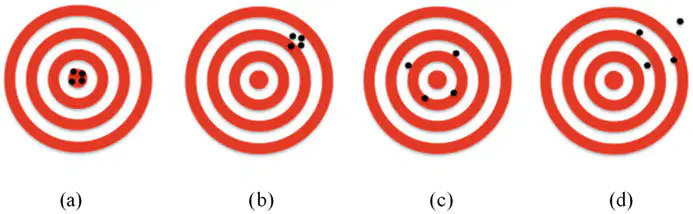
which one is high precision, low accuracy?
a
b
c
d
How many centimeters are in 351 km?
35, 100
35, 100, 000
3.51 * 10-7
0.00000351
assuming 1 calorie = 4.184 J, how many joules of energy are in a 185 kilocalorie muffin
1.85*103
4.42*103
4.42*104
7.7404*105
convert the following into scientific notation
56, 190, 000
56.19*10-6
56.19*10-7
56.19*106
5.619*107
convert the following into standard notation
1.97 * 10-4
19,700
0.00197
0.000197
1,970
The density of object A is 4.0 g/cm3 and the density of object is B 7.4 g/cm3. Which of the following statements are true about the objects?
Object A and object B have the same volume
Object A and object B have the same mass
If samples of object A and object B have the same volume, then object b will have more mass
If samples of object A and object B have the same volume, then object a will have more mas
Which of the following statements is true about density?
The density of an object changes as you make it smaller
Density is the ratio of an object's volume to its mass
Density is the ratio of an object's mass to its volume
The density of the object increases as you make it larger

Figure 1 describes the number of protons and neutrons necessary for a nucleus to be stable. Which
the following statements are the most correct?
1: Stable elements generally have more protons than neutrons
2: Stable elements generally have more neutrons than protons
3: As the mass of an atom increases, more neutrons are required per proton to compose a stable nucleus
1 and 2
2 and 3
1, 2, and 3
1 and 3
elements heavier than Helium and lighter than carbon can best be described as the immediate
result of
Formation of elements during the big bang
Formed on earth by scientists using particle colliders
Formed by fusion in stars during the main sequence of their life
Formed by fusion in stars during the red giant phase
Fission is most likely to occur in elements with mass numbers
less than 10
less than 40
between 40-80
greater than 80
The theoretical endpoint of stellar fusion reactions is which of the following elements?
hydrogen
oxygen
iron
uranium

The main fuel of main sequence
stars is mostly which of the following elements?
hydrogen
helium
Beryllium
carbon

Why does helium fusion not occur
in main phase stars?
No helium is present in main phase stars
Hydrogen outcompetes helium in star enzymes, reducing the rate of helium fusion
Temperatures in main phase stars are too low for helium nuclei to overcome the coulomb barrier
The strong nuclear force prevents helium fusion from occurring in the low pressure environment of main phase stars
A supernova is an extremely energetic event that occurs at the end of the life cycles for high mass stars. A supernova results in extremely high temperatures and pressures - where a normal star has normal core temperatures of 4* 106 °C, a supernova can result in temperatures of up to 1 *1011 °C. Which of the following is most likely to occur during a supernova that doesn't normally occur in stars?
Fission of nuclei lighter than iron
Fission of nuclei lighter than uranium
Fusion of nuclei heavier than hydrogen
Fusion nuclei heavier than silicon
What is the best explanation for why the Deuterium Helium-3 reaction has twice the required temperature compared to the deuterium tritium reaction?
The total mass involved in the deuterium-helium reaction is greater than the deuterium tritium reaction, increasing the effect of the strong nuclear force.
The charge of the helium nucleus is twice that of the tritium nucleus, increasing the repulsive force between the nuclei and making the Coulomb barrier harder to overcome
The product of the deuterium-helium reaction is helium-4, which is twice as stable as the helium-3 nucleus and requires more energy to make
The total mass involved in the deuterium-helium reaction is greater than the deuterium tritium reaction, decreasing the effect of the strong nuclear force
The half life of carbon-14 is about 5.7* 103 years, while the half life of uranium-238 is 4.5 * 109 years. Which element would you describe as having a faster rate of decay?
Carbon-14
Uranium-238
They are the same
Not enough information
If the half-life of uranium-235 is 7.05 x 10⁸ years and 12.5 g of uranium-235 remain after 2.82 x 10⁹ years, how much of the radioactive isotope was in the original sample?
0.78 g
1.57 g
100 g
200 g
Which of the following is the best description of what a half-life is?
The time it takes for half of a sample to become antimatter
Half the time it takes for a sample to undergo radioactive decay
The time it takes for half of a sample to iron or lead
The time it takes for half of a sample to undergo radioactive decay
Which statement best describes how the half-life provides information on nuclei stability?
Nuclei with a shorter half-life are more stable because they undergo radioactive decay sooner
There is no correlation between half-life and nuclei stability
Nuclei with a longer half-life are more stable than nuclei with shorter half-life
Nuclei stability depends on the half-life for all decay products of a nuclei
Which of the following statements are true for all neutral atoms of an element.
I. The number of neutrons in the element is always the same
II. The number of protons in the element is always the same
III. The number of electrons in the element is always the same
l, ll, ll are all true
l, ll are true
ll, lll are true
l, lll are true
Assuming that 1 calorie = 4.184 J, how many joules of energy are in a 426 kilocalorie muffin?
1.78 * 105 Joules
1.78 * 106 Joules
1.02* 105 Joules
1.02* 106 Joules
Properly writing and balancing a nuclear equation requires keeping the mass conserved (balanced) on each side of the equation. Which description best explains why this is required?
Balancing the mass makes sure all atoms are present
Balancing the mass shows where the new mass was created
The law of conservation of mass states mass is not created or destroyed in a reaction
The law of conservation of mass states mass can only be created in a reaction
The Bohr model primarily differs from the Rutherford model in that it
places electrons outside the nucleus
places electrons on discrete and specific energy levels
indicates that electrons have negative charge
places protons in the nucleus
The potential energy of an electron is quantized, meaning that it
Is measurable
Is a gradient
It can be described using a number
It can only be certain, discrete amounts, instead of being a gradient
Which of the following statements describing electron energy levels is correct?
Electrons in energy levels further from the nucleus have more potential energy
Electrons in energy levels closer to the nucleus have more potential energy
There is no correlation between energy levels and electron potential energy
Electrons in all energy levels have identical energy
If the first energy level currently contains 2 electrons, how many more could it hold
4
6
0
1
How does an excited state electron configuration differ from the ground state electron configuration?
The excited state contains more electrons
The ground state has more than two electrons in an orbital
Excited electrons occupy orbitals with higher energy than the lowest energy orbital available
The spin of excited electrons is always up
How many valence electrons does fluorine (F) have?
5
7
17
9
How many valence electrons does calcium (Ca) have?
2
5
10
20
The maximum number of valence electrons for energy levels higher than 1 is
4
6
8
2
Hydrogen has four spectral lines in the visible spectrum. The shortest wavelength of these is 410 nm, and the longest wavelength is 656-nm.
Each line on the emission spectrum is caused by
Radiation from nuclear decay
An energized electron falling to a lower energy level and releasing energy as light
Atoms reflecting only certain colors of light from outside sources
Fusion reactions releasing radiation
The reason different elements have different emission spectra is because
Different elements have different numbers of neutrons and electrons
Emission spectra are caused by different numbers of protons in the nucleus
Light travels at different speeds depending on the color
Different elements have different numbers of protons and electrons
The reason that emission spectra are distinct lines instead of gradients is because
There aren't enough atoms of the element in the tube to see all the lines There aren't enough atoms of the element in the tube to see all the lines
The rest of the gradient is outside of visual range
Electron energy is quantized, meaning that it can only be released in certain, discrete
amounts
There isn't enough potential energy to create the whole rainbow
If more lines are observed on an emission spectrum, that means that
Electrons are being totally stripped from the atom
More energy transitions are present in that element
Less energy transitions are present in that element
Enough energy is being applied to the atom to induce beta decay
A single particle of light is known as a
Photon
Planck
Quantum
Quark
The amount of energy in light emitted from an atom is directly related to
The difference in energy levels from the excited state to the ground state
The amount of electrons in the atom
The mass of the atom
The number of neutrons in the nucleus
Coulomb's law describes the force between any two charges, including protons and electrons. Which factor is the most important for determining the size of the force on a valence electron?
Number of electrons
The constant
Distance between charges (number of energy levels)
Number of protons
According to Coulomb's law, valence electrons in which of the following atoms will feel the greatest force from the nucleus?
Aluminum
Silicon
Gallium
Indium
Strontium has valence electrons in which energy level?
4
5
6
7
Elements on the periodic table with the same number of valence electrons but a different number of energy levels are known as a
Group
Actinide
Lanthanide
Period
Elements on the periodic table with the same number of energy levels but a different number of valence electrons are known as a
Group
Actinide
Lanthanide
Period
Arrange Carbon, Nitrogen, and Oxygen in order of increasing (lowest to highest)
electronegativity
Oxygen, Carbon, Nitrogen
Oxygen, Nitrogen, Carbon
Carbon, Nitrogen, Oxygen
Nitrogen, Carbon, Oxygen
Arrange Lithium, Beryllium, and Sodium in order of increasing (lowest to highest) atomic radius
Beryllium, lithium, sodium
Sodium, Beryllium, lithium
Lithium, beryllium, sodium
Sodium, lithium, beryllium
One positively charged and one negatively charged particle approach each other
As the particles get closer, the kinetic energy of the objects:
increases
decreases
stays the same
One positively charged and one negatively charged particle approach each other
As the particles get closer, the potential energy of the objects:
increases
decreases
stays the same
You decide to celebrate after taking a chemistry test by baking brownies for yourself. You decide to weigh your ingredients and discover that while you used 500 grams of ingredients, yo only produced 400 grams of brownies. Which of the following statements best describes the amount of matter in this situation?
The total amount of matter in the universe decreased after you baked the brownies
The total amount of matter in the universe increased after you baked the brownies
The total amount of matter in the universe is the same before and after you baked the brownies
You are unable to make a prediction about the total amount of matter in the universe without capturing all of the steam rising off the brownies
n electron is initially excited, but jumps down to a lower energy level and releases light. Which statement about the energy in the universe is most correct?
The total amount of energy in the universe decreased after the electron released light
The total amount of energy in the universe increased after the electron released light
The total amount of energy in the universe stays the same after the electron released light
You are unable to make a prediction about the total amount of energy in the universe without measuring the wavelength of light released
ITER (International Thermonuclear Experimental Reactor) is a test site in France where scientists and engineers are attempting to harness the power of fusion for our energy needs. Questions 38-39 have to do with current fusion reactors.
The fusion reaction that scientists are using in ITER is a deuterium (hydrogen-2)-tritium (hydrogen-3) fusion reaction. Which of the following statements best describes this reaction?
This reaction will produce a two hydrogen nuclei and energy
This reaction will produce a nucleus with lesser atomic number than hydrogen and energy
This reaction will produce a nucleus with greater atomic number than hydrogen and energy
This reaction will produce a nucleus with lesser atomic number than hydrogen
The primary problem that scientists and engineers need to solve to make fusion viable has to do with Coulomb's law. Which of the following best describes this problem?
Like charges repel each other, so it is difficult to get two nuclei to collide.
Opposite charges attract, so it is difficult to prevent two nuclei from colliding.
As two nuclei approach each other, the repulsive force between them increases exponentially. This makes it difficult to get two nuclei to collide.
As two nuclei approach each other, the attractive force between them increases exponentially. This makes it difficult to prevent two nuclei from colliding.
Ionic compounds are composed of a
Metal and Metal
Metal and Semi-Metal
Non-metal and Non-Metal
Metal and Non-Metal
Covalent compounds are composed of
Metal and Metal
Metal and Semi-Metal
Non-metal and Non-Metal
Metal and Non-Metal
Ionic compounds are typically formed between atoms with
A small difference in electronegativities
A moderate difference in electronegativites
A large difference in electronegativites
Electronegativity is not involved in ionic bonds
Polar covalent and nonpolar covalent bonds differ because
Polar bonds involve the sharing of electrons while nonpolar bonds involve the transfer of electrons
Nonpolar bonds involve the sharing of electrons while polar bonds involve the transfer of electrons
Nonpolar bonds are stronger than covalent bonds
Polar bonds cause a partial separation of charges while nonpolar bonds do not
Magnesium bromide is an ionic compound with the chemical formula MgBr2. What does the "2" tell you?
Bromide has a 2- charge
There are two magnesium ions to every bromide ion
There are two bromide ions for every magnesium ion
Bromide has a 2+ charge

determine if the molecule is polar, nonpolar, ionic, or metallic
polar
nonpolar
ionic
metallic
determine if the molecule is polar, nonpolar, ionic, or metallic
polar
nonpolar
ionic
metallic

determine the correct charge for the identified atom
H in ethanol
Full negative charge
Full positive charge
Partial negative charge
Partial positive charge
determine the correct molecular geometry for the given compound
PH3
bent
trigonal pyramidal
linear
trigonal planar
determine the correct molecular geometry for the given compound
SiCL4
bent
square pyramidal
tetrahedral
trigonal planar
determine the correct molecular geometry for the given compound
SCl2
bent
trigonal pyramidal
linear
trigonal planar
determine the correct molecular geometry for the given compound
N2
linear
bent
trigonal pyramidal
trigonal planar
determine the correct molecular geometry for the given compound
BF3
tetrahedral
bent
trigonal pyramidal
trigonal planar
Atoms that lose their electrons to form an octet are known as
anions
cations
isotopes
noble gases
Atoms that gain their electrons to form an octet are known as
anions
cations
isotopes
noble gases
Ionic compounds are normally
Good conductors of electricity in the solid state
Gases at room temperature
Formed when a metal transfers its valence electrons to a nonmetal
Electrically charged
How many pairs of shared and unshared electrons does the Lewis dot structure for Ammonia, NH3, have?
4, 0
3, 1
2, 2
4, 4
In a double bond between two atoms, the number of shared electrons is
2
4
6
8
In the compound ammonia, NH3,
Each hydrogen has a partial negative charge
The nitrogen has a full positive charge
The NH bond is an ionic bond
The Lewis structure will have one pair of unshared electrons
Which of the following bonds would be considered completely nonpolar?
H-N
O-O
O-C
F-Cl

Which of the following is the correct lewis dot structure for nitride ion?
a
b
c
d
what bond will form between carbon and hydrogen
nonpolar covalent
polar covalent
ionic
intermolecular covalent
what bond will form between sodium and fluorine
nonpolar covalent
polar covalent
ionic
intermolecular covalent
select the name or formula for the given compound
SO4
sulfur oxide
sulfur (II) oxide
sulfur tetraoxide
sulfate
select the name or formula for the given compound
N2O5
nitrogen oxide
nitrogen (II) oxide
nitrogen heptaoxide
dinitrogen pentaoxide
select the name or formula for the given compound
tricarbon hexahydride
C3H7
CH3
C3H6
CH6
select the name or formula for the given compound
Li3PO4
lithium (III) phosphide
lithium phosphate
trilithium phosphide
lithium phosphide
select the name or formula for the given compound
Li3P
lithium (III) phosphide
lithium phosphate
trilithium phosphide
lithium phosphide
select the name or formula for the given compound
Fe(O2)2
iron (II) oxide
iron (IV) peroxide
iron (IV) oxide
iron (II) hydroxide
The number of protons, neutrons, and electrons in lead-208
P=82, N=208, E=82
P=82, N=82, E=208
P=82, N=82, E=1126
P=82, N=126, E=82
How many valence electrons does sulfur have?
4
5
6
16

