
 Worksheets
AP Chemistry Fall Semester Exam Review
Total questions: 100
Worksheet time: 25hrs 0mins
A 5.00 g sample of a compound consisting of calcium and chlorine contains 1.82 g of calcium and 3.23 g of chlorine. What is the empirical formula?
CaCl2
Ca2Cl4
Ca2Cl2
Ca4Cl2

When hafnium metal is heated in an atmosphere of chlorine gas, the product of the reaction is found to contain 62.2 percent Hf by mass and 37.4 percent Cl mass. What is the empirical formula for this compound?
HfCl
HfCl2
HfCl3
HfCl4
Hf2Cl3
Which of these elements would have the same number of PES peaks as Fluorine?
Neon
Beryllium
Sodium
Chlorine

The PES spectrum below is for the element _______________.
O
Ne
N
F

Examine the spectrum below. Where would you expect the 2p peak for F be if it were on the same spectrum?
To the left of the peak at 3.04
To the right of the peak at 3.04
To the left of the peak at 1.31
To the right of the peak at 1.31

What does the 4th peak from the left represent?
The 2s electrons
The 3d electrons
The 2p electrons
The 3s electrons

Which peak (or peaks) correspond to the valence electrons?
The peak at 1
The peaks at 1 and 2.05
The peak at 239
The peaks at 239 and 22.7


The Lewis structure of the CO32- ion is


In the nitrite ion (NO2-), __________.
both bonds are single bonds
both bonds are double bonds
both bonds are the same because of resonance
there are 20 valence electrons
there is one single and one double bond

The formal charge on carbon in the molecule shown is _______.
0
+1
+2
+3
-1
Choose the correct shape for H2S
Tetrahedral
Trigonal pyramidal
Bent
Trigonal planar


The carbon atom undergoes what type of hybridization?
sp hybridization
sp2 hybridization
sp3 hybridization
dsp3 hybridization
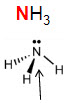
The nitrogen atom undergoes what type of hybridization?
sp hybridization
sp2 hybridization
sp3 hybridization
dsp3 hybridization
Which best describes the bonding in the cyanide ion (CN-)?
3 (sigma) bonds
2 (sigma) bonds and I (pi) bond
1 (sigma) bond and 2 (pi) bonds
3 (pi) bonds

Which of these alloys is a substitutional alloy?
Bronze
Steel
The melting point of MgO is higher than that of NaF. Which of the following best explains this observation?
O2- is more negatively charged than F-
Mg2+ is more positively charged than Na+
The O2- ion is smaller than the F- ion
Mg2+ is more positively charged than Na+ and O2- is more negatively charged than F-
How would coulombic forces affect physical properties of a molecule such as boiling (BP) and melting point(MP)?
Higher coulombic forces would lead to lower BP and MP
Higher coulombic forces would lead to higher BP and MP
Higher coulombic forces would lead to higher BP ,but a lower MP
Lower coulombic forces would lead to higher BP and MP
Steel is an alloy containing Fe atoms and C atoms. Which of the following diagrams best represents the particle-level structure of steel?


Which of the following molecules has the shortest bond length?
N2
O2
Cl2
Br2
I2
Which of the following probably has the highest solubility in hexane, C6H14?
Metals
Polar covalent molecules
Ionic compounds
Nonpolar covalent molecules
Of the following molecules, which is the most polar?
CO
CO2
O2
HF
F2
Which of the following has the lowest melting point?
Zn
SiO2
CaCl2
C2H6
Which of the following is most likely to be soluble in water?
NaF
C12H22O
Mn
Cl2
The density of an unknown gas is 2.00 grams per Liter at 3.00 atmosphere pressure and 127oC. What is the molar mass of this gas?
(254/3) R
188 R
(800/3) R
600 R
A gaseous mixture containing 7.0 moles of nitrogen, 2.5 moles of oxygen, and 0.5 moles of helium exerts a total pressure of 0.90 atmosphere. What is the partial pressure of the nitrogen?
0.13 atm
0.27 atm
0.63 atm
0.90 atm
NH4NO3(s) → N2O(g) + 2 H2O(g)
A 0.03 mol sample of NH4NO3(s) is placed in a 1 L evacuated flask, which is then sealed and heated. The NH4NO3(s) decomposes completely according to the balanced equation above. The total pressure in the flask measured at 400 K is closest to which of the following? ( The value of the gas constant, R, is 0.082 L atm mol–1 K–1)
3 atm
1 atm
0.5 atm
0.1 atm
Which of the following is an assumption of the kinetic-molecular theory of gases?
Collisions between gas particles are inelastic.
Gases consist of closely spaced particles.
Gas particles move around in an orderly manner.
The temperature of a gas depends on the average kinetic energy of the gas particles.
1. Under which conditions does a real gas behave very much like an ideal gas?
high temperature and low pressure
high temperature and high pressure
low temperature and high pressure
low temperature and low pressure
1. Liquids are more ordered than gases because liquids have ?
Weaker Intermolecular Forces And Lower Mobility Of The Particles
stronger intermolecular forces and lower mobility of the particles.
weaker intermolecular forces and greater mobility of the particles
stronger intermolecular forces and greater mobility of the particles
Chromatography separates mixtures based on what property?
particle size
intermolecular forces
boiling points
state of matter
In paper chromatography, if water is the mobile phase, what kind of substance will move up the farthest?
polar substance
non polar substance
Distillation separates mixtures based on differences in what property?
Solubility
Boiling Point
Particle Size
State of Matter
List the 4 Intermolecular forces from weakest to strongest
hydrogen bonding, ion-dipole, london dispersion, dipole dipole
london dispersion, hydrogen bonding, ion-dipole, dipole dipole
london dispersion, dipole dipole, hydrogen bonding, ion-dipole
dipole dipole, hydrogen bonding, ion-dipole, london dispersion
“More polarizable” refers to which Intermolecular Force?
hydrogen bonding
london dispersion
dipole dipole
What is a titration?
when the moles of hydrogen ions is equal to the moles of hydroxide ions
adding a known amount of solution of known concentration to determine the concentration of an unknown
reaction in which an acid and a base react in an aqueous solution to produce a salt and water
the extent of ionization of an acid or base
CuCl2(aq) + NaOH(aq) → Cu(OH)2(s) + NaCl(aq)
How many grams of hydrogen are produced if 120 g of Na are available?
A Bronsted Lowry acid:
donates H+ to another substance
accepts H+ from another substance
produces H+
produces OH-
PbCl2 + AgNO3 → Pb(NO3)2 + AgCl
2 CaO--> 2 Ca + O2
How many grams of NO are formed if 6.30g of ammonia react with 1.80g of oxygen?
12.00 moles of NaClO3 will produce how many grams of O2?
Which product in the following equation is a conjugate base?
H2O + HCl → H3O+ + Cl-
Water
Hydrogen chloride
Hydronium
Chloride
Actual yield = 62g
Calculate the percent yield.
Al(OH)3 → Al2O3 + H2O
In the equation below, what is the Bronsted Lowry base (accepts H+)?
HCl + NH3 → Cl- + NH4+
HCl
NH3
Cl-
NH4+
2Ca(s) + O2(g) → 2CaO(s), calcium is...
30mL of NaOH is neutralised by 12.3mL of 0.2mol/l HCl. What is the concentration of the NaOH.
82 mol/l
0.82 mol/l
0.49 mol/l
0.082 mol/l
How many grams of potassium chloride can be produced from 356 g of chlorine and 356 g of potassium bromide?


Ignoring D, which has the largest Ea?
A. has largest Ea
B. has largest Ea
C. has largest Ea
E. has largest Ea
step 2: O3 + O → 2 O2
The oxygen atom (O) is considered to be a(n)...


rate = k[CO]2[O2]2
rate = k[CO]2[O2]
rate = k[CO][O2]2
rate = k[CO][O2]1/2
Mechanisms in which one elementary step is followed by another are very common.
step 1: A + B → Q
step 2: B + Q → C
net reaction: A + 2B → C
Which of the following is false?

The graph shown depicts the relationship between concentration and time. What is the slope of this line?
-k
-1/k
k
ln[A]o

What is the rate law for this reaction?
rate = k[X]0
rate = k[X]
rate = k[X]2
rate = -k[X]2
If the reaction rate increases by a factor of 4 when the concentration of reactant A is increased by a factor of 2 (assuming any other reactants remain constant), the order of the reaction with respect to reactant A must be
zero order
first order
second order
fourth order
If a graph of concentration versus time is linear, the order of the reaction must be
zero order
first order
second order
If a graph of ln(concentration) versus time is linear, the order of the reaction must be
zero order
first order
second order
If a graph of 1/concentration (reciprocal concentration) versus time is linear, the order of the reaction must be
zero order
first order
second order
Given
Step 1: AB + C2 → ABC + C (slow)
Step 2: C + AB → ABC (fast)
What would be the overall reaction?
2AB + C3 → 2ABC + C
2AB + C2 + C → 2ABC + C
2AB + C2 → 2ABC
Given
Step 1: AB + C2 → ABC + C (slow)
Step 2: C + AB → ABC (fast)
What would be the rate law
Rate = k[AB]2[C2]
Rate = k[AB][C2]
Rate = k[AB]2[C2][ABC]
Rate = k[AB]2[C2][ABC]2

Which curve represents the most particles in this Maxwell-Boltzmann curve (# of particles vs. speed)?
Black (peak on the left)
Red (peak in the middle)
Blue (peak on the right)
They all have the same number of particles
Which curve in this Maxwell-Boltzmann distribution represents the highest proportion of particles moving the fastest (# of particles vs. speed)?
Black (peak on the left)
Red (peak in the middle)
Blue (peak on the right)
All particles are moving at the same speed

