
 Worksheets
Flashcards for Space Science
Total questions: 33
Worksheet time: 1hrs 6mins
Name
Class
Date
1.
Why was Sputnik a significant piece of space technology?
a)
It was the first manmade satellite to be launched in space
b)
It found evidence of other life
c)
It discovered dwarf planets
d)
It gave evidence that reclassified Pluto
2.
A straight line that an object or body rotates around or seems to rotate around is called?
a)
revolution
b)
equinox
c)
axis
d)
Equator
3.
A gaseous body that produces its own energy through nuclear fusion (nuclear explosions) releasing it as light and heat. This is called a....
a)
Constellation
b)
Moon
c)
Emitter
d)
Star
4.
A large ball of ice, dust, rock, and gas that orbits the sun circling the dark edges of the solar system is called?
a)
Asteroid
b)
Meteriod
c)
Comet
d)
Elijah
5.
An object that gives out light, is called?
a)
Moon
b)
Emitter
c)
Reflector
d)
Planet
6.
The source of light that enables astronomers to see Jupiter through a telescope is
a)
the Moon
b)
the Sun
c)
Jupiter
d)
Earth
7.
All existing matter and space as a whole is considered _________?
a)
The Earth
b)
The Galaxy
c)
The Universe
d)
Space
8.
Which of the following is a natural satellite?
a)
Hubble Space Telescope
b)
Alouette 1
c)
The Moon
d)
James Webb Space Telescope
9.
What is the main focus of the Hubble Space Telescope?
a)
Infrared observations
b)
Visible and ultraviolet wavelengths
c)
Radio signals
d)
X-ray astronomy
10.
Why is the position of the James Webb Space Telescope important?
a)
It is closer to Earth
b)
It avoids Earth's heat and light interference
c)
It can see more stars
d)
It is easier to maintain
11.
What role does the Canadarm2 play on the ISS?
a)
It provides power
b)
It assists with construction and maintenance
c)
It serves as a living space
d)
It monitors weather
12.
What does the ISS represent in terms of international relations?
a)
Competition in space
b)
International cooperation
c)
Space tourism
d)
Military presence in space
13.
How often does the ISS orbit the Earth?
a)
Every 24 hours
b)
Every 90 minutes
c)
Every 12 hours
d)
Every 60 minutes
14.
What is one of the main goals of scientists studying long-term living in space?
a)
To create artificial satellites
b)
To understand the effects of gravity
c)
To explore Mars
d)
To improve communication technology
15.
Which telescope is known for its FIRST detailed images of galaxies?
a)
James Webb Space Telescope
b)
Hubble Space Telescope
c)
Alouette 1
d)
Canadarm2
16.
What is the primary purpose of the International Space Station?
a)
To serve as a military base
b)
To conduct scientific research
c)
To launch satellites
d)
To monitor Earth's weather
17.
What was the first artificial satellite launched into space?
a)
Sputnik
b)
Alouette 1
c)
Ex-Alta 1
d)
Explorer 1
18.
When was Ex-Alta 1, Alberta's first satellite, launched?
a)
2007
b)
2012
c)
2017
d)
2022
19.
What is the main purpose of most Canadian satellites?
a)
Communications
b)
GPS navigation
c)
Military surveillance
d)
Environmental monitoring
20.
What is the main reason why artificial satellites are launched into orbit?
a)
For military surveillance
b)
For space tourism and exploration
c)
For communication and scientific research
d)
For mining and resource extraction
21.
What is the primary difference between inner planets and outer planets in our Solar System?
a)
Inner planets are made of gas while outer planets are made of rock
b)
Inner planets are rockier planets while the outer planets are mostly gas
c)
Inner planets have more moons while outer planets have fewer moons
d)
Inner planets are smaller in size while outer planets are larger
22.
According to the International Astronomical Union (IAU), what are the three criteria for a celestial body to be considered a 'planet'?
a)
It must orbit the Sun, it must have cleared its orbit of other objects, and it must have a certain size
b)
It must orbit a star, it must have a spherical shape, and it must have a certain mass
c)
It must orbit a star, it must have cleared its orbit of other objects, and it must have a certain size
d)
It must orbit the Sun, it must have a spherical shape, and it must have a certain mass
23.
What is the main reason why the number of known exoplanets has increased dramatically in recent years?
a)
Improved telescope technology allows detection of smaller exoplanets
b)
More space missions have been launched to search for exoplanets
c)
Existing telescopes have been able to observe farther into space
d)
Scientists have developed better models to predict the existence of exoplanets
24.
What is the primary purpose of artificial satellites?
a)
To orbit planets
b)
To monitor weather
c)
To create natural satellites
d)
To explore the Moon
25.
What does the term 'exoplanet' refer to?
a)
A planet in our Solar System
b)
A planet that orbits another star
c)
A moon of a planet
d)
A satellite of Earth
26.
What is the asteroid belt?
a)
A region of space with many stars
b)
A region between the inner and outer planets
c)
A belt of satellites
d)
A type of artificial satellite
27.
Which of the following is NOT a natural satellite?
a)
The Moon
b)
Europa
c)
Sputnik
d)
Titan
28.
A large, round rock orbiting around the Sun with no other objects other than moons.
a)
Planet
b)
Sun
c)
Dwarf Planet
d)
Moon
e)
Asteroid
29.
A ball of ice and dust orbiting around the Sun.
a)
Comets
b)
Sun
c)
Planet
d)
Dwarf Planet
e)
Moon
30.
Check all the things that reflect light.
a)
ISS
b)
Asteroids
c)
Stars
d)
Planets
31.
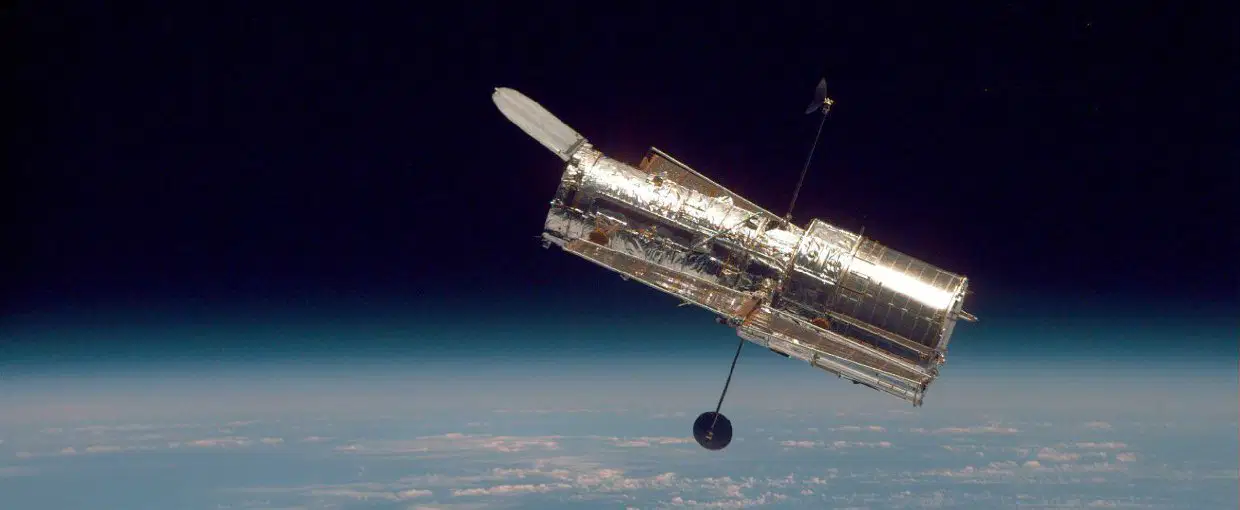
What is the picture of below?
a)
Refracting telescope
b)
Reflecting telescope
c)
James Webb telescope
d)
Hubble telescope
32.
What is the primary purpose of a satellites?
a)
To make stars shine brighter
b)
To monitor weather, help communication, and take pictures of Earth and space
c)
To stop asteroids from hitting Earth
d)
To transport astronauts to other planets
e)
33.
What is the main purpose of a space probes?
a)
To carry astronauts to space stations
b)
To help clean up debris in outer space
c)
To explore areas of space that humans cannot reach
d)
To provide fuel for satellites and rockets
100 %

