
 Worksheets
AFNR - Quizzes STUDY GUIDE
Total questions: 27
Worksheet time: 14mins
Name
Class
Date
1.
Which of the following is a water soluble vitamin?
a)
Vitamin A
b)
Vitamin K
c)
Vitamin C
d)
Vitamin D
2.
Name the SIX essential nutrients
4 lines
3.
What is the importance of nutrient labels?
4 lines
4.
Which of the following is NOT one of the four classifications of fats?
a)
Saturated Fat
b)
Trans-fat
c)
Monosaturated Fat
d)
Polyunsaturated fat
5.

Please identify how may servings are present in this item?
a)
16
b)
1
c)
20
d)
34
6.

Please Identify which of the following ingredients is present in the largest quantity
a)
Sugar
b)
Artificial Flavor
c)
Salt
d)
Nonfat Milk
7.
Parliamentary procedure is primarily used for which of the following?
a)
Ensures the meeting room is set up correctly
b)
Keeps meetings shorts and simple
c)
Gives the president full control of the meeting
d)
Allows everyone in a meeting to be heard and able to make decisions without confusion
8.
Which officer position is in charge of presenting the minutes from the previous meeting?
a)
President
b)
Parliamentarian
c)
Secretary
d)
Reporter
9.
What is the name of the book where all parliamentary procedure comes from?
(a)
10.
Name the five classes of motions
4 lines
11.
What is the unit of measurement for expressing the intensity of sounds?
a)
Decibel
b)
Syllable
c)
Vibration
d)
Acoustic
12.
Arc radiation can cause what on the skin?
a)
Freckles
b)
Moles
c)
Spider Veins
d)
Burns
13.
What does PPE stand for in which of the following
a)
Public Protective Equipment
b)
Personal Protective Equipment
c)
Peculiar Protective Equipment
d)
Personal Preservation Equipment
14.
Name FOUR elements of PPE to wear when welding?
4 lines
15.
Name TWO types of welding?
4 lines
16.
What test can be completed in the field to determine soil texture?
(a)
17.
Which of the following is described as the smallest soil particle?
a)
Gravel particles
b)
Silt particles
c)
Sand particles
d)
Clay particles
18.
What of the following is NOT one of the primary components which make up the soil?
a)
Subsidence
b)
Air and Water
c)
Mineral or inorganic matter
d)
Organic Matter
19.
The proportion of sand, silt, and clay in the soil is known as:
a)
inorganic matter
b)
Soil texture
c)
Erosion
d)
Structure
20.
Which horizon can appear bleached or whitish appearance where the minerals and nutrients dissolve or wash out?
a)
Horizon O
b)
Horizon E
c)
Horizon B
d)
Horizon C
21.
Using the "Our Aunt Erma Bakes Cookies Regularly" please break down each of the soil horizons and what we find there.
4 lines
22.
Please select the correct components of soil and their matching percentages.
a)
Minerals 45%
b)
Organic Matter 5%
c)
Water 25%
d)
Air 25%
e)
Organic Matter 45%
23.
Name the five soil forming factors
4 lines
24.
What does soil compaction cause in the soil ?
(a)
25.
Which soil structure shows where roots have been growing and indicates organic matter is present in the soil?
a)
Single grain
b)
Blocky
c)
Massive
d)
Granular
e)
Platy
26.
Describe the difference between soil profiles and soil horizons
4 lines
27.
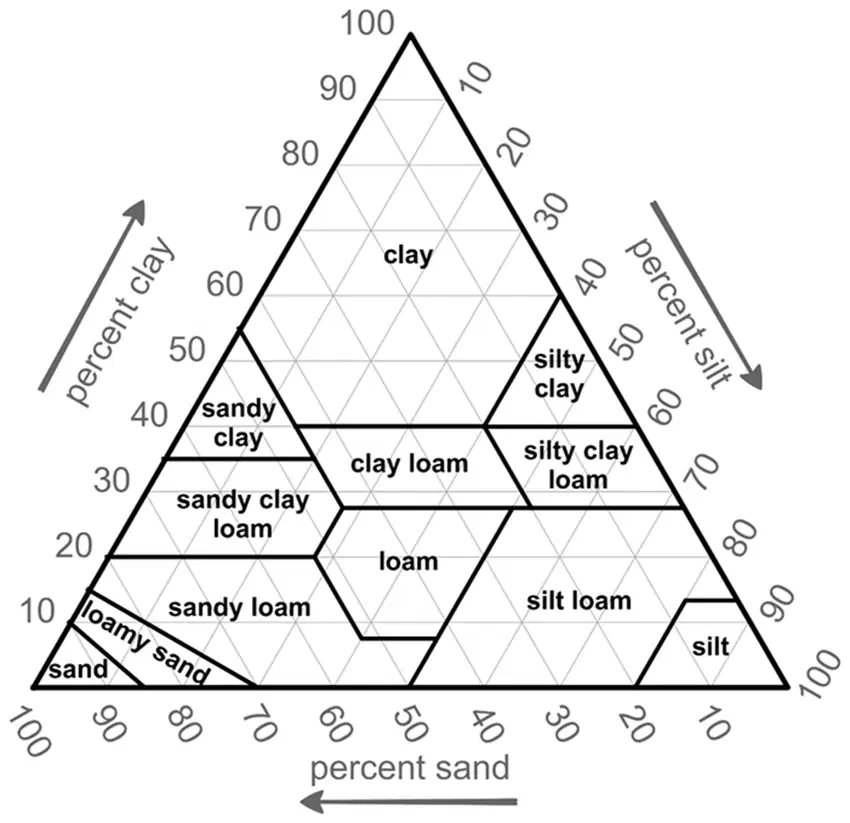
Please identify the soil textural class for - 35% sand, 15% silt, and 50% clay.
(a)
100 %

