
 Worksheets
1st Semester Algebra II Concepts Review
Total questions: 68
Worksheet time: 4hrs 58mins

What is the DOMAIN of this linear function?
[−6, 6]
[0, 6]
(−∞, ∞)
No Solution

What is the RANGE of this linear function?
-6 ≤ y ≤ 6
0 ≤ y ≤ 6
2 ≤ y ≤ 8
4 ≤ y ≤ 3
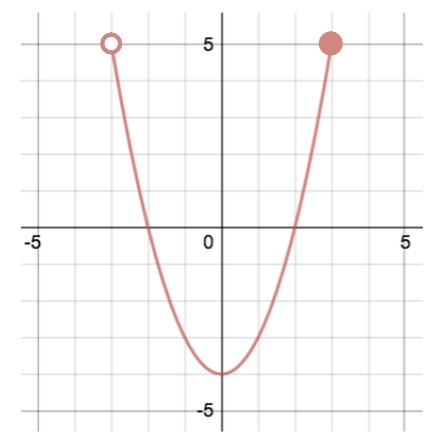
What is the DOMAIN of the function graphed on the grid?
-4 ≤ x < 5
-4 ≤ x ≤ 5
-3 ≤ x < 3
-3 < x ≤ 3

What is the RANGE?
(−∞, 6]
[−10, 6]
[−10, ∞)
(−∞, ∞)

What is the y-intercept?
12
-3
8
0
4x - 5y = 40
y intercept is 8
y intercept is 20
y intercept is 10
y intercept is -8

What is the maximum value?
5
0
-5
2

Determine end behavior of function with the given graph
x→−∞; f(x) → −∞ x→+∞; f(x)→+∞
x→−∞; f(x)→+∞ x→+∞; f(x)→−∞
x→−∞; f(x)→−∞ x→+∞; f(x)→ −∞
x→−∞; f(x)→+∞ x→+∞; f(x)→+∞
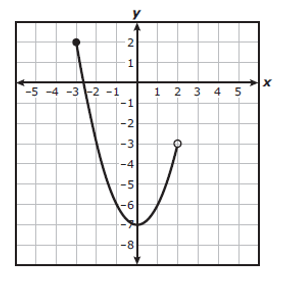
Where is this graph increasing or decreasing?
Increasing: (−7, −3)
Decreasing: (−7, 2)
Increasing: (0, 2)
Decreasing: (−3, 0)
Increasing: (−3, 0)
Decreasing: (0, 2)
Increasing: (−7, 2)
Decreasing: (−7, −3)
Label the transformations that a, b, c, & d represent in a function.
What are the following transformations?
g(x) = - (x+2)
reflection over the y axis and 2 units to the right
reflection over the x axis and 2 units right
reflection over the y axis and 2 units left
reflection over the x axis and 2 units left
g(x) = f(-x) - 4

If the blue is y=x2, the red must be
y=(x+3)2
y=(x-3)2
y=x2+3
y=x2-2

Even, odd, or neither?
Even
Odd
Neither


The red graph shows the graph of y=f(x)
Identify the blue graph...
y = f(x - 3)
y = f(x) - 3
y = f(x + 3)
y = f(x) + 3

The red graph shows the graph of y=f(x)
Identify the blue graph...
y = f(-x)
y = -f(x)
y = f(x - 1)
y = f(x) - 1
Solve the following quadratic...
x2 - 16 = 0
x = -2, 8
x = 2, -8
x = 4, -4
x = -1, -16
Solve the following quadratic...
x2 + 12x + 20 = 0
x = 5, 4
x = 2, 10
x = -5, -4
x = -2, -10
v2 + 6v + 5 = 0

Find the zeros of the following quadratic function.
f(x) = x2 − x −30
{x = -5, 6}
{x = -6, 5}
{x = -3, 10}
{x = -10, 3}
x2+5x +8 =0
Solve the given equation using the Quadratic Formula. Make sure you fully simplify your answer.
2−5±57
25±57
2−5±i7
25±i7
x2−6x +12 =0
Solve the given equation using the Quadratic Formula. Make sure you fully simplify your answer.
3±i3
3± 3
26±−12
3±i
Convert to vertex form:
y = x2 - 14x + 36
y = (x + 7)2 + 13
y = (x - 7)2 - 13
y = (x - 7)2 + 13
y = (x + 7)2 - 13
What transformations have occurred in the function: f(x)=−3(x−1)2+6
Reflection across the x-axis; Vertical stretch of 3; Right 1; Up 6
Horizontal compression of 3; Left 1; Down 6
Horizontal stretch of 1; Reflection across the x-axis; Up 6
Reflection across the x-axis; Vertical stretch of 3; Left 1; Up 6
Which graph has factors of (x+1) and (x-3) ?


Select the transformations of the following equation
y=−3(x−2)2
(select all that apply)
vertical compression
Reflects across x-axis
Shifts right 2 units
Shifts left 2 units
What are the increasing and decreasing intervals for the function: g(x)=−2(x−3)2+1 ?
Increasing: (−∞, 3)
Decreasing: (3, ∞)
Increasing: (−∞, 1)
Decreasing: (1, ∞)
Increasing: (2, ∞)
Decreasing: (-∞, 2)
Increasing: (1, ∞)
Decreasing: (-∞, 1)

How many real and imaginary solutions does this graph have?
one real solution
no imaginary solutions
two real solutions
two imaginary solutions
one real solution
one imaginary solution

How many real and imaginary solutions does the quadratic have?
Two imaginary solutions
One real solution
One imaginary solution
Two real solutions
One real solution
No imaginary solutions

What is the domain and range in this graph?
D: (-∞, ∞)
R: (-1, ∞)
D: (-4, 2)
R: (-1, ∞)
D: (-∞, ∞)
R: (-∞, ∞)
D: (-4, 2)
R: (-2.5, 2.5)

Even or Odd degree?
even
odd


Which root has a multiplicity of 2?
-1
2
4
-4


As x→ +∞, y→ +∞
As x→ +∞, y→ -∞
As x→ +∞, y→ +∞
As x→ +∞, y→ -∞


f(x) = x3 + 2x2 - 6x + 8
f(x) = 3x3 + 2x2 - 6x + 7
Write 4x3 +2x2-6x in factored form.
2x(2x-3)(x+1)
4x(2x+3)(x-1)
2x(2x+3)(x-1)
4x(2x-3)(x+1)
Divide 3x^2 + 7x + 2 by x + 2.
3x + 3
3x - 1
3x + 1
3x - 3
Find all factors of the polynomial x4 - 12x3 + 49x2 - 78x + 40 by long division.
(x-1)(x-2)(x-4)(x-5)
(x+1)(x-2)(x-4)(x-5)
(x-1)(x-2)(x+4)(x-5)
(x-1)(x-2)(x-4)(x+5)


Identify the missing term to complete the solution.
4
-4
5
-5
Use the remainder theorem to find the value of p(c):
p(x) = 4x3 + 3x + 38, c = -2.
p(-2) = 0 so
4x3 + 3x + 38 =
(x + 2)(4x3 - 8x + 19)
p(-2) = 0 so
4x3 + 3x + 38 =
(x - 2)(4x3 - 8x + 19)
p(-2) = 48
p(-2) = 60
Find the following using the Remainder Theorem for:
f(x)=2x4+6x3−5x2−60
f(−1)
Find the y intercept for x2−4x+3x2−5x+6
(0, 1) and (0, 3)
(0, 2)
(0, 3)
(0, 6)

What is the equation for the horizontal asymptote?
y=1
y=2
x=1
x=2

What is the vertical asymptote?
y=6
y=-6
x=2
x=-2


What are the decreasing intervals of this function?
(−∞,∞)
(−∞,3)U(3,∞)
(−∞,3]
(−∞,3)(4,∞)
Consider the function:
f(x)=(x−3)(x+2)2x(x−3)
Does the function have any holes?
yes, when x=3
yes, when x=0
yes, when x=−2
The function does not have any holes.
Consider the function
y=x2−2x−83x−12
When x=4, the function has a . . .
Hole
Vertical Asymptote
Neither


What's the horizontal asymptote of the function?
y = 0
No horizontal asymptote
y = 1
y = 9
Solve for w:
w−24=w+3−1
2
-2
4
-4

Solve for x: x+25=x−41
x = 5
x = 4
x = 211
x = -4
Solve for x: x+38=x−53
x = 49/5
x = -5
x = -49/5
x = 5

