
Font size
 Worksheets
Watersheds Test Review
Total questions: 35
Worksheet time: 1hrs 10mins
Wastewater goes down the drain and is taken to a city water treatment plant to be cleaned and disinfected. What happens to the treated wastewater next?
It is released into a nearby creek or river.
It is pumped underground into aquifers.
It is bottled and sold in stores.
It is pumped directly back to local homes, schools, and businesses
Which TWO are the biggest sources of pollution in our oceans?
Students designed an experiment to study where water drains after the sprinkler system is used to maintain the football field. They attached a container that added red dye to the water before it sprayed onto the field. Students placed water collection containers in many places near the field.
Which location could the students place a water collection container to determine the effect of runoff from the football field?
In the ground near the sprinkler
In a gutter that flows to a nearby pond
Directly under the sprinkler
Suspended directly above the sprinkler
Landfills are a way to manage trash by burying the trash underground. Modern landfills have a bottom layer of thick clay covered with a plastic liner. On top of the plastic liner, the landfill has pipes with holes that flow to collection tanks.
What is the purpose of the clay layer, plastic liner, and pipes?
To stop trash from floating away when it rains
To keep trash dry when it rains
To prevent the groundwater near the landfill from becoming polluted
To stop the landfill from filling up too fast
Which of the following are NEGATIVE effects of pollution on our beaches? (pick 2)
The organisms use the pollution to make their homes.
Some organisms may get sick by eating the pollution.
The pollution does not affect the organisms in the ocean.
Some organisms may get tangled in the pollution and die.
Some of the organisms use the pollution as camouflage.
Extra fertilizer runs off the farms, into the rivers, and out into the oceans. Which of the following would be a likely outcome of this?
Animals will use the fertilizer to grow.
Kelp on the bottom of the ocean will grow.
Coral reefs will grow faster.
Algae will grow, causing algae blooms.
Humans depend on the oceans for food as well as for recreational entertainment. Which of the following are other ways in which humans depend on the oceans?
CHOOSE ALL THAT APPLY
Which of the following impacts on our oceans are able to be controlled by humans?
CHOOSE ALL THAT APPLY

which answer choice correctly summarizes how the pollution from the factory and the commercial fishing industry are connected?
The factories provide nutrients for the fish, increasing their populations, which in turn helps the fishing industry by increasing their profits.
The factories produce pollution, which ends up in the water, reducing the number of animals in the oceans. The fishing industry then cannot catch enough fish to meet the demand.
The fishing boats produce pollution, which impacts the factory’s ability to produce its product.
The fishing boats catch the majority of fish in the oceans, which prevents the factories from having the required materials to function.
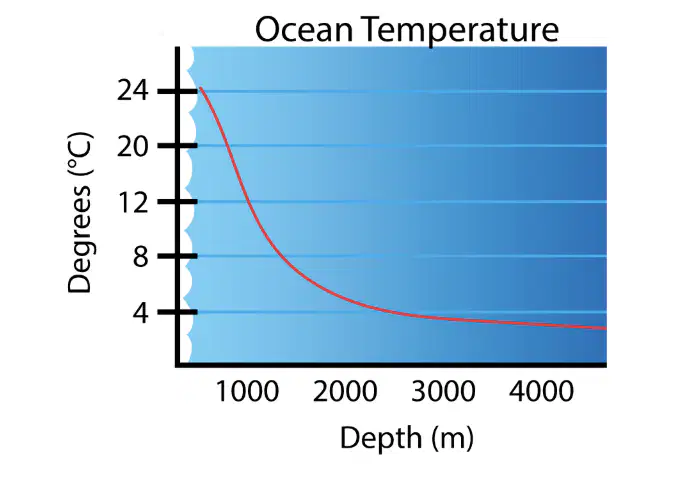
What can you tell about the temperature of the ocean from this graph?
As the depth of the ocean increases, the temperature increases.
Water temperature decreases as the ocean gets deeper.
As the depth of the ocean decreases, the temperature decreases.
Water temperature does not change as the depth of the ocean increases.
For many years, a small stream has flowed through a growing city. Recently, there has been an increase in the building of houses, streets, and storm drains in the area. When it rains, water enters the small stream through storm drains. What effect will the recent growth in the area likely have on the stream?
The water level will rise causing the river to flow more slowly and deposit sediment downstream.
The water quality will remain constant and the number of species in the creek will increase.
The increase in paved areas will increase the amount of water flowing into the creek. The stream bank will begin to erode.
The amount of water flowing into the stream will decrease and the stream bed will begin to erode.
The water quality will decrease and the number of species in the creek will be negatively affected.

There are multiple drainage basins in Texas.
Ft. Worth and Dallas are in the same drainage basin. What is the most likely reason that the water in the Trinity River is dirtier in Houston than it is in Dallas?
Ocean pollutants are entering the river.
Pollutants are entering from other drainage basins.
The river basin picks up more human pollutants.
The water goes through a salt dome and get more polluted.
Santa was changing the oil in his truck. He dumped the used oil around a fence post to keep weeds from growing. John didn't know it, but he was hurting the environment because the oil —
rots the base of the fence post and attracts harmful insects
goes deep into the ground and pollutes the groundwater
kills weeds and they are an important part of the environment
attracts more insects that will take over his yard

Using the image as a reference, which human activities will negatively affect the nearby groundwater?
PICK TWO
Runoff, containing fertilizer from the farm, photosynthesizes and causes algae blooms.
Stormwater flows into the river.
Students can plant trees and tall plants near shorelines.
The factory's smokestacks release pollutants into the atmosphere.
The city manager implemented a water conservation policy.
Water samples were collected from Points A, B, and C on the map. In which sample was pollution found to be the highest?
Organize the following human activities to determine if they have a POSITIVE or a NEGATIVE effect on the environment.
Planting plants near water systems
Increasing the amount of fuel efficient cars
Reduce, reuse and recycle household waste
Industrial waste poured from a factory drain
Fertilizer runoff from farming and agriculture
Sewage treatment
is a process of waste water treatment.
refers to waste water that is released by homes, industries, hospitals etc.
refers to the rain water that run down the streets during heavy rains.
All of the above
What is the primary reason for the increase in algae blooms in freshwater lakes?
Increased sunlight exposure
Excessive nutrient runoff from agriculture
Decrease in fish population
Increased water temperature
Which of the following is a potential consequence of untreated sewage being released into rivers?
Spread of waterborne diseases
Improved water clarity
Decrease in algae growth
Increase in fish population
Can be traced back to the point of origin.
Point Source Pollution
Non-point source pollution
Cannot easily be traced to the source of the pollution.
Point Source Pollution
Non-point source pollution
Sewage leaking from a pipe.
Point Source Pollution
Non-point source pollution
Chemicals dumped into a river from an unknown source.
Point Source Pollution
Non-point source pollution
Septic tank leaking and contaminating groundwater.
Point Source Pollution
Non-point source pollution
Fertilizer farm runoff
Point Source Pollution
Non-point source pollution
A company wants to build a factory in the watershed shown in the image.
The company wants to limit the ecological impact it has on surrounding areas. What would be the worst location for the factory?
oil leaking from cars in a parking lot is found in runoff
Point Source Pollution
Non-point source pollution


A ___________________ is the area of land where the surface water and groundwater drain into a particular body of water; separated from other watersheds by drainage divides
village creek
gully
stream channel
watershed

