wayground logo

Free Printable Worksheets

Font size

S
M
L
XL
Worksheets

Fall Final Exam Review 24-25

Total questions: 100

Worksheet time: 4hrs 17mins
Name
Class
Date
1.
Which particle has a positive charge?
a)
electron
b)
orbital
c)
proton
d)
neutron
2.
This causes the mass of the nucleus to increase.
a)
adding an electron
b)
adding a neutron
c)
more orbitals
d)
adding negatively charged particles
3.
Which particles make up the nucleus of an atom?
a)
protons and neutrons
b)
electrons and protons
c)
electrons, protons, and neutrons
d)
electrons and neutrons
4.
An element with a mass number of 11 and an atomic number of 5 has how many neutrons?
a)
11
b)
5
c)
6
d)
16
5.
In the modern periodic table elements are arranged by:
a)
atomic mass
b)
atomic number
c)
valence electrons
d)
number of isotopes
6.
Who discovered that the nucleus contains positively charged particles called protons?
a)
Ernest Rutherford
b)
James Chadwick
c)
Democritus
d)
Niels Bohr
7.
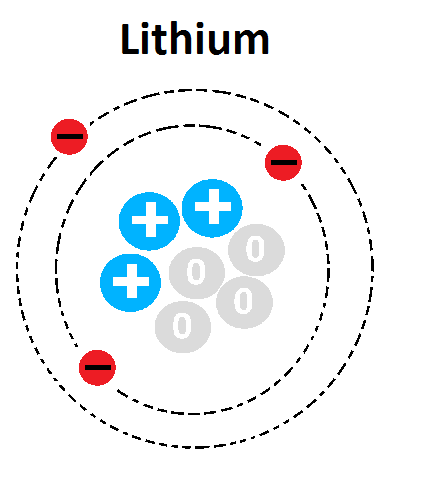
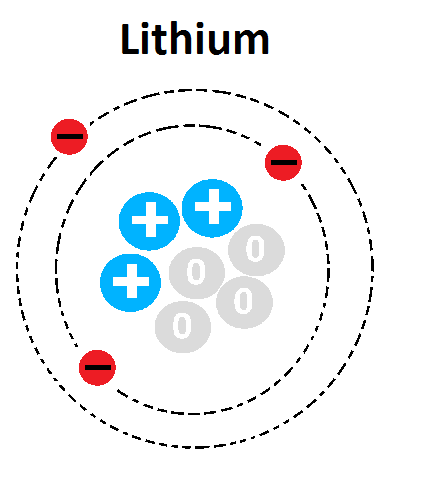
What is the atomic number of this atom?
a)
1
b)
3
c)
4
d)
7
8.

What is the mass number of this atom?

a)

1

b)

3

c)

4

d)

7

9.
A charged atom
a)
Ion
b)
Isotope
c)
Electron Cloud
d)
Quark
10.
Atoms of the same element must always have the same number of _________
a)
electrons
b)
neutrons
c)
isotopes
d)
protons
11.

As the energy increases, the electrons

a)

have lower in energy

b)

are more stable

c)

are weaker

d)

are farther from the nucleus

12.

What does the 1 in "1s" stand for?

a)

energy level

b)

s orbitals

c)

p orbitals

d)

the number of electrons

13.

How many total electrons are in the neutral element 1s2 2s2 2p4?

a)

5

b)

6

c)

8

d)

13

14.

What element has the electron configuration 1s2 2s2 2p6 3s2 3p5?

a)

Chlorine

b)

Argon

c)

Fluorine

d)

Sulfur

e)

Bromine

15.

When an electron returns to ground state from an excited state, the atom will

a)

emit energy

b)

absorb energy

c)

rotate

d)

wiggle

16.

When atoms _____________ energy, their electrons move to higher energy levels. These electrons _____________ energy by emitting light when they return to lower energy levels.

a)

lose, absorb

b)

absorb, lose

c)

lose, lose

d)

absorb, absorb

17.

What does the Greek Letter ν\nu  symbolize?

a)

wavelength

b)

frequency

c)

speed of light

d)

planck's constant

18.

What is the equation that relates the energy of a photon to its frequency?

a)

E = h/c

b)

E = mc^2

c)

E = f^2

d)

E = hf

19.

Calculate the energy of a gamma ray photon whose frequency is 5.02 x 10²⁰ Hz?

a)

4.73 x 1072 eV

b)

2.07 x 10 6 eV

c)

3.33 x 10⁻¹³ eV

d)

1.21 x 10 35 eV

20.
Find the energy, in joules per photon, of microwave radiation with a frequency of 7.91 × 10 10 1/s.
a)
6.63 x 10⁻³⁴ J
b)
5.25 x 10¹⁴ J
c)
5.24 x 10⁻²³ J
d)
1.19 x 1044 J
21.

Calculate the energy of a  photon of light with a frequency  of 6.165 x 10^14 Hz.

a)

4.087×10194.087\times10^{19}  J

b)

4.087×10194.087\times10^{-19}  J

c)

4.087×10494.087\times10^{49}  J

d)

4.087×10494.087\times10^{-49}  J

22.

Cations have what charge?

a)

+

b)

-

23.

This isotope have how many neutrons?

a)

26

b)

12

c)

14

d)

16

24.

What is the planetary model also known as?

a)

Thomson model

b)

Plum pudding model

c)

Bohr model

d)

Nuclear model

25.

Atoms with the same number of protons but different numbers of neutrons (Carbon 14 and Carbon 12) are called ___________.

a)

Anion

b)

Cation

c)

Isotope

26.

What happened to this Magnesium atom to make it an ion?

a)

It LOST electrons

b)

It GAINED electrons

c)

It GAINED protons

d)

It LOST protons

27.

Different isotopes of an element contain different numbers of ___.

a)

protons

b)

neutrons

c)

electrons

d)

elements

28.

How many neutrons are in 1 atom of Carbon-13?

a)

6

b)

13

c)

7

d)

20

29.

Which is the correct symbol for Fluorine-18?

a)
b)
c)
d)
30.

How many protons are in this isotope?

a)

9

b)

21

c)

12

31.
24.1% of all the isotopes of a an element have a mass of 75.23 amu, 48.7% have a mass of 74.61 amu, and 27.2% have a mass of 75.20 amu.
What is the average mass of this element?
a)
74.92 amu
b)
24.97 amu
c)
75.01 amu
d)
74.51 amu
32.

Calculate the average atomic mass of the element iron (Fe) using the following data:

[Isotope / % abundance]

[Iron 54 / 6% ] [Iron 56 / 92% ] [ Iron 57 / 2% ]

a)

53.7 amu

b)

54.9 amu

c)

5592.0 amu

d)

55.9 amu

33.
An element has three different isotopes. One has a mass of 35.00 amu; another has a mass of 36.00  amu; and another has a mass of 38.00  amu. What is the average atomic mass of this element?
a)
36.33 amu
b)
37.00 amu
c)
12.11 amu
d)
impossible to tell
34.
Where do we read the level of liquid?
a)
The highest point the liquid touches
b)
The bottom of the meniscus
c)
Half way between, we make an educated guess and round it
d)
Somewhere about there
35.
What is the correct value?
a)
5 ml
b)
15 ml
c)
20 ml
d)
25 ml
36.
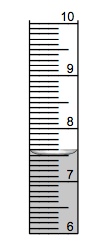
What is the volume of the liquid in this graduated cylinder?
a)
8.5 mL 
b)
7.5 mL 
c)
8 mL 
d)
.1 mL
37.
What is the volume of the liquid in this graduated cylinder?
a)
1.5 mL 
b)
15 mL 
c)
1.05 mL 
d)
.15 mL
38.
Identify the equipment shown here:
a)
graduated cylinder
b)
Erlenmeyer flask
c)
beaker
d)
volumetric flask
39.
What is the volume of the water in this graduated cylinder?
a)
7.6 mL
b)
7.2 mL
c)
6.6 mL
d)
6.8 mL
40.

Rank the objects from MOST dense to LEAST dense.

a)

left, center, right

b)

right, center, left

c)

left, right, center

d)

right, left, center

e)

center, left, right

41.
What is the formula for density?
a)
density = mass x volume
b)
density = mass / volume
c)
density = mass + volume
d)
density = mass - volume
42.
Jack has a rock. The rock has a mass of 14g and a volume of 2cm3. What is the density of the rock?
a)
7 mL
b)
7 g/cm3
c)
28 g/cm3
d)
1/7 g/cm3
43.
A crayon has a mass of 10g and volume of 5 mL. What is the density?
a)
30 g/mL
b)
15 g/mL
c)
1 g/mL
d)
2 g/mL
44.

What is density?

a)

The amount of space an object takes up

b)

The amount of matter in a given space

c)

The amount of matter in an object

45.

PCl5 + ___ H2O → ___ HCl + H3PO4

a)

4, 5

b)

1, 6

c)

3, 8

d)

2,2

46.

__ Al + __ FeO → Al2O2 + __ Fe

a)

1, 1, 2

b)

2,1,2

c)

2, 2, 2

d)

2,4,2

47.
 Mg  +  ___ HCl  →   MgCl2  +   H2
a)
1
b)
2
c)
3
d)
4
48.
Balance this equation.
_SnO+_H2-->_Sn +_H2O
a)
1,1,2,1
b)
1,2,1,1
c)
1,2,1,2
d)
1,2,2,1
49.
Balance this equation.
_CF+ _Br-- _CBr+ _F2
a)
2,1,2,1
b)
1,2,2,1
c)
1,2,1,2
d)
2,2,2,2
50.
Is the equation balanced?: 2H2O + O2 --> 4MgO + 3Fe
a)
Yes
b)
No
51.
This is a correct dot diagram for fluorine (F)
a)
true
b)
false
52.
Three pairs of electrons are shared in a
a)
Single bond
b)
Double bond
c)
Triple bond
53.
Each line in a Lewis Structure represents __________ electron(s).
a)
3
b)
2
c)
1
d)
4
54.

This carbon atom is neutral. How does it become a cation?

a)

Add 1 electron to make it +1

b)

Remove 1 electron to make it -1

c)

Remove 1 electron to make it +1

d)

Add 1 electron to make it -1

55.

This could be the dot diagram of

a)

Mg

b)

Cl

c)

C

d)

O

56.
Which is the electron configuration for an oxygen atom?
a)
1s22s22p63s23p64s2
b)
1s22s22p4
c)
1s22s22p6
d)
1s22s22p63s23p6
57.
How many valence electrons are represented here?
a)
7
b)
5
c)
2
d)
8
58.
What atom matches this electron configuration?
[Xe] 6s2 4f14 5d9
a)
Mercury
b)
Gold
c)
Platinum
d)
Thallium
59.
This is the correct dot diagram for sodium (Na)
a)
true
b)
false
60.
The electron configuration of an atom is 1s22s22p6.  The number of electrons in the atom is 
a)
3
b)
6
c)
8
d)
10
61.

Which orbital shows a violation of the Pauli Exclusion Principle?

a)

A

b)

B

c)

C

d)

D

62.

According to the VSEPR theory, ... want to ... each other.

a)

protons, repel

b)

protons, attract

c)

electrons, repel

d)

electrons, attract

63.
What is the VSEPR theory used to predict?
a)
Bond Strength
b)
Polarity
c)
Molecular Shape
d)
Electronegativity
64.
What molecular shape is the structure shown here? (BCl3)
a)
linear
b)
trigonal planar
c)
tetrahedral
d)
trigonal pyramidal
65.

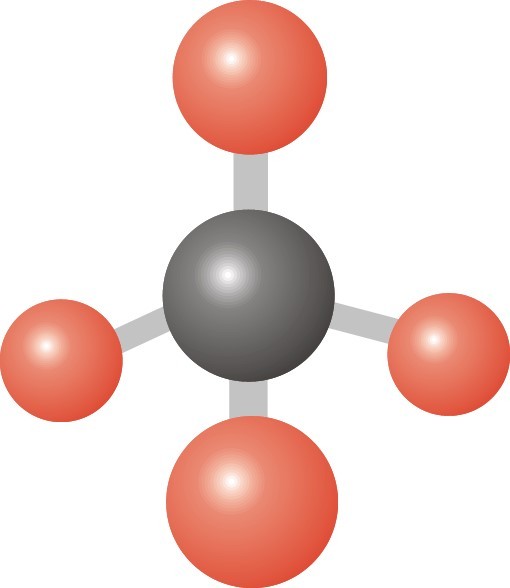
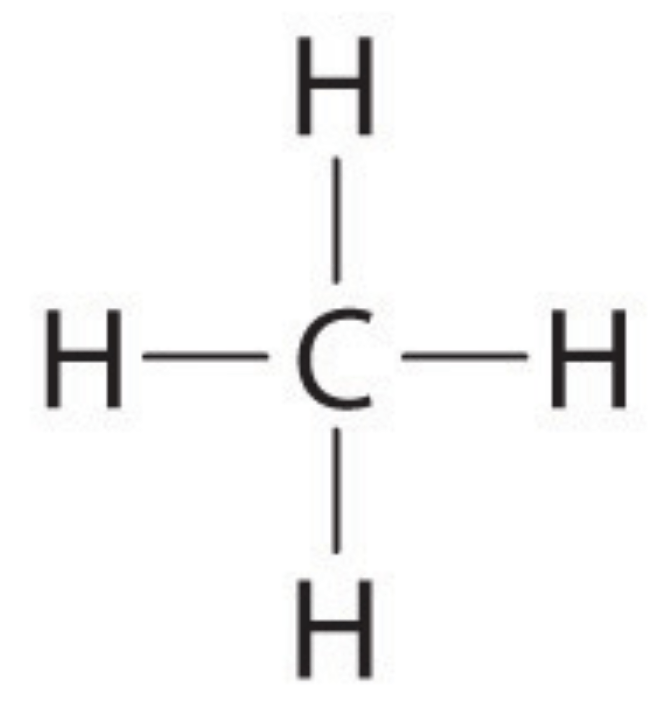
What shape would this have?

a)

Trigonal planar

b)

Pyramidal

c)

Tetrahedral

d)

Bent

66.
Who could this molecule be?
a)
CH4
b)
CO2
c)
PCl5
d)
BF3
67.
What molecular shape is the structure shown here? (H2O)
a)
tetrahedral
b)
trigonal planar
c)
bent
d)
trigonal pyramidal
68.
What molecular shape is the structure shown here? (NH4+)
a)
linear
b)
trigonal planar
c)
tetrahedral
d)
trigonal pyramidal
69.

Classify the following molecule.

a)

polar

b)

nonpolar

70.

Classify the following molecule.

a)

polar

b)

nonpolar

71.

Classify the following molecule.

a)

polar

b)

nonpolar

72.

In a polar covalent bond, the electrons gather around...

a)

The atom with the Greatest Electronegativity

b)

The atom with the Lowest Electronegativity

c)

Each atom Equally

d)

None of the Above

73.

Partial charges are present in which type of bond?

a)

Ionic

b)

Nonpolar Covalent

c)

Polar Covalent

d)

Both Polar Covalent and Ionic

74.
The element with the largest electronegativity in the halogens is - 
a)
At
b)
F
c)
Cl
d)
Br
75.

The symbol δ indicates a partial positive or partial negative charge. Why is Hydrogen postitive?

a)

It is more electronegative than fluorine

b)

It is less electronegative than Fluorine

c)

It has more protons than chlorine

d)

It has more electrons than fluorine

76.
Bromine monoflouride
a)
Br1F1
b)
BrF
c)
Br2F
d)
BrF2
77.

What indicates a TRANSITION metal's charge?

a)

roman numerals

b)

subscripts

c)

coefficient

d)

guess

78.
What is the name of the following compound?
S6O3
a)
sulfurehexa trioxide
b)
hexasulfur trioxide
c)
hexasulfide trioxide
d)
trioxygen hexasulfide
79.
Write formulas for the following compound:
tin (II) fluoride
a)
SnF2
b)
Sn2F
c)
FeF2
d)
Fe2F
80.
The chemical formula of Iron (III)bromide is
a)

FeBr

b)

Fe(III)Br

c)

FeBr₃

d)

Fe₂Br₃

81.

Name the following compound: NaNO3

a)

Sodium Nitrogen Oxide

b)

Sodium nitrate

c)

Sodium nitrite

d)

Sodium nitride

82.
What is the name of K3PO4?
a)
Tripotassium Phosphate
b)
Tripotassium Phosphite
c)
Potassium phosphide
d)
Potassium phosphate
83.
Name the following ionic compound: MgSO4
a)
magnesium sulfoxide
b)
magnesium sulfide
c)
magnesium sulfate
d)
magnesium oxide
84.

Identify the substance in box D.

a)

element

b)

compound

c)

mixture

85.

Identify the substance in box Y.

a)

element

b)

compound

c)

mixture

86.

Identify the substance in box W.

a)

element

b)

compound

c)

mixture

87.
The number of atoms of  N (nitrogen) in 3N2O5 is
a)
2
b)
5
c)
6
d)
15
88.
A precipitate is a 
a)
liquid that forms when two solids are reacted
b)
a solid that forms when two liquids are mixed
c)
a gas that forms when vinegar and baking soda react
d)
a change of color in a solution
89.
C4H6  + 3O2 ---------> 4CO2  +  3H2O is a 
a)
Decomposicion reaction
b)
Combustion reaction
c)
Sintesis reaction
d)
None of the above
90.
CO2 ---------> C + O2 is a 
a)
Synthesis reaction
b)
Decomposicion reaction
c)
Combustion
d)
None of the above
91.
2KClO3 ---------> 2KCl  +  3O2 is a 
a)
Synthesis reaction
b)
Decomposition reaction
c)
Combustion reaction
d)
None of the above
92.

What are the reactants in the equation below:

NaCl + AgNO3 → NaNO3 + AgCl

a)

a. AgNO3 and AgCl

b)

b. NaCl and AgCl

c)

c. NaCl and AgNO3

d)

d. NaNO3 and AgCl

93.

Which of the following best illustrates the Law of Conservation of Mass?

a)

a. H2SO4 → H2O + SO2

b)

b. H2SO4 → 2H2O2 + SO2

c)

c. 2H2SO4 → 2H2O + SO3

d)

d. H2SO4 → H2O + SO3

94.

Which of the following reactions obeys the law of conservation of mass?

a)
b)
c)
d)
95.

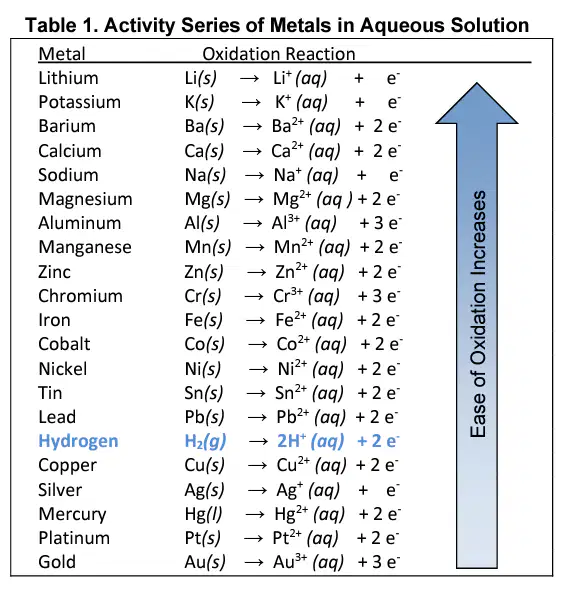
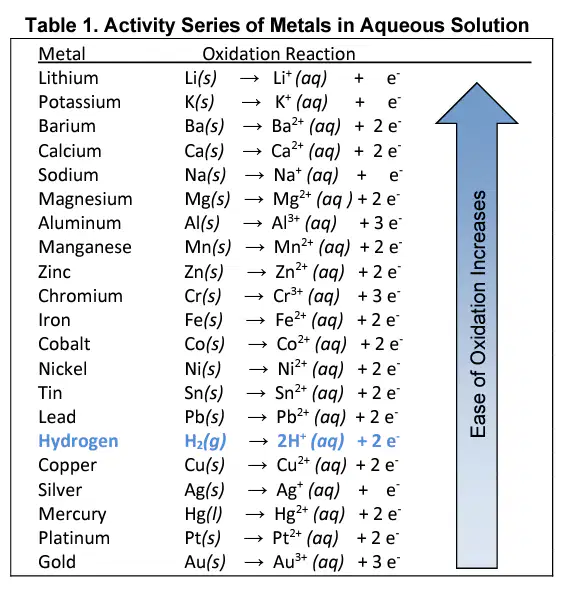
Which metal is more reactive than calcium?

a)

magnesium

b)

potassium

c)

silver

d)

aluminum

96.

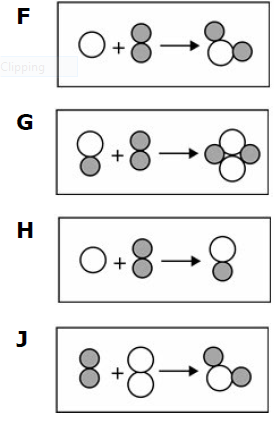
Which of the following models best demonstrates a balanced chemical equation?

a)

F

b)

G

c)

H

d)

J

97.

Using your activity series, will this single replacement reaction occur?
Au + NaF ->

a)

Yes, Gold is more reactive than sodium

(high on chart)

b)

No, Gold is less reactive than sodium

(low on chart)

98.
This image represents
a)
a double replacement reaction
b)
a decomposition reaction
c)
a single replacement reaction
d)
a complex compound reaction
99.

IF this reaction can occur....predict the products
Li + NaF ->

a)
Li will replace F
b)
Na will replace Li
c)
Li will replace Na
d)
no reaction will occur
100.

If an electron moves from n=2 to n=4 ...(goes from ground state to excited state)

a)

it absorbs energy

b)

it releases energy