
 Worksheets
Physics Quiz on Motion
Total questions: 49
Worksheet time: 25mins
Define: Speed, Velocity, and Acceleration.
Speed is the rate of change of distance, Velocity is speed with direction, Acceleration is the rate of change of velocity.
Speed is the rate of change of velocity, Velocity is speed without direction, Acceleration is the rate of change of distance.
Speed is the rate of change of time, Velocity is speed with direction, Acceleration is the rate of change of speed.
Speed is the rate of change of distance, Velocity is speed without direction, Acceleration is the rate of change of time.

How far did the object travel in 3 seconds?
15 meters
30 meters
45 meters
60 meters

How long did it take for the object to travel 15 meters?
1 second
2 seconds
3 seconds
4 seconds
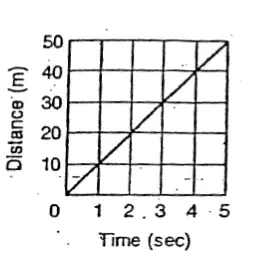
What is the average speed of the object?
10 m/s
15 m/s
20 m/s
25 m/s
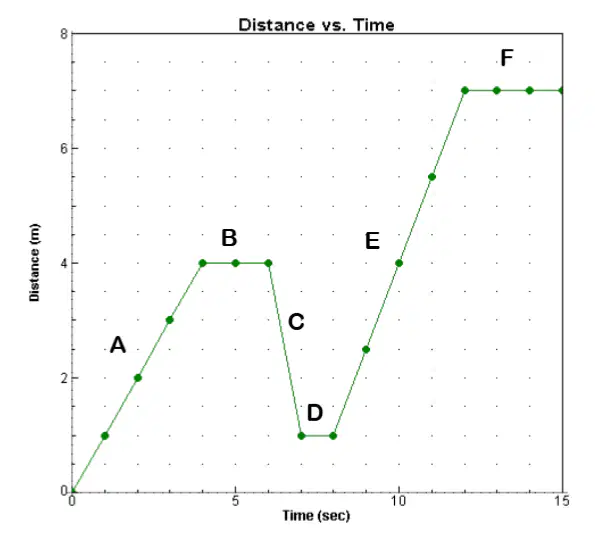
Which section(s) of the graph indicate a positive velocity?
A and E
C and D
E and F
B and E
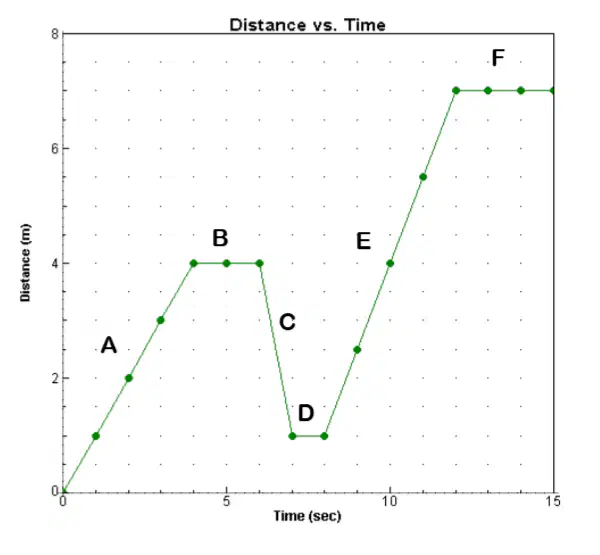
Which section of the graph has the greatest speed (not velocity)?
A
B
C
D
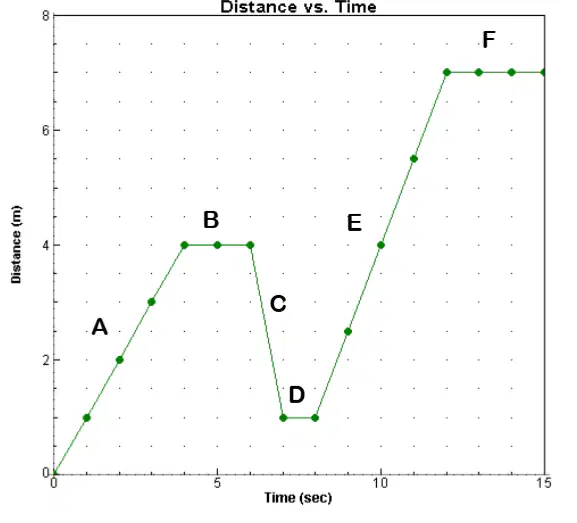
What is the average velocity for the first 6 seconds of the graph?
1 m/s
2 m/s
3 m/s
4 m/s
If an object goes from 20 m/s to 50 m/s in 5 seconds, what is its acceleration?
5 m/s²
6 m/s²
7 m/s²
8 m/s²
An object is consistently traveling 20 m/s around a curve. Is the object's speed constant?
Yes, because the speed is not changing.
No, because the speed is increasing.
No, because the speed is decreasing.
Yes, because the object is accelerating.
What is the difference between distance and displacement?
Distance is a vector quantity, displacement is scalar.
Distance is the total path traveled, displacement is the shortest path.
Distance is measured in meters, displacement in seconds.
Distance is always positive, displacement is always negative.
A force can be defined as a __________ or a __________.
push; pull
twist; turn
lift; drop
slide; glide

What is the "net force" of the example with two 40N forces in the same direction?
0N
40N
80N
20N
State and explain Newton’s 1st Law of Motion.
An object in motion stays in motion unless acted upon by an external force.
Force equals mass times acceleration.
For every action, there is an equal and opposite reaction.
Energy cannot be created or destroyed.
Decide which example best describes Newton’s 3rd Law of Motion.
A person in a car keeps moving when brakes are applied.
The wall pushes back on you as hard as you push on the wall.
More force is needed to accelerate a truck than a car.
Accelerations are produced by forces.
Define weight.
The force of gravity on an object
The mass of an object
The inertia of an object
The velocity of an object
An object with a mass of 1 kg would weigh how many Newtons?
1 N
9.8 N
10 N
0.98 N
On Earth, how fast do things accelerate when falling?
5 m/s²
9.8 m/s²
15 m/s²
20 m/s²
What condition must be met in order for an object to reach terminal velocity?
The object must be in a vacuum
The net force on the object must be zero
The object must be accelerating
The object must be at rest
A feather will fall through the air more slowly than a brick because of what?
Greater mass
Air resistance
Higher density
Larger volume
The force that causes you to ski down a hill is what?
Friction
Gravity
Inertia
Air resistance
What is Felicia's weight in Newton's on Earth if her mass is 45.0 kg?
450 N
441 N
400 N
500 N
What is Felicia's mass on Jupiter if she has a mass of 45 kg on Earth, and the acceleration due to gravity is 25.0 m/s²?
45.0 kg
50.0 kg
40.0 kg
55.0 kg
What is Felicia's weight on Jupiter if her mass is 45.0 kg and the acceleration of gravity is 25 m/s ^2?
1125 N
1000 N
1100 N
1200 N
What is the force exerted by the golf club on a 0.08 kg golf ball if it accelerates at 13,250 m/s²?
1060 N
1000 N
1050 N
1100 N
How much force is needed to accelerate a 50 kg object at a rate of 5 m/s²?
250 N
200 N
300 N
275 N
If 100 N of force is applied to an object to get it to accelerate 2 m/s², what is its mass?
50 kg
45 kg
55 kg
60 kg
If the net force on a sled is 35 N and the sled together with a friend has a mass of 70 kg, what is the acceleration?
0.5 m/s²
0.7 m/s²
0.6 m/s²
0.8 m/s²
What is Dan's horizontal velocity after 0.75 seconds if he runs off a high dive with an initial horizontal velocity of 8.0 m/s?
8.0 m/s
7.5 m/s
8.5 m/s
7.0 m/s
A projectile is...
A moving object under the influence of gravity only
A stationary object
An object moving in a straight line
An object with constant speed
How are the horizontal and vertical components related to each in a projectile?
They are independent of each other
They are directly proportional
They are inversely proportional
They are equal
A high speed horizontal projectile is fired and a similar object is dropped from the same height. Which one hits the ground first?
The fired projectile
The dropped object
Both hit at the same time
Neither hits the ground
A ball at the top of its trajectory has:
Vx = 0
Vy = 0
Acceleration = 0
Both Vx and Vy = 0
Why does a projectile maintain a constant horizontal speed?
Because of air resistance
Because there is no horizontal force acting on it
Because of gravity
Because of friction
Find the resultant velocity of an airplane that has a velocity of 100 m/s north with an east wind of 20 m/s.
102 m/s
120 m/s
100 m/s
110 m/s
A kicker has to make a field goal from 45 yards. Which angle will give him the greatest range?
30 degrees
45 degrees
60 degrees
90 degrees
Rodney, the refrigerator repairman, pushes on a 135.0 kg refrigerator with a force of 200 N. The force of friction between the refrigerator and the floor is 195.0 N. What is the acceleration of the refrigerator?
0.037 m/s²
0.037 m/s
0.037 N
0.037 kg
Define: Work, Power, Energy.
Work: Force x Distance, Power: Work/Time, Energy: Capacity to do work
Work: Mass x Acceleration, Power: Energy/Time, Energy: Force x Distance
Work: Force/Time, Power: Distance/Time, Energy: Mass x Velocity
Work: Energy/Time, Power: Force x Distance, Energy: Work/Time
A 150kg student and a 200kg student walk up the stairs side by side. Describe the work and power of the two students.
The 200kg student does more work and generates more power.
The 150kg student does more work and generates more power.
Both students do the same work and generate the same power.
The 150kg student does more work, but the 200kg student generates more power.
Atlas lifted a 200.0 kg barbell 2.00 m off the ground in 1.00 s. Calculate the force exerted by Atlas.
1960 N
200 N
400 N
980 N
Hercules lifted a 400.0 kg barbell 1.00 m off the ground in 3.00 s. Calculate the work done by Hercules.
3920 J
400 J
1200 J
980 J
Decide whether a person pushing against a stationary wall involves work (W) or no work (NW).
W
NW
Both W and NW
Neither W nor NW
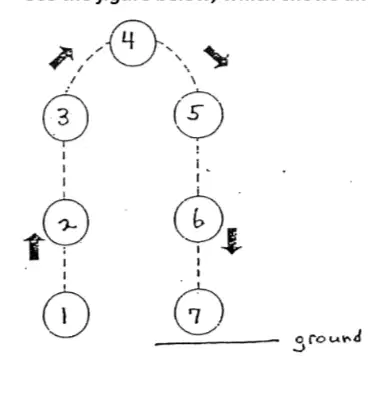
Which number(s) represent maximum potential energy (PE)?
4
1
7
3

Which number(s) represent maximum kinetic energy (KE)?
1
4
7
3
What would be the gravitational potential energy of a 25,000 N boulder if it was 100 meters above Earth’s surface?
2,500,000 J
250,000 J
25,000 J
2,500 J
A 7.0 kg bowling ball is moving down a bowling lane with a velocity of 5.0 m/s. What is the kinetic energy of the bowling ball?
87.5 J
70 J
75 J
80 J
A 15 kg ball is released at the top of a frictionless incline that is 10m high. What is the potential energy at the top of the incline?
1,500 J
150 J
15 J
1,050 J
A 2.5 kg cart rolls across the floor at a velocity of 7.0 m/s. Calculate the initial kinetic energy of the cart.
61.25 J
70 J
87.5 J
75 J
As a swinging pendulum moves from the highest point to the lowest point, what happens to its potential energy and kinetic energy?
Potential energy decreases, kinetic energy increases
Potential energy increases, kinetic energy decreases
Both energies remain constant
Both energies increase
Which has a greater kinetic energy: a bowling ball moving at 5 m/s or a half-massive bowling ball moving at 10 m/s?
Bowling ball at 5 m/s
Half-massive bowling ball at 10 m/s
Both have the same kinetic energy
Cannot be determined

