
 Worksheets
Chemistry Fall Final Review 2024
Total questions: 172
Worksheet time: 2hrs 21mins
What is the best graph to use when graphing data that is showing something happening over time?
Bar graph
Line graph
Pie chart
Histogram
What is the best graph to use when graphing data that is given in percentages (parts of a whole)?
Bar graph
Line graph
Pie chart
Scatter plot
A hypothesis is a testable statement developed from observations.
A guess based on intuition
A testable statement developed from observations
A proven fact
A random idea
What is the purpose of a controlled experiment?
To test multiple variables at once
To isolate and test the effect of a single variable
To prove a hypothesis correct
To collect as much data as possible
What is the INDEPENDENT variable in an experiment?
The variable that is measured
The variable that is changed or controlled
The variable that remains constant
The variable that is dependent on others
What is the DENSITY of an object? What are the UNITS used to measure density?
Mass per unit volume, measured in kg/m³
Volume per unit mass, measured in m³/kg
Mass per unit area, measured in kg/m²
Volume per unit area, measured in m²/kg
What are the three major subatomic particles that comprise (make up) an atom?
Protons, neutrons, electrons
Atoms, molecules, ions
Quarks, leptons, bosons
Nuclei, shells, orbitals
What is an isotope?
Atoms with the same number of protons but different numbers of neutrons
Atoms with different numbers of protons and electrons
Atoms with the same number of neutrons but different numbers of electrons
Atoms with different numbers of protons and neutrons
What is the electron configuration for Sulfur and what is the shorthand/Noble gas configuration for Sulfur?
1s² 2s² 2p⁶ 3s² 3p⁴; [Ne] 3s² 3p⁴
1s² 2s² 2p⁶ 3s² 3p⁶; [Ar] 3s² 3p⁶
1s² 2s² 2p⁶ 3s² 3p²; [He] 2s² 2p⁶
1s² 2s² 2p⁶ 3s² 3p³; [Ne] 3s² 3p³
What are the two names for vertical rows in the periodic table?
Groups and Periods
Columns and Rows
Families and Series
Lines and Sections
What is the name for the horizontal rows in the periodic table?
Groups
Periods
Columns
Families
Which elements on the periodic table might have more than one charge if they become ionic?
Alkali metals
Transition metals
Noble gases
Halogens
Are these multi charge elements metals or nonmetals?
Metals
Nonmetals
Metalloids
Noble gases
Where are p elements found?
In the s block
In the p block
In the d block
In the f block
Which element has the greatest electronegativity?
Fluorine, because it is the most reactive
Oxygen, because it is a gas
Chlorine, because it is a halogen
Helium, because it is a noble gas
Which element has the LARGEST atomic radius on the periodic table?
Helium, because it is a noble gas
Francium, because it is at the bottom of the group
Hydrogen, because it is the lightest
Carbon, because it is in the middle of the table
What is the difference between a cation and an anion?
Cations are negative, anions are positive
Cations are positive, anions are negative
Cations are neutral, anions are charged
Cations are charged, anions are neutral
What are the rules for NAMING an ionic compound?
Use prefixes for both elements
Name the metal first, then the nonmetal with an -ide ending
Name the nonmetal first, then the metal with an -ide ending
Use Roman numerals for both elements
Which of the following is true about a scientific theory?
a scientific theory is an explanation
scientific theories will eventually become scientific laws
scientific theories are not supported by evidence
scientific theories are usually rejected because they are only theories
What is the difference between a scientific theory and a scientific law?
Theories and laws are the same thing: there is no difference.
A theory will eventually become a law after a long period of time.
A theory is an explanation of the natural world and a law is a description of the natural world.
Theories and laws switch back and forth depending on the situation.
Which of the following best describes a hypothesis?
A hypothesis is an educated guess to a parent's question.
A hypothesis is the probability an event will occur such as winning the lottery.
A hypothesis is a prediction about what will happen based on observations and evidence.
A hypothesis occurs when you fall into freezing water and become very, very cold.
Explains something we see in the natural world that has been verified through repeated experiments or testing.
hypothesis
law
theory
Inference
This variable is the one thing that changed on purpose...
Dependent Variable
Control
Independent Variable

What is the DEPENDENT variable (effect) in this experiment?
"Does eating breakfast improve test scores?"
eating breakfast or not
the grade you got on the test
what time you get up in the morning
how tasty the breakfast is

You are testing how the amount you water a plant affects its growth. What would be the INDEPENDENT VARIABLE in this experiment.
They type of pot you put the plants in.
The amount you water each plant.
The amount of sunlight the plants get.
The amount the plant grows.
What are the constant variables?
what we are changing or testing
what we are observing or measuring
what we keep the same to make the experiment fair
Which correctly describes the smallest amount of an element?
Atom
Molecule
Compound
Proton
How would H2O be classified? Check all that apply.
Atom
Molecule
Compound
How would O2 be qualified. Check all answers that apply.
Atom
Molecule
Compound
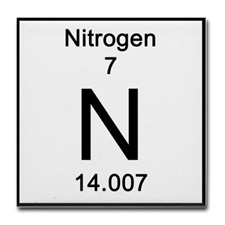


What does the 1.00794 stand for?
Hydrogen
atomic number
atomic mass
atomic explosion
What subatomic particles would you find in the nucleus of an atom?
Protons only
Protons and Neutrons
Neutrons and Electrons
Protons and Electrons
If an atom has 10 protons, 10 neutrons, and 10 electrons, what is the mass of the atom?
10
20
30


Which number here is the atomic number?
5
10.811
O2


The _ is a small, dense region at the center of the atom. It consists of positive protons and neutral neutrons, so it has an overall positive charge.
protons
neutrons
nucleus
electrons
Physical science is the study of matter and energy. It includes all but:
physics
biology
chemistry
When nuclei decay, massive amounts of __________ is released.
energy
electrons
protons
neutrons
Process by which nuclei having small masses combine to form a nucleus with a heavier mass is...
nuclear fission
a chemical reaction
nuclear fusion
a chain reaction
The force that holds neutrons and protons together in the nucleus is known as the:
weak nuclear force
hydrogen bonding
strong nuclear force
electronegative force
Atoms of the same element that have different numbers of neutrons and different mass numbers:
nucleons
isotopes
gamma rays
ions
You have 20 grams of uranium that has a half-life of 2 seconds, how much will be left after 4 seconds?
5 grams
2 seconds
6 grams
8 grams

Nuclear fission of uranium-235 can start a chain reaction by
releasing enough thermal energy to start nuclear fission in neighboring atoms
producing two smaller atoms that can then strike and split neighboring atoms
producing neutrons that can then strike and split neighboring atoms
combining two atoms with low mass to form one large atom

1s22s22p63s23p64s23d10
Each row on the periodic table represents:
an energy level
a sublevel
an electron
an orbital
Which periodic table family below has their last, most energetic electron in their electron configuration in the s-block?
Alkaline Earth
Halogens
Noble Gases
Transition Metals

1s22s22p63s2


Which of the following is a positively charged particle found in the nucleus of an atom?
Electron
Proton
Neutron
Quark
Which particle carries no charge?
Neutrons
Electrons
Protons
The 4 orbitals are
s, p, d, f
a, b, c, d
2, 4, 6, 8
What does Hund's rule state?
An orbital can contain two electrons only if the electrons have opposite spins.
An orbital can contain two electrons only if all other orbitals at that sublevel are empty.
An orbital can contain two electrons only if the electrons have different energy levels.
An orbital can contain two electrons only if all other orbitals in that sublevel contain at least one electron.

What does the sign represent with respect to electrons?
opposite spin of two electrons
different principal energy levels of two electrons
distances of two electrons from the nucleus
attraction between two electrons
According to the Pauli exclusion principle, when can two electrons occupy the same orbital?
only if there is no place else to put them
only if they have the same spin
only if they have opposite spins
only if they are alike in all their properties
Electron configuration of hydrogen (H)
1s1
1s2
2s1
2s2 2p1
Electron configuration of helium (He)
1s1
1s2
2s1
2s2 2p1
Energy levels are denoted by:
letters
numbers
a combination of letters and numbers
subscripts


Write the electron configuration
1s22s22p6
1s12s12p3
1s22s22p63s2
1s22s22p63s3

Write the electron configuration for the element.
1s12s12p33s1
1s22s22p53s1
1s2s2p3s
1s22s22p63s1
Check all of the following that could actually exist in a correctly written electron configuration.
4s3
3p4
2p8
6d3
1s1
What period is Lead (Pb) in?
6
4
Metals
4A
How many electrons does Barium (Ba) have?
13
2
71
56
What is the ionic charge of Phosphorus (P)?
+5
-3
+3
-5
How many electrons does a Strontium (Sr) ION have?
38
10
8
36
How many neutrons does Bromine (Br) have?
35
80
45
7
What is group name of the most reactive metals?
Noble gases
Halogens
Alkali metals
Alkaline earth metals
Why are halogens so reactive?
They want to get rid of their only valance electron
They only need one more electron
They are non reactive, they have a full shell
Which scientist created the first periodic table?
Dmitri Mendeleev
Isaac Newton
Albert Einstein
John Dalton
Metals are found on the ____ side of a periodic table and nonmetals are found on the ___ side.
left, right
right, left
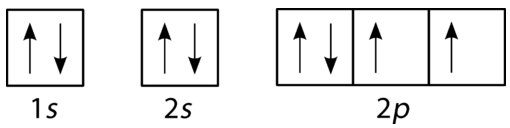
This orbital diagram represents:
Carbon
Boron
Nitrogen
Oxygen

This orbital diagram represents
Nitrogen
Oxygen
Carbon
Neon

What is incorrect about this orbital diagram?
Both arrows in the 2p box should be pointing up
There are too many electrons in the 1s orbital
In the 2p boxes, there should only be 1 electron in the first 2p box and one in the 2nd 2p box
All the arrows should be pointing up

When magnesium burns in oxygen it produces MgO. Use the ionic formula to name the compound produced.
Magnesium oxygen
Oxygen magnesium
Magnesium oxide
Oxygen magnesiumide
According to the Octet Rule, atoms of elements react with each other in order to attain ____ electrons in their outermost energy level or shell.
2
4
6
8
10
Which of the following could NOT form an ionic compound? Check all that apply.
Li+ and Cl-
F- and O2-
Ba2+ and Ag+
Mg2+ and S2-
Lithium is in group 1 of the periodic table, which ion would it form?
Li-
Li2-
Li+
Li2+
NaC2H3O2
(a)
Magnesium hydroxide
(a)
MnOH
(a)
Al2O3
(a)
Which of the following would be the correct formula for a compound of Aluminum and Fluorine?
AlF3
Al2F3
AlF2
AlFI
A metal will always ____ electrons
Lose
Take
Give
Hold
Which particle is involved in bonding?
Neutron
Proton
Electron
Photon
Which of these has five valence electrons?
Nitrogen
Oxygen
Hydrogen
Chlorine
An atom with seven valence electrons is a:
Noble Gas
Metal
Nonmetal
Transition Metal
An atom of Beryllium can bond to two atoms of:
Nitrogen
Oxygen
Chlorine
Sulfur
What is the net charge of an ionic compound?
Four
Zero
One
Eight
Alkali Metals cannot form ionic bonds with:
Sulfur
Alkaline Earth Metals
Oxygen
Halogens
Nonmetals will ____ electrons
Give
Take
Gain
Lose
Ionic Compounds are named without prefixes.
True
False
An element gains two electrons. This element is:
An anion with a +2 charge
A cation with a +2 charge
An anion with a -2 charge
A cation with a -2 charge.
An elements loses one electron to become a cation. This element is a:
Alkaline Earth Metal
Halogen
Alkali Metal
Metalloid
In a Bohr model, the valence electrons are placed on the:
Nucleus
Outer Shell
Inner Shell
Middle Shell
A compound that has a formula of SrF2 is named:
Calcium Fluoride
Strontium Fluoride
Fluorine Strontide
Strontium Difluoride
A negative ion is called a(n):
(a)

The positive ions tend to _____________ electrons.
lose
gain
The negative ions tend to _____________ electrons.
lose
gain
When an atom loses an electron, it becomes a
positive ion
negative ion
neutral ion
neutral atom

Beryllium and sulfur will form a ______ bond
ionic
covalent
metalloid
Sodium and Bromine will make a _____ bond.
ionic
covalent
metallic
Carbon and Oxygen will make a ___________ bond.
ionic
covalent
metallic
Nitrogen and Oxygen will make a ____________ bond
ionic
covalent
metallic

