
 Worksheets
Spring 23-24 Practice Final Exam
Total questions: 174
Worksheet time: 5hrs 37mins
In a lab report, students must write out the word equation for
Zn + Pb(NO3)2 --> Zn(NO3)2 + Pb
What is the correct word equation?
Zinc and lead nitrate react to form zinc nitrate and lead.
Zinc and lead (II) nitrate react to form zinc nitrate and lead.
Zinc and lead nitrogen oxide react to form zinc nitrogen oxide and lead
Zinc and lead (II) nitrate react to form zinc nitrite and lead (II)
Students perform an experiment that instantaneously forms a precipitate. They mix aqueous iron (III) nitrate and sodium hydroxide to produce iron (III) hydroxide and aqueous sodium nitrate.
What is the correct balanced equation for this reaction to show conservation of mass?
3FeNO3 + 2NaOH → FeOH3 + 3NaNO3
FeN + 3NaOH → FeOH3 + 3NaN
Fe(NO3)3 + 3NaOH → Fe(OH)3 + 3NaNO3
Fe3+NO3- + Na+OH- → Fe3+OH- + Na+NO3-
What are the correct coefficients if the law of conservation of mass is applied to the decomposition of solid ammonium nitrite to nitrogen gas and liquid water?
2, 2, 2
1, 1, 2
2, 1, 2
1, 2, 2
The reaction between solid aluminum and liquid bromine is exothermic. This reaction creates the product aluminum bromide.
What equation includes the correct formulas and demonstrates conservation of mass?
Al(s) + Br2(l) → AlBr3(s)
Al(s) + Br(l) → AlBr(s)
Al(s) + 3Br(l) → AlBr3(s)
2Al(s) + 3Br2(l) → 2AlBr3(s)
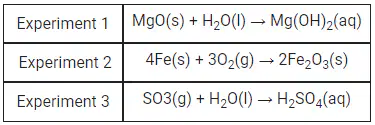
Students perform several experiments recording the reactions in lab journals. The students write and balance the chemical equations for each reaction and include the state of matter notations for each compound. The equations are pictured here. Which chemical involved in the student experiments is dissolved in water?
Fe2O3
Fe
Mg(OH)2
MgO
What are the coefficients that would correctly balance this reaction?
__Ni + __C4H8N2O2 → __Ni(C4H8N2O2)2
1, 2, 1
2, 2, 1
2, 1, 1
2, 2, 2
What is the balanced equation for the combustion of magnesium?
Mg (s) + O2 (g) → MgO (g)
Mg (s) + O2 (g) → MgO2 (g)
2 Mg (s) + O2 (g) → 2 MgO (s)
Mg (s) + 2 O2 (g) → MgO42- (aq)
Which coefficients are required to correctly balance the equation, C2H2 + O2 → CO2 + H2O?
1, 2, 3, 2
2, 5, 4, 2
2, 4, 5, 2
2, 3, 5, 2
What are the coefficients that would correctly balance this equation?
__Zn + __K2CrO4 → __K + __ZnCrO4
2, 1, 2, 1
1, 2, 3, 1
1, 2, 1, 2
1, 1, 2, 1
When solid zinc is dissolved into a solution of copper sulfate, the reaction creates a clear solution of zinc sulfate. In this oxidation-reduction reaction, the zinc atoms are oxidized, and copper (II) ions are reduced to create solid copper.
What type of reaction occurs between zinc and copper sulfate?
Acid-Base
Synthesis
Decomposition
Single replacement
Methane is natural gas containing both carbon and hydrogen. What type of reaction occurs when methane reacts with oxygen gas to produce carbon dioxide, water, and energy?
Synthesis
Double replacement
Single replacement
Combustion
Which equation above represents a precipitation reaction?
H2CO3 (aq) → CO2 (g) + H2O (l)
H2SO4 (aq) + 2NaOH (aq) → Na2SO4 (aq) + 2H2O (l)
2H2 (g) + O2 (g) → 2H2O (l)
AgNO3 (aq) + NaOH (aq) → AgOH (s) + NaNO3 (aq)
A student observes what happens when two different aqueous solutions are mixed in a test tube. Which of the following observations would be most indicative of a precipitation reaction?
Gas bubbles are produced.
A solid settles out.
There is a color change.
The test tube warms.
Which equation represents a neutralization reaction?
H2CO3 (aq) → CO2 (g) + H2O (l)
H2SO4 (aq) + 2NaOH (aq) → Na2SO4 (aq) + 2H2O (l)
2H2 (g) + O2 (g) → 2H2O (l)
AgNO3 (aq) + NaOH (aq) → AgOH (s) + NaNO3 (aq)
By predicting the outcome of the following reactants mixing together in an aqueous solution, what type of reaction will take place?
Pb(NO3)2 (aq) + 2 KI (aq) →
Double-replacement reaction
Synthesis reaction
Decomposition reaction
Single-replacement reaction
Which of the following reactions involves the ions of two compounds exchanging places to form two new compounds?
Synthesis reaction
Single-replacement reaction
Double-replacement reaction
Combustion reaction
What type of reaction involves a single compound producing two or more simpler substances?
Synthesis reaction
Decomposition reaction
Combustion reaction
What reaction involves one element replacing an element in a compound that is from the same activity series?
Combustion reaction
Decomposition reaction
Single-replacement reaction
Double-replacement reaction
What reaction involves two or more substances combining to form a single compound?
Single-replacement reaction
Synthesis reaction
Decomposition reaction
Combustion reaction
How many Mg atoms are found in 1.00 mole of MgO?
3.01 × 10²³
6.02 × 10²³
1.20 × 1024
6.02 × 1025
How many atoms of NaCl are present in 11.0 moles?
58 atoms
642 atoms
6.62 × 1024 atoms
3.51 × 1025 atoms
How many atoms are in a sample containing 4.000 moles of carbon?
6.022 x 10²³ atoms
2.408 x 1024 atoms
7.233 x 1024 atoms
2.893 x 1025 atoms
How many atoms are in a 591 g sample of gold?
3.00 atoms
116,000 atoms
1.81 × 1024 atoms
3.60 × 1025 atoms
How many atoms of silicon would there be in a sample that contained 4.66 x 1030 grams?
9.99 x 10690
9.99 x 1052
1.69 x 10690
1.69 x 1052
A three (3.00) mole sample of K2S would have how many atoms of potassium?
2.01 x 10²³
1.21 x 1024
1.81 x 1024
3.61 x 1024
Calculate the number of molecules present in .20 moles of H2O.
2.9 x 1025 molecules
5.1 x 10²² molecules
1.2 x 10²³ molecules
2.4 x 10²³ molecules
How many Mg ions are present in 3.00 moles of MgCl2?
1.81 x 1024
3.02 x 1024
12.0 x 1025
16.0 x 10²³
A molecule of glucose is comprised of 6 atoms of carbon, 12 atoms of hydrogen, and 6 atoms of oxygen.
What is the molar mass of glucose?
30.026 g/mol
137.49 g/mol
180.16 g/mol
231.37 g/mol
What is the molar mass of MgSO4?
116.13 g/mol
272.83 g/mol
111.21 g/mol
120.37 g/mol
What is the molar mass of sodium chloride, NaCl?
53.02 g/mol
58.44 g/mol
102.8 g/mol
112.5 g/mol
Describe the process of calculating the molar mass of Li2S.
Add the masses of 1 mole of lithium and 2 moles of sulfur
Add the masses of 1 mole of lithium and 1 mole of sulfur
Add the masses of 2 moles of lithium and 1 mole of sulfur
Add the masses of 2 moles of lithium and 2 moles of sulfur
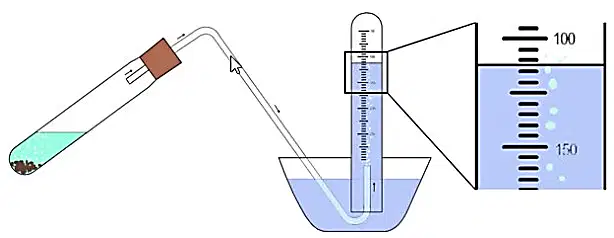
A student is conducting an experiment at STP where a solid metal is reacting with an acid solution to produce a hydrogen gas as seen above. This gas is then collected in a eudiometer, and its volume is measured in milliliters.
Using the diagram of the experiment, determine how many moles of hydrogen gas have been collected in the eudiometer (assuming the gas is still at STP).
0.00804 moles of H2
2.51 moles of H2
0.005 moles of H2
5.00 moles of H2
A student has a 5.00 gram sample of calcium chloride (CaCl2) solid. How many moles of calcium chloride are contained in this sample?
378 moles of CaCl2
0.0662 moles of CaCl2
555 moles of CaCl2
0.0451 moles of CaCl2
What is the molar mass of ethanol (C2H5OH) in g/mol? (Answer to three decimal places.)
Use the following atomic masses to solve:
Carbon: 12.011
Hydrogen: 1.008
Oxygen: 15.999
What is the molar mass of bromine gas in grams? (Round to three decimal places.)
Which of the following is the mass in grams of 4.25 × 10³ mol of N2?
2.35 × 10⁻⁴ g
1.52 × 10² g
5.95 × 10⁴ g
1.19 × 10⁵ g
In the reaction N2 + 3H2 → 2NH3, what is the mole ratio of hydrogen to nitrogen?
1 : 1
1 : 2
3 : 1
3 : 2
In the reaction 2 H2 + O2 → 2 H2O, what is the mole ratio of hydrogen to water?
2 : 2
2 : 1
1 : 2
4 : 4
Calcium hydroxide and hydrochloric acid react to form calcium chloride and water as shown in the chemical reaction. If the chemicals are present in exactly the correct ratios to fully use all of the ingredients, how many moles of water would be formed from 5 moles of HCl?
___Ca(OH)2 + ___HCl ___CaCl2 + ___H2O
1 mole
2 moles
5 moles
10 moles
In the reaction 2H2 + O2 → 2H2O, how many moles of oxygen are required to fully react with 6.0 mol of hydrogen?
3.0 mol
6.0 mol
12.0 mol
18.0 mol
In the reaction 2RbNO3 → 2RbNO2 + O2, how many moles of O2 are produced when 5.0 mol of RbNO3 decompose?
1.0 mol
2.5 mol
3.0 mol
7.5 mol
A scientist fills a large, tightly sealed balloon with 75,000 mL of helium at STP. Using significant figures, how many moles of helium are contained within the balloon?
3.3 moles of helium
3,348 moles of helium
18 moles of helium
3.348 moles of helium
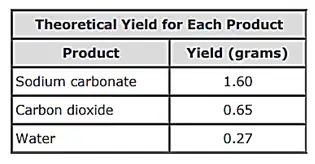
In a lab experiment, 2.5 grams of sodium bicarbonate is heated and decomposed into sodium carbonate, carbon dioxide, and water vapor when heated. The actual yield of sodium carbonate produced in the experiment is 2.04 grams. The theoretical yield of each product is recorded in the data table.
Using this data, determine the percent yield for sodium carbonate? Round your answer to the whole number.
Use the following chemical equation to answer the question.
4K(s) + O2(g) → 2 K2O(s)
If a staff member at a laboratory has 12.0 grams of potassium metal, what is the theoretical yield of potassium oxide that the scientist could potentially produce from the reaction with oxygen gas?
9.96 grams of K2O
14.5 grams of K2O
28.9 grams of K2O
57.8 grams of K2O
In 1860, Robert Boyle was the first to use phosphorus to ignite sulfur-tipped wooden splints that gave rise to our modern matches. One of the ways it can be made involves the chemical reaction of calcium phosphate with carbon and silicon dioxide in a furnace:
2Ca3(PO4)2 + 6SiO2 + 10C → 6CaSiO3 + P4 + 10CO
Refer to the information above. A match manufacturer received a supply of 2.72 × 10⁶ g of silicon dioxide. In order to reduce waste and improve product purity, the match manufacturer must measure precise amounts of the other reactants.
How many grams of calcium phosphate and carbon should the match manufacturer use?
4.68 × 10⁶ g of calcium phosphate and 9.06 × 10⁷ g of carbon
1.40 × 10⁷ g of calcium phosphate and 5.43 × 10⁷ g of carbon
4.68 × 10⁶ g of calcium phosphate and 9.06 × 10⁵ g of carbon
1.40 × 10⁷ g of calcium phosphate and 5.43 × 10⁵ g of carbon
In 1860, Robert Boyle was the first to use phosphorus to ignite sulfur-tipped wooden splints that gave rise to our modern matches. One of the ways it can be made involves the chemical reaction of calcium phosphate with carbon and silicon dioxide in a furnace:
2Ca3(PO4)2 + 6SiO2 + 10C → 6CaSiO3 + P4 + 10CO
Refer to the information above. If you use 100.0 grams of calcium phosphate and an excess of silicon dioxide and carbon, how many moles of phosphorus will be produced?
0.1612 moles
0.3224 moles
15510 moles
1.551 moles
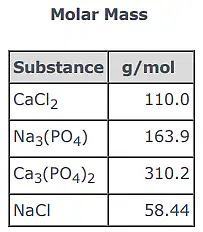
3CaCl2(aq) + 2Na3(PO4)(aq) → Ca3(PO4)2(s) + 6NaCl(aq)
Use the balanced equation and the Molar Mass table above to answer the following question.
Suppose 163.9 g of Na3(PO4) in solution mixed with sufficient CaCl2 in solution yields 116 g of Ca3(PO4)2(s) . What is the percent yield of Ca3(PO4)2(s)?
141%
74.8%
70.8%
50.0%
3CaCl2(aq) + 2Na3(PO4)(aq) → Ca3(PO4)2(s) + 6NaCl(aq)
Use the balanced equation and the Molar Mass table above to answer the following question.
How much Ca3(PO4)2(s) could be produced in an industrial process if 55.00 g of CaCl2 in solution reacted completely with sufficient Na3(PO4) (aq)?
310.2 g
155.1 g
103.4 g
51.70 g
A student burns 1.50 mol C3H8 according to the following reaction:
C3H8 + 5O2 → 3CO2 + 4H2O
How many grams of carbon dioxide are produced?
44.0 g
66.1 g
132 g
198 g
One step in the production of copper is to heat copper (I) sulfide, Cu2S, with oxygen. This produces copper (I) oxide and sulfur dioxide gas according to the following reaction:
2Cu2S(s) + 3O2(g) → 2Cu2O(s) + 2SO2(g)
What is the greatest mass of SO2 that can be produced from 15.0 mol Cu2S?
480 g SO2
721 g SO2
961 g SO2
1920 g SO2
In order to produce CO2, a student put a sample of calcium carbonate in a flask and added hydrochloric acid using the following equation:
Ca(CO3) + HCl → H2O + CO2 + CaCl2
The student finds the mass of CO2 generated to be 100 g. If the student began with 200 g of HCl and there was ample CaCO3 left unreacted, what was the percent yield?
82.8%
87.6%
96.3%
100%
K2HPO4 is a highly water-soluble salt. It can be used as a buffering agent, food additive, or fertilizer. The neutralization of phosphoric acid with potassium hydroxide can be used to form potassium hydrogen phosphate.
H3PO4 + 2KOH → K2HPO4 + 2H2O
100 g of phosphoric acid (H3PO4) is reacted with excess potassium hydroxide. The final mass of K2HPO4 produced is found to be 163 g.
What is the percent yield?
89.3%
91.7%
95.3%
97.7%
One example of rocket fuel is the reaction of hydrazine with dinitrogen tetroxide.
2N2H4(l) + N2O4(g) → 3N2(g) + 4H2O(g) + heat
This reaction is hypergolic, meaning it does not need an external ignition source, and highly exothermic. 1.000 liter of hydrazine is reacted with excess dinitrogen tetroxide. The density of hydrazine is 1.021 g/mL, and the molar mass is 32.0452 g/mol.
How many moles of water could be produced?
8.011 mol
15.93 mol
31.86 mol
63.72 mol
Baking soda (sodium bicarbonate) is a compound commonly used in baked goods, as a deodorizer in refrigerators, and as an antacid. Commercial quantities of baking soda are produced by mixing soda ash dissolved in water with carbon dioxide. Baking soda precipitates as a solid from this method:
Na2CO3 + CO2 + H2O → 2NaHCO3
How many grams of soda ash would be needed to produce 1.00 kg of sodium bicarbonate?
396 grams
631 grams
1270 grams
1590 grams
Carbon tetrachloride is a solvent which is used as a refrigerant and also as a cleaning agent. Today, methane and chlorine are mainly used to produce carbon tetrachloride:
CH4 + 4Cl2 → CCl4 + 4HCl
How many grams of carbon tetrachloride can be produced from reacting 709.0 grams of chlorine (Cl2) with excess methane?
3.845 g
61.53 g
384.5 g
6153 g
When sodium is placed in water, the following chemical reaction occurs.
2Na(s) + 2H2O (l) → 2NaOH (aq) + H2 (g)
If a teacher uses a 0.350 gram sample of sodium metal for a demonstration with excess water, how many liters of hydrogen gas would be produced at STP?
0.171 L of H2
0.682 L of H2
0.341 L of H2
0.718 L of H2
The balanced equation for the combustion of hexane is shown below.
2C4H14 + 15 O2 → 14 H2O + 8 CO2
If 364 g of hexane are combusted, how many liters of carbon dioxide are produced? Record your answer with correct significant figures.
The balanced equation for the combustion of methane is shown below.
CH4 + 2O2 → 2H2O + CO2
If 2.6 L of methane are combusted, how many grams of water are produced? Record your answer with correct significant figures.
Use the balanced equation below for the combustion of butane to form carbon dioxide and water to answer the following question.
2C4H10(g) +13O2(g) → 8CO2(g) +10H2O(g)
Suppose a grill lighter contains 50.0 g of butane. How many grams of butane in the lighter would have to be burned to produce 17.9 L of carbon dioxide at STP?
8.00 g
8.95 g
11.6 g
46.4 g
Use the balanced equation below to answer the following question about the reaction of calcium with hydrochloric acid that produces hydrogen.
Ca(s) + 2HCl(aq) → Ca2+(aq) + 2Cl-(aq) + H2(g)
What is the theoretical yield in liters of hydrogen at STP if 20.1 g of calcium are completely reacted?
5.60 L
11.2 L
22.4 L
44.8 L
Ammonia and oxygen can react to produce nitrogen and water.
Following is the balanced equation:
4NH3(g) + 3O2(g) 2N2(g) + 6H2O(g)
Suppose 17.0 grams of ammonia react completely with oxygen. How many liters of nitrogen will be produced at STP?
11.2
14.0
22.4
28.0
Given the combustion reaction C3H8 + 5 O2 → 3 CO2 + 4 H2O, how many liters of carbon dioxide can be produced from 1.00 liter of O2 at standard temperature and pressure?
0.600 L
0.825 L
1.21 L
1.67 L
Given the following reaction for photosynthesis, 6 CO2 + 6 H2O → C6H12O6 + 6 O2, how many liters of O2 can be produced from 100 g of water at standard temperature and pressure?
1.49 L
24.8 L
80.4 L
124 L
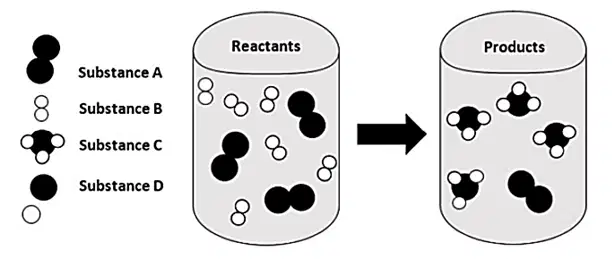
A model of a chemical reaction is shown. Which substance is the limiting reagent in the chemical reaction?
Substance A
Substance B
Substance C
Substance D
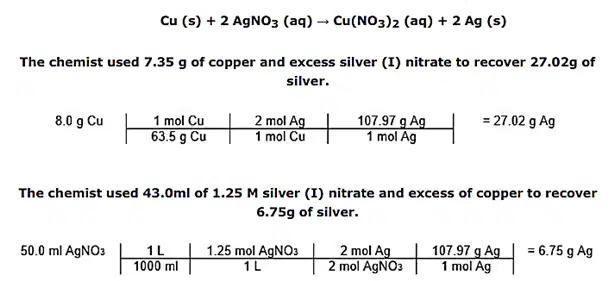
A chemist wants to recover solid silver by reacting solid copper with aqueous silver nitrate. The chemist uses stoichiometry to determine which reactant is completely used and which is in excess. The chemist's equation and calculations are shown below.
Using this information, identify the limiting reagent.
AgNO3
Cu
Cu(NO3)2
Ag
The products of the reaction CaF2 + Br2 → CaBr2 + F2 are formed by reacting calcium fluoride with bromine. If equal moles of each reactant were present, what would be the limiting reactant?
F2
CaBr2
Br2
There is no limiting reactant.
The equation demonstrates a reaction of sodium chloride and fluorine.
2NaCl + F2 → 2NaF + Cl2
In order for the reaction to proceed, for every two moles of sodium chloride, there must be at least how many mole(s) of fluorine?
1 mole
2 moles
3 moles
4 moles
In a closed system, equal amounts of ammonia and oxygen react to produce nitrogen monoxide and water. What is the limiting reactant?
4NH3 + 5O2 → 4NO + 6H2O
NH3
O2
NO
H2O
For the equation SnO2 + 2H2 → Sn + 2H2O, tin (IV) oxide reacts with excess hydrogen to produce tin and water. What is the limiting reactant?
SnO2
H2
Sn
H2O

Students held a four-mole strip of magnesium over a flame until a combustion began. Students were provided the balanced chemical reaction for the combustion of magnesium and asked to describe the limiting reactant.
2Mg + O2 → 2MgO
Student 1
Student 2
Student 3
Student 4
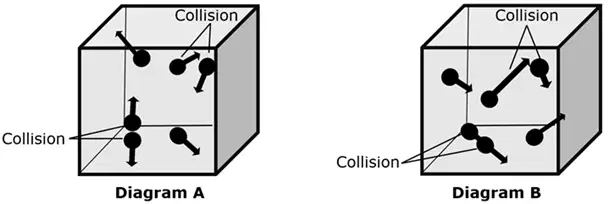
Students created diagrams to demonstrate collisions between gas molecules in a container. They drew dots to represent the gas molecules and arrows to indicate the direction and kinetic energy of each gas molecule. Which diagram and explanation best demonstrates the postulates of the kinetic molecular theory of gases?
Diagram A: gas molecule collisions are in direct motion and not perfectly elastic
Diagram A: gas molecule collisions are in random motion and perfectly elastic
Diagram B: gas molecule collisions are not perfectly elastic
Diagram B: gas molecules collision are in direct and random motion
According to the kinetic molecular theory of gases, the pressure of the gas is due entirely to the ―
size of the gas particles compared to the size of its container
mass of the gas particles compared to the size of its container
force of the collisions of the gas particles with the walls of the container
moles of gas particles within the walls of the container
Which statement accurately depicts the mass and volume of a gas according to the kinetic molecular theory?
Gases have a defined volume and a defined mass.
Gases have a defined volume but no defined mass.
Gases have no defined volume and no defined mass.
Gases have no defined volume but a defined mass.
According to the kinetic molecular theory, which statement best describes the motion of gas particles?
Gas particles are stationary.
Gas particles are only in motion when a gas is heated.
Gas particles are in continuous, random motion.
Gas particles move together in the same direction.
Which of the following statements is related to a postulate (assumption) of the kinetic molecular theory of gases?
Gas particles are in constant motion, giving them a large amount of potential energy.
Gas particles are in constant motion so they lose kinetic energy when they collide with the walls of their container.
Gas particles are in constant motion because they are strongly attracted to each other.
Gas particles are in constant motion and are very far apart compared to their size.
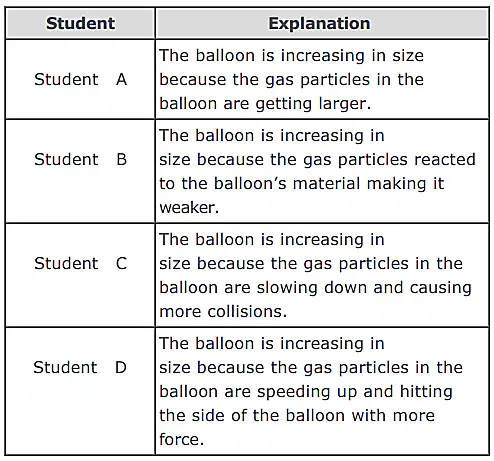
A teacher asked students to observe a sealed balloon that was held over a pot of boiling water. Students observed steam begin to surround the balloon and heat up the balloon. The students observed that the balloon increased in volume as it was held over the water. The teacher asked each student to provide an explanation of the phenomenon. Samples of student explanations were recorded below.
Which student's explanation correctly explains why the balloons increased in volume?
Student A
Student B
Student C
Student D
Which of the following is not one of the postulates of the kinetic molecular theory for ideal gases?
The collisions between particles are elastic.
The particles attract and then repel each other.
The particle size is very small compared to the space between the particles.
The particles are in constant random motion.
Which of these is a postulate of kinetic molecular theory?
Molecules of gases have a finite volume.
Molecules of gases attract and repel one another.
Collisions between gas molecules are inelastic.
The kinetic energy of gas molecules depends on temperature.

Observe the balloons A and B above. Both balloons have a temperature of 25.0°C, contain 0.50 moles of gas sealed by the knot at the bottom, and have a volume of 2.2 L.
If balloon A is placed in a freezer with a temperature of -5.50°C, which of the following statements regarding the volumes of the balloons is accurate?
The balloons will remain unchanged and have equal volume at 2.2 L.
Balloon A will be smaller due to fewer moles of gas in the balloon.
Balloon A will be larger due to lower pressure inside the freezer.
Balloon A will be smaller due to the gas particles moving slower.
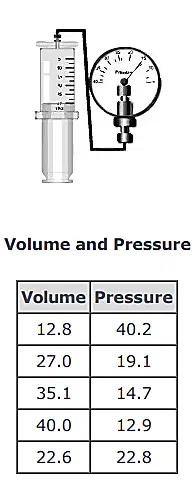
In an experiment with the apparatus shown, the plunger is used to compress helium gas to different volumes. The corresponding volume and pressures (arbitrary units) are measured and displayed in the data table. What is the best estimate of the pressure if the volume is compressed to a value of 10.0 units?
3.23 units
40.3 units
51.6 units
80.4 units
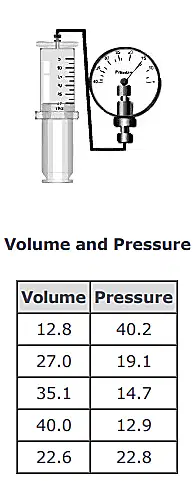
In an experiment with the apparatus shown, the plunger is used to compress helium gas to different volumes. The corresponding volume and pressures (arbitrary units) are measured and displayed in the table. Which statement best characterizes the data in the table?
The volume and pressure values are randomly related.
As the pressure increases, the volume also increases.
As the volume decreases, the pressure increases.
The volume seems to jump around, going up and then down.
Consider four sealed, rigid containers with the following volumes: 50 mL, 100 mL, 250 mL and 500 mL. If each of these contains .25 moles of helium gas at standard temperature, which container would have the greatest pressure?
50 mL
100 mL
250 mL
500 mL
If the temperature of a gas changes, but the number of moles and volume remain constant, which of the following values must also change?
Density
Pressure
Number of atoms
Mass
A fixed quantity of gas is placed inside a container of fixed volume at a temperature of 27°C. The gas has a pressure, P.
Which expression shows the pressure of the gas at 57°C?
(27/57) P
(57/ 27) P
(300/330) P
(330/300) P
The volume of a sample of oxygen is 200.0 mL when the pressure is 3.000 atm and the temperature is 37.0 oC. What is the new temperature if the volume increases to 400.0 mL and the pressure decreases to 2.000 atm?
49.33 oC
140.3 oC
209.8 oC
413.0 oC
The volume of a gas is 50.0 mL at 20.0 K. What will be the new temperature if the gas is compressed to 10.0 mL under constant pressure?
100 K
10.0 K
4.00 K
5.00 K
Calculate the approximate volume of a 1.50 mol sample of gas at 15.0oC and a pressure of 3.75 atm.
1.73 L
5.93 L
8.65 L
9.46 L
A sample of a gas in a rigid container at 30.0°C and 2.00 atm has its temperature increased to 40.0°C. What will be the new pressure?
1.50 atm
2.67 atm
2.07 atm
6.04 atm
Solid sodium carbonate, Na2CO3, reacts with sulfuric acid, H2SO4, to produce CO2 gas according to the following equation:
Na2CO3(s) + H2SO4(aq) → CO2(g) + H2O(l) + Na2SO4(aq)
During an experiment to produce carbon dioxide gas, a student recorded the following data:
Pressure CO2 = 708.1 mm Hg
Volume CO2 = 29.65 mL
Temperature CO2= 25.5 °C
How many moles of CO2 were produced?
1.13 × 10⁻³ mol CO2
8.57 × 10⁻¹ mol CO2
8.46 × 10⁻¹ mol CO2
8.88 × 10² mol CO2
With pressure, volume, and temperature being known values, the ideal gas law can be used to —
calculate the kinetic energy
calculate the chemical formula
calculate the number of moles
calculate the density
What is the volume of 1 mole of gas at Standard Temperature and Pressure (STP)?
22.4 L
2.4 L
0.24 L
0.024 L
What is the new pressure of 150 mL of a gas that is compressed to 50 mL when the original pressure was 3.0 atm and the temperature is held constant?
100 atm
0.90 atm
1.0 atm
9.0 atm
A student is making a solution of sodium carbonate (Na2CO3). They mix 0.79 grams of sodium carbonate into 50.0 mL of water.
What is the molarity of the sodium carbonate solution?
0.15 M Na2CO3
1.5 x 10⁻⁴ M Na2CO3
6.7 M Na2CO3
15.8 M Na2CO3
How many grams of iron (III) chloride, FeCl3, should be added to a 100.0mL volumetric flask in order to prepare 0.050 M FeCl3? (Answer with significant digits.)
An aqueous solution is made from 0.315 mol of Na2Cr2O7. If the volume of the solution is 25.0 mL, what is the molarity of the solution? (Answer with significant digits.)
What volume of 0.125 M KMnO4 is required to yield 0.180 mol of potassium permanganate, KMnO4?
0.694 L
22.5 mL
0.0230 L
1.44 L
A sample of 0.0255 mol potassium hydroxide, KOH, was dissolved in water to yield 10.0 mL of solution. What is the molarity of the solution?
2.55 M
2.55 x 10⁻³ M
392 M
0.392 M
What volume of 2.5M NaOH solution contains 3.25 mol of NaOH?
0.098 L
0.575 L
1.30 L
1.45 L
What is the molarity of a 9.79 L solution that contains 0.400 mol HCl?
0.0133 M
0.0409 M
0.959 M
5.67 M
In Flint, Michigan, toxic lead metal was found in the water and it needs to be filtered out in order for the city to have clean and safe drinking water. A company is proposing a solution where they mix negative ions into the water to bond with the Pb+2 ions and form an insoluble solid that can be filtered out.
Which of the following compounds contains ions that could be used in order to form a precipitate with lead?
NaNO3
K2SO4
HC2H3O2
NaClO2
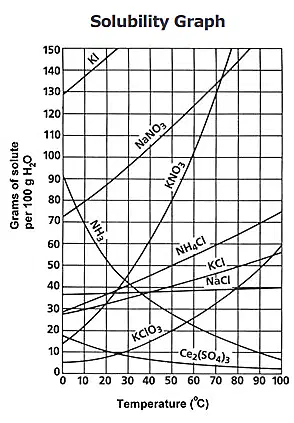
Based on the solubility graph above, which of the following substances is the most soluble in water at 40o C?
KCI
KNO3
NaCl
NH3
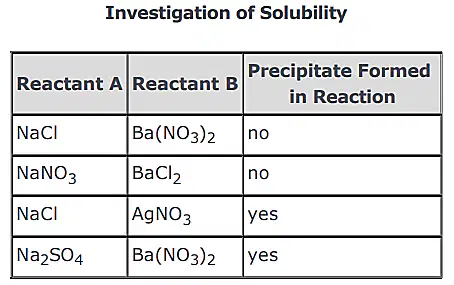
In chemistry class, a student wanted to develop solubility rules by reacting various 0.1 M aqueous solutions together to see if a precipitate formed. His results are pictured. Which of the following conclusions can be made based on the results shown here?
NaNO3 is insoluble in water.
Ba(NO3)2 is insoluble in water.
AgNO3 is insoluble in water.
AgCl is insoluble in water.
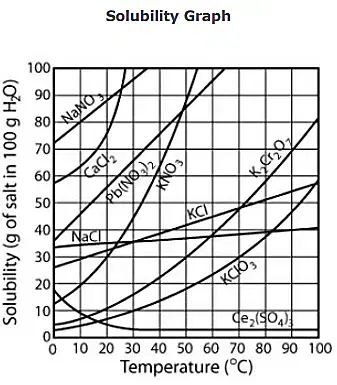
According to the graph above, which salt has a solubility curve which resembles the behavior of gasses in solution?
KNO3
Ce2(SO4)3
KClO3
K2Cr2O7
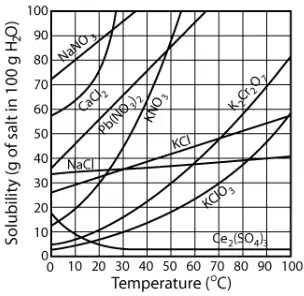
Students are asked to make statements about the solubility graph above. Which student does the best job of communicating the general features of the graph?
Student A. Most salts require 100 grams of water in order to dissolve completely.
Student B. Table salt has the average solubility of all salts.
Student C. The solubility of most salts increases with increasing temperature.
Student D. Most curves show a decreasing slope as the temperature rises.
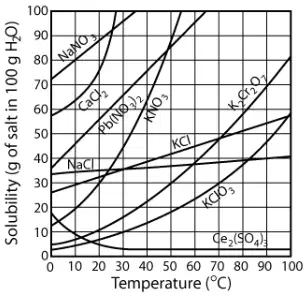
Refer to the graph above. In order to have a saturated solution, how many grams of potassium nitrate, KNO3, need to be dissolved in 100 grams of water at 20°C.
20
30
60
100
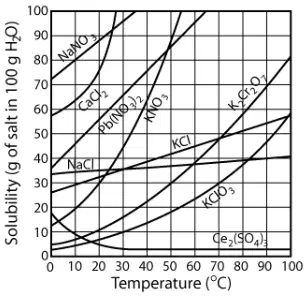
Refer to the above graph. 90 grams of sodium nitrate (NaNO3) are put into 100 grams of water and stirred. The final mixture has a temperature of 20°C.
About how many grams of the sodium nitrate dissolved?
23
80
73
88
The solubility rules for various salts in water indicate most salts of _______ are not soluble in water.
Li+
Ag+
K+
Na+
Hard water contains ions, such as calcium and magnesium, which can dry out the skin and hair. Water softeners work to remove some ions and replace them with others, such as sodium or potassium.
What property of water allows it to transport ions?
Surface tension
Density
Boiling point
Polarity
Why is water used as a solvent in many solutions?
Water dissolves other water molecules.
Water dissolves any chemical.
Water dissolves nonpolar molecules.
Water dissolves polar molecules.
Electrolytes are important to the body because they contribute to basic functions such as muscle contraction. Electrolyte ions, such as sodium and magnesium, must be balanced correctly in order to maintain bodily functions.
What property of water allows it to act as carrier for these ions?
Polarity
Viscosity
Shape
Density
What makes water, H2O, a polar molecule?
Its density, as liquid water, is more than that of ice.
It has N and S poles like a magnet.
Its hydrogen atoms have a greater electron affinity than its oxygen atom.
Its structure is bent rather than linear.
Why is water sometimes called the “universal solvent?”
The adhesion level in H2O is very high.
Many substances dissolve in H2O
The density of H2O is 1.0 g/cm3.
The hydrogen bonding of H2O is very low.
Water can dissolve many substances because ―
it has the molecular formula H2O
it has a linear molecular shape
it has a nonpolar molecular structure
it has a partial charge on each side of its molecules
A diluted solution of hydrofluoric acid has a volume of 3 L and a molarity of 3 M. If the original solution had a volume of 2 L, what was the initial molarity?
2 M
4.5 M
8 M
11 M
Of an 8 M solution of NaOH, 5.4 L is diluted to 18 L. Calculate the molarity of the new solution. Round your answer to one decimal point.
Of an 8 M solution of HCl, 1 L is diluted to 2 M. What is the volume of the diluted solution?
0.25 L
4 L
6 L
16 L
A chemical company is advertising that the vinegar they produce is superior to other company’s vinegar because it contains 1.24 M acetic acid. An investigation into their techniques shows that in order to make a bottle of Superior’s Vinegar they start with 150 mL of 17.4 M acetic acid and dilute it to a total volume of 2500 mL with distilled water.
Which of the following statements correctly evaluates the claim that Superior’s Vinegar contains 1.24 M acetic acid?
The claim is valid because the vinegar contains 1.24 M acetic acid.
The claim is invalid because the vinegar contains 0.96 M acetic acid.
The claim is invalid because the vinegar contains 290 M acetic acid.
The claim is invalid because the vinegar contains 1.0 M acetic acid.
How many mL of stock NH3 is needed to make 100.0 mL of 1.00M NH3? Your stock solution is 14.8M. (Round your answer to two decimal places)
The label is missing from the stock solution of sodium hypochlorite. Consulting partial lab notes, you find that you prepared a 0.49 M solution of sodium hypochlorite by adding 0.067 L of the stock solution to water to make a total volume of 0.55 L.
What must the concentration have been of the stock solution? Round your answer to a whole number.
Beginning with commercial grade hydrochloric acid, 1.00 x 10² mL of a 12.4 M HCl is added to water to bring the total volume of the solution to 0.820L. What is the concentration of this new solution?
1.02 M
1.51 M
6.60 M
10.2 M
To make 2.00 L of 0.300 M sulfuric acid, how many mL of a 1.00 M stock solution should be used?
1.50 x 10² mL
6.00 x 10² mL
6.67 x 10² mL
1.50 x 10³ mL

High-nitrogen fertilizers change the pH of soil for optimal crop production. Students collected soil samples treated with high-nitrogen fertilizers to test the pH. What conclusion is best supported by the data?
The fertilizer caused the soil to be slightly acidic due to low hydrogen ion concentration.
The fertilizer caused the soil to be slightly acidic due to high hydrogen ion concentration.
The fertilizer caused the soil to be highly acidic due to low hydrogen ion concentration.
The fertilizer caused the soil to be highly acidic due to high hydrogen ion concentration.
Potassium hydroxide, also known as lye, dissociates into metal and hydroxide ions in water. The resulting solution is caustic and used for industrial purposes.
What describes the dissociated solution?
Strong base
Weak acid
Weak base
Which type of solution has achieved equilibrium between solute and solvent if the solute is still visible after mixing?
An unsaturated solution
A saturated solution
A supersaturated solution
A dilute solution
Which of the following is the best way to determine if an aqueous solution of sodium acetate (NaC2H3O2) is supersaturated?
Add water to the solution.
Measure the temperature of the NaC2H3O2.
Filter all the NaC2H3O2 out of the solution.
Add a crystal of NaC2H3O2 to the solution.
A solution that contains the maximum amount of solute that is soluble at a given temperature is said to be —
unsaturated
saturated
supersaturated
diluted
Any substance that does not conduct electricity when in solution is called a(n) ―
nonelectrolyte
electrolyte
conductor
semiconductor
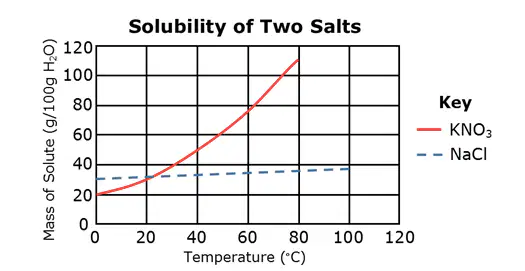
Which of the following statements makes a valid conclusion regarding the graph above?
Temperature has a greater effect on the solubility of potassium nitrate compared to sodium chloride.
Temperature has a greater effect on the solubility of sodium chloride compared to potassium nitrate.
At 10 °C, potassium nitrate has a greater solubility when compared to the solubility of sodium chloride.
At 30 °C, sodium chloride has a greater solubility when compared to the solubility of potassium chloride.
What will happen to the ability of a solid to dissolve in a liquid if the temperature increases?
Solubility of the solid always increases
Solubility of the solid always decreases
Solubility of the solid usually increases
Solubility of the solid usually decreases
What will happen to the ability of a gas to dissolve in a liquid if the temperature increases?
Solubility of the gas increases
Solubility of the gas decreases
Solubility of the gas increases or decreases
Solubility of the gas is not affected
Which of the following would decrease the rate of solution when dissolving a solid in water?
Raise the temperature of the solution
Crush the solid before mixing
Stir the solution after mixing
Use a single cube of solid
Which of the following would increase the rate of dissolution of a solid in a solution?
Cool the solid and the solution
Cool only the solid
Dry up the solvent
Stir the solid and solution
Which of the following would result in being able to dissolve a greater amount of gas in a solution?
Cool the gas and solution
Make the gas an electrolyte
Heat the gas and solution
Decrease the pressure of the solution
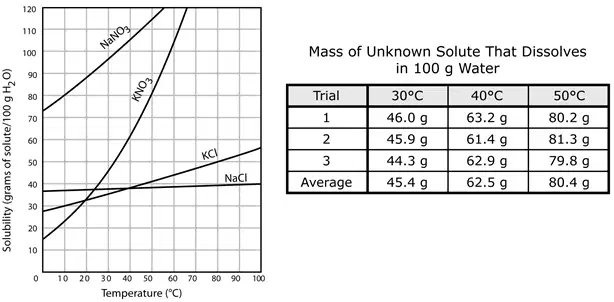
The solubility of an unknown substance was tested during an experiment. Based on the solubility curve information and the results of the experiment, what is most likely the identity of this unknown solute?
NaCl
KCl
KNO3
NaNO3
Determine the pH of a solution that has a hydrogen ion concentration of 8.10 x 10⁻⁸
Round your answer to three significant digits.
What is the pH of a solution with a hydrogen ion concentration of 1.3 x 10⁻¹¹?
11.1
10.9
1.3
0.11
Determine the pH of a solution that has a hydrogen ion concentration of 6.3 x 10⁻⁶.
-6.8
-0.80
0.80
5.2
What does pH measure?
Electron concentration
Neutron concentration
Hydroxide ion concentration
Hydrogen ion concentration
The pH of a basic solution is —
exactly 7
less than 7
greater than 7
between 3 and 6
A sample of lemon juice is found to have a pH of 2.3. What is the concentration of hydrogen ions in the lemon juice? (Answer in M, and round to three decimals.)
A sample of fruit juice is found to have a hydrogen ion concentration of 2.87 x 10⁻⁴. What would the pH be?
2.87
3.54
4.58
8.16
What is the pH of a substance that has a hydrogen ion concentration of 1.2 ×10⁻² M ?
2.08
1.92
1.00
0.080
Predict the missing product in the acid-base reaction.
2HBr + Ca(OH)2 → 2H2O + _______
CaBr
CaBr2
HCa
H2O2
Predict the missing product in the acid-base reaction.
HCl + NaOH → H2O + ______
HNa
ClOH
NaCl
CO2
How are acids described according to the Bronsted-Lowry definition?
Bronsted-Lowry acids are electron donors.
Bronsted-Lowry acids contain hydroxide groups.
Bronsted-Lowry acids are proton donors.
Bronsted-Lowry completely dissociate when dissolved in water.

A student researched some of the properties of H2CO3. Based on the properties described, what type of chemical is H2CO3?
Acid
Base
Salt
Polyatomic ion
A researcher is conducting a titration experiment where they mix hydrochloric acid with barium hydroxide:
___ HCl (aq) + ___ Ba(OH)2 (aq) → ___ _____ + ___ _____
Which of the following reactions shows a correctly balanced chemical equation for the titration being performed?
2 HCl (aq) + Ba(OH)2 (aq) → BaH2 (aq) + 2 ClOH (aq)
2 HCl (aq) + Ba(OH)2 (aq) → BaCl2 (aq) + 2 H2O (l)
HCl (aq) + Ba(OH)2 (aq) → BaCl (aq) + H2O2 (l)
HCl (aq) + Ba(OH)2 (aq) → BaO (s) + H3ClO (aq)
sour
corrosive
produce H+ ions in solution
pH below 7
donate protons
HClO3
feel slippery
pH above 7
produces OH- ions in solution
accept protons
LiOH
taste bitter
NH3
An aqueous solution of sodium hydroxide reacts completely with a solution of hydrochloric acid. After all the water evaporates from the reaction mixture, what will remain?
Sodium chloride
Chlorohydroxide
Sodium oxide
Sodium chlorate
During exercise, muscle cells break down glucose to provide energy. This chemical reaction is represented by the following chemical equation.
C6H12O6 + 6O2 --> 6CO2 + 6H2O + energy
How does this equation show the conservation of mass?
Glucose is broken down into smaller molecules.
The mass on each side of the equation is the same.
Mass is conserved when it is converted to heat.
Energy is created by breaking apart molecules.
The unbalanced equation below shows the combustion of methane.
_CH4 + _O2 --> _CO2 + _H2O
Which series of numbers represents the coefficients necessary to balance the
equation?
2, 2, 1, 4
1, 1, 1, 2
1, 2, 1, 2
0, 3, 2, 2
Which of these is a decomposition reaction?
2KlO3 --> 2KCl + 3O2
2H2 + O2 --> 2H2O
Fe + CuCl2 --> FeCl2 + Cu
NaOH + HCl --> NaCl + H2O
What type of reaction is shown below?
2KClO3 (s) --> 2KCl (s) + 3O2 (g)
synthesis
combustion
decomposition
single replacement
Magnesium chloride has an atomic mass of 94 amu. What is the mass of one mole of magnesium chloride?
3 g
47 g
94 g
188 g
Which BEST defines what a mole represents in chemistry?
the total number of protons and neutrons contained in any substance
the amount of chemical substances that contain 6.02 x 10²³ chemical units
the number of molecules of solute dissolved in one liter of solvents
the standard unit for mass in the International System of Units
How many hydrogen atoms are in 2 mol of H2O?
6.022 x 10²³
1.204 x 1024
2.409 x 1024
4.816 x 1024
How many atoms are in a 4.67 g sample of silicon?
3.62 x 1024
1.00 x 10²³
4.59 x 10²¹
2.81 x 1024
The chemical formula for glucose is C6H12O6. What is the percent by mass of hydrogen in glucose?
5.0%
33.3%
6.7%
53.3%
What is the percent of sodium present in sodium hydrogen carbonate, NaHCO3?
27.38%
33.82%
44.23%
84.00%
Which of the following is true of a limiting reagent?
I. It is a reactant
II. It limits the amount of product formed
III. It determines the maximum amount of product formed.
I only
II only
I & II
I, II, and III
What determines the theoretical yield in a chemical reaction?
percent yield
actual yield
limiting reactant
excess reactant
Solid zinc (II) oxide is added to hydrochloric acid to form zinc (II) chloride in water. How many moles of zinc chloride will be produced when 112 grams of zinc oxide is used?
1.38 moles
3.07 moles
56 moles
112 moles
Antimony is burned in oxygen to form antimony oxide.
4Sb + 3O2 --> 2Sb2O3
How many moles of Sb2O3 will be formed when you have 20.0 moles of oxygen gas?
10.0 moles
13.3 moles
15.5 moles
40.8 moles

Which graph shows the correct relationship between pressure and volume?
A
B
C
D
Charles' law describes the relationship between which two quantities?
pressure and volume
moles and pressure
volume and temperature
temperature and moles
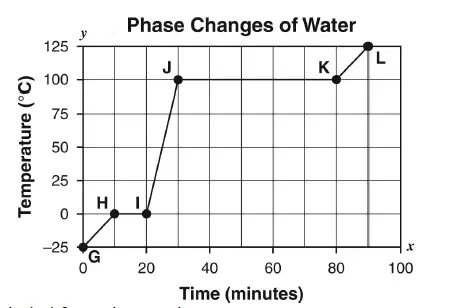
The graph below represents data collected during a laboratory investigation on the phase changes of water. Which can be concluded from the graph?
From time G to H, heat energy was absorbed.
From time H to I, the water changed from a gas to a solid.
From time J to K, heat energy remained the same
From time K to L, the water changed from a solid to a liquid.
Water vapor in the atmosphere condenses to form droplets in clouds. What happens to energy during condensation?
it is absorbed
it is released
it is created
it is destroyed
Which property of water allows it to dissolve substances like sodium chloride and glucose but prevents it from dissolving lipids?
pH
polarity
adhesion
cohesion
All of the planets in the solar system formed at about the same time from a large cloud of gas and dust. How is Earth different from other planets in the solar system?
Earth has no natural satellites.
Earth’s atmosphere is composed of gases.
Water is found in all three phases on Earth.
Volcanoes release liquid rock onto Earth’s surface.
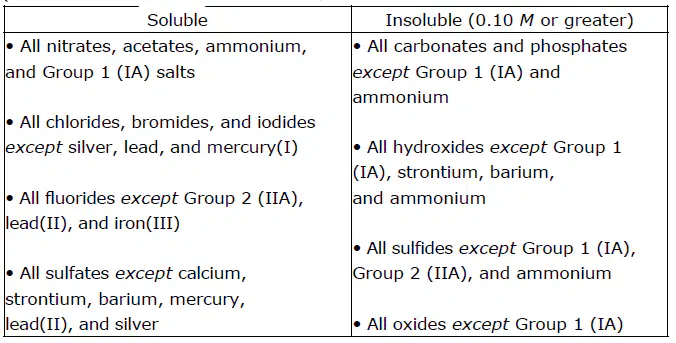
Based on these rules, what would the precipitate be in the reaction below?
ZnSO4(aq) + 2AgCl(aq) --> Ag2SO4(?) + ZnCl2(?)
ZnCl2
Ag2SO4
Ag2SO4 and ZnCl2
no precipitate will form
A student mixes oil and water in a flask. After a while, the oil and water separate into two layers. Which statement BEST explains this result?
Only one of the substances can act as a solvent to the other.
Only one of the substances can act as a solute to the other.
Neither substance can act as a solvent to the other.
Neither substance is able to form solutions.
What is the concentration of a solution if 2.0 moles of sodium chloride is dissolved in 0.50 liter of water?
0.5 M
1.0 M
2.0 M
4.0 M
Which unit listed below is used to measure solution concentration in chemistry?
electronegativity
molarity
solubility
viscosity
Which equation can be used to calculate the dilution of a solution?
a = bc
c = λν
PV = nRT
M1V1 = M2V2

