wayground logo

Free Printable Worksheets

Font size

S
M
L
XL
Worksheets

Chem 1 Final Review

Total questions: 170

Worksheet time: 3hrs 12mins

Name
Class
Date
1.
Which of the following best describes the particles in a gas?
a)
Vibrate, they do not move much at all and stay close together
b)
They break up and come together to form different types of particles. .
c)
They move fast and spread apart. 
d)
They can slide past one another, but stay close together.
2.
Which of the following best describes the particles in a liquid?
a)
Vibrate, they do not move much at all and stay close together
b)
They break up and come together to form different types of particles. .
c)
They move fast and spread apart. 
d)
They can slide past one another, but stay close together.
3.
Which of the following best describes the particles in a solid?
a)
Vibrate, they do not move much at all and stay close together
b)
They break up and come together to form different types of particles. .
c)
They move fast and spread apart. 
d)
They can slide past one another, but stay close together.
4.
Which of the following best describes sublimation?
a)
A liquid changing to a gas.
b)
A gas changing to a solid.
c)
A solid changing to a gas.
d)
A liquid changing to a solid.
5.
Which of the following best describes freezing?
a)
A solid changing to a liquid.
b)
A gas changing to a solid.
c)
A solid changing to a gas.
d)
A liquid changing to a solid.
6.
Which of the following best describes a gas changing to a liquid?
a)
Evaporation
b)
Condensation
c)
Sublimation
d)
Deposition
7.
Which of the following best describes a liquid changing to a gas?
a)
Evaporation
b)
Condensation
c)
Sublimation
d)
Deposition
8.
Which of the following substances have an indefinite shape but a definite volume?
a)
Solid
b)
Liquid
c)
Gas
9.
Which of the following substances has a definite shape and a definite volume?
a)
Solid
b)
Liquid
c)
Gas
10.
Which of the following substances has an indefinite shape and an indefinite volume?
a)
Solid
b)
Liquid
c)
Gas
11.
 A measure of the motion of the atoms and molecules in a substance.
a)
Temperature
b)
Thermal energy
c)
Potential energy
d)
Kinetic energy
12.
Rotting fruit
a)
Chemical
b)
Physical
13.
Erase a pencil mark
a)
Chemical
b)
Physical
14.
Salt + water
a)
Chemical
b)
Physical
15.
A nail gets rusty
a)
Chemical
b)
Physical
16.
Frying an egg.
a)
Chemical
b)
Physical
17.
A change in phase
a)
Chemical
b)
Physical
18.
Bubbles form
a)
Chemical
b)
Physical
19.
How many significant figures does the following number have: 0.002040
a)
6
b)
4
c)
3
d)
2
20.
How many significant figures does the following number have: 0.998005
a)
9
b)
10
c)
6
d)
5
21.
Round 0.010229 to four sig figs
a)
1022
b)
1023
c)
0.01023
d)
0.01022
22.
How many Significant Figures in the number below?
4.56 x 10³
a)
5
b)
4
c)
6
d)
3
23.
This particle is found in the nucleus and has no charge
a)
Neutron
b)
Proton
c)
Electron
24.
This particle is found in the nucleus and has a positive charge
a)
Electron
b)
Proton
c)
Neutron
25.
This is a negatively charged particle found outside the nucleus
a)
Electron
b)
Proton
c)
Neutron
26.
What scientist is best known for his "Plum Pudding" model of the atom?
a)
J.J. Tomson
b)
Ernest Rutherford
c)
John Dalton
d)
Democritus
27.
This particle determines what element you have - the elements identity.
a)
electron
b)
proton
c)
neutron
d)
valence shell
28.
What is the mass of a proton and a neutron?
a)
1amu
b)
2grams
c)
13amu
d)
10cm
29.
What are valence electrons?
a)
electrons on the first orbital always
b)
nucleus
c)
the outermost shell
d)
the number of electrons on the outermost orbital
30.
Which particles make up the nucleus of an atom?
a)
protons and neutrons
b)
electrons and protons
c)
electrons, protons, and neutrons
d)
electrons and neutrons
31.
What is the mass number and name of an element with 8 protons and 8 neutrons?
a)
16 - Carbon
b)
16 - Oxygen
c)
24 - Oxygen
d)
8 - Neon
32.
An element with a mass number of 11 and an atomic number of 5 has how many neutrons?
a)
11
b)
5
c)
6
d)
16
33.
Elements on the periodic table increase by...
a)
atomic mass
b)
size
c)
mass number
d)
atomic #
34.
Most of the mass of an atom is contained here.
a)
electron orbitals 
b)
nucleus
c)
shells
d)
atomic #
35.
Each column in the periodic table is called a 
a)
period
b)
group
c)
cluster
d)
unit
36.
Which group of the periodic table is composed of inert (not reactive)  gases?
a)
alkali metals
b)
alkaline earth metals
c)
halogens
d)
noble gases
37.
The atoms along the staircase are called 
a)
metals
b)
nonmetals
c)
metalloids
d)
noble gases
38.
Elements which are shiny, conduct electricity and heat are called
a)
metal
b)
nonmetal
c)
metalloid
d)
nonexistent
39.
What atom matches this electron configuration?
1s22s22p63s23p64s23d10
a)
Zinc
b)
Copper
c)
Nickel
d)
Germanium
40.
What electron configuration matches an oxygen atom?
a)
1s22s22p63s2, 3p64s23d104p5
b)
1s22s22p4
c)
1s22s22p6
d)
1s22s22p63s23p64s23d1
41.
How many electrons does Si contain? (click to see image)
a)
14
b)
28
c)
2
d)
4
42.
How many electrons can the first energy level hold?
a)
1
b)
2
c)
8
d)
0
43.
There are 4 different types of subshells s,p,d,f
a)
true
b)
false
44.
What is the maximum number of electrons that an orbital can have?
a)
1 electron
b)
2 electrons
c)
3 electrons
d)
4 electrons
45.
Which element is pictured?
a)
neon
b)
fluorine
c)
magnesium
d)
argon
46.
Which of the following does not exist?
a)
2d
b)
5f
c)
4d
d)
6p
47.
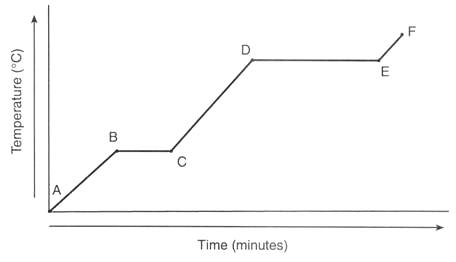
What line segment represents only the solid state?
a)
A-B
b)
B-C
c)
C-D
d)
D-E
48.
In which segment is the kinetic energy remaining constant?
a)
A-B
b)
B-C
c)
C-D
d)
E-F
49.
What state(s) of matter are present at D-E?
a)
Solid-liquid
b)
Liquid
c)
Liquid-gas
d)
Gas-Solid
50.
Between which points is the temperature of the substance increasing?
a)
A-B only. 
b)
A-B, C-D, E-F
c)
B-C only. 
d)
B-C, D-E
51.
Between which points is the substance changing state?
a)
A-B only. 
b)
A-B, C-D, E-F
c)
B-C only. 
d)
B-C, D-E
52.
Density: Chemical or Physical Property
a)
Chemical Property
b)
Physical Property
53.
Flammability (burns): Chemical or Physical Property
a)
Chemical Property
b)
Physical Property
54.
Reacts with Acid: Chemical or Physical Property
a)
Chemical Property
b)
Physical Property
55.
Melting Point: Chemical or Physical Property
a)
Chemical Property
b)
Physical Property
56.
Which box has a higher density?  
a)
Box A
b)
Box B
c)
cannot be determined
d)
they are the same
57.
Can an element be broken down into a simpler substance 
a)
yes 
b)
No
58.
Is salt (NaCI) a compound or a element
a)
Compound
b)
element
59.
Which of the following represents an element?
a)
H2O
b)
H2
c)
NaCl
d)
CaCO3
60.
What is made up two or more elements that are chemically combined?
a)
Element
b)
Mixture
c)
Compound
d)
Solids
61.
A combination of substances that are not chemically combined is called a(n)____________. 
a)
mixture
b)
compound
c)
physical
62.
The horizontal rows on the periodic table are known as
a)
periods.
b)
atoms.
c)
groups or families.
d)
valence electrons.
63.
What will happen to these molecules if they were put into a colder environment?
a)
They would speed up
b)
They would move further apart
c)

They would slow down

d)
They would multiple
64.
These kind of observation use your senses to observe results.
a)
Qualitative
b)
Quantitative
c)
Scientific
65.
These kind of observations are made using instruments such as rulers, balances and thermometers.
a)
Qualitative
b)
Quantitative
c)
Scientific
66.
A possible explanation to a problem that has not yet been tested. 
a)
data
b)
theory
c)
hypothesis
d)
fact
67.
This variable in an experiment is the one being deliberately changed by the scientist. 
a)
dependent variable
b)
independent variable
c)
data
d)
control group
68.
In a controlled experiment, how many independent variables can be worked with at a time? 
a)
one
b)
none
c)
two or more
d)
how ever many makes sense.
69.
Mr. S. sets up an experiment to see how the mass of a ball affects the distance it rolls off a ramp.  Identify the independent variable.
a)
distance traveled by the ball
b)
height of the ramp
c)
mass of the ball
d)
weight of the ball
70.
Which of the following will have a higher electronegativity than arsenic (As)?
a)
Carbon (C)
b)
Neon (Ne)
c)
Antimony (Sb)
d)
Germanium (Ge)
71.
Which of the following will have a lower ionization energy than Scandium (Sc)?
a)
Helium (He)
b)
Titanium (Ti)
c)
Calcium (Ca)
d)
Magnesium (Mg)
72.
As atoms of elements in group 16 are considered in order from top to bottom, the electronegativity of each successive element....
a)
decreases
b)
increases
c)
remains the same
d)
none of the above
73.
Which atom has the largest atomic radius?
a)
potassium
b)
rubidium 
c)
francium
d)
cesium
74.
Atoms that have a high electronegativity, _______________.
a)
give up their electrons more easily.
b)
hold on to their electrons more tightly.
c)
have more electron shells.
75.
As you move across the periodic table atoms tend to get smaller because, ______________.
a)
the atoms have more mass.
b)
the atoms have less mass
c)
the atoms have more protons.
d)
the atoms have less electrons.
76.
Ionization energy is...
a)
the energy required to add an electron to a specific atom
b)
how much energy it takes to remove an electron from an atom
c)
the energy required to shield the outer electrons from the nucleus
d)
a measure of the ability of an atom to attract electrons
77.
The element with the largest electronegativity in the halogens is - 
a)
At
b)
F
c)
Cl
d)
Br
78.
Atomic radius generally increases as we move __________.  
a)
down a group and from right to left across a period 
b)
up a group and from left to right across a period 
c)
down a group and from left to right across a period 
d)
up a group and from right to left across a period 
79.
Electronegativity __________ from left to right within a period and __________ from top to bottom within a group.
a)
decreases, increases 
b)
increases, increases
c)
increases, decreases 
d)
stays the same, increases
80.
Which orbital block corresponds to transition metals in the periodic table?
a)
s
b)
p
c)
d
d)
f
81.
Which of the following will have a larger radius than Zinc?
a)
Gallium
b)
Aluminum
c)
Magnesium
d)
Strontium
82.
A group of elements that includes the most active of the elements is the -
a)
halogens.
b)
noble gases.
c)
nitrogen group.
d)
alkaline earth metals.
83.

A measure of the size of an atom, and is generally defined as the distance from the nucleus to the outermost electron orbit

a)

chemical reactivity

b)

atomic radius

c)

energy levels

d)

orbit

84.
Which is larger:
P or P-3
a)
P
b)
P-3
c)
both are same size
85.
Which of the following will have a lower ionization energy than Scandium (Sc)?
a)
Helium (He)
b)
Titanium (Ti)
c)
Calcium (Ca)
d)
Magnesium (Mg)
86.
Atomic size _______ as you move down a group.
a)
increases
b)
stays the same
c)
decreases
d)
doesn't follow a pattern
87.
Which of the following is formed by losing electrons?
a)
ions
b)
anions
c)
cations
d)
dogions
88.
Metalloids can be described as...
a)
same as nonmetals
b)
bad conductors
c)
characteristics of metals and nonmetals
d)
same as metals
89.
Noble gases would fit into which group?
a)
metals
b)
nonmetals
c)
metalloids
d)
diatomic molecules
90.
Which family of metals is most reactive?
a)
Boron
b)
Halogens
c)
Noble Gases
d)
Alkali Metals
91.
Which of the following is NOT true about cations?
a)
They have a positive charge
b)
Non-metals form cations
c)
They are formed by losing electrons
d)
They are formed from metals
92.
Which of the following elements has the least metallic characteristics?
a)
Zinc
b)
Cadmium
c)
Mercury
d)
Gold
93.
Who first arranged the elements according to atomic mass?
a)
Louis Pasteur
b)
Henry Moseley
c)
John Dalton
d)
Dmitri Mendeleev
94.
The actinides are of greatest interest because of their
a)
abundance
b)
brilliance
c)
reactivity
d)
radioactivity
95.
Who was responsible for establishing the order in which the elements are presented in the modern periodic table?
a)
Dmitri Mendeleev
b)
Ernest Rutherford
c)
Henry Moseley
d)
Robert Bunsen
96.
In the ground state, how many electrons are in the outermost energy level of each element in Group 17 (VII A)?
a)
8
b)
2
c)
7
d)
5
97.
Which is NOT a property of metals?
a)
Good conductor 
b)
High boiling point
c)
Form negative ions (anions)
d)
Malleable
98.
Which is NOT one of the 6 elements essential for life?
a)
Calcium
b)
Nitrogen
c)
Sulfur
d)
Hydrogen
99.
Which block or blocks are included in the Representative Elements?
a)
s & p
b)
s & d
c)
d
d)
d & f
100.
Which block is known as the Transition Elements?
a)
s
b)
p
c)
d
d)
f
101.
Which of these is NOT a metal?
a)
Calcium
b)
Silicon
c)
Gallium
d)
Aluminum
102.
Which of these is a metalloid?
a)
Antimony
b)
Lead
c)
Carbon
d)
Bromine
103.
Is the molecule H2O polar or non-polar?
a)
polar
b)
non-polar
104.
Ionic compounds are written with
a)
cation (+ ion) first then anion (- ion)
b)
anion (- ion) first then cation (+ ion)
c)
either way is fine
d)
polyatomic ions first
105.
Ba+2, Br-1
a)
BrBa
b)
Br2Ba2
c)
BaBr2
d)
Br2Ba
106.
Ca+2, O-2
a)
CaO
b)
OCa
c)
Ca-2O+2
d)
Ca2O2
107.
Ca+2P-3
a)
PCa
b)
P2Ca3
c)
CaP
d)
Ca3P2
108.
The name of FeCl₂ is
a)
iron chloride
b)
iron (II) chloride
c)
iron (I) chloride
d)
iron dichloride
109.
The correct chemical formula for magnesium phosphide is
a)
MgP
b)
Mg₂P₃
c)
Mg₃P₂
d)
Mg₃(PO₄)₂
110.
When adding a subscript to a polyatomic ion, you should...
a)
multiply any subscripts on the polyatomic ion by the subscript you are adding
b)
put parentheses around the polyatomic ion before adding a subscript
c)
write the new subscript next to any subscripts on the polyatomic ion
d)
put the polyatomic ion in square brackets before adding the subscript
111.
What is the correct formula for dinitrogen tetroxide?
a)
N₃O₃
b)
(N₂)₂(O₄)₃
c)
N₂O₄
d)
N₄O₂
112.
What is the correct formula for dichlorine monoxide?
a)
Co₃O
b)
ClO₂
c)
Cl₂O
d)
(Cl₂)₂O
113.

What is the correct name for SO₂?

a)

Sulfur oxide

b)

Monosulfur dioxide

c)

Sulfur dioxide

d)

Sulfur II Oxide

114.
Which of the following is a covalent compound?
a)
CH4
b)
NaCl
c)
K3PO4
d)
Zn(OH)
115.
True or false: When naming ionic compounds, use prefixes to indicate subscripts
a)
True
b)
False
116.
Roman numerals tell you the ____ of the metal cation(s) in an ionic compound.
a)
number
b)
mass
c)
type
d)
charge
117.
What is the one prefix you NEVER USE if it is associate with the FIRST element in a covalent/molecular compound?
a)
di-
b)
tri-
c)
tetra-
d)
mono-
118.
Ionic or covalent?
Na  F
a)
Ionic
b)
Covalent
119.
Ca3(PO4)2
a)
ionic
b)
covalent
120.
Why can water have no net charge but have slight charges in different parts of the molecule?
a)
The oxygen end is slightly negative and the hydrogen end is slightly positive
b)
The hydrogen end is slightly negative and the oxygen end is slightly positive
c)
The hydrogen and oxygen ends change in polarity
d)
Because it is hydrophobic
121.
Attractions between water molecules are called
a)
Covalent bonds
b)
Ionic bonds
c)
Polar bonds
d)
Hydrogen bonds
122.
The attraction that causes water and other liquids to form drops on thin films is called ________________. This is also water’s ability to be attracted to other water molecules.
a)
adhesion
b)
capillary action
c)
cohesion
d)
surface tension
123.
Water is a universal solvent because it...
a)
It can be found anywhere
b)
It freezes when it gets cold
c)
floats when frozen
d)
Dissolves most substances
124.
Water molecules require a lot of energy to separate one from the others.  This gives water a high
a)
density
b)
polarity
c)
solvency
d)
specific heat
125.
Plant roots are able to absorb water because of ....
a)
evaporation
b)
capillary action
c)
surface tension
d)
universal solvent
126.
When putting salt in water, the water is considered the _________ and the salt is the ___________
a)
solute, solvent
b)
solvent, solute
c)
mixture, solvent
d)
mixture, solute
127.
What word describes when water is attracted to other substances?
a)
cohesion
b)
adhesion
c)
capillary action
d)
surface tension
128.
The normal pH scale goes from
a)
0 - 12
b)
0 - 14
c)
0 - 7
d)
0 - 10
129.
What is the only substance with a neutral pH of 7?
a)
Milk
b)
Orange Juice
c)
Water
d)
Blood
130.
A(n) ______ is a substance with a pH less than 7
a)
Acid
b)
Alkaline
c)
Base
d)
Buffer
131.
A solution with a pH of 8.6 would be...
a)
Acid
b)
Base
c)
Neutral
d)
Acid and Base
132.
A solution with a pH of 3.6 would be...
a)
Acid
b)
Base
c)
Neutral
d)
Acid and Base
133.
pH greater than 7.
a)
Acids
b)
Bases
c)
All
134.
Forms hydroxide ions (OH-) in water
a)
Acids
b)
Bases
c)
All
135.
What kind of reaction is this:
2H2 + O2 --> 2H2O
a)
Synthesis
b)
Decomposition
c)
Single Replacement
d)
Double Replacement
136.
What kind of reaction is this:
2H2O2 →2 H2+ O2
a)
Synthesis
b)
Decomposition
c)
Single Replacement 
d)
Combustion
137.
What kind of reaction is this:
2C3H7OH +9O2 -> 6CO2 + 8H2O
a)
Double Replacement
b)
Combustion
c)
Single Replacement
d)
Decomposition
138.
What kind of reaction is this:
Fe + CuSO4 -> Cu + FeSO4
a)
Double Replacement
b)
Decompostion
c)
Single Replacement
d)
Combustion
139.
The reaction below is an example of?
AgNO3 + NaCl 
→ AgCl + NaNO3
a)
Single Replacement
b)
Double Replacement
c)
Decomposition
d)
Combustion
140.
Classify
Zn + H
2S → ZnS + H2
a)
synthesis
b)
combustion
c)
single replacement
d)
double replacement
141.
Classify
CH4 + O2 → CO2 + H2
a)
single replacement
b)
double replacement
c)
synthesis
d)
combustion
142.

one mole is equal to

a)

6.02 x 10²² of anything

b)

6.02 x 10²³ of anything

c)

6.02 x 1024 of anything

d)

6.02 x 1025 of anything

143.

The numerical value of an atoms' molar mass and the value of its atomic mass are ________________.

a)

different

b)

the same

c)

varied

d)

large

144.

The molar mass of carbon is

a)

12.01 g/mol

b)

20.01 g/mol

c)

30.01 g/mol

d)

40.01 g/mol

145.

Find the molar mass of NaCl

a)

22.99 g/mol

b)

35.45 g/mol

c)

58.44 g/mol

d)

62.00 g/mol

146.

Find the molar mass of CH4

a)

12.00 g/mol

b)

10.00 g/mol

c)

16.04 g/mol

d)

25.00 g/mol

147.

Which are conversion factors that you can interchange

a)

22.4 L/mole and 1 mole/22.4 L

b)

6.02 x 10²³ molecules / 1 mole and 1 mole/6.02 x 1023 molecules

c)

6.02 x 10²³ atoms /1 mole and 1 mole/6.02 x 1023 mole

d)

all of them

148.

Which equation is balanced?

a)

KClO3 --> KCl + O2

b)

2KClO3 --> KCl + 2O2

c)

2KClO3 --> KCL + 3O2

d)

2KClO3 --> 2KCl + 3O2

149.

review: MgI2 is named___________________________________ and is it ionic or covalent?

a)

Magnesium Iodine, It's covalent

b)

Magnesium Iodide, It's Ionic

c)

Manganese Iodine, it's covalent

d)

Manganese Iodide, It's Ionic

150.
What are the units for molar mass?
a)
grams
b)
amu
c)
grams/mole
d)
liters
151.
The number 6.02 x 10²³, which is the number of particles found in a mole. 
a)
molar mass
b)
mole
c)
Avogadro's number
d)
hydrate
152.
How many molecules are in 9.44 moles of AlCl3?
a)
5.68 molec AlCl3
b)
5.68x1024 molec AlCl3
c)
0.705 molec AlCl3
d)
1.25x10²³ molec AlCl3
153.
Which of the following would increase the (gas) pressure of a system?
a)
Increase the Temperature
b)
Pump in more gas
c)
Decrease the volume
d)
All of these
154.
Boyle's Law demonstrates the relationship between _____ and _____. 
a)
Temperature and Volume
b)
Volume and Pressure
c)
Temperature and Pressure
155.
In order to convert to Kelvin, you add ______ to the Celsius measurement.
a)
372
b)
273
c)
237
d)
732
156.
What is 0 Kelvin known as
a)
No such thing
b)
Very cold
c)
Freezing point of Water
d)
Absolute Zero
157.
What is the equation for Charles' Law?
a)
P1V1=P2V2
b)
V1/T1=V2/T2
c)
V1/n1=V2/n2
d)
P1/T1=P2/T2
158.
What happens to the average kinetic energy of matter when it is heated?
a)
It increases
b)
It decreases 
c)
It doesn't change
d)
It cannot be determined
159.
If a balloon is cooled what will happen to the volume?
a)
Volume will increase
b)
Volume will decrease
c)
Volume will not change
160.
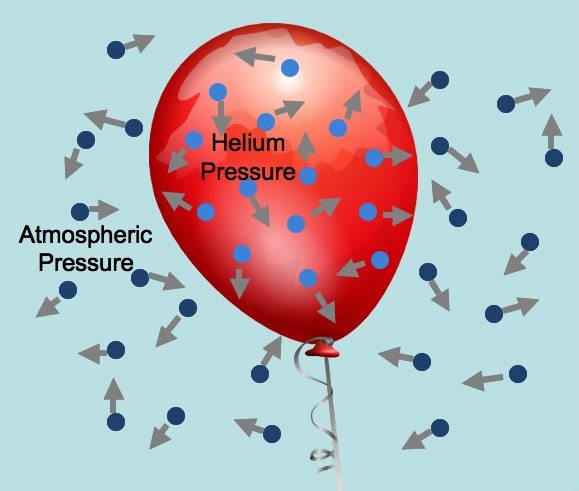
What causes pressure?
a)
The walls of the container
b)
The vacuum in the container
c)
The collisions of the particles
d)
Atmospheric pressure acting on the outside walls
161.
Pressure is ______ at standard conditions.
a)
760 torr
b)
1 atm
c)
101.3 kPa
d)
All choices are correct
162.
Which container will have lower pressure?
a)
left
b)
right
c)
they both have the same pressure
163.

Atmospheric pressure is measured with a —

a)

Thermometer

b)

Barometer

c)

pH meter

d)

scale

164.

Which is a characteristic of a base?

a)

it decreases pH

b)

it tastes sour

c)

it has a slippery feel

d)

it is a proton donor

165.
Which of the following is a base?
a)
orange juice
b)
water
c)
vinegar
d)
dishwashing detergent
166.
 Which of the following is an acid?
a)
shampoo
b)
baking soda
c)
orange juice
d)
water
167.
When dissolved in water, acids produce:
a)
bases
b)
salts
c)
hydrogen ions
d)
hydroxide ions
168.
Which type of ion does a base produce when it is dissolved in water?
a)
oxide
b)
oxygen
c)
hydrogen
d)
hydroxide
169.
Which of the following is true about acids and bases?
a)
The lower the pH, the stronger the acid
b)
the higher the pH, the stronger the acid
c)
The lower the pH, the more neutral the acid
d)
The higher the pH, the weaker the base
170.
A compound that changes color when it is in contact with an acid or base is called______________
a)
Acid
b)
Base 
c)
Neutral
d)
Indicator