
 Worksheets
Semester I Final Exam Review
Total questions: 45
Worksheet time: 33mins
A scale is a scientific tool used to measure (a)
Which of the following metric units is a measure of volume?
liter
kilogram
centimeter
Candela
The composition of the mixture of gases that makes up our air is best represented on what kind of graph?
bar graph
line graph
variable graph
pie chart
In a controlled experiment, (a)
During a storm, rainwater depth is measured every 15 minutes. Which of these terms describes the depth of the water?
controlled variable
dependent variable
independent variable
significant variable
After completing an experiment, all chemical wastes should be
left at your lab station for the next class.
disposed of according to your instructor's directions.
dumped in the sink.
taken home.
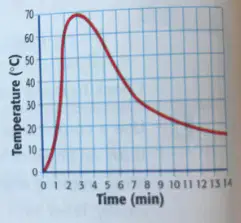
What was the highest temperature reached during the reaction?
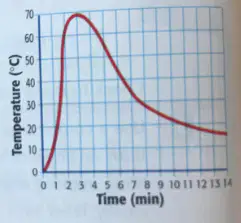
How many minutes passed before the highest temperature was reached?
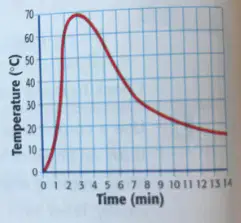
During what range of time was the temperature increasing?
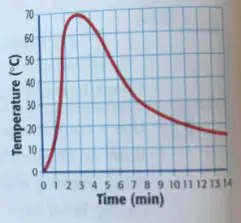
Did heating or cooling occur faster?
You are heating a substance in a test tube. Always point the open end of the tube
toward yourself.
toward your lab partner.
toward another classmate.
away from all people.
Matter is...
any visible solid that has mass.
any liquid that takes up space and has mass.
anything that takes up space and has mass.
any liquid or solid that takes up space.
Match the following substances with their types.
grape juice
mixture of fruit extracts
salt water
mixture of salt and water
table salt
pure sodium chloride
gasoline
mixture of hydrocarbons
Compounds and elements are
always solids.
mixtures.
pure substances.
dense.
Which of the following substances is a compound?
air
carbon dioxide
nitrogen
oxygen
If vinegar is poured into two test tubes containing white powders that look identical, which of the following statements is a reasonable conclusion as to why bubbles form in one tube but not the other?
The test tubes contain two different mixtures.
The contents of the test tubes are two different pure substances.
The materials in the two test tubes cannot be the same substance.
One test tube contains an element, and the other contains a compound.
Which of these statements describes the particles of a liquid?
Particles are far apart and move freely.
Particles are close together and vibrate in place.
Particles are far apart and unable to change location.
Particles are close together and move past each other easily.
The nucleus contains (a) and is positive.
Which statement is NOT true of Bohr’s model of the atom?
The nucleus can be compared to the sun.
Electrons orbit the nucleus.
An electron’s path is not known exactly.
Electrons exist in energy levels.
According to the modern model of the atom,
moving electrons form an electron cloud.
electrons and protons circle neutrons.
neutrons have a positive charge.
the number of protons an atom has varies.
The atom has a mass of 11 amu and contains five electrons, its atomic number must be
55
16
6
5
Which statement about atoms of elements in the same group of the Periodic Table is true?
They have the same number of protons.
They have the same mass number.
They have similar chemical properties.
They have the same number of total electrons.
The majority of elements in the Periodic Table are
nonmetals.
conductors.
synthetic.
noble gases.
Which of the following statements about Krypton is NOT true?
Its atomic mass is 83.80 amu.
Its atomic number is 36.
It is a metal.
It is a noble gas.
Which group on the Periodic Table is most likely to gain 2 electrons?
Alkali metals
Alkaline Earth metals
Group 16
Halogens
Which group on the Periodic Table is highly reactive?
Alkali metals
Alkaline Earth metals
Group 16
Noble gases
Which series of elements are in the same period?
Mg, Co, Bi, Rn
Sn, Pb, F, I
Ca, Sr, Cu, Ag
Na, Mg, Si, P
What causes atoms to form chemical bonds with other atoms?
They want to have filled outer orbitals (octet rule).
When two atoms get close together, they merge into one.
The interaction of valence electrons forms a more stable configuration.
The attraction of the nuclei for one another causes atoms to share electrons.
Which of the following pairs of atoms is most likely to form a covalently bonded compound?
bromine and lithium
helium and fluorine
nitrogen and iodine
nitrogen and copper
Which of the following statements about covalent compounds is TRUE?
Covalent compounds generally exist as molecules.
Covalent compounds are good electrical conductors in solution.
The valence electrons are always shared equally by the two atoms in a covalent bond.
Covalent bonds generally involve two atoms that are very different, such as a metal and a nonmetal.
Which substance has ionic bonds?
CO
CO₂
KCl
O₂
A chemical bond can be defined as
A force that joins atoms or ions together.
A force blending nuclei together.
A force caused by electric repulsion.
All of the above.
An atom of which of the following elements is unlikely to form a positively charged ion?
potassium, K
selenium, Se
barium, Ba
silver, Ag
How many valence electrons does Si have?
One
Two
Three
Four
Which electron-dot symbol (Lewis dot diagram) correctly represents an atom of its given element?
S with 4 electron dots around it
Li with 3 electron dots around it
Al with 3 electron dots around it
B with 5 electron dots around it
Match the following statements with the correct part of an atom involved in a chemical reaction:
the nucleus of an atom.
Where nuclear reactions occur.
only in the protons in the nucleus.
Involves changes in the identity of the element.
acquires or loses protons.
Involves changes in atomic number.
the electrons in the outer shells.
Where chemical reactions occur.

How many electrons are in the valence shell of this atom?
2
3
8
10
What kind of reaction occurs when sodium reacts with magnesium hydroxide? Na + Mg(OH)₂ →
synthesis
decomposition
single replacement
double replacement
(a) occurs when two compounds are involved in a chemical reaction? KCl + PbNO₃ →
For the reaction below choose the correct coefficients to balance the equation. C₃H₈ + O₂ → CO₂ + H₂O
2, 2, 3, 4
1, 5, 3, 4
3, 5, 2, 4
1, 7, 3, 4
Place the following compounds in order of decreasing strength of intermolecular force, HF, O₂, CO₂
HF < O₂ < CO₂
CO₂ < O₂ < HF
HF > CO₂ > O₂
O₂ > CO₂ > HF
What type of intermolecular force causes NaCl to dissolve in water?
London dispersion
Ion-Dipole
Hydrogen bonding
Dipole-Dipole
What is the dominant intermolecular force present in H₂?
London dispersion
Ion-Dipole
Hydrogen Bonding
Dipole-Dipole
This intermolecular force accounts for HF being a liquid, while H₂ and F₂ are gases at room temperature.
London dispersion
Ion-Dipole
Hydrogen bonding
Dipole-Dipole
Which of the following statements is true?
Covalent bonds result from electrons being shared between atoms in a molecule.
Intermolecular forces are forces of attraction between atoms.
Intermolecular forces determine physical properties such as the boiling point of a substance.
Chemical bonds include ionic bonds and covalent bonds.

