
Font size
 Worksheets
Semester Exam Environmental Sys
Total questions: 65
Worksheet time: 1hrs 9mins

Abiotic is non-living
The main idea of sustainability is to act responsibly so that the resources on the planet will be able to _____________many generations to come.
feed
wipe out
support
clothe
An accurate definition of Sustainability is
meeting population needs
meeting the needs of the present without compromising the ability of future generations to survive
meeting the needs of the future without worrying about todays
meeting the food needs of animals
Renewable resources ...
are not replaceable
are used more frequently than non renewables
are never going to run out
going to run out
What are fossil fuels?
coal, oil, uranium
oil, natural gas, uranium
coal, oil, natural gas
geothemals, coal, natural gas
What is a disadvantage of using non-renewable resources?
They have a large carbon footprint.
They can all be used up over time.
They can lead to global warming.
All of these.
Which of the following could be caused by an interaction between the hydrosphere and geosphere?

Glaciers

Soil erosion

Plants growing

Waves
What is included in the Earth's biosphere?
Air, water, and minerals
Plants, animals, and microorganisms
The Earth's crust
Gases and trace elements
What is the difference between abiotic and biotic resources?
Abiotic resources are living or once were, while biotic resources come from inorganic materials
Abiotic resources come from inorganic materials, while biotic resources are living or once were
Abiotic resources are renewable, while biotic resources are nonrenewable
Abiotic resources are nonrenewable, while biotic resources are renewable
How can you distinguish between renewable and nonrenewable resources?
Renewable resources can be replaced naturally, while nonrenewable resources cannot
Renewable resources cannot be replaced, while nonrenewable resources can
Renewable resources are biotic, while nonrenewable resources are abiotic
Renewable resources are abiotic, while nonrenewable resources are biotic

Which of these answers describes Earth’s atmosphere?
All living and once living things.
The mixture of gasses that surrounds the earth.
The mixture of nickle and iron below the earth's surface.
All the fresh and salt water on the earth's surface.

Water availability impacts plant growth and animals who depend on plants for food are interactions between the
Geosphere and Hydrosphere
Cryosphere and atmosphere
Biosphere and geosphere
Hydrosphere and biosphere

Sometimes fires burn large areas of forests, which are part of the biosphere. Other than the biosphere, which of Earth’s other spheres is a forest fire most likely to affect?
atmosphere
cryosphere
geosphere
hydrosphere

A volcano erupts adding carbon dioxide to the air are interactions between the
atmosphere and biosphere
geosphere and atmosphere
geosphere and hydrosphere
biosphere and atmosphere
A ________________ feedback loop makes a system more stable.
Positive
Neutral
Negative
Circular
A _________________ feedback loop moves a system to an extreme.
Positive
Neutral
Circular
Negative

Divergent
Convergent
Transform

Divergent
Convergent
Transform
Crust is neither created nor destroyed
Divergent
Convergent
Transform
San Andreas
Divergent
Convergent
Transform
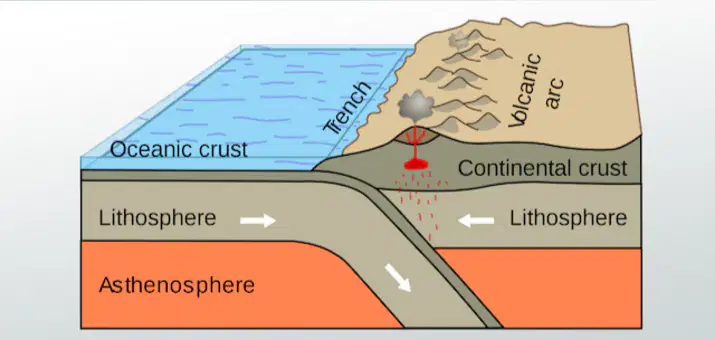
Divergent
Convergent
Transform

New oceanic crust (sea floor) is created at this boundary.
Divergent Oceanic
Divergent Continental
Convergent Oceanic
Transform
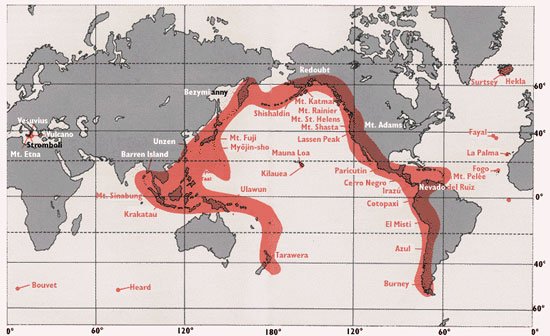
This is the name for the chain of volcanos around the edge of the Pacific Plate.
Circle of Fire
Ring of Lava
Ring of Fire
One Hot Magma


This layer in the center of the Earth.
Crust
Mantle
Core

We live on this layer.
Crust
Mantle
Core

This layer is below the crust.
Crust
Mantle
Core
The idea that continents were once part of a single landmass that broke apart and
moved
Continental Drift
Tectonic Plates
Transform
Subduct
The land mass where all of the continents were once together in one large continent is called ________________.
Laurasia
Pangaea
Eurasia
Gondwana
The land mass where all of the continents were once together in one large continent is called ________________.
Laurasia
Pangaea
Eurasia
Gondwana
The three types of plate boundaries are
Convergent, divergent, change
Divergent, allegiant, insurgent
Convergent, divergent, transform
Push, pull, slide
The outer core is
Layer of liquid metal.
Outermost layer of the Earth.
Made up of the lithosphere and asthenosphere.
Innermost layer of solid metal.
The inner core is
Layer of liquid metal.
Outermost layer of the Earth.
Made up of the lithosphere and asthenosphere.
Innermost layer of solid metal.

Which of the following increases as depth increases into the Earth? (choose all that apply)
time
Pressure
temperature
density


__________________ is the process by which moisture is carried through plants from roots to small pores on the underside of leaves, where it changes to vapor and is released to the atmosphere. It is essentially evaporation of water from plant leaves.
Transpiration
Percolation
Infiltration
Plant Uptake
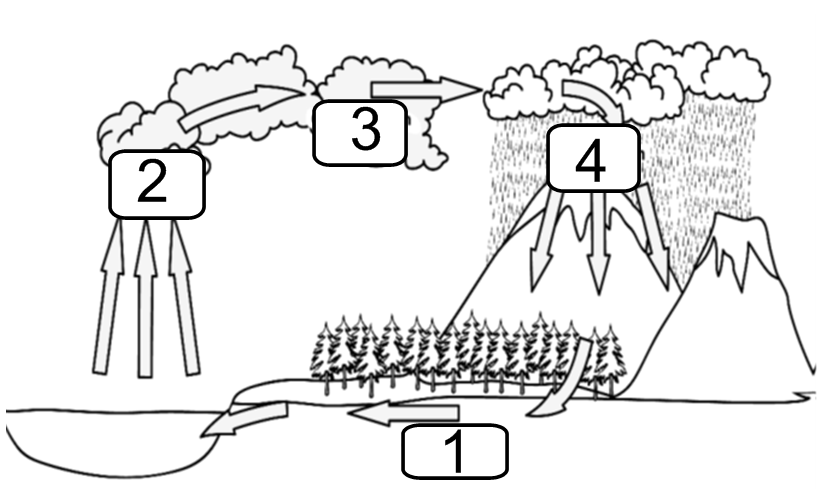

evapotranspiration
Which of the following is in the correct order?
Evaporation -> Transpiration -> Groundwater
Precipitation -> Condensation -> Evaporation
Evaporation -> Sublimation -> Precipitation
Condensation -> Precipitation -> Runoff
True or False - All of the water on Earth is recycled through biogeochemical cycles.
True
False
Water can change to gas through which process?
Evaporation
Sublimation
Transpiration
All answer choices are correct
In the carbon cycle, animals can release carbon back into the cycle through __________ or through __________.
burning . . . photosynthesis
fixation . . . decomposition
decomposition . . . photosynthesis
respiration . . . decomposition
respiration . . . photosynthesis
Where does all the carbon in organisms (living things) originate from?
Earth's atmosphere
Rocks
Water
Soil
What kind of organism takes out the most carbon from the atmosphere?
Plants
Bacteria
Animals
Humans
Why are plants usually green?
Because the chlorophyll reflects green light
Because the chlorophyll absorbs green light
Because the accessory pigments combine to make green
Because the accessory pigments only absorb green light
Which of these is the correct equation for photosynthesis?
6O2 + C6H12O6 --> 6CO2 + 6H2O
6O2 + 6CO2 --> C6H12O6 + 6H2O
6CO2 + 6H2O --> C6H12O6 + 6O2
6CO2 + 6H2O --> O2 + C6H12O6
bacteria that convert atmospheric nitrogen into ammonia.
Nitrogen Fixing Bacteria
Eubacteria
Archaebacteria
Nitrogen Cycle
What is the original cause of eutrophication?
Too many predators
Too much bacteria
Excess fertilizer
Too much oxygen
The term "hypoxic" refers to an absence of what?
The largest "Dead Zone" in the world is located in
Atlantic Ocean
Pacific Ocean
Gulf of Mexico
Indian Ocean
Southern Ocean
In eutrophication, dissolved oxygen levels decrease because
bacteria use it as they decompose organic material
algae uses it during photosynthesis
it reacts with hydrogen to form H2O (water)
fish use it up as they consume algae
Gas that makes up 78% of our atmosphere.
Oxygen
Nitrogen
Hydrogen
Carbon Dioxide
What process occurs when dead plant and animal matter decomposes and nitrogen is released back into the atmosphere?
Assimilation
Fixation
Ammonification
Denitrification

