
Font size
 Worksheets
EM Spectrum Quiz
Total questions: 35
Worksheet time: 53mins


Emission spectra (bright line spectra) are created when electrons move from ___.
higher to lower energy levels.
lower to higher energy levels.
s orbitals to p orbitals.
one atom to a different atom.
How much of the electromagnetic spectrum is made up of visible light?
only a small portion
a very large portion
about half

When comparing infrared waves to X-rays, what relationships would you expect to see in terms of wavelength, energy, frequency, and why?
Because of their inverse relationship, infrared waves will have longer wavelengths with lower frequencies than that of X-rays.
Wavelength and frequency are directly related, so infrared waves will have longer wavelengths with higher frequencies than that of X-rays.
Wavelength and frequency are inversely related, so infrared waves will have longer wavelengths with higher frequencies than that of X-rays. Their energies will be the same.
Wavelength and frequency are directly related, so infrared waves will have longer wavelengths with lower frequencies than that of X-rays. Their energies will be the same.
The regions of the electromagnetic region move at the speed of light. Which of the following values shows the speed of light in vacuum?
3.0 x 10⁸ m/s
3.0 x 10⁻⁸ m/s
3.0 x 10¹⁸ m/s
3.0 x 1080 m/s
What unit is used to measure the number of complete wave cycles in a second?
Hertz
Sievert
rem
frequency
Which of the following has the highest energy?
microwave
ultraviolet rays
x-rays
infrared waves
Among the seven colors of visible light, which color has the least energy?
red
violet
yellow
blue
What type of wave creates sunburn?
UV
Xray
Gamma
Infrared


The number of times a wave cycles in one second, measured in Hertz is called
frequency
wavelength
velocity of a wave
displacement from equilibrium

Wavelength is
the time it takes to complete one wave
the number of times a wave cycles in one second
the height of a wave
the length of a wave from crest to crest or trough to trough
all of the frequencies or wavelengths of electromagnetic radiation
electromagnetic spectrum
frequency
x-rays
wavelength
the number of complete waves that pass a given point in a certain amount of time
frequency
wavelength
amplitude
electromagnetic spectrum
electromagnetic waves with the shortest wavelengths and the highest frequencies.
gamma rays
radio waves
infrared
visible light
Colored band produced when a beam of light passes through a prism
Spectrum
Spectroscope
Emission Spectrum
Absorption Spectrum
The spectrum formed by electromagnetic radiation emitted by a given source.
Emission Spectrum
Absorption Spectrum
Spectroscope
Spectrum
Visible light is the only EM waves humans can see without tools.
True
False
Amplitude
The distance from crest to crest
The distance from trough to trough
The measurement from resting point to crest
The length of the wavelength
very short electromagnetic wave - Is shown right next to radio wave on the EMS.
Ultraviolet
X Ray
Visible light
Microwave
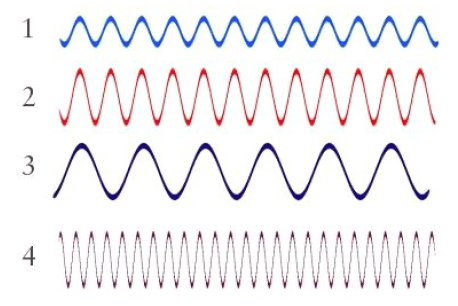

What happens to frequency when wavelength decreases?
stays the same
decreases
increases
There is no relationship between wavelength & frequency.
Which color waves have the shortest wavelength?
red
yellow
green
violet
Which EM waves are have the highest energy & are the most dangerous?
radio
gamma rays
infrared
x-rays
Which EM waves are invisible? (more than one correct answer)
radio
visible
ultraviolet
gamma rays
Carried in different amounts by all waves
Frequency
Wavelength
Energy
Electromagnetic Spectrum
When two different variables do the opposite thing
Direct Relatinship
Inverse Relationship
When two different variables do the same thing
Direct Relatinship
Inverse Relationship
Which two variables of the electromagnetic spectrum have a direct relationship?
Crests and trough
energy and frequency
wavelength and energy
frequency and wavelength
When comparing infrared waves to X-rays, what relationships would you expect to see in terms of wavelength, energy, frequency, and why?
Because of their inverse relationship, infrared waves will have longer wavelengths with lower frequencies than that of X-rays.
Wavelength and frequency are directly related, so infrared waves will have longer wavelengths with higher frequencies than that of X-rays.
Wavelength and frequency are inversely related, so infrared waves will have longer wavelengths with higher frequencies than that of X-rays. Their energies will be the same.
Wavelength and frequency are directly related, so infrared waves will have longer wavelengths with lower frequencies than that of X-rays. Their energies will be the same.
Electromagnetic Spectrum
A continuum of all electromagnetic waves
arranged according to frequency and wavelength
The specific wavelengths of electromagnetic
radiation emitted by the electrons of atoms or
molecules as those electrons return to a lower
and more stable energy state
The ability of a
system to do work
or produce heat
The number of wave cycles that pass a given
point per unit of time
Energy
The number of wave cycles that pass a given
point per unit of time
The ability of a
system to do work
or produce heat
A form of energy that exhibits wavelike behavior
as it travels through space; part of the
electromagnetic spectrum
An elementary particle that is the smallest
possible amount of light and all other forms of
electromagnetic radiation that can interact with
anything
Light
A form of energy that exhibits wavelike behavior
as it travels through space; part of the
electromagnetic spectrum
An elementary particle that is the smallest
possible amount of light and all other forms of
electromagnetic radiation that can interact with
anything
A disturbance in particles or a field that transfers
energy progressively from point to point without
the field or particles having any net movement
themselves
The distance between two adjacent crests or
troughs of a wave
Photon
A disturbance in particles or a field that transfers
energy progressively from point to point without
the field or particles having any net movement
themselves
The distance between two adjacent crests or
troughs of a wave
A continuum of all electromagnetic waves
arranged according to frequency and wavelength
An elementary particle that is the smallest
possible amount of light and all other forms of
electromagnetic radiation that can interact with
anything

