Wayground logo

Free Printable Worksheets

Font size

S
M
L
XL
Worksheets

20 questions on Charles Darwin for Y8

Total questions: 20

Worksheet time: 24mins

Name
Class
Date
1.
What characteristic did Darwin observe about the finches on the Galapagos Islands?
a)
Their feathers 
b)
Genotypes 
c)
Their beaks
d)
Their body sizes
2.
Darwin referred to this as survival of the fittest. Over time, it results in changes in the inherited characteristics of a population because organisms with adaptations that make them fit for their environment will survive and reproduce better than those without favorable traits.
a)
Natural Selection
b)
Genetic Variation
c)
Survival of the Fittest
3.
Genetic differences between organisms of the same species
a)
Variation
b)
Adaptation
c)
Behavior
d)
Environment
4.
Which statement best describes the process of evolution?
a)
Populations can survive in different locations on earth
b)
Environmental conditions limit the number of species on Earth
c)
Populations grow when resources are abundant
d)
The traits of a species can change over time
5.

When was Charles Darwin born?

a)

1809

b)

1825

c)

1812

d)

1836

6.
Which process produced the two different types of beaks in the ground finch and the tree finch?
a)
artificial selection
b)
geographical distribution
c)
natural selection
d)
disuse of the beak
7.

Which of the following statements is true?

a)

Human beings evolved from chimpanzees

b)

Chimpanzees evolved from human beings

c)

Humans and chimpanzees both evolved from a common ancestor

d)

Chimpanzees and humans are not closely related, biologically

8.

When is a trait most likely to be passed on to the next generation? Choose the best answer.

a)

When it serves no purpose to the organism

b)

When it prevents the organism from finding a mate

c)

When it gives the organism an abundant supply of water

d)

When it becomes an advantage to the organism's survival

9.

The name of the ship was...

a)

The Eagle

b)

The Easel

c)

The Maiden

d)

The Beagle

10.

What is a fossil?

a)

The remains of an animal that just died

b)

A live animal

c)

The preserved remains of an ancient animal

d)

A type of food from Tahiti

11.

Darwin's book is called "On the origin of..."

a)

Changes

b)

Animals

c)

Species

d)

Adaptation

12.

Why are the polar bears better adapted to their environment than the brown bears?

a)

they are better camouflaged

b)

they are smarter

c)

they are stronger

13.

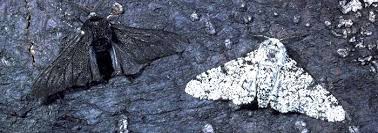
In our graphing examples, why did the population of peppered moths change?

a)

Predators were able to easily see their prey.

b)

People hunted lighter colored moths

c)

White moths were killed by the smoke from the factories

d)

Moths mood changed to sad, causing them to become dark

14.
what did Charles Darwin observe in finch populations of the Galapagos Islands off the coast of South America?
a)
different species on different islands
b)
all species on one of the islands
c)
identical species on all the islands
d)
the same species as North America
15.
The gradual change in species over time is...
a)
Evolution
b)
Nucleotide 
c)
Adaptation
d)
Natural Selection
16.
The struggle for existence against other members of an organisms species is
a)
Competition
b)
Natural Selection
c)
gene flow
d)
genetic drift
17.
What is another name for natural selection?
a)
survival of the smartest
b)
survival of the fastest
c)
survival of the biggest
d)
survival of the fittest
18.
Predict which moth would increase in population
a)
light 
b)
dark
19.
The white feathers of a snowy owl allow it to blend in with its environment during the winter months (snow). This is an example of ________________
a)
Species
b)
Environmental Change
c)
Adaptation
d)
Variation
20.
An animal's color or pattern that helps it blend into its surroundings
a)
Environment 
b)
Mimicry
c)
Camouflage