
 Worksheets
PHY201_PracticeQuiz
Total questions: 170
Worksheet time: 5hrs 18mins
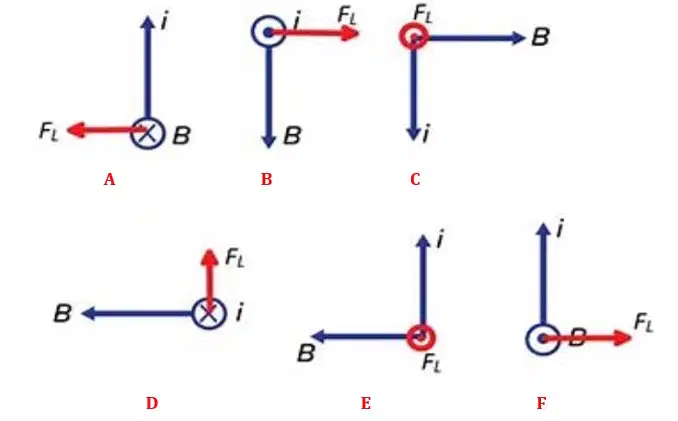
Which of the following images is correct?
A,B,C
A and C
B and D
D only
All are correct
If an electron moves at 10^6 m/s in a magnetic field of 500 T, where the angle between the velocity vector of the electron and the magnetic field is 37 degrees, what is the Lorentz force felt by the electron?
1.6 x 10^-11 N
4.8 x 10^-11 N
6.4 x 10^-11 N
1.6 x 10^-19 N
4.8 x 10^-19 N
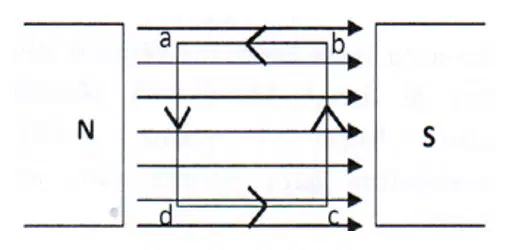
A rectangular coil with a length of 12 cm and a width of 10 cm consists of 40 turns and carries a current of 2 A. The coil is in a magnetic field of 0.25 T. What is the magnitude of the torque experienced by the coil?
0.06 Nm
0.10 Nm
0.24 Nm
0.36 Nm
0.48 Nm

What is the direction of the field?
into the plane
out of the plane
parallel to the plane

If the red arrow is the current, what is the direction of the force?
to the left
to the right
there is no force
into the plane

What was the direction of the current?
to the left
to the right
into the plan
out of the plane
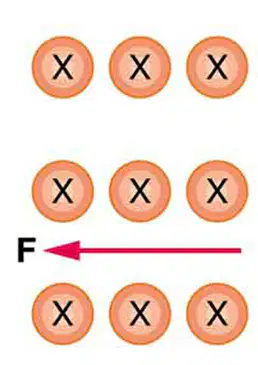
What is the direction of the current?
upwards
downwards
to the left
42
There is no force if...
there is too much current
the current is perpendicular to the B-field
the current is parallel to the B-field
There is always a force.
A coin is rubbed with a cloth gains 3X10^-16 C of positve charge, How many electrons it lost.
1875
18750000
187500
What is the end result of charging by contact?
Both object have the same charge, so they will attract one another
Both object have the same charge, so they will repel one another
Both object have the opposite charge, so they will attract one another
Both object have the opposite charge, so they will repel one another

Which image shows a neutral conductive pith ball after a positively charged balloon is brought near the left side, but doesn't touch?
A
B
C
D
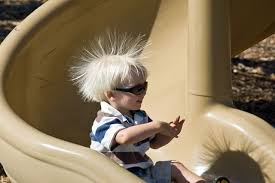
Why does the child's hair stick up?
The boy is grounded since he's at the bottom of the slide
He gained a charge from the slide, and since he's not grounded, his hairs have the same charge so they repel one another
He gained a charge from the slide, and since he's not grounded, his hairs have opposite charges so they repel one another
When hair is neutral, some have a positive side and some have negative side, so they will attract to each other, making it stand up
A balloon is rubbed against a student's hair and then touched to a wall. The balloon sticks to the wall due to
The balloon is charged neutral, so is the wall, so it attracts to the wall
The balloon is charged opposite the wall, so it attracts to the wall
The balloon has a charge, so it attracts the neutral wall
The wall grounds the balloon, so it sticks
Two like charges
neutralize each other.
repel each other.
must be neutrons.
attract each other.
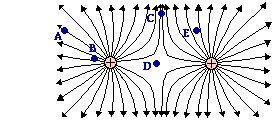
Which of the following labeled points is in the region with the strongest force of electric charge
A
B
C
D
When the distance between two charges is halved, the electrical force between the charges
quadruples
reduces to one fourth
halves
doubles
During a physics lab, a plastic strip was rubbed with cotton and became positively charged. The correct explanation for why the plastic strip becomes positively charged is that ...
the plastic strip acquired extra protons from the cotton.
the plastic strip acquired extra protons from the charging process
protons were created as the result of the charging process
the plastic strip lost electrons to the cotton during the charging process
Two similar metal spheres, A and B, have charges of +2.0 x 10⁻⁶ coulomb and +1.0 x 10⁻⁶ coulomb, respectively. The magnitude of the electrostatic force on A due to B is 4.0N newtons. What is the magnitude of the electrostatic force on B due to A?
2.0N
4.0N
8.0N
1.0N
which is the field for opposite charges


2 charged objects both feel a force of 200 N. If q1 becomes 3 times bigger, what is the new force
203
600
66.7
1800
2 charges are 20 cm apart and feel a force of 500 N. if the distance between them becomes 60 cm, what is the new force
4500
540
1500
55.6
2 charges feel a force of 40 N. if we cut the distance between them in half, what is the new force they feel
20
80
160
10


If a glass plate is placed over a magnet and iron filings are sprinkled over the glass, a pattern will be visible. What does this pattern indicate?
The magnetic field
The electrostatic field
The piezoelectric effect
The chemical reaction of the magnet and the filings

Iron, Nickel and cobalt are all __________________ materials
Diamagnetic
Ferromagnetic
Paramagnetic
Temporary magnet
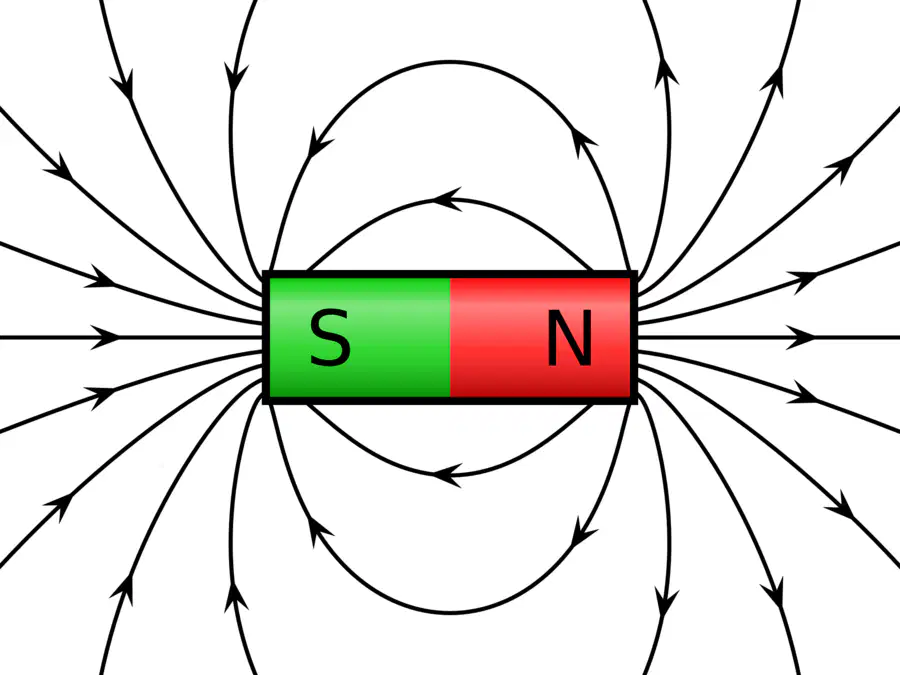
It is the substances that are SLIGHTLY attracted by strong magnets.
Diamagnetic
Ferromagnetic
Magnetism
Paramagnetic
Which of these is STRONGLY attracted to a magnet?
Aluminum
Bismuth
Iron
Wood
It is the process of removing the magnetic property of a magnet.
Demagnetization
Magnetic Field
Magnetism
Magnetization
How is a permanent magnet DIFFERENT from a temporary magnet?
A permanent magnet attracts materials made of iron.
A permanent magnet has a magnetic field.
A permanent magnet has poles.
A permanent magnet keeps its magnetism for a long time.
It refers to the properties and interactions of magnets.
Demagnetization
Magnetism
Magnetization
Natural Magnet
Which of these is STRONGLY attracted to a magnet?
Aluminum
Bismuth
Iron
Wood
It is the process of removing the magnetic property of a magnet.
Demagnetization
Magnetic Field
Magnetism
Magnetization
What does the thumb indicate in flemings left hand rule?
Force
Motion
Current
Magnetic field direction
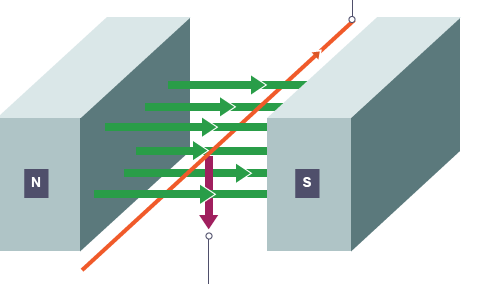
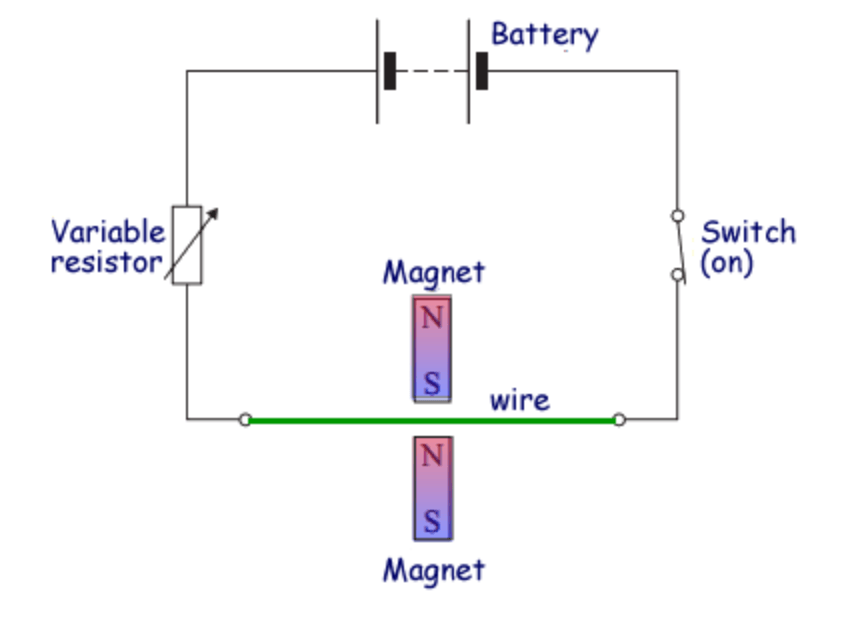
What direction is the force/motion in the following diagram?
Perpendicular to the magnets
Downwards
Parallel and through the magnets

What angle must there be between a magnetic field and a conductor in order for the maximum force to be exerted?
180
45
90
270
Which rule can be used to work out which way a coil of wire rotates in a motor?
Fleming's left-hand rule
Fleming's right-hand rule
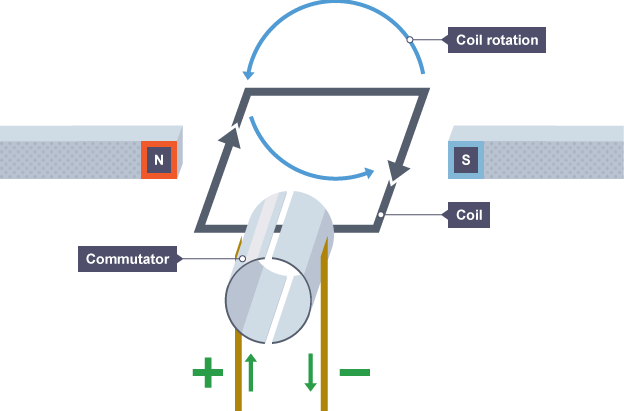
How does a split ring commutator work?
Swaps the contact evert full turn, so that the left-hand and right-hand arms of the coil always experience a force in the same direction.
Swaps the contact evert half turn, so that the left-hand and right-hand arms of the coil do not experience a force in the same direction.
Swaps the contact evert half turn, so that the left-hand and right-hand arms of the coil always experience a force in the same direction.

Which action will increase the deflection of the galvanometer pointer?
The magnetic pole is reversed
The number of turns of coils is increased
The coil is made from insulated wire
The magnet is slowly pushed into the coil

A voltage is created in a wire when...
it cuts through magnetic field lines
it moves parallel to magnetic field lines
it is stationary in a magnetic field
a wire moves anywhere
Main difference between the motor effect and EM induction
Motor effect: current + magnetic field = motion
Induction: motion + magnetic field = current
Motor effect: current + motion = magnetic field
Induction: motion + magnetic field = current
Motor effect: current + motion = magnetic field
Induction: motion + magnetic field = no effect

The diagram show the direction of magnetic field, B and current, I.
By using Fleming left hand rules, determine the direction of Magnetic force, F.
no force produced
downward
into the page
out from the page
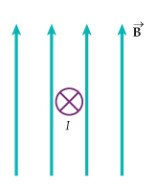
The diagram show the direction of magnetic field,B. The current is going into the page.
By using Fleming left hand rules, determine the direction of Magnetic force, F.
no force produced
right
into the page
out from the page
For the motor effect, there must be some form of power source
True
False
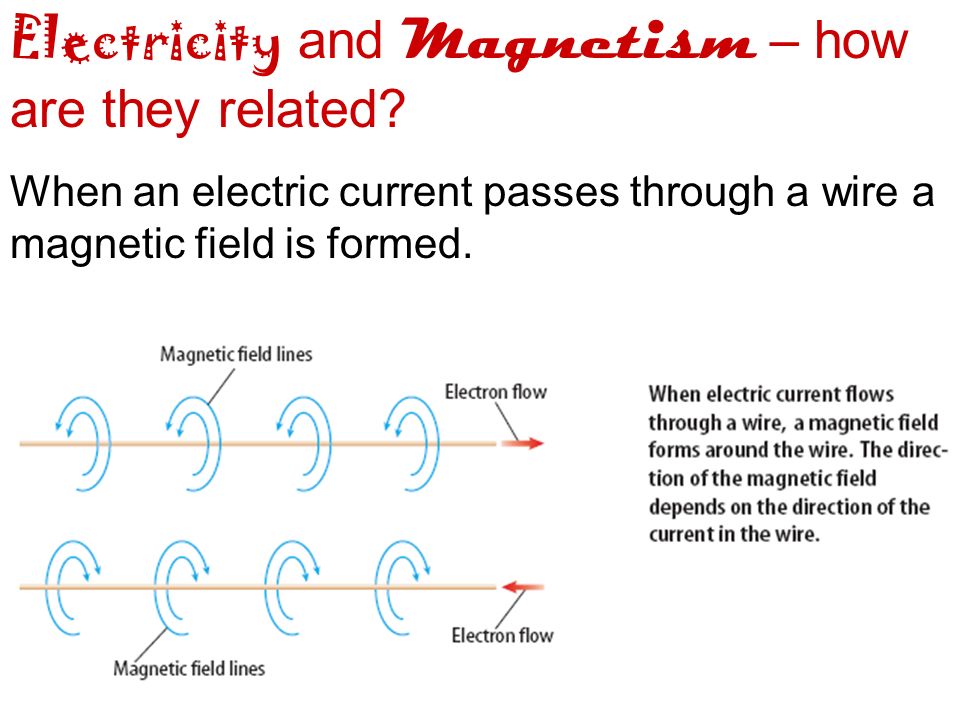

Name one factor that does not affect the size of a force in on a current-carrying conductor placed in a magnetic field?
Gravity
Magnetic flux density/size of magnetic field
Size of the current
Length of the conductor
A 20 cm section of wire with a current of 8 A is at 90 degrees to a 0.1 T magnetic field. What direction is the force and calculate the size of it? F = BIl
up, 0.1 x 8 A x 20 cm = 16 N
down, 0.1 x 8 A x 20 cm = 16 N
down, 0.1 x 8 A x 0.20 m = 0.16 N
up, 0.1 x 8 A x 0.20 m = 0.16 N
Which rule can be used to work out which way a coil of wire rotates in a motor?
Fleming's left-hand rule
Fleming's right-hand rule
How does a split ring commutator work?
Swaps the contact evert full turn, so that the left-hand and right-hand arms of the coil always experience a force in the same direction.
Swaps the contact evert half turn, so that the left-hand and right-hand arms of the coil do not experience a force in the same direction.
Swaps the contact evert half turn, so that the left-hand and right-hand arms of the coil always experience a force in the same direction.
The working principle og AC generator is

The voltage induced in a conductor is ___________ ___________ to the rate which the conductor cuts the magnetic lines of force.
inversely proportional
directly proportional
negatively coorelated
absolutely opposite
How is contact between the coil and circuit maintained in an AC generator?
A split ring commutator connects to each side for half a turn
It cannot be maintained.
The alternator can only complete one revolution and must then be rotated in reverse
Slip rings and brushes allow continuous connection

A coil is rotated steadily between the poles of a magnet. The coil is connected to an oscilloscope.
Which graph shows the output voltage V against time t?


If the coil is placed perpendicular to field lines then the number of lines passing through the coil is:
Minimum
Maximum
Zero
May be maximum or minimum
AC generator converts:
Mechanical energy to electrical energy
Electrical energy to mechanical energy
Heat energy to mechanical energy
Chemical energy to electrical energy
The direction of induced emf or current is indicated by:
Fleming’s left-hand rule
Fleming’s right-hand rule
Faraday’s law of electromagnetic induction
Ampere’s swimming rule
When a coil is held stationary in magnetic field, the induced current in it:
continuously changes
randomly changes
remains zero
becomes maximum

Which type of current is flowing ?
Alternating current
Direct current
Both
None

Name the device
DC motor
DC generator
AC generator
None of the above

Name the Device and type of current as indicated by waveform
DC generator ,DC
DC motor , AC
AC Generator , AC
AC Generator , DC

Graph P represents the output emf of an AC generator. Graph Q is the output emf after a change has been made using the same generator. Which one of the following changes has been made to the generator to produce graph Q?
The number of turns of the coil has been doubled
The surface area of the coil has been doubled
The speed of rotation has been doubled
The strength of the magnetic field has been doubled

The graph shows the output of an a.c. generator. The coil in the generator rotates 20 times in one second.
Which graph shows the output when the coil rotates 10 times in one second?


Select the correct voltage graph for a DC dynamo.


Which ONE of the following changes may lead to an increase in the emf of an AC generator without changing its frequency?
Decrease the resistance of the coil.
Increase the area of the coil.
Increase the resistance of the coil.
Decrease the speed of rotation.

In order for electromagnetic induction to occur, you need...
a conductor
a magnetic field
relative motion
all three
When a coil is held stationary in magnetic field, the induced current in it:
continuously changes
randomly changes
remains zero
becomes maximum
What is true of AC GENERATOR?
It works on the principle of electromagnetic induction
The mechanical energy of the rotation is converted into electrical energy
A pair of slip rings are used in the AC generator
All the above
What does the index finger show you in the Fleming’s right-hand rule?
Direction of current
Motion of wire
Direction of electric field
Direction of magnetic field
In a generator armature makes one full revolution, it goes through ………….. degrees of mechanical rotation.
0
90
270
360
The AC voltage waveform is in the positive direction for some period of time and in the negative direction for some period of time. What is the name given to this waveform?
Alternating wave
Inverted wave
Hertz wave
sine wave
The electricity generated from the power plant is ……
Alternating Current
Direct Current
Delayed Current
Eddy Current
What is voltage?
the amount of push the electrical source supplies to the circuit
how much a given device resists the flow of electric current
flow of electric charge
none of the above
Voltage divided by Current
(V / I)
Current
Power
Resistance
Watts
Voltage divided by Resistance
(V / R)
Current
Power
Ohms
Watts

Which graph is for a diode?
Graph C
None of the graphs
Graph B
Graph A
Which graphs follow Ohm's law?
Graph B only
Graph A and C only
Graph A only
None of the graphs
Select all that apply. A diode is a...
Ohmic component
Non-ohmic component
Component that allows current to flow in both directions.
Component that allows current to flow in one direction only.

This graph is for a filament lamp. What is the reason for the shape of the line shown on the graph?
Filament lamps are variable resistors. So we can use a sliding scale to change their resistance, which will change the current going through them.
Filament lamps cool down when current runs through them, their resistance increases causing the current to decrease over time.
Filament lamps heat up as current runs through them, this increases resistance causing the current to decrease over time.
Filament lamps heat up as current runs through them, this increases resistance causing the current to increase over time.

Which statement fully describes the graph shown.
As current increases voltage decreases (inversely proportional). This graph does not follow Ohm's law, it is for a non-ohmic component.
As voltage increases current increases (directly proportional). This graph follows Ohm's law, it is for a non-ohmic component.
As voltage decreases current increases (inversely proportional). This graph does not follow Ohm's law, it is for an ohmic component.
As voltage increases current increases (directly proportional). This graph follows Ohm's law, it is for an ohmic component.
Ohm's law is the relationship between...
Circuits, switches and resistors
Voltage, Amps and Circuits
Amps, Ohms and Volts
Voltage, Current and Resistance
A 3-V battery sends a current of 0.10 A through a light bulb. What is the resistance of the filament of the bulb?
.033 Ω
30 Ω
.3 Ω
300 Ω


18 kΩ
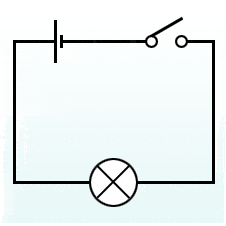

How many lightbulbs will work if there is a break in the circuit at POINT A?
1
2
3
NONE
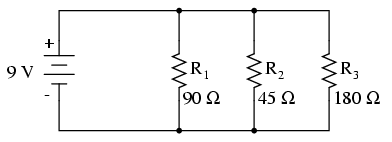
The current going through the 90 ohm resistor is
10 amps
0.1 amps
0.2 amps

Why is electrical wiring usually made from copper?
Because copper is shiny
Because copper conducts electricity
Because copper is not magnetic
Because copper insulate electricity

Why is electrical wiring usually are covered with a layer of plastic?
To make it look pretty
To help electricity flow along the wire
To make it safe
To add more energy

What is a circuit with several paths for electricity to flow?
conductor
series circuit
parallel circuit
open circuit

What is a circuit that only has ONE path for electricity to flow?
series circuit
closed circuit
parallel circuit
light bulb

When the switch is closed the buzzer will sound because -


The circuit in the diagram contains two capacitors connected in parallel. What is the total capacitance of the circuit?
100 μF
65 μF
35 μF
30 μF

The circuit in the diagram contains two capacitors connected in series. The total capacitance of the circuit is 12 µF.What is the capacitance 𝐶?
19 μF
21 μF
16 μF
13 μF

The circuit in the diagram contains two capacitors connected in series. What is the total capacitance of the circuit? Answer to the nearest microfarad.
46 μF
109 μF
94 μF
35 μF
What is a capacitor?
A device that resists changes in voltage
A device that stores electrical energy in an electric field
A device that converts electrical energy into mechanical energy
A device that increases the voltage of an electrical circuit
When capacitors are connected in series, how is the total capacitance Ceq calculated?
Ceq=C1+C2+C3+...
Ceq=C11+C21+C31+...1
Ctotal=C1+C2+C3+...C1⋅C2⋅C3⋅...
Ceq=C12+C22+C32+...
6. The total capacitance of two capacitors connected in series is _____________ the lowest value capacitor
equal to
opposite
greater than
less than
A 130 mF capacitor and a 150 mF capacitor are each connected across a 6 V dc source. The voltage
across the 330 pF capacitor is ?
8 Volts
6 Volts
4 Volts
2 Volts
Doping of Semiconductors
materials which can conduct electricity better than insulator, but not as well as conductors.
The process of adding of a certain amount of specific impurities atoms in the pure semiconductor.
when 4 electrons in outermost orbit.
Let np and ne be the number density of holes and conduction electrons respectively in a semiconductor. Then,
np > ne in an intrinsic semiconductor, I < Ip + Ie
np = ne in an extrinsic semiconductor, I > Ip + Ie
np = ne in an intrinsic semiconductor, I = Ip + Ie
np > ne in an intrinsic semiconductor, I = 0( Here, Ip = current due to holes,Ie= current due to electrons, I= total current)
LED is
Light Enhancing Diode
Light Emitting Diode
Light Emitting Detector
Light Enhancing Detector
The energy band in which free electrons exist is know as
first band
second band
conductive band
valence band
What is the most common semiconductor material used for producing integrated circuits
Quartz
Silicon
Diamond
Tantalum
------------------------ is created out of two metal plates and an insulating material called a dielectric.
A capacitor
An inductor
A fixed resistor
A variable resistor
If C is the capacitance in Farads, ϵ permittivity of the dielectric, A area of plate overlap in square meters and d distance between plates in meters, then:
C = ϵd/A
C = ϵA/d
C = A/ϵd
C = d/ϵA
How does the capacitance of a parallel plate capacitor change if the distance between the plates is increased?
Decreases
Becomes negative
Remains the same
Increases
What happens to the electric field strength between the plates of a parallel plate capacitor when a dielectric material is inserted?
The electric field strength increases.
The electric field strength remains the same.
The electric field strength becomes negative.
The electric field strength decreases.
Explain the role of surface area of the plates in determining the capacitance of a parallel plate capacitor.
Surface area has no impact on capacitance
Increasing surface area decreases capacitance
Surface area affects resistance, not capacitance
Surface area of the plates plays a crucial role in determining the capacitance of a parallel plate capacitor.
What is the SI unit of capacitance?
ohm
newton
farad
joule

What is the name of this component?
battery
cell
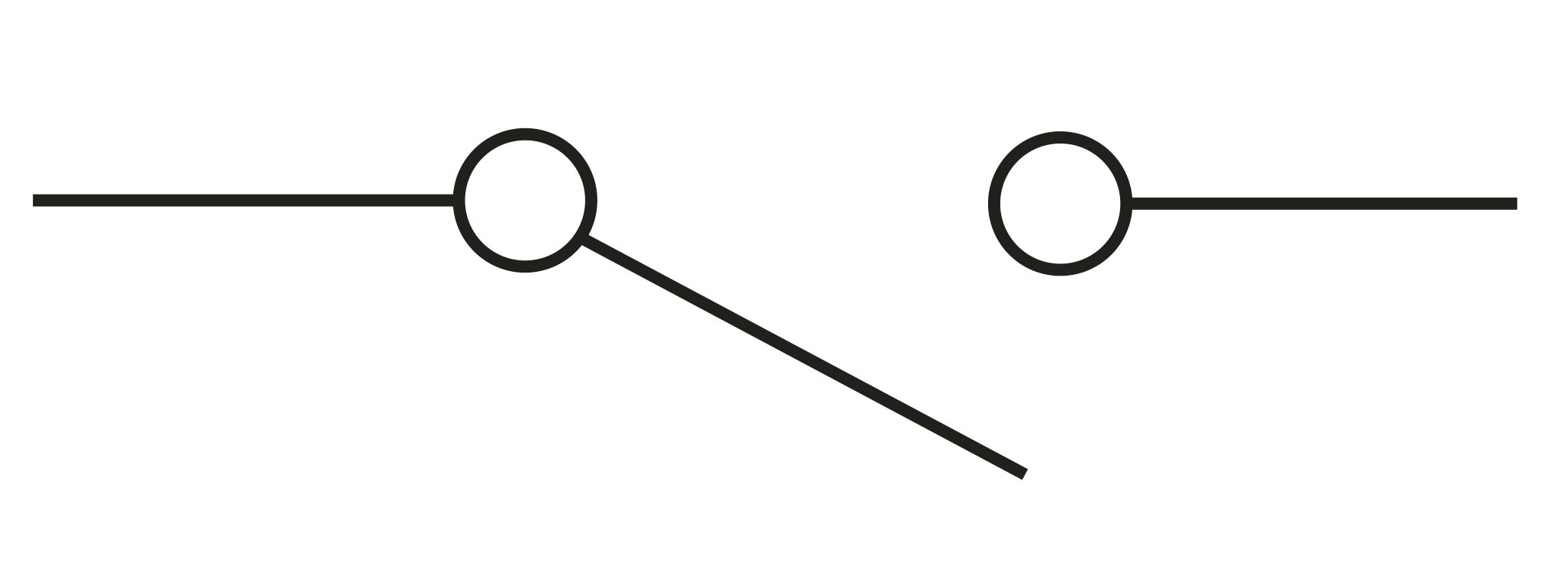
open switch
lamp

What is the name of this component?
battery
bell
motor
lamp

What is the name of this component?
battery
cell
open switch
lamp

What is the name of this component?
fuse
cell
motor
lamp

What is the name of this component?
fuse
cell
motor
lamp

What is the name of this component?
fuse
cell
battery
wire

What is the name of this component?
closed switch
cell
open switch
wire

What is the name of this component?
fuse
cell
bell
lamp

What is the name of this component?
fuse
cell
wire
bell

What is the name of this component?
fuse
cell
motor
lamp

Is this an example of a series circuit?
yes
no
It is a parallel circuit

What type of circuit is this?
Series circuit
Kilowatt circuit
Parallel circuit
potential circuit

This symbol represents a ..............
valve
voltmeter
Voltage
Vacuum

This symbol represents a .............
Anode
Alternator
Amplifier
Ammeter

This symbol represents a ..........
Bulb
Battery
Buzzer
Microphone

