
Font size
 Worksheets
End of term Economics yr 13 Quiz
Total questions: 85
Worksheet time: 2hrs 6mins
What prevents firms from entering a monopoly?
Barriers to Entry
Technology
Price
Barriers to Travel
Which of the following industries is an example of a monopoly?
utilities/water
department stores
auto industry
commercial airlines
A market that has a few sellers of basically the same goods.
Perfect Competition
Pure Monopoly
Monopolistic Competition
Oligopoly
Public utilities are an example.
Perfect Competition
Natural Monopoly
Monopolistic Competition
Oligopoly

Using the pizza store graphic, what market structure best fits the pizza industry?
Monopoly
Oligopoly
Perfect competition
Monopolistic competition
If a single firm raises its price it will not be able to sell any of its output.
Perfect Competition
Pure Monopoly
Monopolistic Competition
Oligopoly
In this market, the producer is the least responsive to buyers' needs and wants.
Perfect Competition
Pure Monopoly
Monopolistic Competition
Oligopoly
When firms agree to charge the same or similar prices for a product, this is known as
price-fixing
independent behavior
natural monopoly
laissez-faire
Which type of market structures has many producers (companies) and sell similar but different products from each other? These companies have a little control over the price and there are relatively low barriers to entry.
perfect competition
monopolistic competition
oligopoly
monopoly
If a firm can change market prices by altering its output, then it
Has market power.
Faces a flat demand curve.
Is a price taker.
Engages in marginal cost pricing
ability of a company to control prices and total market output
market power
price discrimination
license
government monopoly
Which of the following industries is an example of a monopoly?
utilities/water
departments stores
auto industry
commercial airlines
Market failure occurs whenever
free markets fail to distribute resources efficiently.
goods fail to arrive at a market in a timely fashion.
government builds infrastructure.
voluntary exchange in a market fails to result in a sale.

When companies that form on oligopoly cooperate together to set or fix prices at a given level, they are engaging in
Monopoly
Vertical Integration
Collusion
Which one of the following is most likely to discourage the growth of a firm? The existence of
diseconomies of scale at low levels of output.
large economies of scale at low levels of output.
large economies of scale at low levels of output.
competing firms in the same industry
A company wishes to increase labour productivity. All other things being equal, this is most likely to be achieved if the company
employs more workers.
reduces the wages it pays its employees.
reduces current output.
invests in more capital equipment.

remains constant
falls over the whole range
rises at first and then falls.
falls at first and then rises

3
5
7
63
Diseconomies of scale might arise because
firms spend money on new technology which leads to lower average costs.
decision-making by management becomes more difficult in larger firms.
workers are more likely to be productively efficient in larger firms.
larger firms can buy in bulk.
Fill in the blank. Economies of scale is when as output _________, unit costs ________ in the long run.
increases; decrease
increases; increase
decreases; increase
decreases; decrease
Internal economies of scale are those that
Result from changes in production techniques
Increase due to the growth of the industry as a whole
Generate lower per unit production costs
Reduce production costs in the short run
Larger firms are better able to diversify into a range of product areas or markets and thus lessen their risk. This is an example of
Financial economies of scale
Technical economies of scale
Managerial economies of scale
Marketing economies of scale
Risk bearing economies of scale
Large firms can afford to advertise and sell in larger quantities to develop brand loyalty. This is an example of
Purchasing economies of scale
Technical economies of scale
Managerial economies of scale
Marketing economies of scale
Risk bearing economies of scale
Large firms can negotiate better interest rates on loans; this reduces the costs of borrowing for larger companies. This is an example of
Financial economies of scale
Technical economies of scale
Managerial economies of scale
Marketing economies of scale
Risk bearing economies of scale
Large firms can buy raw materials in bulk at more favourable rates. This is an example of
Purchasing economies of scale
Technical economies of scale
Managerial economies of scale
Marketing economies of scale
Risk bearing economies of scale
Fill in the blank. __________ economies of scale occur due to an increase in the scale of production within a single firm
Internal
External
Complex
Simple
Larger firms can hire specialists (e.g. managers, accountants) and are therefore able to increase productivity. This is an example of
Purchasing economies of scale
Technical economies of scale
Managerial economies of scale
Marketing economies of scale
Risk bearing economies of scale
Which of the following EOS refers to improving the production process?
Financial
Managerial
Technical
Purchasing

Machinery is likely to be efficient. what economies does it indicate?
Diseconomies of Scale result in a lower per unit production cost over the long run
True
False
External economies of scale can arise from
Bulk purchases of raw materials, parts and components at favorable prices by a particular business/firm
Purchase and use of physical/human capital by a particular business/firm
Greater availability of skilled laborers for a particular industry in a particular area
A business/firm being able to obtain lower interest rates on loans
Which of the following answers are business objectives?
Survival
Profit
Specific
Market share
Which of the following is not a business objective?
Corporate social responsibility
Market share
Growth
Employment
What is the first and most important objective of any business organisation?
Profit Maximisation
Growth
Survival
Social Responsibility
The owner is rewarded for conducting business and bearing the risk. What is the form of reward the owner receives?
Remuneration
Commission
Bonus
Profit

Which objective would this organisation have?
Growth
Customer Satisfaction
Market leader/share
A national sofa business aims to increase the number of sofas it sells in the UK compared to the number sold by all other UK sofa manufacturers. Which of the following best describes this aim/objective?
Increasing market share
Maximising chances of survival
Increasing profit
Keeping full control over business decision-making
What is a trade union?
It is an organisation
A group of workers
Trade unions are independent organisations that represent workers to their employers.
To register a trade union, you must apply to the Registrar of labour relations.
What are the roles and responsibilities of Trade union?
Is to ensure the welfare of its members such as safeguarding the interests of its members
Protecting the reliability of its trade
achieving higher wages by securing economic benefits
All of the above
Once a TU is recognised in a workplace, the negotiations with the employer are called...
collective bargaining
group bargaining
informed bargaining
bargaining
The main function of trade unions is to obtain improved ___________ and working conditions for their members.
wages
surroundings
dress codes
none
A strike is an example of _____________________________.
an industrial agreement
collective bargaining
industrial action
a lock out
Which type of industrial action is displayed when workers follow the rules and regulations of the company exactly?
Strike
Work to rule
Go slow
Boycott
Which of the following can be regarded as a non-monetary factor affecting labour supply to an industry?
The typical weekly working hours, as negotiated by an industry-representative trade union
The amount of National Insurance that must be paid on earnings
The opportunity to take advantage of overtime payments
The wage differentials in the industry
All other things being equal, which one of the following is most likely to cause the marginal revenue product of labour curve in the shoe manufacturing industry to shift to the right?
A decrease in money wage rates in the shoe industry.
A decrease in the number of workers employed in the shoe industry.
An increase in the market demand for shoes.
An increase in the number of firms competing in the shoe industry.
The marginal revenue product of labour is the...
addition to total revenue when the firm produces and sells an extra unit of output.
amount produced per worker per time period.
change in total output that is produced when one extra worker is employed.
revenue gained by selling the extra output produced by employing one more worker.
All other things being equal, the demand for labour is more likely to be wage elastic if...
it is difficult to substitute capital for labour.
the cost of labour is a low percentage of total costs.
the final product has a high price elasticity of demand.
the supply curve for labour is wage elastic.
Assuming a perfectly competitive labour market, a firm’s demand curve for labour would be derived from its marginal
Cost curve
Revenue curve
Utility curve
Revenue product curve

The graph shows the market demand for labour (DL = MRPL), the market supply of labour (SL = ACL), and the marginal cost of labour (MCL), in a particular industry. The employer in this industry is a monopsonist. From the graph above, it can be concluded that, in the absence of a trade union or a minimum wage, the firm will employ...
OQ1 workers at a wage of OW1.
OQ2 workers at a wage of OW1.
OQ2 workers at a wage of OW2
OQ2 workers at a wage of OW3.
In a labour market dominated by a monopsonist, wages and employment are usually lower than in a competitive labour market. This is because a monopsonist...
employs workers up to the point where the marginal revenue product of labour is equal to the wage rate.
is a monopoly supplier of labour.
restricts output to raise the price of the product sold.
equates the marginal revenue product of labour with its marginal cost not the wage rate.
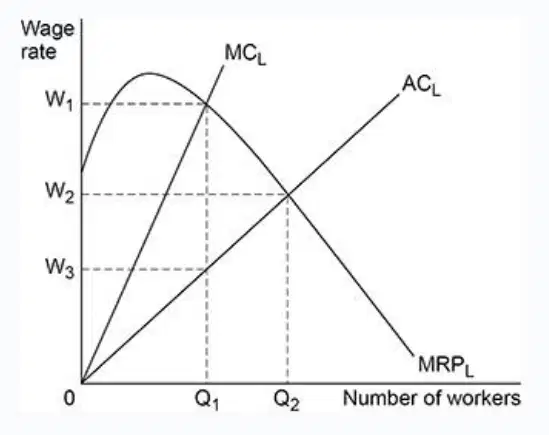
The diagram below shows the marginal cost (MCL), average cost (ACL) and marginal revenue product (MRPL) curves for labour in a specialised computer programming industry. Following a series of mergers between firms in this industry, a single large firm remains as a monopsony employer. Which one of the following is the most likely to result from a competitive labour market being replaced by a monopsony employer?
The total amount paid in wages will fall from
(W2 × Q2) to (W3 × Q1).
The total amount paid in wages will increase from
(W3 × Q1) to (W1 × Q1).
The wage rate will fall from W1 to W2.
The wage rate will increase from W3 to W2.
What is the average salary in the UK?
£56, 497
33,402
24, 876
43,567
What's the largest generation group in the UK?
Boomer (1946-1964)
Gen X 1965 – 1980
Millennials (1981-1996)
Gen Z 1997 – 2012
A rise in income increases the demand for leisure time and causes the supply of labour curve to shift
left
right
More students are staying in education and completing a Masters, this would cause the supply of labour curve to shift...
left
right
The upward sloping supply curve for labour reflects...
The substitution effect
The income effect
A rise in income increases the demand for leisure time and causes the supply of labour curve to shift
left
right
A rise in the population causes the supply of labour curve to shift to the...
left
right
Market is any means through which ________
buyers and sellers can exchange goods and services
goods and services can be produced
sellers can exchange goods with each other
buyers can exchange goods with one another
The major difference between wages and salary is ______
salary is paid hourly while wages is paid monthly
wages is paid weekly while salary is paid monthly
salary is paid weekly while wages is paid monthly
there are no differences between wages and salary
Individual's choice of occupation can be influenced by _____ and _____
wage factor and non-wage factor
salary and wage factor
time and money factor
All of the above
The demand for labour curve slopes______
downward
upward
backward
frontward
The supply of labour curve slopes _______
downward
upward
backward
frontward
Equilibrium wage rate is when_______
quantity demanded equals quantity supplied
demand does not equal to supply
demand for labour is not the same as supply of labour
demand for labour equals supply of labour
What is the price of labour?
Value
Wages
Labour productivity
Human capital
The demand for labour is said be
Derived
Infinite
Direct
Elastic
Which of the following will cause wage rates to rise in a labour market?
An increase in the supply of labour
An increase in supply and a fall in the demand for labour
An increase in the demand for labour
A fall in demand for labour

