
Font size
 Worksheets
End of Semester 1 Review
Total questions: 45
Worksheet time: 3hrs 21mins
What is the smallest unit of life in the human body
Tissue
Organ
Cell
Organism
What is the main function of the Digestive System?
Support/Protection
Breaks down food
Protect against germs
Remove waste
What is the main function of the Nervous System?
Breaks down food
Protect against germs
Exchange gasses/remove waste
Send and Receive information
What is the main function of the Excretory System?
Breaks down food
Moves materials
Remove waste
Exchange gasses/remove waste
What is the main function of the Respiratory System?
Support/Protection
Exchange gasses/remove waste
Breaks down food
Movement
What is the main function of the Muscular System?
Remove waste
Movement
Exchange gasses/remove waste
Control
What is the main function of the Immune System?
Movement
Breaks down food
Moves materials
Protect against germs
1. What body systems are mainly being used while running?
Immune and Respiratory
Respiratory and Muscular
Nervous and Digestive
Digestive and Skeletal
What body Systems are mainly being used while sitting at lunch eating?
Digestive and Immune
Skeletal and Muscular
Digestive and Muscular
Nervous and Immune

Which Body System is this?
Skeletal
Cardiovascular
Nervous
Digestive

Which Body System is shown here?
muscular
Digestive
Cardiovascular
Respiratory

Which body system is shown here?
Cardiovascular
Immune
Digestive
Nervous

Which Body System is shown here?
Digestive
Respiratory
Cardiovascular
Nervous
Cells have two ways in which they can move things in and out through the cell membrane. These two ways are...
Endocytosis and Exocytosis Transport
Active and Passive Transport
Diffusion and Osmosis
Pushing and Pulling
Passive transport is different from Active transport in that...
It requires no energy
it requires energy
Flows from High concentration to Low concentration
Flows from Low concentration to High concentration
The three types of passive transport are
Osmosis
Diffusion
Protein Pumps
Facilitated Diffusion
Active transport...
Requires energy and flows from High to Low concentration
Requires energy and flows from Low to High Concentration
Does not requires energy
Does not require energy and there is no movement

Osmosis (passive) is the movement of
Small Particles
Larger particles through protein
Water through proteins
Gas

Diffusion is the movement of
Large particles through proteins in the membrane
Small particles or gasses through the membrane
Water through proteins in the membrane
small particles through proteins in the membrane using energy

Facilitated (helped) Diffusion is the movement of
Small particles through the membrane
Larger particles through proteins in the membrane requiring no energy
Water through proteins in the membrane
Small particles through proteins in the membrane using energy

The following picture is showing which form of active transport where the cell engulfs (eats) material (solid/liquid) by forming a vesicle (transport structure).
Protein Pumps
Exocytosis
Endocytosis
Facilitated Diffusion

The following pictures is showing which form of active transport where the cell expels (releases) waste.
Endocytosis
Protein Pumps
Exocytosis
Diffusion
when some molecules can cross the membrane while others cannot.
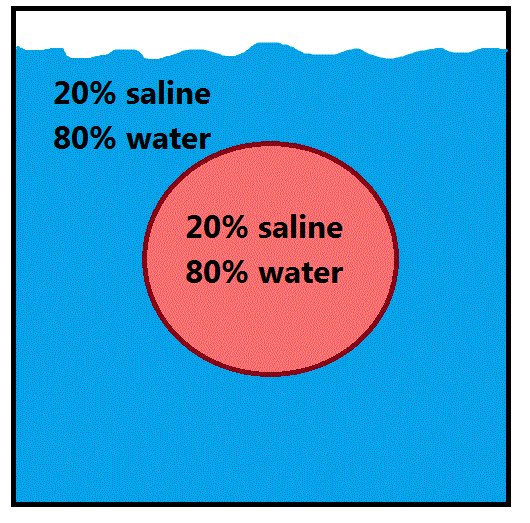
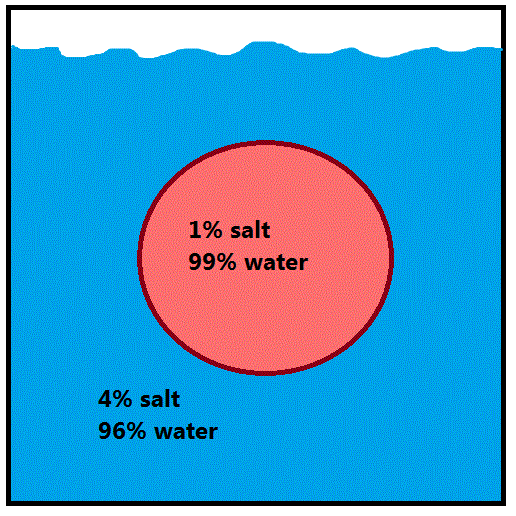

From C to D, what phase of matter is the substance?
Solid
Liquid
Gas
Plasma
From B to C, a solid is changing to a liquid. Is heat being added or taken away during this time?
Added
Taken away
During A to B what phase of matter is the substance?
Solid
Liquid
Gas
Plasma

During which phase of matter are the particles the closest together?
Solid
Liquid
Gas
During which phase of matter do the particles have the most energy?
Solid
Liquid
Gas

Where is melting occurring?
A
B
D
E



