
 Worksheets
Week 6: Text features for Sentiments
Total questions: 86
Worksheet time: 1hrs 20mins
Label the weights received by all.
Label the neurons connected to a11
Label the sentiments that AI can detect

How can AI help us learn which customers are unhappy? _________ ________
(a)
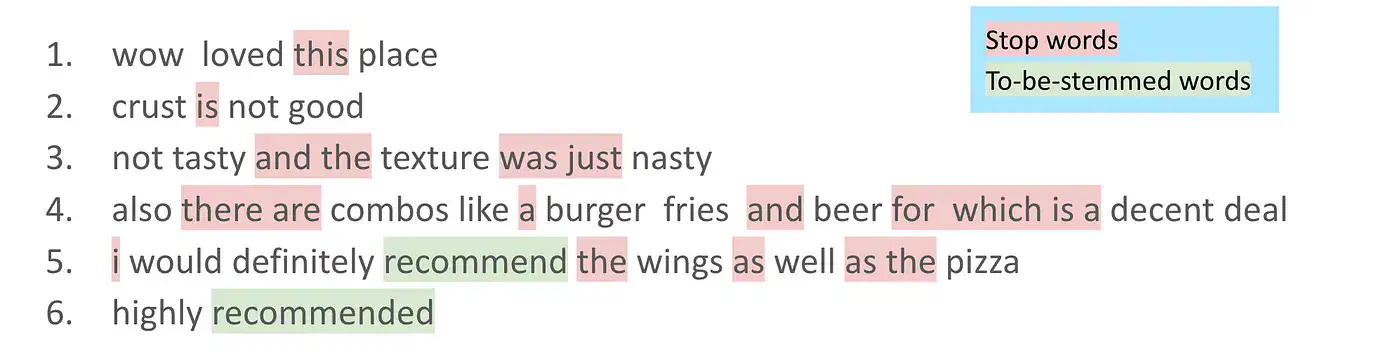
All words highlighted in red here, are called (a) , which generally are non value adding. These words mostly do not help us in understanding sentiment behind a review. So, we would drop these.
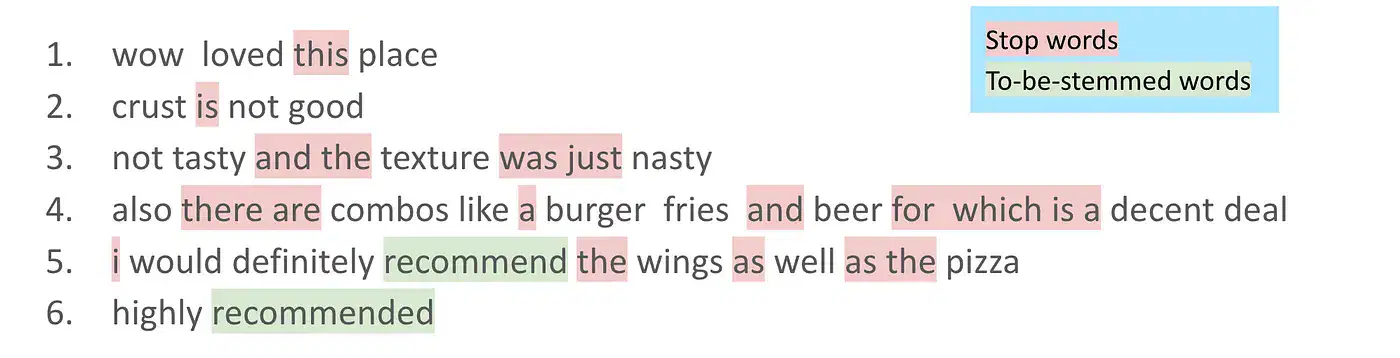
The highlighted (a) depicts how the same dictionary word ‘recommend’ is used in different forms. These words have the message inside to detect sentiment by AI.
Explain why feature extraction is important for ML? (research)
Computer imaging can be defined as the __________ and _______of visual information by computer.
acquisition and processing
editing nd processing
acquisition and Manipulation
Processed images are for use by a computer is ____
Vision applications
image processing applications.
______________ involve the manipulation of image data for
viewing by people.
Image processing application
Vision applications
which one of the list computer vision in Image Analysis, which involves
the examination of the image data for solving a vision problem.
Edge Detection
Segmentation
Transformation
All
None
________ is the process of taking an image with some
known or estimated degradation, and restoring it to its original
appearance.
Image Edge Detection
Image restoration
Image Transformation
_______involves taking an image and improving
it visually, typically by taking advantage of the human visual system’s response.
Pattern (object) classification
Feature extraction
Image enhancement
Images can be represented as an _____.
array form
matrix form
vector.
Which of the following is NOT a primary component of the sensor systems in autonomous vehicles?
Cameras
Radar
Wi-Fi
LiDAR
Fill in the blank: Machine learning in autonomous vehicles helps in ______ decision-making processes.
slowing
improving
ignoring
complicating
Fill in the blank: In autonomous vehicles, redundancy involves backup systems that maintain ______ if the main system fails.
speed
safety
fuel
data
Fill in the blank: V2X communication allows vehicles to ______ with each other and their environment.
communicate
ignore
avoid
collide
Fill in the blank: The six levels of automation describe the degrees of automation from ______ to full automation.
partial
no automation
manual
semi
In autonomous vehicles, redundancy refers to:
Extra data collected by the sensors
Backup systems that maintain safety if the main system fails
Additional passenger safety features
Extra fuel supplies
Which type of sensor technology allows an autonomous vehicle to create detailed 3D maps of its surroundings?
Camera sensors
Radar
GPS
LiDAR
Artificial Intelligence (AI) in autonomous vehicles primarily helps the vehicle to:
Make independent decisions based on sensor data
Connect with other vehicles on the road
Communicate with passengers in multiple languages
Drive faster than a human-driven vehicle
What does LiDAR stand for?
Light Detection and Ranging
Laser Imaging and Detection
Light Image Data Analysis Range
Light Identification Data Array
Why do AI and ML need large volumes of data?
To understand the environment.
To train algorithms and improve accuracy.
To emulate human abilities.
To solve problems based on data.
Purpose of machine learning models?
Create human-like properties in machines.
Develop algorithms to solve problems.
Look for patterns in data and draw conclusions.
Program computers explicitly.
Main difference between AI and ML?
AI trains machines for human tasks, while ML trains machines how to learn.
AI and ML are the same.
AI mimics human abilities, while ML solves problems based on data.
I uses algorithms, while ML uses speech interfaces.
What is the concept that a computer can mimic human abilities?
Virtual Reality
Machine Learning
Artificial Intelligence
Blockchain
What is the method behind how machines learn from data?
Data Analysis
Predictive Modeling
Algorithmic Processing
Machine Learning
Which of the following is a specific subset of AI that trains a machine how to learn?
Deep Learning
Neural Networks
Machine Learning
Natural Language Processing
What is the science of training machines to perform human tasks?
Virtual Reality
Robotics
Blockchain
Artificial Intelligence
What is the main purpose of edge detection in image segmentation?
To smooth the image
To find the boundaries of objects
To increase the contrast
To resize the image
Which technology helps improve the accuracy of image segmentation in complex tasks like recognizing objects in photos?
Neural Networks
Photoshop
3D Printing
Bluetooth
In thresholding, what is used to segment the image?
Colour contrast
A specific intensity value
Object size
The angle of the object
In image segmentation, which method identifies boundaries between different objects?
Edge detection
Blurring
Resizing
Color balancing
Which of the following is a common application of image segmentation?
Creating 3D models from 2D images
Detecting objects in self-driving cars
Compressing images for storage
Enhancing image brightness
Which emerging technology is crucial for improving real-time image segmentation performance?
Quantum computing
Edge AI
Blockchain
3D printing
In what industry is image segmentation commonly used for medical imaging?
Agriculture
Entertainment
Healthcare
Transportation
Which of the following is the simplest form of image segmentation?
Edge detection
Thresholding
Clustering
Morphological operations
What is image segmentation?
Combining multiple images
Dividing an image into meaningful parts
Enhancing the contrast of an image
Filtering noise from an image

What is this an example of?
Diagram
Caption
Illustration
Title

An author would use this diagram to
Compare and contrast adult brain with a child's brain
Identify the parts and areas within a human brain
Explain how the Occipital lobe is the biggest part of the brain
Show the reader where the brain is located within the human body
The _____ identifies what the topic of an article or book will be about.
Subheading
Glossary
Title
Photograph


This is an example of ____________ text feature? NOTICE THE LABELS added to the picture.
Index
Table of contents
Glossary
Diagram

What text feature is this?
Highlighted Font
Heading
Graph
Caption

What text feature is this?
Heading
Graphic Aid
Glossary
Bold text

What purpose would this have in an article about tourism in Antarctica?
It helps readers visualize the changes in tourist numbers from 1992 until 2008
It helps tourists decide when to visit Antarctica
It gives reasons not to visit Antarctica in the winter.
It informs the reader of reasons to visit Antarctica.

Under which heading might you find information on Will’s childhood chores?
Hard Work at Home
Early Fame
Movie Magic
How He Does It

What is the purpose of these subheadings?
To help the reader understand the author’s opinion
To help the reader visualize the information
To help the reader find the main ideas in each section
To help the reader place events in order

What text feature is used in the red boxes?
Sidebar
Column
White Space
Subheading
The purpose of graphics (such as graphs, tables, pictures, or maps) is to
Help the reader visualize important information
Describe what is found in a photo or illustration
Separate text into sections based on main ideas
Show information that occurs in a certain order

