
 Worksheets
Q1 CIVICS EOC REVIEW
Total questions: 150
Worksheet time: 4hrs 21mins

According to the information on the posters, which individual would more likely vote for Aleksi Alho?
A voter concerned about leadership experience
A voter concerned about women’s rights
A voter concerned about protecting the rights of the accused
A voter concerned about rising unemployment in the state
James Madison wrote that “liberty is to faction what air is to fire.” After reading this, Jack points out that the Founders would have wanted more restrictions on lobbyists, special-interest groups, and media influencing the government. What would be a good counterargument?
Elected officials are better able to measure public opinion if there are no interfering factions
Lobbyists will balance one another in government influence if they are subject to fewer laws
Political ads, despite their biases, are best able to inform citizens when there are no regulations
The media, despite its biases, are best able to monitor the government when they are free.

How can the information on this poster best be categorized?
Advertisement
Propaganda
Entertainment
Factual

What is primary goal of this propaganda poster?
To discourage people from moving to government lands
To discourage people from moving to California
To encourage people to move to California
To encourage people to move to government lands
Flora is concerned because her little brother became ill at school. The doctor explains he has the flu. "I've seen an increase in flu cases among children the past few years," says the doctor. "Many children need flu shots, but their parents can't afford them." Flora decides to take action. Which should be Flora’s final step in attempting to encourage her community to provide lowcost flu shots?
Outline her citizen-action plan to the local health department proposing it offer a low-cost vaccination clinic.
Evaluate public policy alternatives by speaking to federal health officials about similar efforts in other communities.
Conduct background research by visiting reliable web sites to read about side effects of flu shots.
Identify public policy alternatives by talking to her doctor about options to locate funding for shots
The legal process to obtain citizenship is called . . .
law of blood
birthright
naturalization
law of soil
A person who has been legally admitted to the US and has permission to stay and work here is called a(n) . . .
legal permanent resident.
tourist.
naturalized citizen.
refugee.
Laura was born in France to two parents who were US citizens. She lived in France until she moved to the US at age 21. At age 25, Laura visited Morocco on vacation. Why did Laura use a US passport to travel?
Laura was a resident alien of the US.
Laura was a US citizen by law of soil.
Laura was a resident national of the US.
Laura was a US citizen by law of blood.
The rule of law
The Constitution is the supreme law of the land and no one is above the law.
The Constitution is the supreme law of the land and the Supreme Court upholds the Constitution.
The Supreme Court is the supreme law of the land and no one is above the law.
The Bill of Rights is the supreme law of the land and immigrants are not accountable for violating it.
According to the 14th Amendment to the Constitution, there are 2 paths to citizenship. What are they?
Law of Soil and Law of Blook
Payment of a fee and birth
Naturalization and residency
Birth and naturalization
What would be the most likely consequence to society if citizens began refusing to fulfill their citizenship responsibilities?
People would face the threat of losing their individual rights and freedoms.
People would benefit from the direction of strong leaders who would guard their freedoms.
People would have more free time because they would have fewer social obligations.
People would find that society was able to look after itself with the help of civic participation.
Democratic elections, trials by jury, and citizen referendums on laws are important principles in US government. To work as they should, the all depend on . . .
educated and informed citizens.
a large and powerful country.
three branches of government.
a government with a direct democracy.
Members of a local teen center are disappointed with a state law that would create a curfew. The curfew would make it illegal for children to be out of their homes after 10:00 pm. Which of these actions would be a good way for the members of the teen center to oppose this law?
stay out at night and break the law on purpose
ignore the law and pretend they never heard about it
convince people to sign a petition against the law
hold a car wash to raise money for the teen center
Jury duty is a legal responsibility that adult citizens are normally required to do. What is the primary reason for requiring jury duty?
to keep a record of the population
to instill patriotism
to guarantee a fair trial
to allow the use of free speech
According to the Rule of Law, if a Florida law conflicts with federal law, the Florida law applies.
True
False
What is a primary difference between a citizen and a non-citizen?
Citizens can go to school; non-citizens cannot.
Citizens have political rights; non-citizens do not.
Citizens have lots of money; non-citizens do not.
Citizens can own vehicles; non-citizens cannot.
What is the impact of not voting in elections?
Important decisions may not consider the needs of the population
Citizens are more engaged in civic activities
It ensures diverse representation in government
Decisions reflect the will of the people
What is the common good?
The individual success of citizens
The well-being of all members of society
The wealth of the nation
The success of the government
The list below identifies several activities.
Attending a school board meeting Voting in a primary election Helping on a phone bank for a mayoral candidate Putting a candidate's sign in your yard. Registering voters at a community colleg.
What do these activities illustrate?
ways that citizens can run for political office
opportunities for citizens to participate in national elections
opportunitites for citizens to influence political action committees
ways in which citizens actively participate in the political process
Which type of service project would help promote the common good?
planning a neighborhood recycling program
participating in a neighborhood party
completing homework on time
visiting public libraries

The image above describes a citizen obligation.
Based on this image, what can be presumed about citizen obligations?
Citizens support attending civic meetings.
Citizens support securing individual rights.
Citizens resist registering for selective service.
Citizens resist contributing to the common good.

Why is it important for citizens to meet the obligation requested in this document?
to guarantee our right to confront witnesses
to preseve constitutional limits on governmental power
to guarantee our right to be judged by a jury of our peers
to protect our right to petition for a writ of habeas corpus
Which REQUIREMENT of the naturalization process is missing from this list:
be at least 18 years old
legal permanent resident for at least 5 years
be of good moral character
speak and read English
have at least one American parent
live in the U.S. prior to 2010
pass a civics and history test
Which of these is a legal obligation of U.S citizenship?
to serve on a jury when summon
to vote in presidential election
to reside in the U.S
to save money for retirement
Which act is considered a citizenship responsibility rather than an obligation?
attending civic meeting
paying taxes
registering for Selective Services
obeying the law
To what do we show loyalty when we say the Pledge of Allegiance?
the state where you live
The President
Congress
the United States
What is Patriotism?
When you get a job.
When you love your country.
When you are mean to others.
•people elect their own representatives to govern them
Natural rights
Due Process of Law
Rule of Law
Representative Government
the freedom to follow one’s own religious belief
Limited Government
Consent of the Governed
Religious Liberty
Protected Liberty
basic rights that all human beings are born with and should enjoy.
Natural Rights
Rule of Law
Due Process
Equality of Mankind
the approval of the people who lived under that government
Limited Government
Consent of the Governed
Rule of Law
Representative Government
There are limits on what government officials can do. These limits prevent our government from becoming too strong and threatening our individual rights.
Limited Government
Representative Government
Rule of Law
Protected Liberty
We are all subject to the same rules, without exception.
Religious Liberty
Protected Liberty
Rule of Law
Due Process of Law
We each have individual worth, and we are all equal as human beings.
Equality of Mankind
Due Process of Law
Natural Rights
Consent of the governed
We are entitled to a speedy and fair trial by jury or some other public hearing before our lives, liberty or property can be taken away. We are entitled to a speedy and fair trial by jury or some other public hearing before our lives, liberty or property can be taken away.
Due Process of Law
Rule of Law
Representative Government
Limited Government
a concept involving fairness, equality, and equitable treatment
Ethical ideas of justice
Rule of Law
Equality of Mankind
Due Process of Law
What is the Census?
A count of some of the people in the US
A count of all people living in the US
A method of deciding which states are republican and which are democrats
A method of creating local governments.
How often does the US Census happen
2 years
5 years
10 years
20 years
How does the US use the results of the census?
Determines who gets elected
Decides where to build monuments
Decides who gets what funds
Creates new universities
What determines the number of seats each state gets in the US House Representatives?
Influence
Money
Power
Population
Who is counted in today's census?
All US Citizens
All people in the US over the age of 5
All the people living in the US regardless of citizenship
Only tax paying citizens
What is unity?
a predisposition to believe a certain way about something, usually negatively
coming together as one
prejudging without all the facts
art, music, food, dress, etc. of a group
What is justice?
a sense of one's self and who one is
fair treatment and consequences
differences
acknowledging and welcoming someone
What is bias?
a predisposition to believe a certain way about something, usually negatively
coming together as one
prejudging without all the facts
coming together as one
What is diversity?
a sense of one's self and who one is
fair treatment and consequences
differences
acknowledging and welcoming someone
Discrimination is...
unjust treatment based on race, gender, age, etc.
based on nationality and race
being fair or impartial
made up of people from many nationalities and cultures
accepting others (even when they are different from us)
Tolerance is...
unjust treatment based on race, gender, age, etc.
based on nationality and race
being fair or impartial
made up of people from many nationalities and cultures
accepting others (even when they are different from us)
Melting pot is...
unjust treatment based on race, gender, age, etc.
based on nationality and race
being fair or impartial
made up of people from many nationalities and cultures
accepting others (even when they are different from us)
Ava, Aria, and Luna are discussing ways to get involved in their local community. Which action discussed by them is the best example of civic engagement in their local community?
Donating to an international charity
Attending a city council meeting
Watching a documentary on global issues
Reading a book on political theory
What activities do active citizens participate in?
Voting
Helping a Neighbor
Community events
Cooking
Which characteristic serves as a long-term protection against tyranny AND is the foundation of liberty in the United States?
The commerce clause
The elastic clause
The right to trial
The rule of law
What is the term for the idea that those who govern must follow the laws, meaning no one is above the law?
rule of law
elastic clause
separation of powers
veto power

This figure is a
symbol of the American justice system. What does the blindfold covering the figure’s eyes represent?
equality under the law
separation of powers
checks and balances
natural law
News article, "Miami Ex-Officer Gets 2 Years' Prison for Gambling Bribes, " www.cbslocal.com, May 17, 2015
Based on the title of this article what can said about the rule of law & transparency of government institutions?
Leaders and government officials are held accountable to the law.
Leaders and government officials are not accountable to the law.
There is no transparency of institutions.
The laws are not legitimate.

IN CIVICS, "TRANSPARENCY OF GOVERNMENT" MEANS
CITIZENS CAN'T KNOW WHAT THE GOVERNMENT IS DOING
INFORMATION ON GOVERNMENT IS VISIBLE AND ACCESSIBLE
GOVERNMENT BUILDINGS HAVE A LOT OF GLASS WINDOWS

Which of these documents was signed 800+ years ago by King John of England. HINT: It is the oldest example of Rule of Law and limited the powers of a king or queen.
The U.S. Constitution (in 1787)
The English Bill of Rights (in 1689)
The Magna Carta (in 1215)
The Mayflower Compact (in 1620)
an organization created to raise and contribute money legally to the campaigns of political candidates.
Interest group
Propaganda
Political Action Committee
Public Policy
a group of people who hold similar views and goals, and try and influence public policy to achieve them.
Lobbying
Bias
Political Socialization
Interest Group
contacting a public official to try and persuade them to support the interests of a particular interest group.
Lobbying
Objectivity
Public Opinion
Mass Media
the choices the government makes and the actions it takes in response to a particular issue or problem.
Mass Media
Public Policy
Propaganda
Objectivity
the collection of views shared by a segment of society on issues of interest or concern.
Lobbying
Political Action Committee
Interest Group
Public Opinion
"They should allow different viewpoints about an issue to be heard, they should hold government officials accountable, and be a place where leaders can share their views." This is describing
the White House
Congress
the United States
the media
What are 3 ways that we can influence public policy?
Vote for who we feel is the best candidate
Protest in marches and rallies if change needs to occur
Read the news and stay informed on current issues
Join an interest group to cause change or to keep freedoms secure
"James Washington took Senator Bilbo out to lunch. While at lunch, Mr. Washington explained that his company would like to donate $100,000 dollars to his re-election campaign. In return, he would like the Senator to vote in favor of the new bill." This is an example of...
Politics
Lobbying
Bribery
Analytics
What is the basic reason laws are made?
In response to problems or issues (public policy)
In response to what other countries are doing (foreign policy)
In response to how well the economy is doing (economic policy)
In response to how the president is behaving (behavioral policy)
What is one way interest groups influence the government?
By peaceful protesting
By broadcasting news
By hiring lobbyists
By running for office
Which of the following is a role of the media in influencing government?
Attending civic meetings
Filing lawsuits
Serving as watchdog to identify issues
Petitioning the government
What is a special interest group focused on?
Multiple issues
One big issue
Government policies
Media influence
A grassroots movement is
a political movement that begins with party leaders.
a political movement that begins with the people.
a political movement that is initiated by the president.
a political movement to improve the environment
An organized effort where candidates and political parties prepare to present their ideas to the voters
Candidate
Electoral College
Citizenship
Campaign
A statement explaining a party's goals, strategies, and beliefs.
Nominee
Political Party
Political Party Platform
Primary Election
An organization that coordinates candidates to compete in an election.
Nominee
Political Party
Political Party Platform
Primary Election

Which is an example of voting at the national level
Election of new members to the state legislature
Election of a new Governor who tours local cities
Election of U.S House of Rep & Senate
Election of Local Mayor
Jaylen is running for the U.S. Senate. What is one of the qualifications for office he must meet?
Be at least 35 years old
Be a "natural born" citizen
Reside in the state he will represent
Have resided in the United States for the last 14 years

Which government office has these requirements?
U.S Senator
Governor of Florida
President of the United States
U.S. House of Representatives

Based on the information on the flyers, why might Mary be considered as more qualified than Tom to be elected as a US Senator?
She has better views on the major issues.
She has more experience in public office
She has more educational qualifications.
She has spent more money in the election campaign.

Based on the cartoon above, what is a major impact of political parties in the government?
The two party system allows for third parties to have a larger say in government decisions.
The two party system allows for all citizens' ideas to be represented.
The two party system makes it difficult to compromise.
The two party system makes it easy to pass legislation.

Jimmy Donaldson is 24 years old. Which office can he run for?
State Representative
U.S. Representative
President
Governor
The following are requirements for which political office?
- At least 35 years old
- Natural born citizen
- Lived in US for 14 years
President
U.S. Senator
FL Senator
Vice President
The following are requirements for which political office?
At least 21 years old
Live in the district they will represent
Live in Florida for 2 years
U.S. Senator
FL Senator/Representative
FL Governor
U.S. Representative
Which is NOT a constitutional requirement to run for President?
What is the minimum age to run for Florida Congress (FL Senator/FL Representative)
18
21
25
30

The newspaper headline above describes a government process.
Why might this have been a difficult election for Richards to win?
Richards is a homeowner.
Richards is a party leader
Richards has less political experience than his opponent.
Richards has less employment experience than his opponent.

The three universal requirements States use for a person to be eligible to vote are
residence, gender, and income.
citizenship, property ownership, and gender.
citizenship, residence, and age.
income, employment, and age.

Which election usually has the highest voter turnout?
Senate elections
Presidential elections
Governor elections
Mayoral election

What age can you vote?
15
18
19
20

Based on this graph, which statement is most accurate?
The number of college- and non-college-educated voters increased between 1972 and 2004
The percentage of voter turnout remained the same for both groups between 1972 and 2004
The number of registered voters in both groups declined each year in all elections
The college-educated voters were more likely to vote than were non-college-educated voters

Athens, an ancient Greek _______, or city-state, is best known as the birthplace of democracy.

When Thomas Jefferson wrote the Declaration of Independence, which democratic principle of the Ancient Greeks influenced him the most?
Term limits preventing anyone from staying in power too long
People have the fundamental right to rule themselves
Civic Participation is an important duty
That only the "best and brightest" should serve in government

The principle of separation of powers _______ government power in ancient Rome.
divided
combined
weakened
strengthened

The modern U.S. Constitution created a(n) _____, in contrast to the government of ancient Athens.
monarchy
oligarchy
republic
direct democracy

The diagram below shows the impact of an important tradition.
Which of the following phrases BEST completes the diagram above?
Voting rights
Separation of Powers
Ethical ideas of justice
Representative government
Government in which citizens vote on laws and select officials directly.
A system of government in which citizens elect representatives, or leaders, to make decisions about the laws for all the people.
Which of the following is NOT a Judeo-Christian ideal?
Justice
Rule by the People
Individual Worth
Personal Accountability
The Mayflower Compact was unique because it
was the first example of colonial European self-government in northeastern North America.
gave freedom to Black colonists
provided a foundation for the Declaration of Independence
allowed slavery
According to John Locke, which rights were guaranteed by natural law?
freedom of worship and the right to petition
trial by jury and no cruel punishments
freedom of speech and of the press
life, liberty and property
Which Enlightenment Idea belongs to John Locke
The law of gravity
Separation of powers
Social contract
Theory of relativity
Separation of Powers
The powers of the government are divided equally among three branches: the Executive, the Legislative, and the Judicial.
Each state has its own separate government that doesn't interact with the federal government.
The President, Congress, and the Supreme Court all have the same powers and responsibilities.
The government separates powers between military leaders and elected officials.
Which of the documents was written first?
Mayflower Compact
English Bill of Rights
Magna Carta
Common Sense
What is a social contract?
an agreement between all the leaders of the country
an agreement between the people of the country and the government
an agreement between you and a record label to release your next musical hit
In English history, the Magna Carta (1215) and the English Bill of Rights (1689) both reinforced the concept of
self-government
religious freedom
limited monarchy
freedom of speech
Which one included free speech and the right to bear arms?
English Bill of Rights
Magna Carta
The Enlightenment
Mayflower Compact
-Magna Carta, 1215
Which political idea was influenced by this provision of the Magna Carta?
The men who created our government are known as the :
Flaming Fathers
Floundering Fathers
Founding Fathers
Confounding Fathers
Another name for The Enlightenment is :
The Age of Seasons
The Age of Reason
The Age of Decision
The Age of Foundation
According to the Declaration of Independence who gives us our rights?
They are given to us by God at birth.
They are given to us by Congress.
They are given to us by our Executive Branch.
They are given to us by our Legislature.
Thomas Jefferson when writing the Declaration of Independence, was inspired by this famous Enlightenment philosopher?
William Penn
Roger Sherman
John Locke
Robert Livingston
What are the three inalienable rights that all people have?
Food, Shelter, and Clothing
Life, Liberty and Property
Life, Liberty and the Pursuit of Happiness
Who gives government the ability to govern?
The People
Parliament
The King
The Sons of Liberty
The List of Grievances.....
detailed the colonists' complaints against King George.
listed a man's natural rights.
introduced the purpose of the Declaration.
concluded the Declaration, declaring America a free country.

What is the name of the form of protest where people stop buying something, or spending their money on something?
a "grievance"
a "deed"
an "import"
a "boycott"
The simple version of the colonists' argument with British policies after 1763 was: "no (a) without representation."
The "representation" that the colonists expected - but were not getting - would have been in:
Congress
Prime Minister
Parliament
The Supreme Court
What did the Quartering Act require colonial towns to provide for the British troops?
Shelter and supplies
Transportation to other colonies
Weapons and ammunition
Money for their salaries
This writing was published during the American Revolution and paved the way for the Declaration of Independence.
Rights of man
The American Crisis
Common Sense
·Common Sense was a pamphlet Thomas Paine published to distribute in the colonies to...
explain to Britain why they should end the quartering act
influence more people to join the independence movement.
to join the Loyalist party
abide by the Intolerable acts
All were weaknesses of the Articles except:
No power to tax
No power to enforce laws
No power in the states
No court system


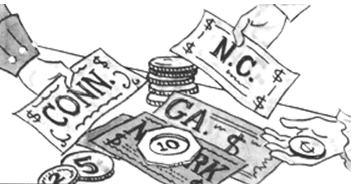
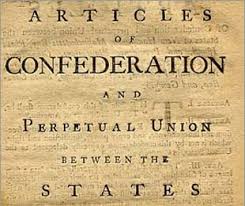
Which two branches of government did not exist under the Articles of Confederation?
Legislative
Executive
Judicial
The main cause for many of the rules in the Articles of Confederation was that the delegates at the Continental Congress...
did not want to give the states too much power because they'd proven they were willing to rebel against a government.
wanted to create a government that was identical to England's government.
were concerned about giving the central government too much power because the King had used his power unfairly.
wanted to unify the states together, which included creating one army and one type of currency.
Why were farmers in Massachusetts so upset in 1786 and 1787?
The US was getting ready to go to war with France and they'd have to be soldiers again
The national government kept raising taxes on farmers to pay off the war debt
They were losing their farms because they could not afford the taxes on them
No one would buy their crops because they were over priced
Who was Daniel Shays?
A former soldier and farmer who was worried about losing his farm, so he started a rebellion
A tax collector from Massachusetts who had to go and collect money from the poor
He was the Governor of Massachusetts at the time of a huge rebellion by farmers
What did Shays' rebellion reveal about the Articles of Confederation?
That it was too similar to the British system
That it was too weak to succeed
That it was strong and resilient
That it was a successful model of government

What is considered the first Constitution of the United States?
Declaration of Independence
Articles of Confederation
Treaty of Paris
Common Sense
What was the main issue that divided the Federalists and Anti-Federalists?
Whether or not to allow slavery
How much representation big states should get
How much power to give to the national government

