
 Worksheets
Quiz on Light Reflection and Refraction
Total questions: 167
Worksheet time: 8hrs 28mins
What happens to a coin placed in a bowl when seen from a distance?
It appears very much deep inside the water
It becomes visible again
It appears above the water surface
It will not be seen
What is the nature of the image formed by a convex mirror?
Virtual, erect, enlarged
Virtual, erect, diminished
Real, inverted, enlarged
Real, inverted, diminished
What is the formula to find the refractive index of a medium?
n = 1 / speed of light in the medium
n = speed of light in air / speed of light in the medium
n = 1 / speed of light in air
n = speed of light in the medium / speed of light in air
In case of refraction through a glass slab, what is true?
Angle of incidence is equal to the angle of refraction
Incident ray is parallel to the refracted ray
Incident ray is parallel to the emergent ray
Angle of refraction is equal to the angle of emergence
What type of mirror is used to view a tall building in a small mirror?
Plano-convex mirror
Plane mirror
Concave mirror
Convex mirror
What is the power of a lens with a focal length of -3.5D?
Plano-concave
Plano-convex
Concave
Convex
What is the angle of refraction when a ray of light passes from a denser medium to a rarer medium?
Both
None
Angle of refraction
Angle of incidence
What is the nature of light waves?
Transverse wave
Longitudinal wave
Mechanical wave
Both (b) and (c) are correct
What happens to the image formed by a concave mirror when the object is placed at its focus?
Of infinite size
Lies at infinity
Virtual and erect
Real and inverted
What is the focal length of a plane mirror?
Infinity
Negative
Positive
Zero
What is the critical angle for total internal reflection?
90 degrees
45 degrees
30 degrees
60 degrees
What type of lens is used to correct nearsightedness?
Convex lens
Concave lens
Plano-concave lens
Plano-convex lens
What is the effect of increasing the temperature on the refractive index of a medium?
Increases the refractive index
Decreases the refractive index
No effect on the refractive index
Depends on the medium
What is the relationship between the angle of incidence and the angle of refraction in Snell's law?
They depend on the refractive indices of the two media
They are independent of each other
They are inversely proportional
They are always equal
Which type of lens is used to magnify small objects?
Concave lens
Convex lens
Plano-concave lens
Plano-convex lens
What phenomenon occurs when light waves bend around the edges of an obstacle?
Dispersion
Diffraction
Reflection
Refraction
What is the phenomenon called when light changes direction as it passes from one medium to another?
Refraction
Dispersion
Reflection
Diffraction
Which type of lens is used to focus light to a point?
Convex lens
Concave lens
Plano-convex lens
Plano-concave lens
What happens to the speed of light as it enters a denser medium?
Increases
Depends on the wavelength
Decreases
Remains the same
What is the effect of a prism on white light?
It absorbs the light
It reflects the light
It magnifies the light
It disperses the light into a spectrum
What type of image is formed by a concave lens?
Real and inverted
Virtual and erect
Real and erect
Virtual and inverted
What is the phenomenon called when light is bounced off a surface?
Dispersion
Reflection
Diffraction
Refraction
The image formed by a plane mirror is:
Virtual, behind the mirror and enlarged
Virtual, behind the mirror and of the same size as the object
Real, at the surface of the mirror and enlarged
Real, behind the mirror and of the same size as the object
The angle between an incident ray and the plane mirror is 30°. The total angle between the incident ray and reflected ray will be:
30°
60°
90°
120°
A ray of light is incident on a plane mirror making an angle of 90° with the mirror surface. The angle of reflection for this ray of light will be:
45°
90°
0°
60°
In a convex spherical mirror, reflection of light takes place at
A flat surface
A bent-in surface
A bulging-out surface
An uneven surface
If R is the radius of curvature of a spherical mirror and f is its focal length, then what is the relation between them
R=f
R=2f
R=f/2
R=1/f
If the focal length of a spherical mirror is 12.5 less cm, its radius of curvature will be
25 cm
15 cm
20 cm
35 cm
The real image formed by a concave mirror is larger than the object when the object is
At a distance equal to radius of curvature
At a distance greater than radius of curvature
At focus and centre of curvature
At a distance less than focal length
The image formed by a concave mirror is virtual, erect and magnified. The position of object is
At focus
At pole
Between centre of curvature and focus
Between pole and focus
The image formed by a concave mirror is real, inverted and highly diminished. The object must be
Between center of curvature and focus
At centre of curvature
At focus
At infinity
The angle of incidence for a ray of light passing through the centre of curvature of concave mirror is
45°
90°
0°
180°
In the concave reflector of a torch, the bulb is placed
Between the pole and focus of reflector
At the focus of reflector
Between focus and centre of curvature of reflector
At the centre of curvature of reflector
The focal length of a small cancave mirror is 2.5 cm. In order to use this concave mirror as a dentist's mirror, the distance of tooth from the mirror should be
2.5 cm
1.5 cm
4.5 cm
3.5 cm
According to new Cartesian sign convention
Focal length of concave mirror is positive and that of convex mirror is negative
Focal length of both concave and convex mirror is positive
Focal length of both concave and convex mirror is negative
Focal length of concave mirror is negative and that of convex mirror is positive
One of the following does not apply to a concave mirror
Focal length is negative
Image distance can be positive or negative
Image distance is always positive
Height of image can be positive or negative
Which of following is the correct mirror formula
1/v - 1/u = 1/f
1/u - 1/v = 1/f
1/u + 1/v = 1/f
1/v + 1/u = 1/f
Linear magnification produced by a concave mirror may be
Less than 1 or equal to 1
More than 1 or equal to 1
Less than 1, more than 1 or equal to 1
Less than 1 or more than 1
Which of the following can make a parallel beam of light when light from a point source is incident on it?
Concave mirror as well as convex lens
Convex mirror as well as concave lens
Two plane mirrors placed at 90° to each other
Concave mirror as well as concave lens
A 10 mm long awl pin is placed vertically in front of a concave mirror. A 5 mm long image of the awl pin is formed at 30 cm in front of the mirror. The focal length of this mirror is
-30 cm
-20 cm
-40 cm
-60 cm

The diagrams showing the correct path of the ray after passing through the
II & III only
I & II only
I, II & III
I, II & IV

A light ray enters from medium A to medium B as shown in figure. The refractive index of medium B relative to A will be
Greater than unity
Less than unity
Equal to unity
Zero

Beams of light are incident through the holes A and B and emerge out of box through the holes C and D respectively as shown in the figure. Which of the following could be inside the box?
A rectangular glass slab
A concave lens
A convex lens
A prism
Magnification produced by a rear view mirror fitted in vehicles
is less than one
is more than one
is equal to one
can be more than or less than one depending upon the position of the object in front of it.
Magnification produced by a plane mirror is
Less than 1
More than 1
Equal to 1
Zero
If a magnification of -1 is to be obtained by using a converging mirror, then the object has to be placed
Between pole and focus
At the centre of curvature
Beyond the centre of curvature
At infinity
an object is placed at large distance in front of a concave mirror of radius of curvature 40cm. The image will be formed in front of the mirror at a distance of
20 cm
30 cm
40 cm
50 cm
The speed of light in air
3×10⁸ cm/sec
3×10⁸ m/sec
2.9970 ×10⁸ m/sec
Both ii and iii

Which of the following diagrams shows the ray of light reflected correctly?
A only
A, B and C
C and D
E only
The reactive indices of four substances P, Q, R and S are 1.50, 1.36, 1.77 and 1.31 respectively. The speed of light is the maximum in the substance
P
Q
R
S
The refractive index of glass for light going from air to glass is 3/2. The refractive index for light going from glass to air will be:
1/3
6/4
3/2
4/6
The refractive index of water with respect to air is 4/3. The refractive index of air with respect to water will be
1.75
0.50
0.75
0.25
You are given water, mustard oil, glycerine and kerosene. In which of these media a ray of light incident obliquely at same angle would bend the most?
Water
Mustard oil
Glycerine
Kerosene
A child is standing in front of a magic mirror. She finds the image of her head bigger, the middle portion of her body of the same size and that of the legs smaller. The following is the order of combinations for the magic mirror from the top.
Plane, convex and concave
Convex, concave and plane
Concave, plane and convex
Convex, plane and concave
Light travel fastest in
Air
Vaccum
Water
Glass

A student used a device (X) to obtain/focus the image of a well illuminated distant building on a screen (S) as shown alongside in the diagram. Select the correct statement about the device (X).
This device is a concave lens of focal length 8 cm.
This device is a convex mirror of focal length 8 cm.
This device is a convex lens of focal length 4 cm.
This device is a convex lens of focal length 8 cm.
A lens of focal length 12 cm forms an erect image, three times the size of the object. The distance between the object and image is:
8 cm
16 cm
24 cm
36 cm
Focal length of plane mirror is
At infinity
Zero
Negative
None of these
The unit of power of lens is
Meter
Centimeter
Diopter
M-1
In order to obtain a real image twice the size of the object with a convex lens of focal length 15 cm, the object distance should be
More than 5 cm but less than 10 cm
More than 10 cm but less than 15 cm
More than 15 cm but less than 30 cm
More than 30 cm but less than 60 cm
A converging lens is used to produce an image of an a screen. What change is needed for the image to be formed nearer to the lens
Increase the focal length of the lens
Insert a diverging lens between the lens and the screen
Increase the distance of the object from the lens
Move the object closer to the lens
If the spherical lens has a power of -0.25 D, the focal length of this lens will be
-4 cm
-400 mm
-4 m
-40 m
One dioptre is the power of lens whose focal length is
1 m
1 cm
1 mm
1 dm
The focal length of four convex lenses P, Q, R and S are 20 cm, 15 cm, 5 cm and 10 cm respectively. The lens having greatest power is
P
Q
R
S
The optical phenomena, twinkling of stars, is due to
Atmospheric reflection
Total reflection
Atmospheric refraction
Total refraction
Power of the lens is -40, its focal length is
4 m
-40 m
-0.25 m
-25 m
Assertion (A) : A ray passing through the centre of curvature of a concave mirror after reflection, is reflected back along the same path.
Reason (R) : The incident rays fall on the mirror along the normal to the reflecting surface.
A and R are true and R is the correct explanation of A
A and R are true but R is not the correct explanation of A
A is true but R is false
A is false but R is true
Assertion (A) : Light does not travel in the same direction in all the media.
Reason (R) : The speed of light does not change as it enters from one transparent medium to another
A and R are true and R is the correct explanation of A
A and R are true but R is not the correct explanation of A
A is true but R is false
A is false but R is true
Assertion(A) : The emergent ray is parallel to the direction of the incident ray.
Reason (R) : The extent of bending of the ray of light at the opposite parallel faces (air- glass interface and glass-air interface) of the rectangular glass slab is equal and opposite.
A and R are true and R is the correct explanation of A
A and R are true but R is not the correct explanation of A
A is true but R is false
A is false but R is true
Assertion(A) : For observing traffic at back, the driver mirror is convex mirror.
Reason (R) : A convex mirror has much larger field of view than a plane mirror.
A and R are true and R is the correct explanation of A
A and R are true but R is not the correct explanation of A
A is true but R is false
A is false but R is true
Assertion(A) : Mirror formula can be applied to a plane mirror.
Reason (R) : A plane mirror is a spherical mirror of infinite focal length.
A and R are true and R is the correct explanation of A
A and R are true but R is not the correct explanation of A
A is true but R is false
A is false but R is true
Assertion(A) : It is not possible to see a virtual image by eye.
Reason (R): The rays that seem to emanate from a virtual image do not in fact emanates from the image.
A and R are true and R is the correct explanation of A
A and R are true but R is not the correct explanation of A
A is true but R is false
A is false but R is true
Assertion(A) : Concave mirrors are used as make-up mirrors.
Reason (R) : When the face is held within the focus of a concave mirror, then a diminished image of the face is seen in the concave mirror.
A and R are true and R is the correct explanation of A
A and R are true but R is not the correct explanation of A
A is true but R is false
A is false but R is true
Assertion(A): A person cannot see his image in a concave mirror, unless, he is standing beyond the center of curvature of the mirror.
Reason (R) : In a concave mirror, image formed is real provided the object is situated beyond its focus.
A and R are true and R is the correct explanation of A
A and R are true but R is not the correct explanation of A
A is true but R is false
A is false but R is true

A beam of light is incident through the holes on side A and emerges out of the holes on the other face of the box as shown in Figure. Which of the following could be inside the box?
Concave lens
Convex lens
Prism
Rectangular glass slab
The speed of light in air is 3 x 10⁸ m s-1. Calculate the speed of light in glass. The refractive index of glass is 1.5
2×10⁸ m/sec
2.50×10⁸ m/sec
2.25×10⁸ m/sec
1.5×10⁸ m/sec
The Snell's laws of refraction are:
The incident ray, the refracted ray and the normal at the point of incidence, all lie in the same plane.
The ratio of the sine of the angle of incidence to the sine of the angle of refraction is constant for the pair of the given media
Refractive index= sin i/sin r
All of the above

In the diagram, which letter represents the angle of incidence?
A
B
C
D

Which diagram represents specular reflection?
A
B

Which diagram represents diffuse reflection?
A
B
C
D
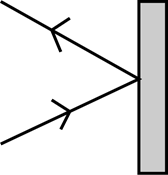
In the illustration, the light ray striking the object is-
Why can you see most objects?

Given that the angle of incidence = 30 degrees
a. Draw a ray diagram, labelling clearly the normal, incident ray, angle of incidence, reflected ray and angle of reflection accurately.
Which is the correct diagam?
Which is NOT a source of light?
sun
lightbulb
fire
car
Your light-sensing organ is your
ear
finger
brain
eye
In order to see a picture it must
produce light
reflect light
absorb light
To get the best reflection from a mirror you need
a very shiny surface to reflect lots of light
to stand right in front of it
to shine a bright light on it
it to produce light
According to the laws of reflection, if i = angle of incidence and r = angle of reflection,

If a capital letter R is seen in an ordinary mirror, what does it look like?


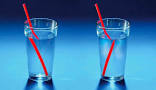
A student placed a pencil in a cup of water. The pencil appears broken because light
always travels in a straight line.
bends when it passes through water.
makes the water in the glass evaporate.
reflects the pencil on the water's surface.
When light passes at an angle to the normal from one medium into another in which its speed is higher
it is bent toward the normal.
it always lies along the normal.
it is unaffected.
it is bent away from the normal.
When light passes at an angle to the normal from one medium into another in which its speed is lower
it is bent towards the normal.
it always lies along the normal.
it is unaffected.
it is bent away from the normal.
flint glass n=1.70
barium glass n=1.60
crown glass n=1.523
water n=1.33
diamond n=2.45

If all other variables are held constant, what happens to the angle of refraction if the angle of incidence increases?
the angle of refraction stays the same
the angle of refraction decreases
the angle of refraction increases
cannot be determined from the information provided

Based on the image, which medium has a larger index of refraction?
Medium 1 has a larger index of refraction.
Medium 2 has a larger index of refraction.
Both mediums have the same index of refraction.
Cannot be determined.

Based on the image, as light passes from medium 1 to medium 2
light speeds up and bends towards the normal
light speeds up and bends away from the normal
light slows down and bends towards the normal
light slows down and bends away from the normal
Based on the image, as light passes from medium 1 to medium 2
light speeds up and bends towards the normal
light speeds up and bends away from the normal
light slows down and bends towards the normal
light slows down and bends away from the normal

Will light change direction toward or away from the perpendicular when it goes from air to water?
away from the perpendicular
toward the perpendicular

Will light change direction toward or away from the perpendicular when it goes from glass to water?
away from the perpendicular
toward the perpendicular
A student placed a pencil in a cup of water. The pencil appears broken because light
always travels in a straight line.
slows down when it passes through water.
makes the water in the glass evaporate.
reflects the pencil on the water's surface.
When light goes from a less dense to a more dense medium,
it is bent towards the normal.
it always lies along the normal.
it is unaffected.
it is bent away from the normal.
Glass has a _____________ level of refraction than air.
Based on the image, which medium has a higher density?
Medium 1 has a higher density.
Medium 2 has a higher density.
Both mediums have the same densities.
Cannot be determined.
Based on the image, as light passes from medium 1 to medium 2
light speeds up and bends towards the normal
light speeds up and bends away from the normal
light slows down and bends towards the normal
light slows down and bends away from the normal

When light passes from a dense medium into a less dense medium
it is bent toward the normal.
it always lies along the normal.
it is unaffected.
it is bent away from the normal.


Which letter represents the angle of incidence?
A
B
C
D

What is the angle of reflection?
650
500
250
400

What type of image is formed?
virtual and inverted
virtual and upright
real and upright
real and inverted
How does a concave lens differ from a convex lens?
A convex lens is another way to describe a plane mirror; a concave lens is curved
A concave lens is curved inward on both sides; a convex lens is on only one side
A convex lens has a thick center and thin edges, a concave lens has a thin center and thicker edges
A convex lens has a thin center and thick edges. a concave lens has a thick center and thinner edges

A concave lens has an inward curved shape. It refracts light outward from the lens. They light rays spread apart as they exit the lens. Which represents a concave lens?
A
B
A and B
neither A or B
What do a prism, a magnifying glass, a microscope, and eyeglasses ALL have in common.
They are opaque
They refract light
They reflect light
That are translucent
A ____ lens is sometimes called a converging lens because it_____.
convex; makes parallel light rays curve outward or diverge
concave; makes parallel light rays travel at a faster speed than before they encountered the lens
convex, makes parallel light rays passing through it bend inward and meet (converge) at a spot just beyond the lens known as the focal point.
concave; makes parallel light rays passing through it bend inward and meet (converge) at a spot just beyond the lend known as the focal point.


When light waves move from passing through air to passing through a glass lens when happens to them?
They slow down and change direction
They speed up and change direction
They maintain the same speed and change direction
They maintain their same speed and direction

How does a concave lens differ from a convex lens?
A convex lens is another way to describe a plane mirror; a concave lens is curved
A concave lens is curved inward on both sides; a convex lens is on only one side
A convex lens has a thick center and thin edges, a concave lens has a thin center and thicker edges
A convex lens has a thin center and thick edges. a concave lens has a thick center and thinner edges

The above lens is a type of ___.
diverging lens
converging lens
divergent lens
convergent lens
Where are lenses used? (multiple correct)
Telescopes
Tables
Eye-glasses
Binoculars
Which one of these is a convex lens?


None of the above
Concave lenses are thick in the middle and thin in the edges.
TRUE
FALSE

