
 Worksheets
The cell and Virus
Total questions: 239
Worksheet time: 2hrs 26mins
Which phrase best describes the function of mitochondria?
Located in the cytoplasm
Bacteria-sized organelle
Converts energy for cell use
Contains a folded inner membrane
Which cell organelle stores DNA?
Cell wall
Cell membrane
Vacuole
Nucleus

What is a cell?
A room
The smallest unit that can perform all life processes
Something that is abiotic
What happens during photosynthesis

Which one of these people discovered cells?
George Washington
Robert Hooke
Captain Hook
Robert Redford
What are the smallest units that make up your body?
tissue
cell
organ
organ system
which scientist Observes cork and names the tiny chambers that he sees cells
Anton van Leeuwenhoek
Matthias Schleiden
Robert Hooke
Theodor Schwann
The cell theory states that
All living organisms are composed of one or more cells
Cells are the basics unit of structure and organization of all living organisms.
Cells arise only from previously existing cells. (Cells passing copies of their genetic material on to other daughter cells)
all of the above
What is a cell?
A room
The smallest unit that can perform all life processes
Something that is abiotic
What happens during photosynthesis
What invention made the discovery of cells possible?
The lightbulb
The phonograph
The kinetoscope
The microscope
What scientific tool that allowed scientists to discover a cell?
Electronic Scale
Instead of light, a Transmission electron microscope and Scanning electron microscope utilize ____________ to create an image.
a colored pencil
neutrons
protons
electrons
Eukaryotic Cell
Prokaryotic Cell
Virus
You are sing a microscope that requires light to pass through the specimen in order to observe it. What type of microscope are you using?
transmission electron microscope
compound light microscope
scanning electron microscope
refracting telescope


which is NOT an example of an organelle?
mitochondrion
nucleus
heart
cell membrane

Which of the following statements is not part of the cell theory?
Cells are the basic unit of structure and function in all living things.
All cells are produced from other cells.
Only animal cells are composed of cells.
All living things are composed of cells.

Cells are often called "the ____ of life."
bread
road map
building blocks
meaning
Cell theory is not applicable for
bacteria
fungus
algae
virus

Which of the following scientists concluded that all animals are made of cells?
Rudolf Virchow
Matthais Schleiden
Robert Hooke
Theodor Schwann

Which of the following scientists was the first to observe bacteria under a microscope?
Robert Hooke
Matthais Schleiden
Anton van Leuwenhoek
Theodor Schwann

When cells are damaged, new cells are created by cell a process called cell division. How does the cell theory support this fact?
It states that all cells have a nucleus which divides.
It states that all living things are made up of one or more cells.
It states that cells come from previously existing cells.
It states that the basic units of structure and function are cells.
All plants are made of cells. This was discovered by....
Rudolf Virchow
Matthias Schleiden
Robert Hooke
Aristotle
A plant and an animal are both living things. According to the Cell Theory, what can you conclude about these two very different organisms?
Plants have cells but animals do not.
They are both made of one or more cells.
They both come from the same kind of cell.
They both come from a non-living organism.
Which historical event most directly contributed to the development of the cell theory?
The discovery and classification of thousands of species of organisms.
The development of theories of natural selection on evolution of organisms.
The development of microscopes and higher powered lenses.
The discovery that DNA is the genetic material.
There are three parts to the cell theory. Which is NOT one of those parts?
All organisms are composed of one or more cells.
Cells spontaneously arise from carbon and nutrients carried in the bloodstream.
The cell is the basic unit of structure and organization in organisms.
All cells come from pre-existing cells.
Who named the cell?
Robert Redford
Robert Smith
Robert DeNiro
Robert Hooke
What is something that Prokaryotes and Eukaryote both have in common?
small in size
bacteria
have DNA
complex cell
Cytoplasm is Inflexible barrier for support and structure and is found in _____ and _______.
fruits and vegetables
dogs and cats
Prokaryotes and Eukaryotes
inner and outer membranes
Cilia are found in Prokaryotes and animal cells and have __________ used for locomotion.
spear shaped tails
trianlge shaped tails
numerous hair-like projections that move back and forth
gills
Which do BOTH prokaryotes and eukaryotes contain?
nucleus
mitochondria
ribosomes
cell wall

Which type of cell is represented in this picture?
prokaryote
Eukaryote

Which type of cell is represented by this picture?
Prokaryotes
Eukaryote

According to evolutionary theory, which type of cell developed first?
Prokaryotic Cells
Eukaryotic cells
Which cells contain cytoplasm?
prokaryotic cells
eukaryotic cells
both cell types
None of them
If an organism is multicellular, what is also true of that organism?
It has to be heterotrophic.
It has to be a eukaryote.
It has to be a prokaryote.
It has to be a plant or an animal.
Which of the following is a eukaryotic cell(s)?
Bacteria
Plant
Plant and animal
Animal
What does a plant cell have that an animal cell doesn't have?
Cell Membrane and Cell Wall
Cell Wall and Mitochondria
Cell Wall and Ribosomes
Cell Wall and Chloroplast
The outermost layer of a plant cell and an animal cell is...
Plant cell - cell membrane, animal cell - cell wall
Plant cell - cell wall; animal cell - cell membrane
Plant and animal cell - cell wall
Plant and animal cell - cell membrane
What is the barrier that protects the cell and regulates what substances enter and leave the cell? It is mainly composed of proteins lipids.
Cell Wall
Cell Membrane
Nuclear Envelope
Cristae
Rigid, protective and supportive outer layer of plant cells
cell membrane
nuclear membrane
cell wall
cristae
control, read, and direct the cell using DNA instructions
nucleus
mitochondria
endoplasmic reticulum
ribosome
What is the difference between mitochondria and chloroplast?
Chloroplasts produces energy from food/ sugars and Mitochondria capture energy from sunlight, and use it to produce food/ sugars.
They both have the same function (they produce energy), but one is found in animal cells and one is found in plant cells.
Mitochondria produces energy from food/ sugars and chloroplasts capture energy from sunlight, and use it to produce food/ sugars.
Produces energy in the form of ATP for the cell.
chloroplast
mitochondria
ribosome
nucleolus
An organelle that captures energy from the sunlight and uses it to produce food/ sugars in plant cells is ______________.
Chromatin
Chloroplast
Mitochondria
Ribosome
System of membranes, which fold and process proteins. The surface is covered in ribosomes.
Rough endoplasmic reticulum
Golgi Body
Smooth endoplasmic reticulum
Nucleolus
System of membranes, which synthesise and process lipids.
Smooth endoplasmic reticulum
Golgi Body
Rough endoplasmic reticulum
Nucleolus
Which organelle receives proteins and lipids from the endoplasmic reticulum, packages them (eg. in vesicles), and distributes them?
lysosomes
golgi apparatus
ribosomes
smooth endoplasmic reticulum
What is the name of the small, round organelles that contain digestive (hydrolytic) enzymes that digest invading cells, break down worn out components of the cell and aid in removal of wastes from the cell?
Lysosomes
Vacuoles
Ribosomes
Golgi Bodies

What are the small organelles that function as factories that make proteins (protein synthesis)? They can be attached to the endoplasmic reticulum or they may float free in the cytoplasm.
Nucleolus
Ribosomes
Mitochondria
Chrloroplasts
A gel-like substance, predominantly made of cytosol, where most cellular activities occur...
cytoplasm
chromatin
chloroplasts
centrioles
Found in both plant and animal cells, but is much larger in plant cells. It holds materials and wastes. It also keeps the proper (osmotic) pressure in the plant cells, and supports the growing plant...
Centrioles
Cell wall
Chloroplast
Vacuole

Name the circled organelle
Rough endoplasmic reticulum
Smooth endoplasmic reticulum
Golgi body

Name the circled organelle
Rough endoplasmic reticulum
Smooth endoplasmic reticulum
Golgi body

What am I?
Golgi apparatus
Rough endoplasmic reticulum
Smooth endoplasmic reticulum

What am I?
Mitochodria
Ribosome
Chloroplast
Centriole

This is an animal cell. What is number 3 pointing to?
Ribosome
Chloroplast
Mitochondria
Lysosome
This organelle controls what goes in and out of plant and animal cells.
Cell Wall
Cell Membrane
Chloroplasts
Cytoplasm
The _____________ stores food, water, wastes, and other materials in both plant and animal cells.
Vacuole
Mitochondria
Cytoplasm
Nucleus
The _____________ holds the DNA, and controls the functions of eukaryotic cells.
Nucleus
Nuclear Membrane
Mitochondria
Chloroplast
The _____________ is a gel-like fluid that fills plant and animal cells. It holds the organelles in place and gives each cell its shape.
Cytoplasm
Cell Membrane
Cell Wall
Chloroplast
What can only be found in plant cells?
Cell membrane
Vacuole
Chloroplast
Mitochondria


The 3 parts of the Cell Theory are...?
All living things are composed of cells
Cells are the basic units of structure and function in living things
All cells are produced from other cells
All living things are composed of cells
Cells are the basic units of dance and vibes in living things
All cells are destroyed from other aliens
All living things are composed of Jell-O
Cells are the basic units of structure and function in living things
All cells are produced from factories in Canada
All living things are composed of cells
Cells do karate and practice eating whole pies in their free time
All cells are produced from other cells
Which type of cell is found in BACTERIA?
Prokaryotic
Eukaryotic
Which type of cell has a cytoplasm?
Prokaryotic
Eukaryotic
Both
Which type of cell has DNA floating in its cytoplasm?
Prokaryotic
Eukaryotic
Which types of cells have cell walls?
Animal cells and plant cells
Animal cells and bacteria cells
Bacteria cells and plant cells

Which type of cell is this?
Prokaryotic
Eukaryotic
Which type of cell has a flagella?
Prokaryotic
Eukaryotic
2. Cells are the building blocks of life.
3. All cells come from preexisting cells.
What is this theory called?

Check all the organelles that can be found in an animal cell.
chloroplasts
mitochondria
nucleus
golgi complex

The function of the mitochondria is
is to make proteins for the cell.
transport materials in and out of the cell.
break down waste products for the cell.
break down glucose through cellular respiration and make energy for the cell.
Ribosomes are important because
they make proteins for the cell.
they make glucose for the cell.
they transport materials throughout the cell.
they control the cell's activities
Both an animal cell and a plant cell have a cell membrane.
TRUE
FALSE
Genetic material can be found in what organelle?
the golgi complex
the mitochondria
the nucleus
the chloroplasts

Check the functions of the cell wall.
provides support for the plant cell
provides structure and support for the plant cell
provides energy for the animal cell
provides structure for the animal cell

Check the three major differences between a plant cell and an animal cell.
cell wall
mitochondria
large central vacuole
chloroplasts

Chloroplasts are organelles that
make food for the plant cell by going through photosynthesis.
transport proteins.
package materials and distribute them throughout the cell.
break down waste products.

Arrow 12 is pointing to what organelle in the plant cell.
the chloroplasts
the large central vacuole
the cell wall
the mitochondria

Arrow 7 is pointing to what organelle in the animal cell.
the large central vacuole
the chloroplasts
the cell membrane
the mitochondria
Encloses the cell, it acts like a gatekeeper, allowing some materials to pass through it but not others.
Chloroplasts
Cell Wall
Cell Membrane
Cytoplasm
A rigid structure that surrounds the cell membrane for support and protection of the cell.
Chloroplasts
Cell Wall
Cell Membrane
Cytoplasm
Organelles where photosynthesis occurs, are green due to chlorophyll pigment found in them.
Chloroplasts
Cell Wall
Cell Membrane
Cytoplasm
A gel like fluid that takes up most of the space inside the cell. The organelles are found scattered throughout it.
Chloroplasts
Cell Wall
Cell Membrane
Cytoplasm
Organelles that package cellular materials and transports them within the cell or out of the cell.
Golgi Body
Endoplasmic reticulum
Large central vacuole
Lysosomes
A fluid like vesicle that stores water and provides support for the cell.
Golgi Body
Endoplasmic reticulum
Large central vacuole
Lysosomes
Powerhouse of the cell, organelle that is the site of ATP ( energy production ) and cellular respiration in plants and animals.
Nucleus
Ribosomes
Mitochondria
Vacuoles
Is the structure located in a plant and animal cell that is home to DNA, where new cells are made and directs cell activity
Nucleus
Ribosomes
Mitochondria
Vacuoles
Where proteins are made in the cells.
Nucleus
Ribosomes
Mitochondria
Vacuoles
Saclike structures that store materials such as water, salts, proteins, and carbohydrates.
Nucleus
Ribosomes
Organelles
Vacuoles
The function of the mitochondria is
is to make proteins for the cell.
transport materials in and out of the cell.
break down waste products for the cell.
break down glucose through cellular respiration and make energy for the cell.
The two kingdom Classification was Proposed by
Whittaker
Bentham
Hutchinson
Linnaeus
The five kingdom classification includes the following kingdoms
Monera, Algae, Fungi, Plantae, Animalia
Bacteria, Algae, Fungi, Plantae, Animalia
Monera, Protista, Fungi, Plantae, Animalia
Bacteria, Protista, Fungi, Plantae, Animalia
Which of the following is NOT the main criteria for classification proposed by Whittaker?
Cell structure
Mode of nutrition
Locomotion
Phylogenetic Relationship
The Two Kingdom Classification was found to have certain drawbacks for which other classifications emerged later. Which one of the following was not a drawback of the two kingdom classification?
Grouping of prokaryotes and eukaryotes together
Cyanobacteria was placed under plant kingdom
organism having cell wall separated from organism lacking cell wall
Unicellular amd multicellular organisms were not separated
Which of the following kingdoms includes both unicellular and multicellular?
Kingdom Monera
Kingdom Protista
Kingdom Plantae
Kingdom Animalia
Which of the following is the unique characteristic of organisms in Kingdom Protista?
i. Eukaryotic
ii. All of them are heterotrophs
iii. Can only reproduce sexually
iv. Can be found in dry place
i only
ii and iii only
i, ii and iii only
all of the above
Algae are not considered as plants even though they are autotrophic because
they lack true roots, stems and leaves
do not have cuticle
do not have multicellular gametangia
all of the choices
The mode of nutrition found in most Protozoa is
autotrophic
chemotrophic
photosynthetic
heterotrophic
A viruses genetic material is:
DNA
RNA
DNA or RNA
DNA and RNA
Viruses can only reproduce by:
Mitosis
Binary fision
Infecting living cells
They can't reproduce
Viruses are surrounded by a protein coat known as a
Capsid
Capsule
Enzyme
Nucleotide
A pathogen is
Any foreign substance that causes an immune response in your body
A protein that flags an invading bacteria in your body
A genetic pathway
The cell that engulfs and destroys invaders in your body
A disease caused by infectious agents that is spread directly or indirectly from person to person
Pathogen
Infectious Disease
Virus
Bacteria
takes over the cell's functions.


When new viruses are being assembled (IV), what mediates the assembly?
assembly proteins coded for by the viral genes
assembly proteins coded for by the host nucleus
host cell chaperones
nothing; the proteins self-assemble
All viruses are different, but what are two parts that a virus must have?
Genetic Information (DNA or RNA)
a lipid membrane
a nucleus
a protein coat

Which of these statements is true?
A virus is unicellular, it has only one cell.
A virus may sometimes be multicellular, have many cells.
A virus has no cells
Which statement is true?
A virus has a nucleus, but no other organelles.
A virus has a nucleus and ribosomes.
A virus has no organelles, because it has no cells, and it is non-living.

A virus is so small that 250,000 viruses could fit inside
a grain of sand
an apple
a basketball

Cell membranes of living organisms are made of a bilayer (2 layers) of
lipids
proteins
carbohydrates
Which sentence is true
All viruses, although they are not living, have a lipid layer that surrounds them.
Many viruses, although they are not living, have a lipid layer that surrounds them. This includes the corona viruses.

The little sticks poking out of the sides of these viruses are called
sugar sticks
spike proteins
covid claws

Which sentence is true about this picture.
It shows a virus being made.
It shows a virus entering the cell of a human or animal.
It shows a virus being destroyed by soap.

At the top left of this picture, you can see the spike protein of a virus fitting perfectly into a receptor site on our cells. Which sentence below is true?
Humans have receptor sites for viruses on our cells because we want viruses to invade our cells.
Humans have receptor sites for viruses on our cells because those receptor sites were made for a different purpose, but viruses evolved to be able to use them.

Once the virus is attached to our cell, the lipid layer of our cell and the lipid layer around the virus can merge because
Lipids attract lipids
Lipids attract proteins
The DNA instructs them to do this.
Which sentence is true?
Soap destroys viruses because it dissolves the DNA or RNA
Soap destroys viruses because it bends the spike proteins
Soap destroys viruses because it breaks up the lipid layer and allows it to be washed away.
Soap destroys viruses because it is acidic.
Once a virus gets into a cell, it
Releases its DNA or RNA into the cell.
It begins to create DNA or RNA in the cell.
It destroys its own DNA and RNA in the cell.

takes over the cell's functions.

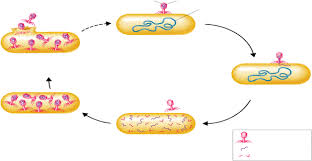


Host DNA is compromised and viral DNA takes over in which phase?
1
2
3
4
A viruses genetic material is:
DNA
RNA
DNA or RNA
DNA and RNA
Viruses can only reproduce by:
Mitosis
Binary fision
Infecting living cells
They can't reproduce
Viruses are surrounded by a protein coat known as a
Capsid
Capsule
Enzyme
Nucleotide
A pathogen is
Any foreign substance that causes an immune response in your body
A protein that flags an invading bacteria in your body
A genetic pathway
The cell that engulfs and destroys invaders in your body
A disease caused by infectious agents that is spread directly or indirectly from person to person
Pathogen
Infectious Disease
Virus
Bacteria
takes over the cell's functions.
When new viruses are being assembled (IV), what mediates the assembly?
assembly proteins coded for by the viral genes
assembly proteins coded for by the host nucleus
host cell chaperones
nothing; the proteins self-assemble

Mumps' is a viral disease caused due to inflammation of
Submaxillary gland
Parotid gland
Sublingual gland
Infraorbital gland

Out of the following one disease is caused by virus
Malaria
Influenza
Diphtheria
Typhoid

If a person shows production of interferons in his body, the chances are that he has got an infection of
Typhoid
Measles
Tetanus
Malaria

The region in the body where the polio virus multiplies is
Nerve cells
Intestinal cells
Muscle cells
None of these

The smallest virus one, which causes
Measles
Mumps
Rabies
Poliomyelitis

