
 Worksheets
WCHS BIO MOCK EOC 24-25
Total questions: 35
Worksheet time: 20mins
How is a DNA molecule arranged?
A. double-stranded with alternating deoxyribose and phosphate groups on the sides with adenine, guanine, cytosine, and thymine in the middle
B. double-stranded with alternating deoxyribose and phosphate groups on the sides with adenine, guanine, cytosine, and uracil in the middle
C. double-stranded with alternating ribose and phosphate groups on the sides with adenine, guanine, cytosine, and thymine in the middle
D. double-stranded with alternating ribose and phosphate groups on the sides with adenine, guanine, cytosine, and uracil in the middle
A group of students completed two experiments. Their notes are below: Experiment 1: - Hydrogen peroxide was poured on a slice of raw potato. - The peroxide bubbled vigorously. - The peroxide was broken down into water and oxygen. Experiment 2: - A slice of raw potato was heated and then hydrogen peroxide was poured on it. - There was no visible reaction. Which statement explains the results of these experiments?
A. Heating the potato had no effect on the potato enzymes.
B. Heating the potato caused the hydrogen peroxide to evaporate, so the reaction did not occur.
C. Heating the potato caused the potato enzymes to release the water and oxygen from the hydrogen peroxide.
D. Heating the potato caused a shape change in the potato enzymes, so they could no longer function properly.
Hummingbirds thrive in warm, moist climates, and their primary source of food is nectar from flowering plants. A three-year drought is expected in an ecosystem. How will this most likely affect the hummingbird population in that ecosystem?
The hummingbirds will increase their reproductive rate in order to ensure enough individuals survive.
The hummingbirds will decrease their reproductive rate in order to decrease genetic diversity within the population.
The hummingbirds will immediately adapt to eat new food sources, increasing the overall survival rate of the population.
The hummingbirds will struggle to find food, and only those that can adapt to new food sources will survive.
Which is most likely a prokaryotic cell?
Cell 1
Cell 2
Cell 3
Cell 4
What is the significance of three consecutive nucleotides in DNA?
They code for one amino acid.
They code for three amino acids.
They code for one complete protein.
They code for three complete proteins.
A cell experiences an error during the cell cycle, causing it to go through cytokinesis before mitosis. Which statement best describes the new cells?
The new cells will be double the size of the original cell.
The new cells will have twice as much DNA as the original cell.
The new cells will have no DNA or organelles but will continue progressing through the cell cycle.
The new cells will have an incorrect amount of DNA and organelles, and will likely experience cell death.
Among birds, some skin cells grow feathers when they mature, while other skin cells grow scales at maturity. Which statement best explains this difference?
Skin cells exposed to colder environments grow feathers, while skin cells exposed to wet environments grow scales.
While all cells have the same DNA, specialized cells express certain traits that produce feathers or scales.
Skin cells that have feathers are diploid, while skin cells that make scales are haploid.
Some skin cells have different DNA to build structures like feathers and scales.

The table below describes several different types of energy transfer processes. Which transfer represents photosynthesis?
1
2
3
4
Which substance must be present to release energy from glucose?
hydrogen
oxygen
lactic acid
carbon dioxide
Which is an example of the cycling of carbon?
Animals use the carbon in carbon dioxide for cellular respiration.
Graphene is formed by causing carbon atoms to align in a particular way.
Carbon dioxide is trapped in the atmosphere and contributes to the greenhouse effect.
A plant uses the carbon in carbon dioxide for photosynthesis and is eaten by an animal.

How does the cellular membrane of the finger mullet’s cell contribute to homeostasis within the cell?
It serves as a solid membrane, allowing no materials to pass into and out of the cell.
It serves as an impermeable membrane, allowing only water to move into and out of the cell.
It serves as a selectively permeable membrane, allowing water and other materials to move into and out of the cell as needed.
It serves as a permeable membrane, allowing any material to easily pass into and out of the cell, whether needed or not.

Place (click and drag) the phrases to correctly complete the statement, so that it explains how the cellular membrane shown in Figure 1 helps support the finger mullet in a high-salinity environment. Fill in all of the cells. The cell membrane [1] by allowing water [2].
(a)
A researcher hypothesizes that water will move out of the cell more quickly when the concentration of salt in the water outside the cell is greater. Which experiment would best test this hypothesis?
A researcher places three cells of the same type in varying concentrations of salt water. Then the researcher measures the size of each cell every minute during a 5-minute period of time.
A researcher places three cells of the same type in the same concentration of salt water. Then the researcher measures the size of each cell every minute during a 5-minute period of time.
A researcher places cells from three different fish in varying concentrations of salt water. Then the researcher measures the size of each cell at the end of a 5-minute period of time.
A researcher places cells from three different fish in the same concentration of salt water. Then the researcher measures the size of each cell at the end of a 5-minute period of time.

Based on the food web (Figure 2), what effect will a decrease in the algae population have on the finger mullet population in the estuary?
The finger mullet population will increase because the zooplankton population will decrease.
The finger mullet population will decrease because the zooplankton population will increase.
The finger mullet population will decrease because the zooplankton population will decrease.
The finger mullet population will stay the same because algae is not a direct food source for the mullets.

Based on the food web, which statements are true? Select (click) three true statements.
The red drum only receives energy by consuming finger mullets.
The phytoplankton produce oxygen and glucose the heron needs to survive.
The phytoplankton produce carbon dioxide and glucose the algae need to survive.
The bull shark and heron populations have the most energy available because they are at the top of the food chain.
The phytoplankton population has the most energy available because it is at the bottom of the food chain.

Which model represents energy transfer within a food web in a stable ecosystem?
A. tertiary consumers, secondary consumers, primary consumers, producers
B. secondary consumers, primary consumers, producers
C. secondary consumers, primary consumers, producers
D. tertiary consumers, secondary consumers, primary consumers, producers
What would most likely occur if a new insect species were introduced into North Carolina’s ecosystems?
The new insect species would maintain the stability of the area.
The new insect species would have less reproductive success.
The new insect species would be eaten by natural predators.
The new insect species would increase competition for food resources.
Which human action could best reduce global climate change?
increasing the ozone layer
converting to carbon-free energy
monitoring smog levels in urban areas
protecting fresh water against pollution

These diagrams illustrate two reproductive processes. Which statement best explains the processes?
Process X results in cells that have more genetic variation than those produced through Process Z.
Process X results in cells that have less genetic variation than those produced through Process Z.
Process X results in 1 cell that has the exact same DNA as the parent cells, and Process Z results in 2 cells that have the exact same DNA as the parent cell.
Process X results in 1 cell that has the exact same DNA as the parent cells, while Process Z results in 2 cells that have different DNA from the parent cell.

This diagram shows homologous chromosomes. Which choice best describes the source of genetic variation?
crossing over
gene mutation
nondisjunction
independent assortment
A student crosses two plants. - Plant 1 has red petals (RR). - Plant 2 has white petals (WW). - All of the offspring plants have pink petals (RW). Which type of inheritance do these plants exhibit?
polygenic
codominant
incompletely dominant
autosomal recessive
Nicolette conducted a study of neck length in giraffes. Neck length for the giraffes ranged from 5.9 feet to 7.9 feet. What can most likely be inferred from the study?
Neck length is a sex-linked trait.
The trait for neck length is controlled by multiple genes.
Neck length is a codominant trait.
The trait for neck length is controlled by dominant alleles.
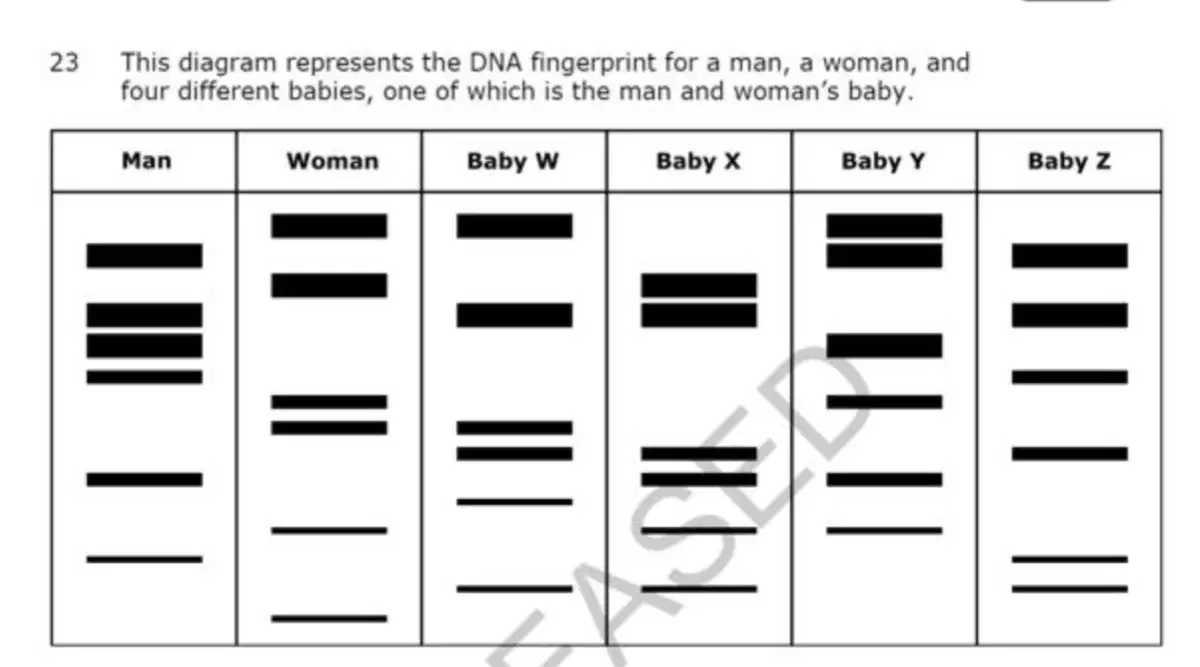
This diagram represents the DNA fingerprint for a man, a woman, and four different babies, one of which is the man and woman’s baby. Based on the DNA fingerprints, which is most likely the man and woman’s baby?
Baby W
Baby X
Baby Y
Baby Z
A farmer reads this information: - A bacterium has a gene that allows it to create pesticide. - The gene has been transferred into a corn plant, allowing the corn plant to produce pesticide. Why might a farmer choose to plant genetically engineered corn?
to spread mutations from the corn to other crops
to reduce chemical use during the growing season
to allow the fields to be used for more than one season
to decrease the amount of land needed to grow the corn crop
A patient takes medication to treat strep throat caused by the bacteria Streptococcus pyogenes. Which statement best describes the reproductive success of the bacteria after the patient has taken the medication for a period of time?
The bacteria may develop resistance to the medication and continue to reproduce.
The patient will require a vaccination to prevent the bacteria from reproducing.
The patient’s immune system will produce antibodies that prevent the bacteria’s reproduction.
The medication may serve as an energy source and cause rapid reproduction of the bacteria.
Which information provides the most reliable evidence of common ancestry for four species of mammals?
embryological forms
nucleotide sequences
anatomical structures
homologous structures


What is "A"?
Nucleotide
Deoxyribose Sugar
Nitrogenous base
Phosphate

A nucleotide is composed of
A phosphate, sugar and nitrogenous base
A protein, protein and Guanine
A phosphate, Adenine, and nitrogenous base
A protein, Adenine and nitrogenous base
What do we call the shape a DNA molecule takes?
double-stranded
double helix
sugar-phosphate backbone
pentagon
The genetic code is used for translating the information from DNA into a protein. This means that sequences of nucleotides are used to determine the sequences of -
disaccharides
amino acids
carbohydrates
glycerols

What is the purpose of transcription?
Transferring amino acids to the ribosome.
Producing more nucleotides for the DNA sequence.
Producing a mRNA from information found in the DNA.

