
 Worksheets
Review USA 6 The Solar System
Total questions: 71
Worksheet time: 2hrs 38mins

Why do objects in the sky appear to move?
the rotation of the Earth
the rotation of the sky around the Earth
scientists have not determined the reason yet
each star has different absolute magnitude

Which of the following supports concepts of gravity in the solar system? Choose all that apply.
accretion- small masses are pushed together to form larger masses
many objects in space are spheres
objects revolve around greater masses
most objects in the solar system revolve around Earth.
The Sun is made of...
Water and Ice
Hydrogen
Magnesium
Hydrogen and Helium
Different parts of the Sun rotate at different rates because
The sun is solid and heavy
The sun is made of water and is unstable
The sun is made of gas
The Sun is terrestrial
The Sun's core....
The region of the sun where energy is produced.
The region of the sun where solar flare happen.
The sun spots are generated at core
Carry particles of light
Solar Flare
The crown of the sun
Cooler spots on the sun
A loop of energy
Brief eruption of intense high energy of gas
Joining of hydrogen atoms to form helium
Nuclear Fusion
Nuclear Fission
Sun spots moving together
These are areas slightly cooler than the other regions of the sun.
Convection Zone
Corona
Sunspots
Prominence
What gases compose the sun?
Hydrogen and Helium
Oxygen and Carbon Dioxide
Nitrogen and Helium
Nitrogen and Carbon Dioxide

These are violent explosions of magnetic energy on the sun’s surface
Solar Flare
Solar wind
Prominence
Sunspots

Hydrogen nuclei combining to form helium is referred to as nuclear
fusion
fission
fallout
decay
armageddon

Sun spots are areas in the photosphere that are
cooler than the surrounding gases
hotter than the surrounding gases


What are TWO things that happen on the surface of the Sun?
Sunspots
Explosions
Solar Flares
Greenspots
The Sun is in the center of our Solar System. True or False
True
False

Sun spots are a result of
fusion
fission
convection
radiation

What makes many objects in space have a spherical shape?
radiation
fission
fusion
gravity
Where does convection, transferring heat from the center to the surface, occur on Earth?
inner core
mantle
crust

Put the planets in the correct order from greatest length of rotation to smallest:
Earth, Mars, Mercury, Venus
Earth, Mars, Mercury, Venus
Mars, Mercury, Venus, Earth
Mercury, Earth, Venus, Mars
Venus, Mercury, Mars, Earth

Which planet has the longest daily rotation?
Mercury
Venus
Earth
Mars

Which layer of the Sun is visible during a solar eclipse?
Corona
Chromosphere
Photosphere
Core

Which layer of the Sun compares to the Earth's atmosphere?
core
radiative zone
photosphere
corona

What are asteroids made of?
ice and dust
rock and metal
gas
plasma

What are comets made of?
ice and dust
rock and metal
gas
plasma
Why doesn't Venus have a moon?
The gravitational pull of Venus is greater than the Sun
The gravitational pull of Venus is smaller than the Sun
Venus has no gravity
Venus has no rizz
Sun spots and solar flares start from
convection
fusion
magnetic activity
fission
Earth has a surface temperature of 15 degrees Celsius, which plant has a surface temperature closest to that of Earth?
Mercury
Venus
Mars
Jupiter
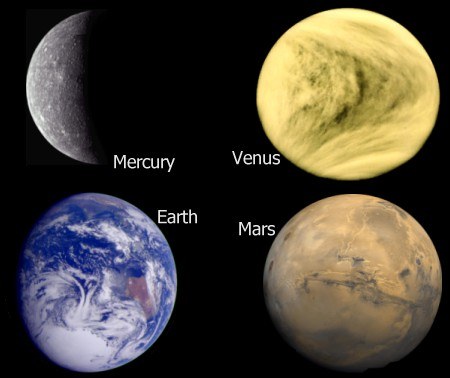
Which of these are inner planets?
Mercury
Venus
Earth
Saturn

Why was the Ptolemaic model of the universe accepted for so long?
no one had ever thought of a better explanation
people were prone to superstition
it basically explained most of the movements of the planets
religious & cultural reasons liked to put Earth at the center

Aristarchus (of ancient Greece) correctly predicted the _______ theory of the Universe. Choose all that apply.
geocentric
heliocentric
earth-centered
sun-centered

Heliocentric theory has the ____ revolving around the Sun, with only the ____ orbiting Earth.
Moon, planets
Moon, Sun
stars, Moon
planets, Moon
Who was the person that contributed to and helped popularize the geocentric model?
Galileo
Ptolemy
Copernicus


Who came up with this model?
Copernicus
Kepler
Galileo Galilee
Ptolemy
What does "helios" mean?
Helium
Earth
Sun
Medicine
Who worked out the arrangement of the known planets and suggested the heliocentric model?
Ptolemy
Copernicus
Kepler
Galileo
Evidence collected by Italian scientist Galileo Galilei gradually convinced others that the ___________model was correct
geocentric
heliocentric
big bang
solar system
Nicolaus Copernicus was able to work out the arrangement of the known planets and how they....
shine
moved around the sun
were made
Galileo discovered four moons around Jupiter using a telescope which proved not everything in the sky _________ around Earth
revolved
rotated
spins
shined
Why was it important that Jupiter had moons?
It was the first direct evidence that not everything orbited around the earth
It was the first evidence that turtles existed in the sky
It was viewed as a good place to go on vacation
It demonstrated that the Earth was the center of the universe
What do scientists do when new information doesn't fit their existing models?
They adapt or change their model to fit the new information once they have confirmed it
They ignore the new information
They put their fingers in their ears and go lalalalala
They immediately throw everything they know out the window

This table shows the rotation period and revolution period for 6 planets, and Earth’s moon, all relative to Earth’s periods. Which 2 planets have shorter days than Earth?
Jupiter and Saturn
Venus and Mercury
Mars and Jupiter
Saturn and Moon

a small rocky body orbiting the sun, ranging from the size of a small house to dust particles
nebula
terrestrial planets
collision
asteroids
What does a comet look like?


The diagram below represents a simple geocentric model. Which object is represented by the Letter X?
Sun
Moon
Earth
Polaris
In the geocentric model, which motion would occur?
Earth would revolve around the sun.
Earth would rotate on its axis.
The moon would revolve around the sun.
The sun would revolve around Earth.
Why do the stars appear to move across the sky?
Because the Earth is spinning (rotating)
Because the stars are spinning (rotating)
Because you are dizzy
They're not, it is an illusion
Which of the models is widely accepted today?
Heliocentric
Geocentric
Who is the astronomer who further developed the heliocentric model of the solar system?
Copernicus
Newton
Galileo
Ptolemy
What did Ptolemy's and Aristotle's model have in common?
Both models had Earth as the center of the solar system.
Both discovered galaxies beyond the Milky Way.
Both models had the sun as the center of the solar system.
Both model had objects in solar system have epicycles.
Who were the people that popularized the geocentric model?
Galileo and kepler
Aristotle and Ptolemy
Copernicus and Aristarchus
Brahe and Kepler
What is the biggest difference between the Geocentric Model and the Heliocentric Model?
the shape of the planets' orbits
the movement of the moon
the object at the center of the universe
the brightness of the sun
Which planets are more likely to form systems of moons?
massive planets
smaller planets
planets closest to the sun
planets farthest away from the sun
What is gravitational force?
an elastic force that causes planets to expand
an attractive force between all objects that have mass
a destructive force that creates radiation in the solar system
a conductive force that helps light travel through the solar system

Core
Radiation zone
Convection zone
Photosphere

Core
Radiation zone
Convection Zone
Corona
Label Part 3
Core
Radiation zone
Convection zone
Corona

Where is the gravitational force the greatest?
When Planet A is to the left of the Sun
When Planet A is to the right of the Sun

